Menu
Text size

() ·

A painting made for you, by hand

The Triumph of Galatea

Ręcznie malowana reprodukcja olejowa

Ręcznie malowany obraz olejny na płótnie, wykonany na zamówienie przez naszych artystów w wybranym przez Ciebie wymiarze i oprawie. ( Przełącz na wydania drukowane Przejdź do wersji cyfrowej)

Opis obiektu

Triumf Galanii – Rapsodia Renesansu. Niesamowity fresk Rafaela z 1512 r. przedstawiający mitologiczną historię Galanii w eterycznym stylu, idealny dla miłośników sztuki i piękna – odkryj i zainwestuj!

Biografia artysty

Rafael Santi (1483-1520): Wszechstronny malarz renesansu, znany z Madonn i fresków, takich jak "Szkoła Ateńska". Jego dzieła emanują elegancją i harmonią. Odkryj jego życie i twórczość!

from ·

Chapter 1

How large should it be?

Slide to change the size; the picture on the left shows the frame at its real width. The proportions of the original are kept.

Standardowy format
personalizowane
CM
INCH

Wybierz spośród naszych standardowych rozmiarów, które zachowują oryginalne proporcje dzieła sztuki.

szerokość
wysokość

Wpisz wymaganą szerokość i wysokość, aby obraz pasował do Twojej ramy lub ściany. Ponieważ jest to dzieło malowane ręcznie, w przypadku rozmiaru o innych proporcjach artysta może domalować nieco więcej wokół obrazu lub przyciąć jego fragmenty — wybór należy do Ciebie. Przed rozpoczęciem pracy prześlemy Ci cyfrową wizualizację do zatwierdzenia. Obraz widoczny na tej stronie nie przedstawia rzeczywistego efektu — jedynie wizualizacja oddaje realny rezultat.

Chapter 2

How should it arrive?

Choose the edges of the stretched canvas

Choose your frame

Corner sample of the WhiteWrap canvas edge finish, stretched on lite drewno bars
White zł1
Corner sample of the BlurSideWrap canvas edge finish, stretched on lite drewno bars
Blurside zł1
Corner sample of the ExtendedWrap canvas edge finish, stretched on lite drewno bars
Extended zł1
Corner sample of the P118B picture frame: polistyren formowany, 5 cm wide and 3 cm thick
P118B zł10
Corner sample of the P118H picture frame: polistyren formowany, 5 cm wide and 3 cm thick
P118H zł10
Corner sample of the P118W picture frame: polistyren formowany, 5 cm wide and 3 cm thick
P118W zł10
Corner sample of the P438Z picture frame: polistyren formowany, 5.5 cm wide and 3.5 cm thick
P438Z zł10
Corner sample of the P508JH picture frame: polistyren formowany, 7 cm wide and 3.5 cm thick
P508JH zł12
Corner sample of the P508YH picture frame: polistyren formowany, 7 cm wide and 3.5 cm thick
P508YH zł12
Corner sample of the P805H picture frame: polistyren formowany, 5 cm wide and 3.5 cm thick
P805H zł10
Corner sample of the P805Z picture frame: polistyren formowany, 5 cm wide and 3.5 cm thick
P805Z zł10
Corner sample of the P919BZ picture frame: polistyren formowany, 7 cm wide and 3.5 cm thick
P919BZ zł10
Corner sample of the P919G picture frame: polistyren formowany, 7 cm wide and 3.5 cm thick
P919G zł10
Corner sample of the P919XJ picture frame: polistyren formowany, 7 cm wide and 3.5 cm thick
P919XJ zł10
Corner sample of the P959ZH picture frame: polistyren formowany, 5 cm wide and 3 cm thick
P959ZH zł10
Corner sample of the P968JZ picture frame: polistyren formowany, 6 cm wide and 4 cm thick
P968JZ zł12
Corner sample of the W106C picture frame: lite drewno, 5 cm wide and 3 cm thick
W106C zł8
Corner sample of the W218G picture frame: lite drewno, 5 cm wide and 3 cm thick
W218G zł10
Corner sample of the W218JH picture frame: lite drewno, 5 cm wide and 3 cm thick
W218JH zł8
Corner sample of the W218Y picture frame: lite drewno, 5 cm wide and 3 cm thick
W218Y zł10
Corner sample of the W307PJ picture frame: lite drewno, 6 cm wide and 3 cm thick
W307PJ zł10
Corner sample of the W316G picture frame: lite drewno, 6 cm wide and 3 cm thick
W316G zł10
Corner sample of the W316PJ picture frame: lite drewno, 6 cm wide and 3 cm thick
W316PJ zł8
Corner sample of the W316Y picture frame: lite drewno, 6 cm wide and 3 cm thick
W316Y zł10
Corner sample of the W398PJ picture frame: lite drewno, 5 cm wide and 3 cm thick
W398PJ zł8
Corner sample of the W4111J picture frame: lite drewno, 6.5 cm wide and 3.5 cm thick
W4111J zł10
Corner sample of the W500HY picture frame: lite drewno, 7 cm wide and 5 cm thick
W500HY zł15
Corner sample of the W500JH picture frame: lite drewno, 7 cm wide and 5 cm thick
W500JH zł15
Corner sample of the W692G picture frame: lite drewno, 8 cm wide and 4 cm thick
W692G zł12
Corner sample of the W849H picture frame: lite drewno, 5 cm wide and 3 cm thick
W849H zł8
Corner sample of the W940BG picture frame: lite drewno, 7.5 cm wide and 4.5 cm thick
W940BG zł15
Corner sample of the W953PJ picture frame: lite drewno, 6 cm wide and 3.5 cm thick
W953PJ zł8
Corner sample of the H24-GOLD picture frame: rzeźbione drewno pokryte gipsem, 10 cm wide and 6 cm thick
H24-GOLD zł30
Corner sample of the H24-SILVER picture frame: rzeźbione drewno pokryte gipsem, 10 cm wide and 6 cm thick
H24-SILVER zł30
Corner sample of the H36-GOLD picture frame: rzeźbione drewno pokryte gipsem, 15 cm wide and 6.5 cm thick
H36-GOLD zł45
Corner sample of the H36-SILVER picture frame: rzeźbione drewno pokryte gipsem, 15 cm wide and 6.5 cm thick
H36-SILVER zł45

Moulding: . Overall size with the frame: .

Chapter 3

Who paints it, and should anything change?

Examples of what can be changed: Replace face with customer photo; Add pet (e.g., replace cat with dog); Include hidden message in background; Change background landscape or elements.
After order, OriginalUniqueArt.com team will email client for instructions and provide a mockup preview

Dostawa na całym świecie () w ciągu 3–4 tygodni zamiast standardowych 5 tygodni. (31 Październik). Bez kompromisów w kwestii jakości.

Chapter 4

The finishing touches

A nameplate, as in a museum?

Szczegóły grawerowanej brązowej tabliczki

This elegant plaque features the artist's name and the title of the artwork, finely engraved for a timeless presentation.

It is made from bronze with a refined, elegant finish. The text is precisely laser-engraved for a sharp and permanent result. Measuring 9x2 cm, the plaque is compact yet easy to read. It's built to be durable and scratch-resistant, offering a professional, museum-quality look. Mounting is simple thanks to the included adhesive backing.

Szczegóły przezroczystej tabliczki akrylowej

The plaque includes essential engraved details such as the artist's name, the title of the artwork, the date it was created, the type of media used-like oil on canvas or watercolor-a brief description of the piece, and a QR code that links to the complete artwork information.

It is crafted from clear acrylic, offering a sleek, modern appearance. The text is UV-engraved in black to ensure strong visual contrast. With a size of 10x15 cm, it ensures optimal readability. It comes equipped with two metal hooks for secure wall mounting. The plaque is designed to be weather-resistant, making it suitable for various environments, and it includes interactive features that work seamlessly with smartphone scanning.

Szczegóły czarnej tabliczki akrylowej

This elegant plaque includes engraved information such as the artist's name, the title of the artwork, the date it was created, the type of media used (like oil on canvas or watercolor), a short description of the artwork, and a QR code for quick access to more information.

The plaque itself is made from refined black acrylic with a premium finish. The text is laser-engraved in white for high contrast and readability. Its size is 10x15 cm, designed to be easy to read. It comes with two metal hooks for professional mounting. The design is sleek and fits any interior style. It is also weather-resistant and durable, with built-in digital integration for mobile compatibility.

A protective varnish?

When do you need it?

Chapter 5

Your painting, as you ordered it

The Triumph of Galatea

Technika reprodukcji

Wymiary reprodukcji

-

Wybitny mistrz artystyczny

Większa szczegółowość, finezja i dodatkowy czas na realizację

-

Opcje oprawy reprodukcji

-

-

W przypadku dzieł sztuki lub reprodukcji, których którykolwiek z boków przekracza 105 cm (około 41 cali), rama zostanie wysłana w formie zestawu do samodzielnego montażu. Metoda ta zapewnia bezpieczną dostawę i zapobiega uszkodzeniom podczas transportu.

Wymagany profesjonalny montaż – nie jest to produkt typu DIY.
Zestaw musi zostać złożony, a płótno naciągnięte przez doświadczonego profesjonalnego ramiarza, przy użyciu kleju do drewna (brak w zestawie), kleszczy do naciągania płótna oraz ścisków, które utrzymają krosna w równej pozycji podczas schnięcia kleju. Nieprawidłowy montaż lub nierównomierne napięcie płótna może trwale uszkodzić dzieło sztuki i nie podlega naszej gwarancji.

  • W zestawie znajdują się wszystkie listwy z litego drewna, precyzyjnie docięte do wymiarów.

  • Montaż odbywa się przy użyciu dołączonych wkrętów oraz kleju do drewna do łączenia narożników, którego zestaw nie zawiera i który musi zostać dostarczony przez ramiarza.

  • Wymagane są profesjonalne narzędzia, których nie ma w zestawie: kleszcze do naciągania płótna (napinacz) oraz zaciski, które pozwolą utrzymać listwy w równej pozycji podczas schnięcia kleju.

Ważne:
Do połączenia narożników niezbędny jest klej do drewna, listwy należy unieruchomić za pomocą ścisków do momentu całkowitego wyschnięcia kleju, a naciągnięcie płótna na złożoną ramę wymaga użycia kleszczy do naciągania płótna. Żaden z tych elementów nie jest dołączony do zestawu. Przed zamówieniem tego rozmiaru zalecamy konsultację z doświadczonym ramiarzem.

Etykieta obiektu

-

-

Lakier ochronny

Lakier z połyskiem (pogłębia kolory, chroni przed światłem i wilgocią)

-

Personalizacja dzieła

Przykłady możliwości personalizacji: zastąp twarz zdjęciem klienta; dodaj zwierzę domowe (np. zamień kota na psa); umieść ukrytą wiadomość w tle; zmień krajobraz lub elementy tła.

-

Ekspresowa

Dostawa na cały świat () w ciągu 3–4 tygodni zamiast standardowych 5 tygodni. (31 Październik). Bez kompromisów w kwestii jakości.

-

Przesyłka ekspresowa

Dostawa na cały świat () w ciągu 5 tygodni. (7 Listopad).

W cenie

Cena całkowita

zł 1165

Suma całkowita zł 1165

Opcja ze szkłem jest dostępna wyłącznie w rozmiarach poniżej 110 cm

Included with every order

  • Bezpłatna ekspresowa wysyłka na cały świat
  • Wysokiej jakości płótno lniane
  • Pełne ubezpieczenie przesyłki
  • Gwarancja zwrotu należności celnych i podatków importowych
  • Gwarancja wiernego odwzorowania kolorów
  • 100-dniowa polityka zwrotów (tylko w przypadku wad)
  • Gwarancja 100% zwrotu pieniędzy
  • Zniżka przy zakupie wielu sztuk

The Triumph of Galatea: A Renaissance Myth Made Radiant

Raphael’s “Triumph of Galatea,” completed in 1512 for the Villa Farnesina in Rome, isn't merely a fresco; it’s an immersive experience. Commissioned by Agostino Chigi, one of the wealthiest men of his age, this work transcends its initial purpose as decoration to become a profound meditation on beauty, mythology, and the very nature of artistic creation. The scene unfolds within the open gallery of the villa, bathed in a luminous quality that immediately draws the viewer into a world of ethereal grace and dramatic narrative. It’s a pivotal piece, often cited as a bridge between the Mannerism of the late 15th century and the burgeoning Baroque style that would dominate the following decades – a testament to Raphael's ability to synthesize tradition with innovation.

At its heart lies Galatea, the Nereid nymph, depicted in a moment of glorious apotheosis. She’s not simply rescued; she *ascends*, lifted by a chorus of angelic figures, their forms rendered with an exquisite delicacy that contrasts sharply with the raw power of Polyphemus, the one-eyed giant looming menacingly in the background. This deliberate juxtaposition is key to understanding Raphael's artistic choices. He deliberately avoids depicting the violent act of Acis’s death – a common element in earlier versions of the myth – instead focusing on Galatea’s elevation, suggesting a triumph over adversity and a celebration of divine beauty. The composition itself is meticulously balanced, utilizing diagonal lines created by the dolphins carrying her chariot to draw the eye across the scene, while the carefully arranged figures create a sense of dynamic movement and layered depth.

The Mythic Narrative: The story originates in Ovid’s *Metamorphoses*, where Galatea falls in love with the mortal shepherd Acis. Jealousy leads Polyphemus to kill Acis, transforming his blood into a river – the River Acis. Raphael cleverly sidesteps this tragic element, presenting instead Galatea's ascension to a higher realm, symbolizing her victory over mortality and suffering. The scene isn’t about destruction; it’s about transcendence—a visual embodiment of hope and renewal.

Symbolism of Light: The fresco is renowned for its masterful use of light. Raphael employs *chiaroscuro*—the dramatic contrast between light and shadow—to sculpt the figures and create an atmosphere of both serenity and drama. This technique not only enhances the beauty of Galatea but also emphasizes her divine nature, casting a radiant glow upon her form. The play of light isn’t merely decorative; it’s integral to the narrative, guiding the viewer's eye and reinforcing the sense of ethereal grace.

The Angels: The angelic figures are rendered with a remarkable degree of realism and humanity, their expressions conveying a sense of awe and reverence. They aren’t idealized representations of divinity; instead, they possess a palpable warmth and empathy, further emphasizing the painting's focus on human beauty and emotion. Their presence underscores Galatea’s transformation—a journey from earthly love to celestial grace.

A Villa Farnesina Setting: Context and Patronage

To fully appreciate “Triumph of Galatea,” it’s essential to understand its historical context. The Villa Farnesina itself was a significant project, commissioned by the Sienese banker Agostino Chigi as a lavish retreat in Rome. The villa's architecture reflects the grandeur and sophistication of Renaissance Italy, and its decoration—including Raphael’s frescoes—was intended to impress guests and showcase the family’s wealth and influence. The fresco cycle within the Villa Farnesina was inspired by Angelo Poliziano’s “Stanze per la giostra,” a series of poems celebrating Florentine festivities. Raphael skillfully adapted these poetic themes into visual form, creating a harmonious blend of literature and art.

Furthermore, the choice of subject matter—a mythological tale of love and transformation—was particularly fitting for a wealthy banker’s villa. Mythological narratives were often used to explore themes of virtue, beauty, and morality – values that were highly valued by Renaissance humanists. The fresco served as both decoration and a subtle commentary on the ideals of the era.

Technique and Artistic Innovation

Raphael's mastery is evident in every detail of “Triumph of Galatea.” He employed *sfumato*, a technique developed by Leonardo da Vinci, to create soft, hazy outlines that blur the boundaries between figures and background. This creates an atmospheric effect that enhances the painting’s sense of depth and realism. The use of color is equally remarkable – vibrant blues and greens evoke the depths of the sea, while delicate pinks and golds highlight Galatea's ethereal beauty. The artist’s attention to anatomical detail is also noteworthy, particularly in the rendering of the angels’ wings and the musculature of the figures.

Interestingly, recent research has revealed that Raphael utilized Egyptian blue pigment—a rare and expensive material—in the painting’s sky and sea. This suggests a conscious effort on his part to evoke the grandeur and timelessness of classical antiquity, aligning with the Renaissance revival of interest in ancient Greek and Roman art and culture.

A Timeless Masterpiece: Reproduction Possibilities

"Triumph of Galatea" remains one of Raphael’s most celebrated works, admired for its beauty, grace, and technical brilliance. OriginalUniqueArt offers meticulously crafted hand-painted reproductions that capture the essence of this iconic fresco. Our artists recreate Raphael's delicate brushstrokes, luminous colors, and atmospheric depth with unparalleled skill, ensuring that your reproduction will be a stunning addition to any interior space. Whether you’re an art enthusiast, a collector, or simply seeking a unique piece of decorative art, a OriginalUniqueArt reproduction of “Triumph of Galatea” is a timeless investment – a tangible connection to one of the greatest artistic achievements of the Renaissance.

To explore our range of reproductions and commission your own, please visit /art/list/?Filter=7YKFWM-Raphael-(Raffaello-Sanzio-Da-Urbinoo)-The-Triumph-of-Galatea and discover the magic of Raphael’s “Triumph of Galatea.” For further research, you may also find valuable insights at https://en.wikipedia.org/wiki/The_Loves_of_the_Gods.

Pytania i odpowiedzi

Czy kolory w "The Triumph of Galatea" są intensywne czy stonowane?

Kolory w „The Triumph of Galatea” – Rafael charakteryzują się Zrównoważony intensywnością.

Czy dzieło "The Triumph of Galatea" znajduje się w domenie publicznej?

„The Triumph of Galatea” – Rafael znajduje się w domenie publicznej (należy do domeny publicznej – autorskie prawa majątkowe wygasły). Status ten określa zasady reprodukcji obrazu tego dzieła.

Czy "The Triumph of Galatea" to słynne dzieło nurtu Other?

„The Triumph of Galatea” – Rafael jest klasyfikowane jako Ikoniczne i należy do nurtu Other.

More about this painting

Podgląd w skali 1:1 Podgląd AR Przełącz na wydania drukowane Przejdź do wersji cyfrowej Wyślij jako kartkę
Szczegóły dzieła Przewodnik Dodaj do ulubionych Pobierz obraz Podobne obiekty RTG Pokaz slajdów Q&A Statystyki

In numbers

  • 29frames to choose from
  • standard sizes, in its own proportions
  • 5weeks to paint and deliver it
Rafael

Rafael

1483 - 1520, Włochy

Quick facts about Rafael

  • Artistic Movement Or Style: Renesans Wysoki
  • Artists Or Movements Influenced By This Artist: ['Neoklasycyzm']
  • Artists Who Influenced This Artist:
    • Leonardo da Vinci
    • Michał Anioł
  • Date Of Birth: 1483
  • Date Of Death: 1520
  • Full Name: Raffaello Sanzio
  • Nationality: Włoski
  • Notable Artworks:
    • Szkoła ateńska
    • Madonna Sykstyńska
  • Place Of Birth (City And Country): Urbino, Włochy

Biografia artysty

Urbino i Początki Geniuszu: Formowanie się Rafaela

Raffaello Sanzio da Urbino, znany światu jako Rafael, wyłonił się z niezwykle żyznego kulturowo krajobrazu. Urodzony w 1483 roku w murach Urbino, niewielkiego lecz intelektualnie tętniącego życia miasta-państwa we Włoszech centralnych, jego najwcześniejsze lata upłynęły w atmosferze ceniącej zarówno umiejętności artystyczne, jak i humanistyczne nauki. Jego ojciec, Giovanni Santi, nie był jedynie malarzem zatrudnionym przez księcia Federica da Montefeltro – był człowiekiem głęboko zaangażowanym w prądy myśli renesansowej, poetą kronikującym życie księcia i aktywnie poszukującym innowacyjnych idei artystycznych z całych Włoch i poza nimi. Zanurzenie w środowisku dworskim, ceniącym wyrafinowanie i intelektualną dyskusję, głęboko ukształtowało wrażliwość młodego Rafaela. Strata ojca w wieku jedenastu lat nałożyła na niego odpowiedzialność, ale również dała możliwość doskonalenia umiejętności w rodzinnym warsztacie, przyswajając techniki i tradycje pod okiem lokalnych artystów. Już we wczesnych pracach zaczęły się ujawniać subtelna gracja i skrupulatna dbałość o szczegóły – cechy charakterystyczne jego dojrzałego stylu.

Od Umbrii do Florencji: Chłonięcie Nowych Inspiracji

Artystyczna podróż Rafaela była procesem ciągłej ewolucji, naznaczoną okresami intensywnych studiów i asymilacji. Początkowe szkolenie pod kierownictwem Pietro Perugino w Perugii położyło solidne fundamenty stylu umbryjskiego – charakteryzującego się miękkim modelowaniem, harmonijnymi kompozycjami i spokojnymi scenami religijnymi. Jednak Rafael posiadał nienasyconą ciekawość, która pchała go do poszukiwania nowych wyzwań i rozszerzania horyzontów artystycznych. W 1504 roku wyruszył we podróż do Florencji, miasta pulsującego energią artystycznej innowacji. Tam zetknął się z arcydziełami Leonarda da Vinci i Michała Anioła, artystów przesuwających granice malarstwa w bezprecedensowy sposób. Skrupulatnie studiował ich techniki – sfumato Leonarda, jego subtelne gradacje światła i cienia, oraz potężną precyzję anatomiczną i dramatyczne kompozycje Michała Anioła. Ten florencki okres był dla Rafaela tyglem, zmuszającym go do konfrontacji z nowymi artystycznymi możliwościami i syntezy ich w jego własnej unikalnej wizji. Wpływ ten jest widoczny we wzrastającej dynamice i psychologicznej głębi jego prac z tego czasu, szczególnie w serii Madonn.

Rzymski Triumf: Zamówienia i Arcydzieła

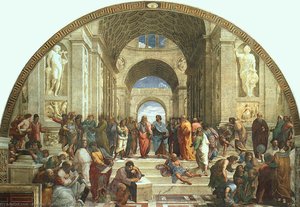
W 1508 roku Rafael otrzymał wezwanie, które zmieniło bieg jego kariery – zaproszenie od papieża Juliusza II do Rzymu. To oznaczało początek jego najbardziej płodnego i sławnego okresu. Wieczne Miasto oferowało mu bezprecedensową możliwość zaprezentowania swojego talentu na dużą skalę, zdobiąc apartamenty papieskie w Watikanie oszałamiającymi freskami. Szkoła Ateńska, być może jego najsłynniejsze dzieło, stanowi świadectwo jego mistrzostwa kompozycji, perspektywy i alegorii filozoficznej. W tej majestatycznej przestrzeni Rafael zgromadził postacie z antyku – Platona, Arystotelesa, Pitagorasa, Euklidesa – tworząc żywą tablicę celebrującą ludzki rozum i pogoń za wiedzą. Kontynuował pracę dla kolejnych papieży, w tym Leona X, podejmując monumentalne projekty, takie jak dekoracja Stanze della Segnatura i Stanza d'Eliodoro. Jego freski w tych pomieszczeniach nie są jedynie dekoracyjne; to głębokie stwierdzenia dotyczące władzy papieskiej, wiary religijnej i ideałów renesansu.

Synteza Gracji i Wspaniałości: Styl Artystyczny Rafaela

Styl artystyczny Rafaela jest często opisywany jako harmonijne połączenie gracji, klarowności i idealnego piękna. Posiadał niezwykłą zdolność do syntezy różnorodnych wpływów – tradycji umbryjskiej, florenckich innowacji, antyku – w unikalnie zrównoważoną estetykę. Jego kompozycje są skrupulatnie zaplanowane, wykazując poczucie porządku i proporcji, które odzwierciedla jego głębokie zrozumienie zasad renesansowych. Jego postacie emanują spokojną godnością i ekspresją emocjonalną, uosabiając humanistyczny ideał ludzkiej doskonałości. Był również mistrzem kolorystyki, wykorzystując bogate, świetliste barwy do tworzenia dzieł, które są zarówno wizualnie urzekające, jak i intelektualnie stymulujące. W przeciwieństwie do często dramatycznego i burzliwego stylu Michała Anioła, praca Rafaela emanuje poczuciem spokoju i harmonii – cechą, która zyskała mu uznanie publiczności przez wieki.

Dziedzictwo i Trwały Wpływ

Przedwczesna śmierć Rafaela w 1520 roku w wieku trzydziestu siedmiu lat przerwała karierę pełną potencjału. Jednak jego dziedzictwo trwa jako jedna z najważniejszych postaci w historii sztuki zachodniej. Jego praca stała się kamieniem węgielnym estetyki wysokiego renesansu, służąc jako wzór dla pokoleń artystów. Chociaż wpływ Michała Anioła później zdominował dyskurs artystyczny, nacisk Rafaela na klarowność, harmonię i idealne piękno przeżył odrodzenie w okresie neoklasycystyki, promowany przez krytyków takich jak Johann Joachim Winckelmann. Dziś jego obrazy nadal budzą podziw i zachwyt, urzekując widzów swoim kunsztem technicznym, głębią emocjonalną i trwałym urokiem. Jego wpływ można dostrzec w niezliczonych dziełach sztuki, które nastąpiły po nim, utrwalając jego miejsce jako prawdziwego mistrza renesansu – malarza, który uchwycił nie tylko fizyczny wygląd swoich postaci, ale także samą istotę ludzkiej gracji i godności.

Najważniejsze informacje

  • Year: 1512
  • Location: Villa Farnesina, Rzym
  • Notable elements: Mitologiczna scena
  • Artistic style: Klasycystyczny, Mannerystyzm
  • Medium: Fresk
  • Dimensions: Nieznane