Dojrzały renesans
Disputa (Rafael Santi)
Disputa is a work by Rafael Santi (1483–1520). It belongs to the Dojrzały renesans movement. It is made in Fresk.
- Fresk

 Ręcznie malowany obraz olejny
 Wyślij jako kartkę
 Udostępnij
 Przewodnik


 Pobierz obraz
 Podobne obiekty
 Pokaz slajdów
 Pytania i odpowiedzi

 Statystyki
Disputa: the essentials
- Title
- Disputa
- Artist
- Rafael Santi (1483–1520)
- Artist born in
- Urbino, Włochy
- Medium
- Fresk
- Movement
- Dojrzały renesans
- Period
- Renesans
Looking at Disputa
A Divine Dialogue: Unveiling Raphael’s *Disputa*
Raphael's *Disputa*, painted between 1509 and 1510, is a cornerstone of High Renaissance art, residing within the breathtaking Stanze di Raffaello in the Apostolic Palace at Vatican City. This monumental fresco isn’t merely a painting; it’s a theological statement rendered with unparalleled grace and intellectual depth, inviting viewers into a visual discourse on faith, reason, and divine truth.Subject & Composition: Heaven Meets Earth
The *Disputa* presents a complex yet harmonious composition divided into two distinct realms. The upper portion depicts a celestial gathering of theologians, saints, prophets, and martyrs arranged in a semi-circular formation around Christ and the Virgin Mary. They engage in animated discussion, their gestures conveying reverence and intellectual fervor. Below, on an architectural platform resembling a classical temple apse, earthly theologians – recognizable figures like Saint Augustine, Saint Thomas Aquinas, and Saint Gregory – continue the debate concerning the Holy Sacrament. This deliberate juxtaposition visually represents the convergence of heavenly wisdom and human inquiry. The composition is masterfully structured with a pyramidal form culminating in Christ, drawing the eye upwards towards the divine source.Style & Technique: The High Renaissance Ideal
*Disputa* exemplifies the hallmarks of the High Renaissance: balance, clarity, and idealized beauty. Raphael’s mastery of perspective creates a convincing sense of depth, while his use of *sfumato* – subtle gradations of light and shadow – lends an ethereal quality to the figures. Executed as a fresco, the painting demonstrates Raphael's technical brilliance in applying pigments to wet plaster, resulting in vibrant colors that have endured for centuries. The figures are not static; they possess dynamic poses and expressive faces, conveying a sense of lively intellectual exchange.Historical Context & Symbolism
Commissioned by Pope Julius II as part of the decoration of his private library (the *Stanza della Segnatura*), *Disputa* reflects the humanist spirit of the Renaissance – a renewed interest in classical learning and philosophical inquiry alongside religious faith. The room itself was intended to represent different branches of human knowledge: theology, law, poetry, and philosophy. The painting’s symbolism is rich and layered. The Holy Spirit, represented as a dove emanating light, signifies divine inspiration. The inclusion of prominent theologians underscores the importance of reason and scholarship in understanding religious doctrine. The architectural setting evokes the grandeur of ancient Rome, linking Christian theology to classical tradition.Emotional Impact & Lasting Legacy
*Disputa* transcends its theological subject matter to evoke a profound sense of awe, reverence, and intellectual curiosity. The painting’s harmonious composition and idealized figures inspire contemplation on the nature of truth, faith, and knowledge. It is not merely a depiction of a debate but an invitation to participate in it – to engage with the eternal questions that have occupied humanity for centuries. Raphael's *Disputa* remains a testament to his artistic genius and continues to captivate viewers with its beauty, intellectual depth, and enduring spiritual power.- Explore high-quality reproductions of *The Disputation of the Holy Sacrament* to bring Renaissance grandeur into your space.
- Discover more about Raphael’s life and artistic contributions within the context of the High Renaissance movement.
Disputa in high resolution

Rafael Santi, Disputa. Public domain.
Questions about Disputa
Jakie wnętrze najlepiej współgra z kolorystyką „Disputa” – Rafael Santi?
Biorąc pod uwagę jego Barwy ziemi kolorystykę, dzieło "Disputa" idealnie pasuje do Salon lub strefa dzienna.
Jaki nastrój oddaje „Disputa” – Rafael Santi w ramach nurtu Dojrzały renesans?
"Disputa" emanuje Duchowy emocjonalnym ładunkiem, wpisując się w nurt Dojrzały renesans.
W jaki sposób Dojrzały renesans dzieła „Disputa” nawiązuje do kraju pochodzenia artysty?
"Disputa" powstało dzięki Rafael Santi, urodzonemu w Włochy, w ramach nurtu Dojrzały renesans. Pochodzenie artysty wiąże to dzieło z Dojrzały renesans w wydaniu twórców z Włochy.
Jaki kolor dominuje w dziele "Disputa"?
Dominującym odcieniem w „Disputa” – Rafael Santi jest Od ochry po sepię.
Jakie zastosowanie i przestrzeń są zalecane dla „Disputa” – Rafael Santi?
„Disputa” idealnie sprawdzi się w Manifestacja artystyczna, a rekomendowanym miejscem jego ekspozycji jest Salon lub strefa dzienna.
Do jakiego wnętrza polecane jest dzieło „Disputa” – Rafael Santi?
Reprodukcja "Disputa" doskonale pasuje do Salon lub strefa dzienna.
Dla kogo „Disputa” – Rafael Santi będzie idealnym prezentem?
Jako prezent polecamy „Disputa” – Rafael Santi dla Rocznica. Doskonale sprawdzi się on również przy innych okazjach.
Do którego okresu twórczości Rafael Santi należy dzieło "Disputa"?
W dorobku artystycznym Rafael Santi dzieło „Disputa” przypada na Mature Period. Ten etap pozwala zestawić je z innymi pracami twórcy.
Jaki klimat wprowadziłaby do wnętrza reprodukcja „Disputa” – Rafael Santi?
Dzięki swojemu Eteryczny nastrojowi, "Disputa" idealnie sprawdzi się w Salon lub strefa dzienna.
About the artist, Rafael Santi

1483–1520, Włochy
Rafael Santi
Życie i tożsamość Rafaela Rafael, znany historii pod wieloma imionami, w tym jako Raffaello Sanzio, Raffaello Santi oraz Raffaello Sanzio da Urbino, był centralną postacią włoskiego dojrzałego renesansu. Jego życie definiowała podwójna biegłość w malarstwie i architekturze – wszechstronność, która pozwalała mu płynnie poruszać się między intymną skalą portretu a monumentalnymi wymaganiami papieskich budowli. Urodził się 6 kwietnia 1483 roku w Urbino, we Włoszech, w świecie tętniącym intelektualną i artystyczną aktywnością. Jego kariera charakteryzowała się niewyobrażalną wręcz płodnością twórczą, która wymagała zarządzania rozległym warsztatem, aby sprostać potrzebom licznych mecenasów.
Also by Rafael Santi
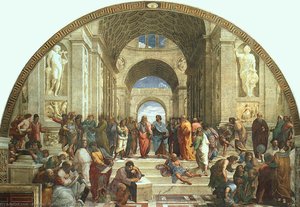 Szkoła Ateńska1511
 The Sistine Madonna1513
 Przemienienie1520
 Małżeństwo Maryjne1504

Essays around Disputa
 Giotto di Bondone: Revolutionizing Late Medieval Painting through Narrative InnovationExplore the revolutionary art of Giotto di Bondone! Discover his groundbreaking techniques, iconic frescoes like those in the Arena Chapel,…
 Masterpieces of Light: The Top 25 Artworks by Duccio di BuoninsegnaJourney through the divine elegance of Duccio di Buoninsegna. Explore 25 iconic Sienese masterpieces, from the Maestà to the Rucellai Madon…
 Raphael: 25 Arcydzieł Mistrza Renesansu - Obrazy i Dekoracje OriginalUniqueArt.comOdkryj 25 arcydzieł Raphaela – od Madonn po freski Watykanu. Poznaj historię, technikę i piękno renesansowego malarstwa. Reprodukcje obrazó…