
 Podgląd w skali 1:1
 Wyślij jako kartkę
 Udostępnij
 Szczegóły dzieła
 Przewodnik

 Pobierz obraz
 Podobne obiekty
 RTG
RTG Pokaz slajdów
 Q&A
Q&A Statystyki
Roses

- 73.0 x 97.0 cm


 Rozwiń treść
Otrzymaj plik gotowy do druku, którego jakość znacznie przewyższa podgląd internetowy. Każdy sprzedawany przez nas obraz cyfrowy pochodzi z wysokorozdzielczego pliku wzorcowego w naszej bazie — zazwyczaj o szerokości od 5 000 do 15 000 pikseli — dzięki czemu możesz drukować w dużym formacie, mocno kadrować lub z pełnym przekonaniem odwzorowywać najdrobniejsze detale.
Żaden plik nie opuszcza naszego studia bez odpowiedniej obróbki. Ekspert ds. cyfrowej edycji sprawdza zgodność kolorów z oryginałem i w razie potrzeby je koryguje, a następnie za pomocą profesjonalnych narzędzi do retuszu poprawia ostrość oraz szczegółowość — zawsze zachowując wierność pociągnięciom pędzla i stylowi artysty. Rezultatem jest obraz, który wygląda jak prawdziwe dzieło, a nie jak przefiltrowany skan.
Zatwierdzasz przed finalizacją zamówienia: nasz ekspert prześle obraz drogą mailową w ciągu 72 godzin do Twojego wglądu. Nie jesteś zadowolony? Poproś o poprawki lub korektę, bądź o zwrot kosztów, jeśli jakość nie spełnia oczekiwań.
To jakość, na której polegają wydawcy, studia projektowe, galerie oraz drukarnie.
Obraz cyfrowy
Pobierz plik o wysokiej rozdzielczości do osobistego użytku, druku oraz projektów kreatywnych. ( Przełącz na wydania drukowane Zamów ręcznie malowaną reprodukcję)
W każdym zamówieniu na obraz cyfrowy znajduje się
Profesjonalna dostawa cyfrowa z gwarancją
Wybierając OriginalUniqueArt.com, nie otrzymujesz jedynie obrazu – otrzymujesz profesjonalnie udoskonalone cyfrowe dzieło sztuki, stworzone z najwyższą precyzją i objęte gwarancją satysfakcji. Oto wszystko, co automatycznie dołączane jest do Twojego zamówienia:

Błyskawiczna wysyłka e-mailowa
Plik z obrazem cyfrowym w wysokiej rozdzielczości zostanie przesłany na Twój adres e-mail w ciągu 72 godzin od złożenia zamówienia – gotowy do natychmiastowego użycia.

Plik cyfrowy wzbogacony przez AI
Twoja grafika została profesjonalnie zoptymalizowana przy użyciu zaawansowanych narzędzi AI oraz ręcznej edycji, co zapewnia maksymalną szczegółowość, klarowność i wierność kolorów.

Darmowe ponowne przesyłki dożywotnio
Przypadkowo usunąłeś lub zgubiłeś swój plik? Bez obaw – prześlemy go Tobie ponownie w dowolnym momencie, bez żadnych opłat.

Bez opłat importowych – zawsze
Ciesz się swoją sztuką natychmiast, bez żadnych opłat celnych, należności ani kosztów dostawy – pliki cyfrowe są zawsze wolne od podatku.

Gwarancja wierności kolorów
Dzięki zastosowaniu profesjonalnych narzędzi i procesów zarządzania barwą zapewniamy, że Twoje cyfrowe zdjęcie odzwierciedla oryginalne kolory tak wiernie, jak to tylko możliwe.

Gwarancja satysfakcji przez 100 dni
Jeśli nie będziesz zadowolony ze swojego cyfrowego obrazu, dokonamy jego poprawki lub zwrócimy 100% kosztów w ciągu 100 dni – bez zbędnych pytań.

100% Gwarancja zwrotu pieniędzy
Nie jesteś zadowolony? Otrzymaj pełny zwrot kosztów w ciągu 100 dni od otrzymania pliku cyfrowego – bez zbędnych pytań.

Rabaty przy zamówieniach hurtowych
Kup 3 obrazy, oszczędź 10% - Kup 5, oszczędź 15% - Kup 10+, oszczędź 20%. Idealne do projektów kreatywnych, galerii i agencji.
A Silver Symphony of Petals and Light
In the vast, textured tapestry of twentieth-century Balkan art, few works capture the delicate transition between tradition and modernity as poignantly as Petar Lubarda’s Roses. Painted in 1937, this masterpiece serves as a luminous gateway into what historians fondly refer to as Lubarda’s "silver period." At first glance, the viewer is greeted by a breathtaking arrangement of blossoms, where the soft, velvety textures of roses mingle with complementary flora, all cradled within a graceful vase. The composition is not merely a study of botanical beauty but a sophisticated dance of light and form. As the eye wanders across the canvas, one notices how the artist employs a masterful balance of depth; certain blooms press forward with vibrant vitality, while others recede into a soft, atmospheric haze, creating a sense of three-dimensional space that breathes within the frame.
The technique displayed in Roses is nothing short of transformative. During this pivotal era of his career, Lubarda was navigating the delicate shift from linear precision to a more fluid, pictorial approach. While his earlier works often relied on defined outlines, here we see the emergence of a "sillevry shine"—a luminous quality where color acts as a deliberate accent against a more ethereal, shimmering background. The brushstrokes are skillful and intentional, capturing the organic weight of the petals and the reflective surface of the vase with an impressionistic touch that recalls the expressive power of Van Gogh, yet remains uniquely anchored in Lubarda’s own visionary language. This interplay of light and shadow lends the painting a rhythmic quality, making the stillness of the still life feel vibrantly alive.
Historical Resonance and Artistic Legacy
Beyond its aesthetic splendor, Roses carries a profound historical and emotional resonance that makes it a cornerstone for any serious collection. The painting was part of the prestigious Pavle Beljanski collection, acquired as early as 1937, marking it as a work of immediate significance. There are even legendary stories surrounding its impact; during an exhibition in Moscow in 1948, one visitor was reportedly captivated by the painting, stating that it was exactly the work he had hoped to paint all his life. This level of reverence speaks to the universal appeal of Lubarda's ability to blend the local spirit of Montenegro with a broader European modernism.
For the discerning collector or interior designer, this piece offers more than just visual beauty; it provides a sense of timelessness. The way the light interacts with the "silver" tones makes it an ideal centerpiece for spaces that value elegance and quiet contemplation. Whether placed in a sun-drenched gallery or a sophisticated contemporary living room, the painting acts as a window into a moment of perfect botanical harmony. It is a work that does not merely decorate a wall but enriches the very atmosphere of a home, inviting viewers to pause and lose themselves in its shimmering, floral depths.
Pytania i odpowiedzi
Czy „Roses” – Petar Lubarda to jasne czy ciemne dzieło?
Postrzegana jasność dzieła „Roses” – Petar Lubarda wynosi balanced. Można ją dopasować do oświetlenia w docelowym pomieszczeniu.
Kto jest autorem dzieła "Roses"?
Autorem dzieła „Roses” jest Petar Lubarda. Praca ta figuruje w katalogu pod nazwiskiem Petar Lubarda.
Jak mogę pobrać obraz „Roses” – Petar Lubarda?
Obraz „Roses” – Petar Lubarda można pobrać na stronie Pobierz plik cyfrowy dzieła: wysokiej rozdzielczości cyfrowe zdjęcie do pobrania.
Biografia artysty
The Visionary Soul of Montenegro: The Life and Legacy of Petar Lubarda
In the vast, rugged tapestry of twentieth-century Balkan art, few names resonate with as much heroic grandeur and profound emotional depth as Petar Lubarda. Born in 1907 in the village of Ljubotinj, near Cetinje, Lubarda’s very existence was steeped in the spiritual and historical echoes of Montenegro. His formative years were shaped by the solemnity of Byzantine traditions and the narrative power of medieval frescoes, elements that would later become the bedrock of his distinctive artistic language. As a painter, he did not merely seek to replicate the world around him; rather, he sought to capture the very essence of identity, sacrifice, and the enduring spirit of a people.
Lubarda’s journey was one of constant movement and intellectual expansion. His early studies at the Belgrade School of Art in 1925 led him to the vibrant artistic currents of Paris, where he encountered the transformative power of European modernism. It was here that the influence of Flemish realism and the expressive, emotive use of color found in Vincent van Gogh’s work began to permeate his technique. This period of exposure allowed him to bridge the gap between the ancient, iconographic traditions of his homeland and the fluid, avant-garde movements of the West. His ability to synthesize these disparate worlds—the rigid spiritual symbolism of the East and the impressionistic light of the West—created a style that was both timeless and strikingly modern.
A Symphony of Light, Shadow, and History
The evolution of Lubarda’s technique is perhaps most beautifully illustrated in his transition from linear precision to a more atmospheric, painterly approach. During what historians often call his "silver period," exemplified by his 1937 masterpiece Roses, one can witness a breathtaking dance of light and form. In these works, the artist moved away from defined outlines toward a luminous quality where color acts as a deliberate accent against an ethereal, shimmering background. He masterfully employed chiaroscoscuro—a technique reminiscent of Rembrandt—to heighten dramatic tension, allowing certain elements to press forward with vitality while others recede into a soft, mysterious haze.
Beyond the delicate beauty of his still lifes, Lubarda’s oeuvre is defined by its monumental themes. He was a painter of epic proportions, most famously revisited in over thirty different versions of the Battle of Kosovo (1389). These canvases are far more than historical chronicles; they are visceral, psychological explorations of courage and tragedy. Through thick, intentional brushstrokes and a powerful command of composition, he transformed historical struggle into a universal symbol of human resilience. His work often grappled with the weight of history, using the landscape of Montenegro not just as a setting, but as a character imbued with memory and myth.
Enduring Influence and Artistic Triumph
The significance of Petar Lubarda extends far beyond the borders of the Balkans. Throughout his career, he achieved international acclaim, earning prestigious honors such as the Herder Prize in 1968 and recognition from major institutions in Brazil, New York, and across Europe. His role as an educator was equally profound; after surviving the hardships of concentration camps during the war years, he returned to Belgrade and Cetinje to shape the next generation of artists, serving as a professor at the Academy of Fine Arts and establishing vital art institutions in Montenegro.
Lubarda’s legacy is characterized by several key pillars of achievement:
- Synthesis of Traditions: The seamless integration of Byzantine iconography and medieval narrative power with modern European Impressionism.
- Mastery of Emotion: A unique ability to use color and light to convey the psychological complexity of both historical events and natural landscapes.
- Cultural Foundation: His instrumental role in establishing professional art schools and institutions that solidified Montenegro's place in the global art dialogue.
- Iconic Imagery: The creation of a visual vocabulary for Balkan identity, most notably through his monumental depictions of historical struggle.
Today, Petar Lubarda remains a cornerstone of 20th-century art. His paintings continue to serve as luminous gateways into a world where the boundaries between reality and myth are beautifully blurred, leaving behind a legacy that is as enduring and rugged as the Montenegrin mountains from which he emerged.
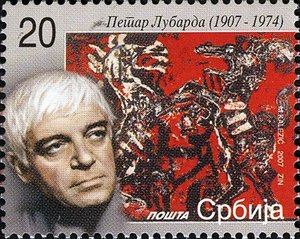
Petar Lubarda
1907 - 1974 , Montenegro
Krótka nota
- Full Name: Petar Lubarda
- Nationality: Serbian
- Date Of Birth: 1907
- Date Of Death: 1974
- Place Of Birth: Cetinje, Montenegro
- Notable Artworks: ['Battle of Kosovo']
- Artistic Movement Or Style: Byzantine & Medieval influence
- Artists Who Influenced This Artist:
- Jan van Eyck
- Vincent van Gogh
- Artists Or Movements Influenced By This Artist: ['Belgrade City Museum']