Zobacz w skali 1:1
 Wyślij
 Udostępnij
 Szczegóły
 Przewodnik

 Pobierz plik obrazu
 Podobne obiekty
 RTG
RTG Pokaz slajdów
 Statystyki
Celtic Tale
 Oil On Canvas
- WallArt
- Synthetist Painting
 1894
1894- 19th Century
 110.0 x 101.0 cm
 Muzeum Sztuki w Dallas
 Czytaj więcej
Giclée / Wydruk artystyczny
Wydruki giclée lub płótna o jakości muzealnej, szybka realizacja i szeroki wybór opcji wykończenia. ( Kup ręcznie malowany obraz Przełącz na wersję cyfrową)




P118B zł10

P118H zł10

P118W zł10

P438Z zł10

P508JH zł12

P508YH zł12

P805H zł10

P805Z zł10

P919BZ zł10

P919G zł10

P919XJ zł10

P959ZH zł10

P968JZ zł12

W106C zł8

W218G zł10

W218JH zł8

W218Y zł10

W307PJ zł10

W316G zł10

W316PJ zł8

W316Y zł10

W398PJ zł8

W4111J zł10

W500HY zł15

W500JH zł15

W692G zł12

W849H zł8

W940BG zł15

W953PJ zł8




Wybierz spośród naszych standardowych rozmiarów, które zachowują oryginalne proporcje dzieła sztuki.

Wpisz wymaganą szerokość i wysokość, aby dopasować grafikę do ramy lub ściany. Wydruk można jedynie przyciąć, nigdy nie powiększając go poza oryginalny obraz, dlatego format o innym proporcji spowoduje utratę części kompozycji. Przed rozpoczęciem druku prześlemy Ci cyfrowy podgląd do zatwierdzenia. Obraz wyświetlany na tej stronie nie pokazuje rzeczywistego przycięcia — jedynie podgląd oddaje ten efekt.
Dostawa na cały świat () w ciągu 2 tygodni zamiast standardowych 4/5 tygodni. (23 Październik)

Bezpłatna ekspresowa wysyłka na cały świat

Wysokiej jakości płótno lniane

Pełne ubezpieczenie transportowe

Gwarancja zwrotu należności celnych i podatków importowych

Gwarancja idealnego odwzorowania barw

100-dniowy okres na zwrot dzieła w przypadku wykrycia wad produkcyjnych

Gwarancja 100% zwrotu pieniędzy

Oferta przy zakupie wielu sztuk
 Opcja ze szkłem jest dostępna wyłącznie w rozmiarach poniżej 110 cm

Celtic Tale
Giclée / Wydruk artystyczny
Rozmiar reprodukcji
-


Suma do zapłaty
zł 308
Paul Sérusier’s “Celtic Tale”: A Window into Synthetist Vision
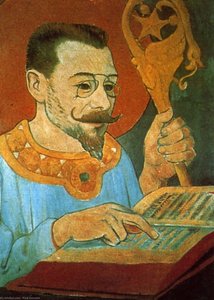
Paul Sérusier's "Celtic Tale," painted in 1894, isn’t merely a depiction of a forest scene; it’s a profound exploration of light, color, and the nascent principles of abstract art. This oil on canvas, now residing within the Dallas Museum of Art, offers a captivating glimpse into the artist's innovative approach to capturing the essence of nature – a style he would later define as Synthetism. Born in Paris in 1864, Sérusier’s artistic journey was marked by a restless pursuit of new forms of expression, culminating in his groundbreaking work with the Nabis movement and his pioneering experiments with Cloisonnism.
The painting immediately draws the eye with its vibrant palette. Bold swathes of emerald green, sapphire blue, and ochre yellow dominate the composition, creating a sense of luminous intensity. These colors aren’t applied realistically; instead, Sérusier employs them in a flattened, almost geometric manner – a hallmark of Synthetism. He deliberately rejects traditional perspective, opting for simplified forms and strong contours that delineate shapes rather than mimicking their three-dimensional appearance. This technique, reminiscent of the decorative art of cloisonné enamelwork (hence “Cloisonnism”), creates an arresting visual effect, pulling the viewer into the heart of the scene.
The Spirit of Pont-Aven: Synthetism and its Roots
Sérusier’s artistic evolution was profoundly shaped by his summer sojourn in 1888 to Pont-Aven, a small village in Brittany. There, he encountered Paul Gauguin, who became a mentor and introduced him to the principles of Synthetism. Gauguin encouraged Sérusier to abandon academic realism and instead focus on capturing the *feeling* of a subject – its essence rather than its literal representation. This shift is powerfully evident in "Celtic Tale," where the forest itself becomes a symbolic entity, imbued with an almost mystical quality.
The painting’s composition echoes the work of Seurat and Signac, key figures in Pointillism and Neo-Impressionism, both movements that influenced Sérusier's development. However, unlike their meticulous application of tiny dots of color, Sérusier utilizes broader brushstrokes and bolder blocks of pigment to achieve a similar effect – creating an impression of light and atmosphere through the manipulation of color itself. The figures within the scene are deliberately simplified, almost dissolving into the surrounding landscape, further emphasizing the painting’s abstract qualities.
Symbolism Within the Scene: Nature, Community, and Mystery
Beyond its formal innovations, “Celtic Tale” is rich in symbolic meaning. The gathering of individuals amidst the forest evokes a sense of community and shared experience – a celebration of life and connection with nature. The two dogs present add to this feeling of warmth and conviviality. However, there’s also an underlying current of mystery and perhaps even melancholy. The cloaked figures, their faces obscured, suggest a ritualistic gathering, hinting at ancient Celtic traditions and the enduring power of myth.
The dappled sunlight filtering through the trees creates a sense of ethereal beauty, while the dark, rocky outcrop in the background provides a stark contrast, representing both obstacles and hidden depths. The painting’s overall mood is one of serene contemplation – an invitation to lose oneself in the beauty of the natural world and reflect on its timeless mysteries. It's a testament to Sérusier's ability to translate complex emotions and ideas into a visually arresting and deeply resonant work of art.
A Legacy of Innovation: Paul Sérusier’s Enduring Influence
Paul Sérusier’s “Celtic Tale” stands as a pivotal work in the history of modern art. It represents a crucial step towards abstraction, demonstrating the power of color and form to convey emotion and meaning independently of representational accuracy. His pioneering use of Synthetism paved the way for subsequent movements such as Fauvism and Cubism, solidifying his place as one of the most important figures in the development of 20th-century art. Reproductions of this captivating painting continue to inspire artists and collectors alike, offering a window into the visionary world of Paul Sérusier.
Pytania i odpowiedzi
Jaka technika i styl charakteryzują „Celtic Tale” autorstwa Paul Sérusier?
"Celtic Tale" powstało przy użyciu Oil On Canvas, w stylu Synthetist Painting.
Jaka technika została użyta w przypadku "Celtic Tale" i kiedy powstało to dzieło?
"Celtic Tale" powstało w 1894 roku przy użyciu techniki Oil On Canvas. Materiał i data opisują, w jaki sposób oraz kiedy wykonano oryginał.
Jaki nastrój oddaje „Celtic Tale” autorstwa Paul Sérusier w ramach nurtu Synthetist Painting?
Reflective emocja dzieła „Celtic Tale” współgra z jego stylem Synthetist Painting.
Biografia artysty
Early Life and Artistic Beginnings
Paul Sérusier, a pivotal figure in the development of modern art, was born on November 9th, 1864, in the heart of Paris. His upbringing within a prosperous family instilled in him a deep appreciation for culture and learning. Unlike many artists of his time who hailed from privileged backgrounds, Sérusier’s father, a successful businessman involved in the perfume industry, provided him with an unusually comprehensive education. He studied philosophy, Greek, and Latin at Lycée Condorcet, a prestigious institution renowned for its rigorous academic standards. This classical foundation would later profoundly influence his artistic approach, shaping his understanding of form, composition, and symbolism. It was during this period that Sérusier encountered Maurice Denis and Édouard Vuillard, two fellow students who would become lifelong friends and collaborators – individuals whose shared intellectual curiosity and artistic aspirations proved to be a fertile ground for innovation. The encounter with these influential figures marked the beginning of his journey towards breaking away from traditional academic painting.The Pont-Aven Years: Cloisonnism and the Nabis
Sérusier’s artistic trajectory took a decisive turn in 1888 when he traveled to Pont-Aven, a small village nestled in Brittany – a region that would become inextricably linked with his life's work. It was here, amidst the rugged beauty of the Breton landscape and under the guidance of Paul Gauguin, that Sérusier encountered the revolutionary concept of *cloisonnism*. Gauguin encouraged him to abandon meticulous representation and instead focus on capturing the essence of a scene through bold, flat shapes delineated by dark outlines – akin to stained glass windows. This technique, characterized by its stark contrast between color and line, allowed Sérusier to distill his perceptions into their purest form, moving away from imitation towards an expressionistic approach. This period also witnessed the formation of *Les Nabis*, a small but influential group of artists who shared a common desire to break free from the constraints of Impressionism and explore new avenues for artistic expression. Alongside Maurice Denis, Pierre Bonnard, and Édouard Vuillard, Sérusier sought to create art that was both decorative and emotionally resonant – a synthesis of form and feeling.Key Works and Artistic Innovations
Sérusier’s most celebrated work, *The Talisman* (1888), exemplifies his pioneering approach to abstraction. Painted during his time in Pont-Aven, the canvas is a vibrant explosion of color and simplified forms – a radical departure from traditional landscape painting. The composition, inspired by a Breton forest, utilizes bold, non-naturalistic colors and flattened shapes to evoke a sense of atmosphere and emotion rather than a literal depiction of the scene. Other notable works include *L’Averse* (1893), a poignant portrayal of a rainy day in Brittany; *Portrait of Paul Ranson* (1890), a striking example of his ability to capture personality through simplified forms; and *Melancholy* (1890), a deeply evocative depiction of human emotion. Sérusier’s later works, such as *The Snake Eaters* (1894) and *Panneau Bretonne avec enfants* (1894), continued to explore themes of nature, spirituality, and the complexities of human experience. His work served as a bridge between Impressionism and the emerging movements of Synthetism and Cubism.Legacy and Influence
Paul Sérusier’s impact on the development of modern art is undeniable. His experimentation with abstraction, his embrace of *cloisonnism*, and his founding of *Les Nabis* paved the way for subsequent generations of artists to explore new forms of expression. His work influenced figures such as Maurice Denis, Pierre Bonnard, and Édouard Vuillard, who went on to become leading proponents of Synthetism. Sérusier’s emphasis on color and emotion, his rejection of traditional representational techniques, and his exploration of spiritual themes continue to resonate with artists today. He taught at the École Ranson, further disseminating his innovative ideas and shaping the artistic landscape of early 20th-century Paris. Paul Sérusier died on October 7, 1927, in Morlaix, leaving behind a legacy as one of the most important and influential figures in the history of modern art – a true pioneer who dared to break free from convention and forge his own unique artistic path.
Paul Sérusier
1864 - 1927 , Francja
Najważniejsze informacje
- Artistic Movement Or Style: Postimpresjonizm
- Artists Or Movements Influenced By This Artist: ['Nabis']
- Artists Who Influenced This Artist:
- Paul Gauguin
- Maurice Denis
- Date Of Birth: 9 listopada 1864
- Date Of Death: 7 października 1927
- Full Name: Louis-Paul-Henri Sérusier
- Nationality: Francuz
- Notable Artworks:
- Talizman
- Krajobraz w Bois d’Amour
- Place Of Birth: Paryż, Francja
Zobacz także powiązane artykuły

Poza Impresjonizmem: Eksploracja Głębii Emocjonalnej Malarstwa Postimpresjonistycznego
Odkryj fascynujący świat postimpresjonizmu! Analiza dzieł Van Gogha, Cézanne'a i Gauguina. Poznaj techniki malarskie, symbolikę oraz wpływ tego ruchu na sztukę współczesną. Ekspercka wiedza i inspiracje dla miłośników sztuki.

Paul Klee: 25 Arcydzieł Koloru i Formy | Reprodukcje Obrazów Online - OriginalUniqueArt
Odkryj 25 arcydzieł Paula Klee – od abstrakcji po ekspresjonizm. Poznaj historie, techniki i inspiracje malarza. Reprodukcje obrazów najwyższej jakości na OriginalUniqueArt.com. Eksploruj pełną kolekcję online!
Paul Sérusier: Pioneering Synthetism & The Nabis’ Symbolic Revolution
Discover Paul Sérusier's pivotal role in the Nabis movement & the birth of Synthetism. Explore 'The Talisman,' his influence on modern art, and a deeper understanding of this symbolic revolution. Expert analysis & insights.

Paul Cézanne: 25 Arcydzieł, które Zrewolucjonizowały Świat Sztuki | OriginalUniqueArt
Odkryj 25 arcydzieł Paula Cézanne'a – od impresjonizmu po postimpresjonizm. Poznaj historie, techniki i inspiracje malarza, który zrewolucjonizował sztukę. Reprodukcje obrazów najwyższej jakości na OriginalUniqueArt.com!

Impressionizm w Obrazach: 10 Arcydzieł Pełnych Światła i Koloru | OriginalUniqueArt
Odkryj 10 arcydzieł impresjonizmu! Poznaj historie Claude Moneta, Degasa i Van Gogha. Reprodukcje obrazów najwyższej jakości – pejzaże pełne światła i koloru do Twojego wnętrza. OriginalUniqueArt.