Przełącz na wydania drukowane
 Rozwiń treść







































 W przypadku dzieł sztuki lub reprodukcji, których którykolwiek z boków przekracza 105 cm (około 41 cali), rama zostanie wysłana w formie zestawu do samodzielnego montażu. Metoda ta zapewnia bezpieczną dostawę i zapobiega uszkodzeniom podczas transportu.


Fragmentacja i Emocje: Odzieża na Mandolinie Pabla Picassa
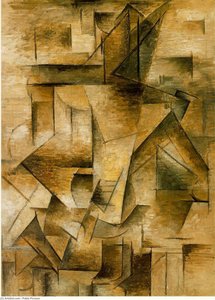
Pablo Picasso’s “Woman with Mandolin,” painted in 1909, is more than just a portrait; it's a pivotal moment not only in the genesis of Cubism but also in the evolution of modern art itself. This oil on canvas masterpiece, born from a period of intense experimentation and fueled by Picasso’s relentless pursuit of innovation, invites us to reconsider our very perception of form, space, and ultimately, representation. It's a work that transcends mere depiction, constructing instead a complex visual puzzle—a deliberate fragmentation of reality that speaks volumes about Picasso’s revolutionary approach to art and its profound connection to the human experience.
Cubism: A Revolution in Perspective
The painting immediately captivates with its fractured composition. The subject – a woman, imbued with an air of mystery and melancholy – is not presented as a unified whole but rather as a collection of interlocking geometric planes. Picasso masterfully dismantles her figure, presenting her simultaneously from multiple viewpoints—a technique central to Analytical Cubism. Lines, sharp and decisive, slice across the canvas, dissecting the form and suggesting that there’s no single, fixed perspective. The mandolin itself, an instrument deeply rooted in Spanish culture and often associated with passion, storytelling, and perhaps even a touch of longing, is similarly fragmented, its curves and contours broken down into angular shapes and overlapping planes. This deliberate ambiguity forces the viewer to actively participate in reconstructing the image—a dynamic and engaging experience that challenges traditional notions of visual representation.
Influences: Cézanne, Africa, and the Parisian Avant-Garde
Picasso’s exploration of this fractured aesthetic was profoundly shaped by his intellectual and artistic environment. The painting emerged during a period of intense experimentation within the vibrant Parisian art scene, fueled by collaborations with figures like Daniel-Henry Kahnweiler, a prominent art dealer who championed Cubism, and deeply influenced by the works of Paul Cézanne, whose emphasis on geometric forms and multiple viewpoints laid the groundwork for Picasso’s innovations. Furthermore, Picasso's fascination with African masks and tribal sculpture—a passion ignited during his time in Barcelona—is subtly evident in the simplified, almost mask-like quality of the woman’s face – a testament to the burgeoning interest in non-Western art at the turn of the century. This confluence of influences propelled Picasso toward a radical departure from traditional representation, paving the way for Cubism's revolutionary impact.
Symbolism and Emotional Resonance
“Woman with Mandolin” carries layers of symbolic meaning that invite contemplation. The mandolin itself represents not just music but also Spanish culture, tradition, and perhaps even a longing for connection—a poignant reminder of the human need for beauty and expression. The woman’s enigmatic expression – a subtle blend of serenity and melancholy – invites speculation about her inner thoughts and emotions. Picasso deliberately avoids providing definitive answers, allowing the viewer to project their own feelings and interpretations onto the image. The overall effect is one of quiet intensity, suggesting that beauty can be found not in perfect representation but in the exploration of complex ideas and emotional states—a hallmark of Picasso’s genius.
OriginalUniqueArt offers meticulously crafted, hand-painted oil painting reproductions of “Woman with Mandolin,” capturing every nuance and detail of Picasso’s groundbreaking work. These reproductions are created by skilled artists who share a deep appreciation for Picasso's legacy, ensuring that you own a stunning piece of art history—a testament to the enduring power of Cubism and one of the most significant works in modern art.
Explore our selection of Picasso’s masterpieces, including “Woman with Mandolin” (130 x 97 cm, Synthetic Cubism, Oil On Canvas) and other iconic pieces on OriginalUniqueArt.com. Discover the beauty of a fragmented melody.
- Woman with Mandolin (130 x 97 cm, Synthetic Cubism, Oil On Canvas)
- Daniel-Henry Kahnweiler
- Le Rêve
- The Weeping Woman
Pytania i odpowiedzi
Jak nasycona jest paleta kolorystyczna dzieła "Woman with mandolin"?
Dzieło „Woman with mandolin” – Pablo Picasso charakteryzuje się Subtelna kolorystyka nasyceniem kolorów.
Co wyjaśnia sytuację prawną dotyczącą praw autorskich do „Woman with mandolin” – Pablo Picasso?
„Woman with mandolin” – Pablo Picasso jest nadal objęte ochroną prawa autorskiego. Okres ochrony praw autorskich liczony jest od śmierci artysty, która nastąpiła w 1973.
Do którego pomieszczenia w domu najlepiej pasuje reprodukcja "Woman with mandolin"?
Zalecaną przestrzenią dla „Woman with mandolin” – Pablo Picasso jest Salon lub strefa dzienna. Sugestia ta może być oczywiście dostosowana do Twojego wnętrza.
 Podgląd w skali 1:1
 Wyślij jako kartkę
 Udostępnij
 Szczegóły dzieła
 Przewodnik

 Pobierz obraz
 Podobne obiekty
 RTG
RTG Pokaz slajdów
 Pytania i odpowiedzi
 Statystyki