Abstract Expressionism · 1953
Untitled (Mark Rothko, 1953)
Mark Rothko (1903–1970) stworzył Untitled. Dzieło pochodzi z 1953. Należy do nurtu Abstract Expressionism. Wykonano w technice Oil On Canvas. Przechowywane jest w Guggenheim Museum Bilbao w Bilbao, Hiszpania. Wymiary to 299 × 442 cm.
- 1953
- Oil On Canvas
- 299 × 442 cm
- Guggenheim Museum Bilbao

 Podgląd w skali 1:1

 Ręcznie malowany obraz olejny
 Wyślij jako kartkę
 Udostępnij
 Karta informacyjna


 Pobierz obraz
 Podobne obiekty
 RTG
 Pokaz slajdów
 Pytania i odpowiedzi

 Statystyki
Untitled w skrócie
- Tytuł
- Untitled
- Artysta
- Mark Rothko (1903–1970)
- Miejsce urodzenia artysty
- Daugavpils, Łotwa
- Data powstania
- 1953
- Technika wykonania
- Oil On Canvas
- Wymiary
- 299 × 442 cm
- Gdzie można je zobaczyć
- Guggenheim Museum Bilbao, Bilbao, Hiszpania
- Epoka
- Modern
- Temat
- color field painting, emotional resonance, chromatic harmony, minimalism, atmospheric depth, geometric forms
Co przedstawia Untitled?
The Creation of Untitled by Mark Rothko
To understand Untitled, one must look toward the origins of Mark Rothko. He was born in 1903 in a place now known as Daugavpils, Latvia. His early years were shaped by the atmosphere of the Pale of Settlement, a region marked by political unrest and the constant shadow of pogroms. This sense of instability followed his family when they emigrated to the United States in 1913, eventually settling in Portland, Oregon. These formative experiences of displacement and loss became a quiet foundation for the man he would become.
By 1953, Rothko had moved into a period of profound abstraction. He painted Untitled during this time, a year that sits within his prolific New York period. The work emerged from a long transition away from the structured realism of his youth. He had moved past the depiction of urban scenes and portraits, seeking instead a way to express the weight of human experience without relying on the literal shapes of the physical world. This shift allowed him to focus on the internal landscape of emotion.
The artist continued to refine this language of color until his death in 1970. In Untitled, we see the result of this lifelong search for a direct encounter with the viewer. He stripped away titles that might suggest a specific narrative, leaving us to face the pigment itself. The canvas becomes a space for quiet, heavy presence, inviting a confrontation with the fundamental mysteries of existence.
Visual Composition and Color Fields
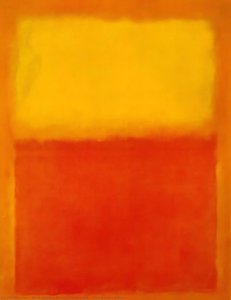
The canvas presents a large-scale encounter with two primary chromatic zones. A yellow background dominates the majority of the space, providing a luminous foundation for the composition. Overlaid upon this expanse is a section of red paint, which occupies a smaller area and is positioned toward the right side of the work. This arrangement creates a deliberate imbalance, drawing the eye across the field of color.
The interaction between these two sections is marked by a sense of quiet movement. In certain areas, the red pigment appears to be fading, which lends the surface a weathered quality. This subtle degradation suggests the passage of time, as if the colors are slowly receding into the canvas itself. The relationship between the expansive yellow and the concentrated red creates a tension that defines the visual structure of the piece.
Technique and Material Application
To understand this work, one must consider the patient, layered process Rothko employed. He utilized a method known as color field painting, moving away from the heavy, textured brushstrokes of traditional realism. Before any color was applied, he meticulously prepared the canvas with gesso, creating a smooth, receptive surface. This preparation allowed him to work with thin washes of oil paint, building the composition through a slow accumulation of pigment. Each layer was applied with a sense of lightness, allowing the colors to interact within the fibers of the cloth.
As the paint dried, it developed a characteristic matte sheen. This finish avoids the aggressive glare of high-gloss oils, instead offering a soft, diffused light that seems to emanate from within the canvas itself. The edges of the rectangular forms are never sharp or defined; they are intentionally blurred and soft. This technique allows the cadmium yellow and crimson to bleed into one another, creating a sense of depth and a breathing, permeable boundary between the hues.
Interpretations of Color and Form
The interaction between the two primary hues suggests a dialogue between opposing human states. The yellow field acts as a beacon, representing enlightenment and optimism. In contrast, the crimson section embodies passion, sacrifice, and primal emotion. These colors do not merely sit side by side; they meet in a way that suggests the tension inherent in the human condition.
The composition relies on the presence of these rectangular blocks to guide the viewer's internal experience. One might see these forms as the boundaries between consciousness and the unconscious. The scale of the canvas is intentional, designed to envelop the person standing before it. This immersion encourages a meditative state, where the viewer is no longer an observer but a participant in the space created by the pigment.
Related Works by Mark Rothko
To understand the evolution of this period, one might look toward his later explorations of color and scale. In 1956, he produced Orange and yellow, a work that continues his investigation into how luminous hues interact within a defined space. His practice also moved toward more specific, numbered compositions, such as No. 5 No. 22, which demonstrate his commitment to the language of abstraction through the use of large, breathing rectangular forms.
The artist also engaged deeply with the architecture of specific environments. He developed the Seagram murals, a series of paintings intended for a New York restaurant, though he eventually chose to donate them to the Tate Gallery in London. Similarly, his interest in how color occupies a room led to the creation of the Harvard Mural series, designed for a dining room at the Holyoke Center. These large-scale projects show his desire to create an immersive atmosphere where the viewer is enveloped by the presence of the paint.
Where to See This Artwork Today
This specific canvas, created around 1953, resides within the permanent collection of the Guggenheim Museum Bilbao. Located in Bilbao, Spain, the museum provides a space where this work can be experienced in its intended scale. The institution is part of the Solomon R. Guggenheim Foundation and maintains a collection that spans the 20th and 21st centuries.
Visiting the museum allows for a direct encounter with the subtle shifts in color that define this piece. The architecture of the building provides a contemporary setting for such a significant work of the mid-twentieth century. It remains a central part of the museum's holdings, offering a quiet moment of reflection within the broader context of modern and contemporary art.
W którym muzeum znajduje się Untitled?
Guggenheim Museum Bilbao
Bilbao, Hiszpania
Historia Guggenheim Museum Bilbao Korzenie Guggenheim Museum Bilbao sięgają 1991 roku, kiedy to rząd Kraju Basków zaproponował powołanie nowej instytucji kulturalnej. Ta śmiała inicjatywa miała na celu całkowitą transformację krajobrazu przemysłowego Bilbao w hiszpańskiej prowincji Bizkaia. Aby urzeczywistnić tę wizję, władze regionu zaangażowały ogromne zasoby, w tym 100 milionów dolarów na koszty budowy oraz 50 milionów dolarów przeznaczonych na fundusz zakupów dzieł sztuki.


Zdjęcia w wysokiej rozdzielczości dzieła Untitled

Chronione prawem autorskim: pliki te służą wyłącznie do osobistego wglądu i nie stanowią licencji na ich powielanie.
Mark Rothko, Untitled (1953), Guggenheim Museum Bilbao.
Odpowiedzi na pytania dotyczące Untitled
Gdzie można obecnie zobaczyć dzieło „Untitled” – Mark Rothko?
„Untitled” – Mark Rothko znajduje się w zbiorach Guggenheim Museum Bilbao, Bilbao, Hiszpania. Informacja o muzeum dotyczy oryginału, a nie reprodukcji.
W którym roku powstało dzieło "Untitled"?
"Untitled" powstało w 1953 roku. Data ta pozwala umiejscowić dzieło w kontekście twórczości Mark Rothko oraz epoki, w której powstało.
W jakiej technice wykonano „Untitled” – Mark Rothko?
Technika wykonania dzieła „Untitled” – Mark Rothko to Oil On Canvas. Reprodukcje mają na celu wierne oddanie wyglądu tej techniki.
Jakie są wymiary oryginalnego dzieła „Untitled” – Mark Rothko?
Oryginalny utwór „Untitled” – Mark Rothko ma wymiary 442 x 299 cm.
Co przedstawia "Untitled"?
Tematyka obecna w „Untitled” – Mark Rothko obejmuje color field painting, emotional resonance, chromatic harmony, minimalism, atmospheric depth, geometric forms, texture. Razem stanowią one podsumowanie tematyki dzieła.
Czy dzieło "Untitled" znajduje się w domenie publicznej?
„Untitled” – Mark Rothko znajduje się w domenie publicznej (nadal objęte ochroną prawa autorskiego). Status ten określa zasady reprodukcji obrazu tego dzieła.
Kto stworzył "Untitled"?
„Untitled” zostało stworzone przez Mark Rothko. Informacje na tej stronie dotyczą oryginalnego dzieła autorstwa Mark Rothko.
Do jakiego nurtu w sztuce należy „Untitled” – Mark Rothko?
„Untitled” to dzieło należące do nurtu Abstract Expressionism. Nurt ten określa tradycję artystyczną, w której osadzone jest dzieło.
Do którego okresu twórczości Mark Rothko należy dzieło "Untitled"?
"Untitled" reprezentuje Mature Period twórczości Mark Rothko.
O artyście: Mark Rothko

1903–1970, Łotwa
Mark Rothko
Wczesne lata życia Marka Rothko Mark Rothko urodził się w 1903 roku jako Markus Yakovlevich Rothkowitz. Jego korzenie sięgają Dwińska w Rosji, w miejscu znanym dziś jako Daugavpils w Łotwie. Jego rodzina żyła w obrębie Pasu Osadniczego, regionu naznaczonego niepokojami politycznymi i nieustannym cieniem pogromów. Ta atmosfera niestabilności towarzyszyła rodzinie również podczas emigracji do Stanów Zjednoczonych w 1913 roku.
Inne prace Mark Rothko
 White Center1950
 Bez. 1
 Nr 61 (Rdza i błękit)1953
 Pomarańczowy i żółty1956
Eseje o Untitled
 Mastering Emotion: The Top 25 Most Iconic Mark Rothko ArtworksImmerse yourself in the profound emotion of Abstract Expressionism. Explore our curated guide to the top 25 Mark Rothko masterpieces, from …
 Action Painting vs. Color Field Painting: A Guide to Two Abstract StylesMaster the differences between Action and Color Field painting through expert analysis. Explore these abstract styles now.
 The Architecture of Emotion: A Connoisseur’s Guide to the Chromatic Sublimity of Mark RothkoExplore the profound emotional landscapes of Mark Rothko. An expert editorial on Color Field painting, decoding the spiritual depth, techni…