

 Wyślij
 Udostępnij
 Szczegóły
 Przewodnik

 Pobierz plik obrazu
 Podobne obiekty
 Pokaz slajdów
 Statystyki
Pope Urban III


 Czytaj więcej
Ręcznie malowana reprodukcja olejowa
Ręcznie malowany obraz olejny na płótnie, wykonany na zamówienie przez naszych artystów w wybranym przez Ciebie wymiarze i oprawie. ( Przełącz na wersję drukowaną Przełącz na wersję cyfrową)




































Wybierz spośród naszych standardowych rozmiarów, które zachowują oryginalne proporcje dzieła sztuki.

Możesz wprowadzić własne wymiary, aby dopasować obraz do konkretnej ramy lub przestrzeni. Jeśli wybrany rozmiar nie będzie odpowiadał proporcjom oryginału, przytniecie dzieło sztuki lub rozszerzymy je o dodatkowe elementy, ręcznie domalowane przez artystę. Przed rozpoczęciem produkcji wyślemy projekt cyfrowy do Twojej akceptacji.
Należy pamiętać, że podgląd na ekranie nie odzwierciedla rzeczywistego przycinania ani rozszerzania obrazu. Tylko projekt dokładnie pokaże ostateczną kompozycję.
Choć oferujemy możliwość zamówienia niestandardowych rozmiarów, zalecamy wybór wymiaru z gotowej listy, aby zachować oryginalne proporcje dzieła.
Po złożeniu zamówienia zespół OriginalUniqueArt.com skontaktuje się z klientem drogą mailową w celu uzyskania instrukcji i prześle wizualizację projektu
Dostawa na całym świecie () w ciągu 3–4 tygodni zamiast standardowych 5 tygodni. (25 Wrzesień). Bez kompromisów w kwestii jakości.

Bezpłatna ekspresowa wysyłka na cały świat

Wysokiej jakości płótno lniane

Pełne ubezpieczenie transportowe

Gwarancja zwrotu należności celnych i podatków importowych

Gwarancja idealnego odwzorowania barw

100-dniowy okres na zwrot dzieła w przypadku wykrycia wad produkcyjnych

Gwarancja 100% zwrotu pieniędzy

Oferta przy zakupie wielu sztuk
 Opcja ze szkłem jest dostępna wyłącznie w rozmiarach poniżej 110 cm

Pope Urban III
Technika wykonania
Rozmiar reprodukcji
-


Suma do zapłaty
$ 300
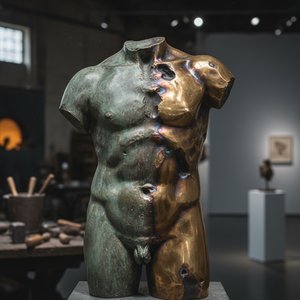
A Fragmented Icon: Lucio Fontana’s “Pope Urban III”
Lucio Fontana's "Pope Urban III" isn’t merely a sculpture; it’s an audacious declaration of artistic rebellion against convention. Cast from bronze, this monumental piece embodies the spirit of Spatialism—a movement Fontana spearheaded that fundamentally questioned the boundaries of traditional art forms and challenged viewers to reconsider their perception of space itself. Created in 1963, shortly before Fontana's untimely death, it represents a culmination of his lifelong exploration into innovative sculptural techniques and conceptual ideas.The Sculpture’s Bold Aesthetic
The sculpture’s visual impact is immediately arresting. Dominating the canvas with its dimensions of 5 x 93 cm, “Pope Urban III” eschews polished surfaces and meticulous detailing for a deliberately rough texture—a characteristic born from Fontana's fascination with Brutalism. Angular planes intersect at sharp edges, creating an unsettling dynamism that contrasts sharply with the seated posture of the papal figure. The artist’s masterful manipulation of bronze lends itself to this expressive style; the visible seams and joins speak volumes about the process of construction, emphasizing materiality and rejecting illusionistic representation. Fontana deliberately disrupts established sculptural norms, prioritizing form over imitation.Spatialism: Beyond Representation
Fontana's artistic vision was rooted in Spatialism, a movement that sought to liberate sculpture from the constraints of depicting recognizable subjects. Instead of striving for realistic portrayal, Fontana aimed to explore the fundamental nature of space—to puncture its surface and invite contemplation about its infinite possibilities. This is powerfully achieved through the sculpture’s fragmented composition; each plane appears to be sliced or pierced, suggesting a disruption of perceived reality. The deliberate asymmetry contributes to an emotional resonance that transcends mere visual appeal.Symbolism and Emotional Resonance
The iconography itself—a depiction of Pope Urban III—is deliberately ambiguous. Fontana wasn't interested in conveying religious piety but rather in interrogating authority and tradition. The fractured face of the pope symbolizes decay, loss, and the crumbling edifice of established dogma. This unsettling effect is heightened by the sculpture’s dark background, which fosters a mood of introspection and invites viewers to confront uncomfortable truths. Fontana’s work compels us to consider not just what we see but how we perceive—a profound statement about the role of art in shaping our understanding of the world.Technique and Materiality
The bronze casting process itself underscores Fontana's commitment to materiality. The sculptor painstakingly crafted a plaster model, which was then meticulously reproduced in bronze using traditional foundry techniques. This careful attention to detail ensures that the reproduction captures not only the sculpture’s form but also its textural qualities—the rough surface finish and visible seams—reflecting Fontana’s desire to engage viewers on a visceral level. The resulting artwork is a testament to both artistic innovation and masterful craftsmanship.Biografia artysty
A Life Forged in Spatialism
Lucio Fontana, a name synonymous with radical innovation in 20th-century art, was born into a world poised between tradition and modernity. His journey began not in Italy, the nation he would come to define within the artistic landscape, but in Rosario, Argentina, in 1899. The son of an Italian sculptor, Luigi Fontana, young Lucio inherited a craftsman’s sensibility alongside a burgeoning artistic vision. This early exposure to form and material proved foundational, even as his life became a series of geographical and stylistic explorations. Returning to Italy with his family, he absorbed the rich cultural heritage of Europe, studying at the Brera Academy in Milan and immersing himself in the avant-garde movements that were beginning to challenge established norms. However, the pull of his origins remained strong; multiple returns to Argentina punctuated his career, shaping his perspective and fueling a desire to transcend conventional artistic boundaries. Fontana’s early work reflected this duality – initially rooted in figurative sculpture and painting, it gradually evolved towards abstraction, hinting at the revolutionary path he was destined to forge.Breaking the Canvas: The Birth of Spatialism
The devastation of World War II proved a catalyst for Fontana's most groundbreaking artistic endeavor. Witnessing the destruction and upheaval firsthand, he felt compelled to redefine art’s purpose in a world irrevocably altered. This led to the formulation of *Spatialism*, a movement that sought not merely to represent space but to incorporate it as an integral element of the artwork itself. Fontana believed traditional painting was limited by its two-dimensionality, confining art within a static plane. He envisioned a new form of expression that would break down these barriers, acknowledging the infinite depth and potential of space beyond the canvas. This wasn’t simply about creating illusions of depth; it was about physically opening up the artwork to reveal what lay *beyond*. Beginning in the late 1940s, Fontana began his now-iconic series of slashed and punctured canvases – the *Concetti Spaziali* (Spatial Concepts). These weren't acts of destruction but rather deliberate interventions, revealing a void that symbolized the vastness of the cosmos. The slashes, often executed with a razor blade, were precise and purposeful, transforming the canvas into a window onto another dimension. He wasn’t destroying the painting; he was liberating it from its limitations.Influences and Artistic Kinship
Fontana's artistic development wasn’t born in isolation. He engaged with a diverse range of influences, absorbing and transforming them into his unique visual language. The expressive power of Vincent van Gogh resonated deeply within him, particularly the emotional intensity conveyed through brushwork. He also admired the satirical edge of Pieter Bruegel the Elder, finding inspiration in the older master’s ability to critique societal flaws. However, a pivotal encounter with the work of Polish artist Jan Grzegorz Stanisławski proved particularly transformative. Stanisławski's exploration of light and color within his 'Mullein' series profoundly impacted Fontana’s approach to abstraction and spatial representation. Furthermore, his participation in groups like *Abstraction-Création* in Paris exposed him to a broader network of avant-garde artists, fostering an exchange of ideas that fueled his experimentation. While distinctively original, Fontana’s work also shares affinities with other post-war movements such as Zero and Nouveau Réalisme, all striving to redefine the boundaries of art and challenge conventional perceptions.The Evolution of Technique: From Slash to Hole
Fontana's technique evolved dramatically over time. Initially, the *Concetti Spaziali* were characterized by bold, decisive slashes that created a dramatic contrast between the painted surface and the exposed canvas behind it. These works immediately captured attention and sparked debate about their meaning and purpose. However, Fontana didn’t remain static. He began to experiment with more subtle interventions, creating *hole paintings* – canvases meticulously pierced with tiny holes to reveal the underlying support. This technique, developed in the late 1950s and early 1960s, further emphasized the concept of spatial depth and invited viewers to contemplate the relationship between the surface and the void. He also ventured into sculpture, producing works that echoed the themes of volume and void found in his two-dimensional pieces – monumental installations that blurred the boundaries between painting, sculpture, and architecture. The *Soffitto Spaziale* (Spatial Ceiling) projects were particularly ambitious, transforming entire rooms into immersive environments designed to evoke a sense of infinite space.A Lasting Resonance
Lucio Fontana’s death in Comabbio, Italy, in 1968, marked the end of a remarkable career but not the end of his influence. Today, his works are held in prestigious museum collections worldwide – from The Metropolitan Museum of Art to the Ballarat Fine Art Gallery in Australia – testament to his enduring legacy. He remains a pivotal figure in post-war abstract art, celebrated for his courage to challenge conventions and redefine the very essence of artistic expression. Fontana didn’t simply paint *on* canvas; he engaged with space itself, creating works that invite viewers to contemplate the infinite possibilities beyond the visible world. His legacy is not merely a collection of slashed canvases but a profound invitation to perceive reality in new and expansive ways. He demonstrated that art could be more than representation—it could be an exploration of existence itself.
Lucio Fontana
1899 - 1968 , Argentyna
Najważniejsze informacje
- Artistic Movement Or Style: Spatializm
- Artists Or Movements Influenced By This Artist:
- Zero
- Nouveau Réalisme
- Artists Who Influenced This Artist:
- Jan Grzegorz Stanisławski
- Vincent van Gogh
- Date Of Birth: 1899
- Date Of Death: 1968
- Full Name: Lucio Fontana
- Nationality: Argentyńsko-Włoski
- Notable Artworks:
- Concetto Spaziale
- Soffitto Spaziale
- Place Of Birth: Rosario, Argentyna
Zobacz także powiązane artykuły

Trwała Forma: Rzeźba w Historii – Technika i Rezonans Emocjonalny
Poznaj historię rzeźby od antyku do współczesności! Ekspercka analiza technik, stylów i emocjonalnego wpływu arcydzieł. Inspiracje dla kolekcjonerów i miłośników sztuki.
Dziedzictwo Brązu: Historia, Techniki i Współczesne Interpretacje Rzeźby
Poznaj historię i techniki rzeźby z brązu – od antycznych arcydzieł po współczesne interpretacje. Przewodnik dla kolekcjonerów i inwestorów sztuki. Ekspercka analiza wartości dzieł.

10 Legendarnych Brązów Rzeźbiarskich, Które Zmieniły Sztukę | OriginalUniqueArt
Odkryj 10 legendarnych rzeźb brązowych od Rodina, Degasa i innych mistrzów! Poznaj historię powstania arcydzieł sztuki i inspiruj się do dekoracji wnętrz. Reprodukcje najwyższej jakości na OriginalUniqueArt.com – zobacz kolekcję!

Trwałe Formy: Ewolucja Technik i Tematów w Rzeźbie Przez Wieki – Od Antyku do Renesansu
Poznaj fascynującą historię rzeźby od antyku do renesansu! Odkryj techniki, wybitnych artystów i wpływ na współczesną sztukę. Ekspercka analiza dla kolekcjonerów i miłośników.

10 Legendarnych Brązów, Które Zrewolucjonizowały Sztukę | OriginalUniqueArt
Odkryj 10 legendarnych rzeźb brązowych, które zrewolucjonizowały sztukę! Poznaj historie Rodina, Donatello i innych mistrzów. Inspiracje wnętrzarskie & reprodukcje najwyższej jakości na OriginalUniqueArt.com.
