- Strona główna

- Reprodukcja obrazu olejnego
- Hokusai Katsushika
- Mendicant And Two Travelers
 Zamów wydruk Kup cyfrowy obraz
 Udostępnij
 Udostępnij
 Szczegóły dzieła
 Dodaj do ulubionych

 Pobierz
 Podobne obiekty
 RTG
RTG
 Pokaz slajdów
Mendicant And Two Travelers


 Rozwiń treść
Ręcznie malowana reprodukcja olejowa
Ręcznie malowany olej na płótnie w Twoim wymiarze i ramie, tworzony na zamówienie przez naszych artystów.




































Wybierz spośród naszych predefiniowanych rozmiarów, które zachowują oryginalne proporcje dzieła sztuki.

Możesz wprowadzić własne wymiary, aby dopasować obraz do konkretnej ramy lub przestrzeni. Jeśli wybrany rozmiar nie będzie odpowiadał proporcjom oryginału, przytniecie dzieło sztuki lub rozszerzymy je o dodatkowe elementy, ręcznie domalowane przez artystę. Przed rozpoczęciem produkcji wyślemy projekt cyfrowy do Twojej akceptacji.
Należy pamiętać, że podgląd na ekranie nie odzwierciedla rzeczywistego przycinania ani rozszerzania obrazu. Tylko projekt dokładnie pokaże ostateczną kompozycję.
Choć oferujemy możliwość zamówienia niestandardowych rozmiarów, zalecamy wybór wymiaru z gotowej listy, aby zachować oryginalne proporcje dzieła.
Po złożeniu zamówienia zespół OriginalUniqueArt.com skontaktuje się z klientem drogą mailową w celu uzyskania instrukcji i prześle wizualizację projektu
Dostawa na całym świecie () w ciągu 3/4 tygodni zamiast standardowych 5 tygodni. (16 Lipiec). Bez kompromisów w kwestii jakości.

Bezpłatna ekspresowa wysyłka na cały świat

Wysokiej jakości płótno lniane

Pełne ubezpieczenie przesyłki

Gwarancja zwrotu należności celnych

Gwarancja pełnego zgodności kolorystycznej

Polityka 60-dniowego zwrotu (tylko w przypadku wad)

Gwarancja 100% zwrotu pieniędzy

Zniżka przy większych zamówieniach
 Opcja szkła jest dostępna wyłącznie w rozmiarach poniżej 110 cm

Mendicant And Two Travelers
Technika reprodukcji
Wymiary reprodukcji
-


Cena całkowita
-
Opis dzieła
A Moment of Shared Journey: Exploring Hokusai’s “Mendicant and Two Travelers”
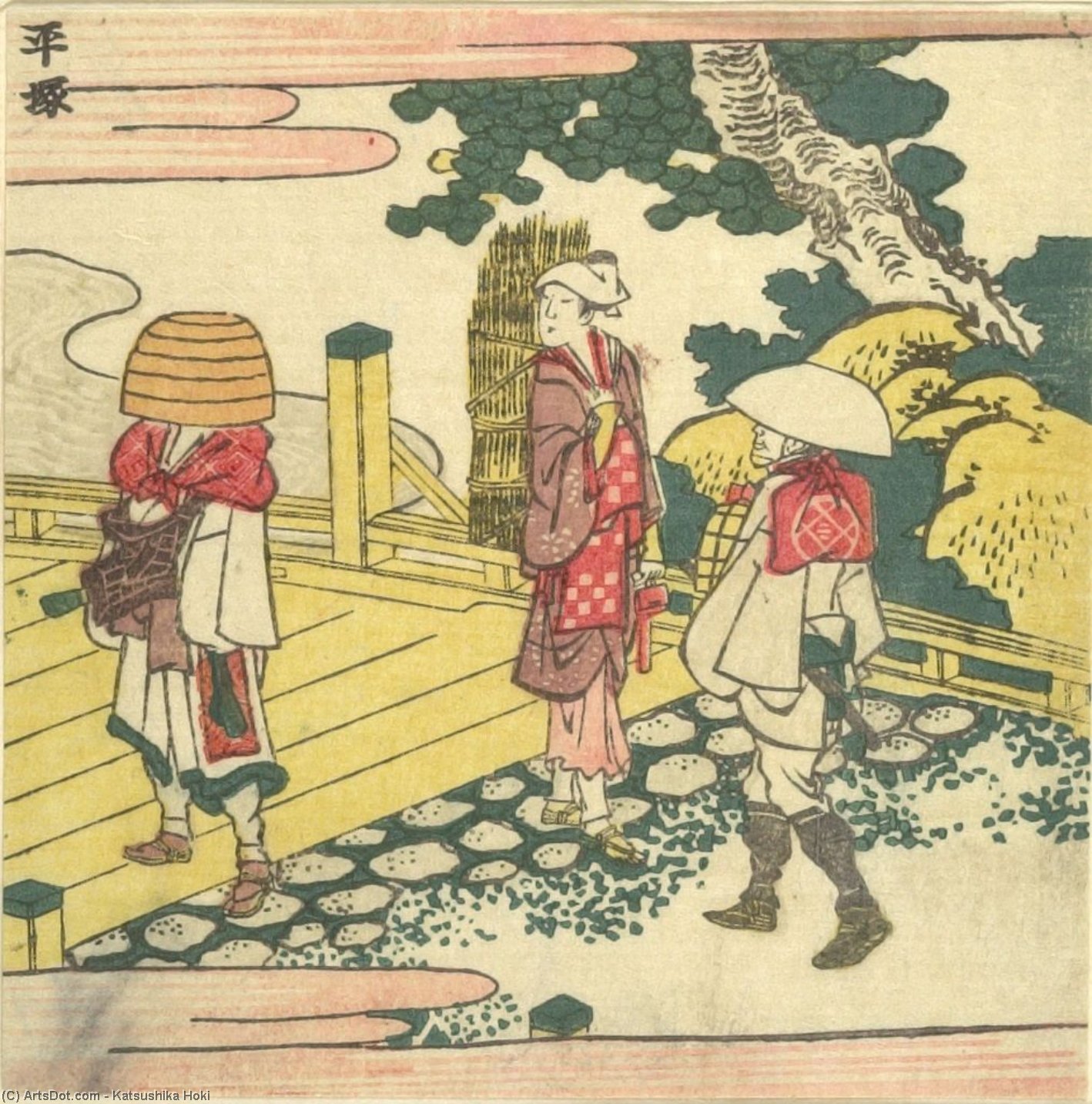
Katsushika Hokusai's "Mendicant and Two Travelers," a captivating woodblock print from the mid-19th century, offers more than just a picturesque scene; it’s a poignant meditation on human connection amidst the vastness of nature. Created during the Edo period, a time of relative peace and burgeoning commercialism in Japan, this artwork embodies the spirit of *ukiyo-e*, or “pictures of the floating world,” a genre renowned for its vibrant depictions of everyday life, landscapes, and popular culture. The print’s enduring appeal lies not only in its exquisite detail but also in its subtle narrative—a quiet story of shared experience and perhaps even a hint of melancholy.

The Composition: A Bridge to Reflection
The scene unfolds on a weathered stone bridge, its uneven surface hinting at the passage of time and countless journeys. Three figures traverse this structure – a man carrying a large sack over his shoulder, a woman with a vibrant red scarf wrapped around her neck, and a younger traveler clutching a smaller bag. Each figure is rendered with remarkable precision, their clothing and postures conveying a sense of purpose and weariness. The placement of the two umbrellas, one positioned centrally and another slightly to the right, adds a layer of visual interest and subtly suggests protection from an unseen storm – perhaps representing the challenges of life’s journey.
Hokusai masterfully employs perspective to draw the viewer into the scene. The bridge recedes into the distance, creating a sense of depth and emphasizing the figures' isolation within the expansive landscape. The background features a stylized depiction of trees, rendered in delicate brushstrokes that evoke both tranquility and a hint of foreboding. The overall composition is balanced yet dynamic, inviting contemplation rather than immediate judgment.
Technique and Style: A Master’s Hand
As a leading figure in *ukiyo-e*, Hokusai was renowned for his innovative use of color and technique. This print showcases his signature approach to woodblock printing – a collaborative process involving the artist, carver, and printer. The colors are rich and vibrant, achieved through the careful application of pigments to the blocks before each print is made. Hokusai’s meticulous attention to detail is evident in the rendering of textures—the rough surface of the bridge, the folds of the clothing, and the delicate branches of the trees.
The use of Prussian blue, a relatively new pigment at the time, is particularly striking. Hokusai was one of the first artists to embrace this color, which he used to create the deep blues of the sky and water in his landscapes. His mastery of *moku-hanga* (woodblock printing) allowed him to achieve remarkable tonal variations and subtle gradations of color – a testament to his artistic skill and experimentation.
Symbolism and Context: Echoes of Edo Japan
“Mendicant and Two Travelers” is deeply rooted in the social and cultural context of Edo-period Japan. The mendicants, or *minyo*, were a common sight in urban areas, often relying on charity for survival. Their presence in the print serves as a reminder of the inequalities inherent in society and the vulnerability of those living on the margins. The travelers themselves could represent any number of individuals—pilgrims seeking enlightenment, merchants embarking on trade expeditions, or simply people searching for new opportunities.
Furthermore, the bridge itself can be interpreted as a symbol of transition – a passage from one state to another, whether it be physical location or spiritual awakening. The umbrellas offer a sense of protection and guidance, suggesting that even in times of uncertainty, there is always hope for finding one’s way.
A Timeless Reflection: The Enduring Power of Hokusai
“Mendicant and Two Travelers” remains a powerful and evocative work of art. Its quiet beauty, combined with its subtle symbolism, continues to resonate with viewers today. Reproductions of this print have graced the walls of museums and private collections around the world, serving as a reminder of Hokusai’s genius and his enduring legacy as one of Japan's greatest artists. Whether displayed in a modern home or a historic setting, this artwork invites us to pause, reflect, and contemplate the shared human experience of travel, resilience, and connection.
Biografia artysty
A Life Etched in Ink: The World of Katsushika Hokusai
Katsushika Hokusai, a name that resonates deeply within the world of art and inextricably linked to the iconic image of *The Great Wave off Kanagawa*, was far more than simply a printmaker. Born in Edo (modern-day Tokyo) around 1760, his life unfolded as an extraordinary journey – a relentless pursuit of artistic mastery, marked by constant evolution, shifting names, and an insatiable curiosity about the world around him. From humble beginnings as the son of a mirror maker, Hokusai’s early inclination towards art wasn't immediately nurtured; yet, he dedicated himself to honing his skills with unwavering determination, reportedly beginning to draw at the tender age of six. This profound commitment would shape a career spanning nearly nine decades, leaving behind a legacy that continues to captivate and inspire audiences globally. His father, Nakajima Ise, though not an artist by trade, recognized and perhaps fostered this nascent talent, providing a foundation upon which Hokusai built his extraordinary artistic empire. Hokusai’s early life wasn't defined by privilege, but rather by a steady climb fueled by ambition and a deep-seated passion to capture the essence of the world in all its fleeting beauty.From Apprenticeship to Innovation: The Blossoming of a Style
Hokusai’s formal artistic training commenced at twelve when he entered the prestigious studio of Katsukawa Shunshō, a leading master of *ukiyo-e* – “pictures of the floating world.” This vibrant genre, flourishing during the Edo period, served as a mirror reflecting the diverse facets of Japanese society: actors performing in Kabuki theaters, courtesans embodying elegance and allure, sweeping landscapes capturing the beauty of nature, and glimpses into the bustling urban culture of Edo. Under Shunshō’s tutelage, Hokusai immersed himself in the intricate techniques of woodblock printing – a demanding process requiring exceptional precision, artistic skill, and an understanding of color theory. However, even within this established framework, Hokusai demonstrated a restless spirit, a desire to transcend mere replication and explore new avenues of expression. From his earliest works, there was evidence of this innate drive—experimentation with different subjects, including book illustrations and single-sheet prints, all meticulously crafted to refine his unique visual language. This period also witnessed the emergence of numerous name changes – a practice common among *ukiyo-e* artists, signifying periods of artistic evolution or affiliations with various schools. Initially, he focused on illustrating books, providing him with invaluable experience in composition and detail, but it was his transition towards single-sheet prints that truly unleashed his creative potential.Mount Fuji and the Floating World: Defining Masterpieces
Hokusai’s artistic output was astonishingly prolific—tens of thousands of woodblock prints, paintings, and illustrated books bear his signature. While he explored a vast array of subjects, it was his series *Thirty-Six Views of Mount Fuji* (circa 1831) that cemented his enduring fame. This monumental collection wasn’t simply a depiction of a landscape; it was a profound exploration of perspective, composition, and the raw power of nature. The central image, *The Great Wave off Kanagawa*, embodies both the breathtaking beauty and terrifying force of the sea—a towering wave poised to engulf tiny fishing boats, a scene that has become one of the most recognizable images in art history. Beyond *Fuji*, works such as *Fireworks at Ryōgoku Bridge* (1790) showcased his remarkable ability to capture dynamic scenes of daily life with an incredible sense of energy and detail. His *Hokusai Manga* – a collection of sketches and studies encompassing people, animals, landscapes, and fantastical creatures—represented a groundbreaking departure from traditional art forms, foreshadowing the development of modern manga as an artistic medium. These works weren’t isolated achievements; they were integral components of a continuous artistic journey, each building upon the last to create a body of work that is both deeply rooted in Japanese tradition and remarkably innovative.The Influence of Europe and the Pursuit of Perfection
As Japan began to open its doors to Western influences in the late 19th century, Hokusai’s work gained international recognition. European artists, particularly Impressionists like Claude Monet and Vincent van Gogh, were profoundly moved by his bold compositions, vibrant colors, and unconventional perspectives. Van Gogh, in particular, was deeply inspired by *The Great Wave*, creating a series of paintings that directly referenced the original woodblock print. Hokusai’s influence extended beyond mere imitation; it permeated various modern art movements, shaping the way artists approached composition, color palettes, and subject matter. His emphasis on capturing fleeting moments, his masterful use of line, and his ability to find beauty in the ordinary resonated with a generation seeking new forms of artistic expression. Furthermore, Hokusai’s relentless pursuit of perfection—a characteristic that fueled much of his prolific output—became increasingly evident as he aged. He famously declared, “At 60, I will paint like a child; at 70, like a fool; and at 80, like a madman.” This philosophy drove him to continually experiment with new techniques and styles throughout his extraordinarily long career.A Legacy of Innovation: Hokusai’s Enduring Impact
Katsushika Hokusai's legacy extends far beyond the confines of Japan. His work continues to be studied, admired, and reproduced worldwide, a testament to his artistic genius and enduring influence. He remains one of the most important figures in Japanese art history, and his innovative approach to *ukiyo-e* fundamentally shaped the genre’s development. His ability to seamlessly blend traditional techniques with contemporary sensibilities, coupled with his profound understanding of human nature and the natural world, ensures that Hokusai's work will continue to captivate audiences for generations to come. His life serves as an inspiring example of dedication, creativity, and a relentless pursuit of artistic excellence.- Major Influences: Ukiyo-e traditions, Chinese landscape painting, everyday life in Edo.
- Key Characteristics: Bold lines, vibrant colors, dynamic compositions, keen observation of nature.

Hokusai Katsushika
1760 - 1849 , Japonia
Kluczowe informacje
- Artistic Movement Or Style: Ukiyo-e
- Artists Or Movements Influenced By This Artist:
- Impresjonizm
- Van Gogh
- Artists Who Influenced This Artist:
- Malbańscy
- Japońskie krajobrazy
- Date Of Birth: 31 października 1760
- Date Of Death: 10 maja 1849
- Full Name: Katsushika Hokusai
- Nationality: Japoński
- Notable Artworks:
- Wysoka fala
- Trzydzieści sześć widoków na górę Fudżi
- Hokusai Manga
- Place Of Birth: Tokio, Japonia
Powiązane artykuły
Tōshūsai Sharaku: A Fleeting Glimpse into Edo Period Kabuki – Life, Art, and the Enigma of a Ukiyo-e Master
Explore the captivating world of Tōshūsai Sharaku, the enigmatic Edo period ukiyo-e master. Discover his iconic Kabuki actor portraits and unravel the mystery behind this fleeting artistic genius. Learn about his unique style & lasting legacy.
Ukiyo-e's Greatest Hits: 10 Masterpieces That Shaped a Movement | OriginalUniqueArt
Journey into Japan's 'Floating World'! Explore 10 Ukiyo-e masterpieces by Hokusai, Hiroshige & more. Discover the stories behind these iconic woodblock prints and bring timeless Japanese art to your home with OriginalUniqueArt.com. Explore the full collection online.
Ukiyo-e: Obrazy Przepływającego Świata – Historia, Techniki i Trwałe Dziedzictwo Japońskiej Sztuki
Poznaj fascynujący świat ukiyo-e – japońskich drzeworytów z okresu Edo. Historia, techniki, artyści i wpływ na sztukę zachodnią. Ekspercka analiza dla miłośników sztuki i kolekcjonerów.
Ukiyo-e's Poetic Visionary: Hiroshige Ando & the Transformation of Landscape in 19th-Century Japan
Explore the life & art of Ando Hiroshige, Japan's last great ukiyo-e master. Discover his iconic landscapes, poetic style, and profound influence on Western Impressionism. Learn about The Fifty-Three Stations & more!
Utagawa Kuniyoshi: A Master of Japanese Ukiyo-e – Narrative Innovation & the Fusion of Tradition with Popular Culture
Explore the captivating world of Utagawa Kuniyoshi, a master of Japanese ukiyo-e woodblock prints. Discover his innovative warrior scenes, vibrant landscapes & lasting legacy in 19th-century art history.