

 Podgląd w skali 1:1
 Wyślij jako kartkę
 Udostępnij
 Szczegóły dzieła
 Przewodnik

 Pobierz obraz
 Podobne obiekty
 RTG
RTG Pokaz slajdów
 Statystyki
El Lissitzky, Dessau


 Rozwiń treść
Dzieło sztuki prezentowane na tej stronie podlega ochronie prawem autorskim, co oznacza, że nie mamy prawa do tworzenia ani sprzedaży jego identycznej reprodukcji. Ochrona ta jest egzekwowana na mocy umów międzynarodowych, takich jak Konwencja berneńska oraz przez przepisy prawa krajowego, w tym te określone w Prawo autorskie USA – Tytuł 17.
Jako pełną szacunku i legalną alternatywę oferujemy personalizowane, malowane ręcznie dzieła sztuki inspirowane oryginałem. Nasi wykwalifikowani i profesjonalni artyści starannie analizują styl, nastrój oraz artystyczną esencję pierwowzoru, aby stworzyć nowe, unikalne dzieło, które przywołuje te same emocje – pozostając jednocześnie w pełni oryginalną kreacją.
Metoda ta jest w pełni zgodna z przepisami prawa autorskiego, ponieważ nie polega na kopiowaniu ani powielaniu chronionego dzieła. Stanowi ona kreatywną reinterpretację – nowy obraz, który czerpie inspirację z oryginału, ale nie jest z nim tożsamy.
Ręcznie malowana reprodukcja olejowa
Ręcznie malowany obraz olejny na płótnie, wykonany na zamówienie przez naszych artystów w wybranym przez Ciebie wymiarze i oprawie. ( Przełącz na wydania drukowane Przejdź do wersji cyfrowej)




P118B zł10

P118H zł10

P118W zł10

P438Z zł10

P508JH zł12

P508YH zł12

P805H zł10

P805Z zł10

P919BZ zł10

P919G zł10

P919XJ zł10

P959ZH zł10

P968JZ zł12

W106C zł8

W218G zł10

W218JH zł8

W218Y zł10

W307PJ zł10

W316G zł10

W316PJ zł8

W316Y zł10

W398PJ zł8

W4111J zł10

W500HY zł15

W500JH zł15

W692G zł12

W849H zł8

W940BG zł15

W953PJ zł8




Wybierz spośród naszych standardowych rozmiarów, które zachowują oryginalne proporcje dzieła sztuki.

Wpisz wymaganą szerokość i wysokość, aby obraz pasował do Twojej ramy lub ściany. Ponieważ jest to dzieło malowane ręcznie, w przypadku rozmiaru o innych proporcjach artysta może domalować nieco więcej wokół obrazu lub przyciąć jego fragmenty — wybór należy do Ciebie. Przed rozpoczęciem pracy prześlemy Ci cyfrową wizualizację do zatwierdzenia. Obraz widoczny na tej stronie nie przedstawia rzeczywistego efektu — jedynie wizualizacja oddaje realny rezultat.
Po złożeniu zamówienia zespół OriginalUniqueArt.com skontaktuje się z klientem drogą mailową w celu uzyskania instrukcji i prześle wizualizację projektu
Dostawa na całym świecie () w ciągu 3–4 tygodni zamiast standardowych 5 tygodni. (28 Październik). Bez kompromisów w kwestii jakości.

Bezpłatna ekspresowa wysyłka na cały świat

Wysokiej jakości płótno lniane

Pełne ubezpieczenie przesyłki

Gwarancja zwrotu należności celnych i podatków importowych

Gwarancja wiernego odwzorowania kolorów

100-dniowa polityka zwrotów (tylko w przypadku wad)

Gwarancja 100% zwrotu pieniędzy

Zniżka przy zakupie wielu sztuk
 Opcja ze szkłem jest dostępna wyłącznie w rozmiarach poniżej 110 cm

El Lissitzky, Dessau
Technika reprodukcji
Wymiary reprodukcji
-


Cena całkowita
zł 1249
El Lissitzky, Dessau: A Dialogue of Form and Function
The photograph presented here – “El Lissitzky, Dessau” – isn’t merely a portrait; it's a carefully constructed distillation of the spirit of early 20th-century artistic experimentation. Captured around 1930-1932 by Josef Albers, this image offers a glimpse into the world of El Lissitzky, a pivotal figure in the Russian avant-garde who bridged the gap between Suprematism and Constructivism. It’s a document of a man grappling with the fundamental questions of form, space, and communication – concerns that resonate powerfully even today.
Lissitzky, a visionary designer and artist, was deeply influenced by Malevich's radical exploration of pure geometric abstraction. However, Lissitzky moved beyond purely formal exercises, recognizing the potential of art to serve practical purposes—designing exhibition spaces, propaganda posters, and even furniture. Albers’ photograph captures this duality: Lissitzky is both an intellectual explorer and a craftsman, his gaze suggesting a thoughtful engagement with the world around him. The composition itself – two square portraits side-by-side – immediately evokes the principles of Constructivism, emphasizing clarity, order, and geometric relationships. The stark contrast between the black and white tones further amplifies this sense of precision and intellectual rigor.
A Study in Light, Line, and Gesture
Albers’ technical mastery is evident in every detail. The photograph utilizes a classic gelatin silver print process, resulting in a rich tonal range that subtly defines Lissitzky's features. The lighting is soft and diffused, minimizing harsh shadows and allowing the textures of his clothing – a crisp white shirt and dark tie – to emerge with clarity. Notice how Albers has employed fine lines to delineate the contours of Lissitzky’s face, capturing not just his likeness but also the subtle gestures that convey his personality. The sharp edges of the portraits create a sense of immediacy, drawing the viewer into the scene.
The photograph's composition is deceptively simple. The two square images are arranged symmetrically within a rectangular frame, creating a balanced and harmonious visual experience. However, this apparent simplicity belies a deeper level of intentionality. Lissitzky’s profile view – a pose that suggests contemplation or perhaps even conversation – contrasts sharply with his frontal portrait, offering a dynamic interplay between stillness and movement. The subtle smile in the first image hints at an approachable nature, while the profile invites introspection.
Historical Context: Bauhaus and Beyond
To fully appreciate “El Lissitzky, Dessau,” it’s crucial to understand its historical context. Albers himself was a key figure at the Bauhaus school in Germany, where he developed his groundbreaking theories of color interaction and geometric abstraction. The Bauhaus sought to unify art, craft, and technology, believing that design could improve people's lives. Lissitzky, who spent time at the Bauhaus before emigrating to Russia, carried these principles with him, influencing his work as a designer and artist.
Following the Russian Revolution, Lissitzky became involved in creating propaganda for the new Soviet state. He designed posters, book layouts, and exhibition spaces—all aimed at promoting socialist ideals through innovative visual communication. His work reflected the dynamism and optimism of the era, but also the challenges of building a new society from scratch. The photograph captures a moment of quiet reflection amidst this period of intense social and political change.
Symbolism and Emotional Resonance
Beyond its technical merits, “El Lissitzky, Dessau” possesses a subtle symbolic power. The geometric composition—the squares, the lines—represents the rational order that Lissitzky sought to impose on the world. The portrait itself can be interpreted as an exploration of identity and representation – how we perceive ourselves and how others perceive us. Lissitzky’s gaze is direct and unwavering, suggesting a confidence in his own vision.
Ultimately, this photograph transcends its documentary value. It's a testament to the power of art to capture not just appearances but also ideas, emotions, and historical moments. It invites viewers to contemplate the relationship between form and function, intellect and emotion, and the enduring legacy of El Lissitzky’s artistic vision.
Pytania i odpowiedzi
Do jakiego nurtu w sztuce należy „El Lissitzky, Dessau” – Józef Albers?
Nurt związany z „El Lissitzky, Dessau” – Józef Albers to Constructivism. Ta klasyfikacja sytuuje dzieło wśród pokrewnych artystów i dzieł sztuki.
Czy „El Lissitzky, Dessau” – Józef Albers to jasne czy ciemne dzieło?
Ogólnie rzecz biorąc, poziom jasności dzieła „El Lissitzky, Dessau” określany jest jako brilliant. Postrzegana jasność opisuje, jak jasne lub ciemne wydaje się dane dzieło.
Kto stworzył "El Lissitzky, Dessau"?
„El Lissitzky, Dessau” zostało stworzone przez Józef Albers. Informacje na tej stronie dotyczą oryginalnego dzieła autorstwa Józef Albers.
Biografia artysty
A Life Forged in Material: The Early Years and Bauhaus Formation
Josef Albers’s artistic journey began not amidst the rarefied air of established academies, but within the pragmatic world of his father’s contracting business in Bottrop, Germany. Born in 1888, young Josef absorbed a deep respect for materials – carpentry, plumbing, house-painting – skills that would fundamentally shape his aesthetic sensibility. This wasn't merely vocational training; it was an immersion into the very essence of making, understanding how forms materialized and the inherent qualities within each medium. He spent his childhood observing his father’s meticulous craft, learning to appreciate the subtle nuances of wood grain, the precise application of paint, and the satisfying solidity of construction. Before dedicating himself fully to art, Albers spent five years as a schoolteacher, honing patience and pedagogical skill—attributes that would later define his influential teaching career. Formal artistic training commenced at the Königliche Kunstschule in Berlin between 1913 and 1915, where he explored printmaking, painting, and, crucially, stained glass. His early commission, “Rosa Mystica Ora Pro Nobis” (1918), a stunning stained-glass window for a local church, foreshadowed his lifelong fascination with the interplay of light and color, hinting at the abstract explorations to come. This initial work wasn’t simply decorative; it was an investigation into how light *transformed* material, a theme that would resonate throughout his career. The experience instilled in him a profound understanding of materials – their textures, weights, and how they responded to light – which would become central to his later artistic practice.The Bauhaus Crucible: Color as Subject
A pivotal moment arrived in 1922 when Albers joined the faculty of the Bauhaus, a revolutionary school seeking to unify all artistic disciplines under Walter Gropius’s visionary leadership. Initially tasked with teaching the preliminary course – *Werklehre* (workshop practice) – he immersed himself in its core principles: functionalism, geometric abstraction, and material exploration. This period proved transformative. Albers began a systematic investigation into color perception, moving away from representational art towards an increasingly abstract vocabulary. He wasn’t interested merely in *what* colors were, but *how* they interacted, how they influenced each other, and how our eyes perceived them. The influence of fellow Bauhaus masters like Paul Klee and Wassily Kandinsky is discernible in his early work, yet Albers charted a unique course, prioritizing empirical observation over metaphysical interpretation. He wasn’t seeking spiritual truths through color; he was meticulously documenting its physical effects – a scientific rigor that became the hallmark of his artistic method. This focus on perception, on how we *see*, rather than what is *seen*, set him apart and laid the groundwork for his future explorations. The Bauhaus environment fostered experimentation with unconventional materials—wire netting, matchboxes, glass shards—pushing Albers to consider the inherent qualities of each medium and their potential for artistic expression.Homage to the Square: A Laboratory of Perception
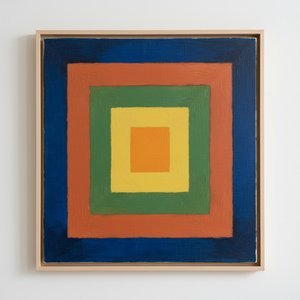
Following a period teaching at Black Mountain College – where he fostered a generation of American artists including Robert Rauschenberg and Cy Twombly – Albers embarked on what would become his most iconic series in 1949: “Homage to the Square.” This ongoing project consisted of paintings featuring nested squares within squares, each iteration exploring subtle variations in color relationships. It’s a deceptively simple premise, but one that belies an incredibly complex and rigorous investigation. Albers meticulously documented his experiments, revealing how colors aren't static entities but dynamic forces governing each other through internal logic – often misleading to the eye. A seemingly brighter square might appear to recede while a darker one advances, defying intuitive understanding. The series wasn’t intended as a celebration of geometry; rather, it was a laboratory for studying color perception. Albers’s goal was not to create beautiful pictures but to reveal the underlying mechanisms of visual experience. This research culminated in his seminal book, “Interaction of Color” (1963), a foundational text still studied by artists and designers today. The book isn't a treatise on color theory; it's a series of exercises designed to demonstrate how our perception of color is relative and contextual – a testament to Albers’ belief that seeing is not passive, but an active process of interpretation.Legacy and Enduring Influence
Josef Albers’s impact extends far beyond his paintings. His tenure as head of the design department at Yale University, from 1950 until his retirement in 1958, cemented his reputation as a profoundly influential teacher. He emphasized hands-on experimentation, critical observation, and relentless questioning of assumptions. Students weren't simply taught *what* to paint; they were taught *how* to see – to analyze, to deconstruct, and to understand the underlying principles governing visual experience. Albers’s approach fostered independent thinking and encouraged students to develop their own unique artistic voices. Interaction of Color continues to be a cornerstone of art education, shaping how generations understand color relationships. Albers is now recognized as a key figure in the development of abstract art, particularly geometric abstraction and minimalist aesthetics. His “Homage to the Square” series remains iconic for its exploration of perceptual phenomena, demonstrating that even within seemingly simple forms, there exists an infinite complexity waiting to be discovered. He died on March 25, 1976, in New Haven, Connecticut, leaving behind a legacy that continues to inspire and challenge artists, designers, and educators alike – a testament to the power of observation, experimentation, and the enduring mystery of color.Notable Works
- Gray Instrumentation I Prospectus (1975): A minimalist monochrome painting exemplifying geometric balance and subtle tonal variations.
- Study for Homage to the Square – Beaming (Date Unknown): A classic example of Albers’s exploration of color interaction within nested squares, evoking a sense of calm and spatial depth.
- Rosa Mystica Ora Pro Nobis (1918): His early stained-glass commission, foreshadowing his lifelong fascination with light and color.

Józef Albers
1888 - 1976 , Niemcy
Krótka nota
- Artistic Movement Or Style: Abstrakcja geometryczna
- Artists Or Movements Influenced By This Artist:
- Minimalizm
- Pola Koloru
- Artists Who Influenced This Artist:
- Paul Klee
- Wassily Kandinsky
- Date Of Birth: 19 marca 1888
- Date Of Death: 25 marca 1976
- Full Name: Josef Albers
- Nationality: Niemiecko-Amerykanin
- Notable Artworks:
- Homage do Kwadratu
- Interakcja Kolorów
- Place Of Birth: Bottrop, Niemcy
Powiązane artykuły

Monochromatyczne Wizje: Estetyka i Historyczne Znaczenie Fotografii Czarno-Białej
Odkryj fascynujący świat fotografii czarno-białej! Poznaj historię, techniki i arcydzieła monochromatycznej sztuki. Inspiracje, porady i analiza wpływu na współczesną estetykę. OriginalUniqueArt.com.
Josef Albers: A Homage to Color Interaction & the Foundations of Visual Perception
Explore Josef Albers's groundbreaking color theory & the 'Homage to the Square' series. Discover how his work revolutionized visual perception and influenced modern art movements like Minimalism & Op Art. Learn about his Bauhaus roots & lasting legacy.

Beyond the Lens: Photography's Enduring Influence on Modern & Contemporary Art
Explore photography's pivotal role in shaping modern & contemporary art. Discover key movements, influential artists like Stieglitz, and expert collecting advice from OriginalUniqueArt.

El Greco: 25 Arcydzieł Genialnego Malarza – Kolekcja dla Koneserów Sztuki i Wystroju Domu
Odkryj 25 arcydzieł El Greco – mistrza renesansu i manieryzmu. Poznaj historie, techniki i duchowość w jego obrazach. Reprodukcje najwyższej jakości na OriginalUniqueArt.com. Inspiracje do wnętrz i kolekcja sztuki online!

Piktorializm w Polsce: Poszukiwanie Duszy Fotografii i Estetyki Malarskiej
Poznaj historię piktorializmu w Polsce – nurtu fotografii artystycznej dążącego do estetyki malarskiej. Odkryj kluczowe postacie, techniki i wpływ na polską sztukę. Ekspercka analiza i fascynujące fakty!