Przełącz na wydania drukowane
 Rozwiń treść







































 W przypadku dzieł sztuki lub reprodukcji, których którykolwiek z boków przekracza 105 cm (około 41 cali), rama zostanie wysłana w formie zestawu do samodzielnego montażu. Metoda ta zapewnia bezpieczną dostawę i zapobiega uszkodzeniom podczas transportu.


Joos de Momper’s Alpine Majesty: A Window into the Flemish Baroque
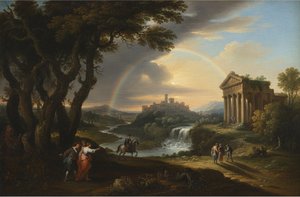
The world of Joos de Momper the Younger, often overshadowed by his more flamboyant contemporaries like Brueghel and Rubens, reveals itself through works like “Landscape with a Road Leading Towards a Settlement on a Hill,” a captivating example of early 17th-century Flemish landscape painting. More than simply a depiction of scenery, this piece is a carefully constructed illusion—a meticulously rendered panorama designed to evoke both the grandeur of nature and a subtle sense of human presence within it. De Momper’s genius lies not in hyperrealism, but in his masterful manipulation of perspective, light, and color to create an atmosphere of serene contemplation and distant drama.
Born in Antwerp in 1564 into a family steeped in artistic tradition—his grandfather a landscape painter himself—de Momper inherited a deep understanding of visual representation. He quickly established himself as a skilled artist, gaining recognition at a remarkably young age for his ability to capture the essence of mountainous regions, drawing inspiration from his travels through the Alps and Italy. Unlike many of his peers who focused on bustling village scenes or dramatic storms, de Momper favored quieter, more contemplative landscapes—a deliberate choice that reflects a shift in artistic sensibilities towards a greater appreciation for the sublime beauty of nature.
A Symphony of Light and Shadow: Technique and Composition
The painting’s strength resides in its sophisticated technique. De Momper employs a layered approach, beginning with a detailed pen-and-ink underdrawing that establishes the basic structure of the composition. This is then built upon with washes of blue, brown, and red watercolor—a palette carefully chosen to mimic the muted tones of a distant mountain range. Notice how he utilizes *hatching* – closely spaced parallel lines – to create texture and depth in the trees and rocks, while broader strokes suggest the vastness of the sky. The use of *atmospheric perspective*, where objects recede into the distance appearing paler and less distinct, is particularly effective in conveying the immense scale of the landscape.
The composition itself is carefully balanced. A winding road snakes its way through the scene, drawing the viewer’s eye towards a small settlement nestled amongst the hills. The placement of figures—a shepherd tending his flock, a ploughman working the land, and a fisherman casting his line—adds a subtle layer of human activity without disrupting the overall sense of tranquility. These figures are rendered with minimal detail, almost as if they are merely fleeting glimpses into a timeless scene.
Symbolism and the Pursuit of the Sublime
Beyond its technical brilliance, “Landscape with a Road Leading Towards a Settlement on a Hill” is rich in symbolic meaning. The towering mountains evoke a sense of awe and humility—a reminder of humanity’s place within the vastness of nature. The inclusion of figures engaged in simple, everyday tasks suggests a harmony between humans and their environment. The painting can be interpreted as an allegory for the pursuit of *the sublime* – that feeling of wonder and reverence experienced when confronted with something grand and overwhelming. It's a concept central to Baroque art, emphasizing the power and majesty of God’s creation.
Interestingly, de Momper’s work aligns with the broader artistic trends of his time—a transition from the Mannerist style of the late 16th century towards a greater emphasis on realism and naturalism. Yet, he retains a distinctly Baroque sensibility through his masterful use of light, shadow, and dramatic composition. The painting's influence can be seen in works by later landscape painters who sought to capture the beauty and grandeur of the natural world.
A Timeless Vision: Emotional Impact and Reproduction
“Landscape with a Road Leading Towards a Settlement on a Hill” is more than just a pretty picture; it’s an invitation to escape—to lose oneself in the tranquility of the mountains and contemplate the beauty of the natural world. The painting's muted colors, balanced composition, and subtle symbolism create a sense of peace and serenity that continues to resonate with viewers today. A high-quality reproduction captures much of this atmosphere, offering a window into a bygone era and a testament to de Momper’s artistic skill.
OriginalUniqueArt offers meticulously crafted reproductions of this masterpiece, ensuring that you can bring the beauty of de Momper's landscape into your home or office. Each reproduction is printed on archival-quality canvas using giclee printing technology, guaranteeing long-lasting color and detail. Consider it a timeless addition to any collection—a reminder of the enduring power of art to inspire and uplift.
Pytania i odpowiedzi
Kto jest autorem dzieła "Landscape"?
Autorstwo dzieła "Landscape" przypisuje się Joos de Momper.
Co łączy "Landscape" z resztą twórczości Joos de Momper?
"Landscape" dzieli z innymi dziełami Joos de Momper styl właściwy dla Flemish Baroque oraz powracające motywy: brueghel’s alpine landscapes, flemish tradition, religious piety, moralizing scenes, political allegories, courtly life, transition mannerism, early realism.
Do jakiego nurtu i epoki zalicza się „Landscape” – Joos de Momper?
W „Landscape” – Joos de Momper nurt Flemish Baroque łączy się z epoką Renesans.
 Podgląd w skali 1:1
 Wyślij jako kartkę
 Udostępnij
 Szczegóły dzieła
 Przewodnik

 Pobierz obraz
 Podobne obiekty
 RTG
RTG Pokaz slajdów
 Pytania i odpowiedzi
 Statystyki