Neoclassicism · 1788
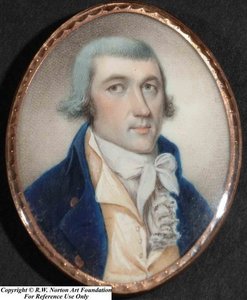
James Bleecker (Jan Ramage, 1788)
Jan Ramage (1748–1802) stworzył James Bleecker. Dzieło pochodzi z 1788. Należy do nurtu Neoclassicism. Wykonano w technice Oil. Przechowywane jest w Metropolitan Museum of Art w Nowy Jork, Stany Zjednoczone Ameryki.

 Podgląd w skali 1:1

 Ręcznie malowany obraz olejny
 Wyślij jako kartkę
 Udostępnij
 Przewodnik


 Pobierz obraz
 Podobne obiekty
 RTG
 Pokaz slajdów
 Pytania i odpowiedzi

 Statystyki
James Bleecker: najważniejsze informacje
- Tytuł
- James Bleecker
- Artysta
- Jan Ramage (1748–1802)
- Miejsce urodzenia artysty
- Dublin, Irlandia
- Data powstania
- 1788
- Technika wykonania
- Oil
- Gdzie można je zobaczyć
- Metropolitan Museum of Art, Nowy Jork, Stany Zjednoczone Ameryki
- Ruch
- Neoclassicism
- Epoka
- Early Modern
- Temat
- man, portrait, cravat, waistcoat, coat, hair
Co przedstawia James Bleecker?
A Portrait of James Bleecker
This monochromatic portrait depicts James Bleecker, a gentleman from the late 18th century. The subject is presented in a formal, seated bust-length depiction, captured within an oval frame. He is positioned slightly off-center to the right, creating a balanced asymmetry. His attire, which includes a cravat, waistcoat, and coat, serves as an indication of his social status. The composition focuses attention solely on his likeness, isolating him from any background context.
The image is rendered in shades of gray, ranging from light to dark. Fine lines are used extensively to define the texture of Bleecker’s hair and clothing, while curved lines outline the oval frame and the contours of his face and neck. Straight lines appear in the details of his waistcoat and cravat. The lighting is diffused and even, creating subtle gradations across his face and clothing, with a gentle highlight on his forehead and nose.
Technical Details and Composition
The artwork is a photograph of an original painting by John Ramage from 1788. The original technique likely involved oil paints applied to canvas or panel. The visual elements include:
The perspective is relatively flat, typical of the period, with minimal depth perception. Depth is achieved through subtle tonal variations and the overlapping of elements, such as the waistcoat partially covering the shirt. The subject's expression is dignified, conveying a sense of seriousness and respectability.
W którym muzeum znajduje się James Bleecker?
Metropolitan Museum of Art
Nowy Jork, Stany Zjednoczone Ameryki
Początki i historia Metropolitan Museum of Art Historia Metropolitan Museum of Art bierze swój początek w wizji podzielanej przez grupę przedsiębiorców, finansistów oraz czołowych artystów i myślicieli. Po oficjalnym zarejestrowaniu instytucji w 1870 roku, zaczęła ona poszukiwać stałego miejsca, które mogłoby pomieścić jej stale powiększające się zbiory. Zanim muzeum osiadło w swojej obecnej lokalizacji, przez krótki czas mieściło się w posiadłości Douglas Mansion przy West 14th Street.


James Bleecker w wysokiej rozdzielczości

Domena publiczna: artysta zmarł w 1802.
Więcej rozmiarów, kadrowania i cytowań →Jan Ramage, James Bleecker (1788), Metropolitan Museum of Art. Domena publiczna
Ekspert ds. cyfrowych weryfikuje kolory względem oryginału i retuszuje plik, zachowując wierność pociągnięciom pędzla artysty.
Kup obraz w wysokiej rozdzielczościPytania o James Bleecker
Jakie miejsce w historii sztuki zajmuje „James Bleecker” – Jan Ramage?
„James Bleecker” – Jan Ramage należy do nurtu Neoclassicism, przypadającego na okres Early Modern. Razem nadają one dziełu jego miejsce w historii sztuki.
W jaki sposób kontrast i harmonia łączą się w "James Bleecker"?
W "James Bleecker" Statement kontrast łączy się z Unified Palette harmonią.
Jak intensywne są kolory w „James Bleecker” – Jan Ramage?
„James Bleecker” – Jan Ramage charakteryzuje się Monochromatic intensywnością kolorów.
Jak duży jest kontrast w „James Bleecker” – Jan Ramage?
Poziom kontrastu dzieła „James Bleecker” – Jan Ramage wynosi Statement.
Ile lat miał Jan Ramage, gdy powstało dzieło „James Bleecker”?
Jan Ramage miał 40 lat w momencie powstania „James Bleecker” w 1788. Wiek ten obliczono na podstawie roku urodzenia artysty, 1748.
W którym roku powstało „James Bleecker” – Jan Ramage?
„James Bleecker” – Jan Ramage powstało w 1788.
Kto jest autorem dzieła "James Bleecker" i do jakiego nurtu ono należy?
"James Bleecker" powstało autorstwa Jan Ramage w stylu Neoclassicism. Artysta oraz nurt definiują tradycję tego dzieła.
Czy kolory w „James Bleecker” – Jan Ramage są nasycone, czy stonowane?
Paleta dzieła "James Bleecker" charakteryzuje się Muted nasyceniem kolorów.
Co przedstawia „James Bleecker” – Jan Ramage?
Tematyka obecna w „James Bleecker” – Jan Ramage obejmuje man, portrait, cravat, waistcoat, coat, hair, oval frame. Razem stanowią one podsumowanie tematyki dzieła.
O artyście: Jan Ramage
1748–1802, Irlandia
Jan Ramage
A Life Bridging Worlds: The Story of John Ramage Born in Dublin, Ireland, in 1748, John Ramage’s life was one of remarkable transition and artistic dedication, a journey that carried him from the refined world of Irish goldsmithing to the burgeoning art scene of colonial America. Details surrounding his early family life remain elusive, yet it is known he received formal training at the Dublin Society of Artists in 1763, laying a foundation in drawing and painting techniques that would serve as the bedrock for his future endeavors. Ramage’s initial career path was notably versatile; he skillfully combined the precision of a goldsmith with the delicate artistry of a miniaturist—a testament to his inherent talent for detail and decorative arts. This early period instilled within him not only technical proficiency but also an appreciation for craftsmanship that would distinguish his work throughout his life.
 Gilbert Van Cortlandt1785
 Governor George Clinton1785
 Major Greene, B.A1777
 Portrait of a Gentleman1780
