Przełącz na wydania drukowane
 Rozwiń treść







































 W przypadku dzieł sztuki lub reprodukcji, których którykolwiek z boków przekracza 105 cm (około 41 cali), rama zostanie wysłana w formie zestawu do samodzielnego montażu. Metoda ta zapewnia bezpieczną dostawę i zapobiega uszkodzeniom podczas transportu.


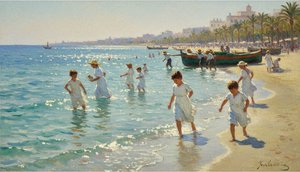
A Vision of Tranquility: The Valencian Fisherman
Joaquin Sorolla’s “Valencian Fisherman” isn't merely a painting; it’s an immersion into the very soul of Spain, captured in a single, shimmering moment. Painted in 1895, this remarkable work transports us to the shores of Valencia – a place where the Mediterranean sun dances on the water and time seems to slow its relentless pace. Sorolla's genius lies not just in his technical skill, but in his ability to evoke a profound sense of serenity, inviting viewers into a world brimming with warmth, light, and quiet contemplation.
Impressionism Rooted in Spanish Light
Sorolla was a pivotal figure within the burgeoning Spanish Impressionist movement. While deeply influenced by masters like Claude Monet and Pierre-Auguste Renoir – particularly their exploration of fleeting moments and broken color – he infused his work with something uniquely Spanish: an almost obsessive devotion to capturing the intense, vibrant light and warmth characteristic of the Mediterranean coast. Unlike his French counterparts who often sought dramatic effects, Sorolla focused on the subtle nuances of light reflecting off water, stone, and human form. His technique is instantly recognizable: loose, expressive brushstrokes applied with remarkable speed, creating a sense of movement and immediacy that feels almost palpable. The paint itself seems to shimmer and dance on the canvas – a testament to his mastery of color and texture.
Symbolism Woven into the Scene
The painting’s composition is rich with symbolic meaning, elevating it beyond a simple depiction of a fisherman's daily life. The solitary figure, rendered in meticulous detail, represents not just a profession – fishing was vital to Valencian society – but also the dignity of labor and the quiet contemplation that can be found in even the most humble tasks. Observe his posture: slightly bent, gazing downwards towards the water. This isn’t simply a pose; it's an embodiment of reflection, a moment of connection with nature and perhaps, a silent acknowledgment of life’s transient beauty. The gentle waves, the bright sky, and the distant boats contribute to an overall feeling of harmony and balance – a carefully orchestrated tableau that speaks volumes about the relationship between humanity and the natural world. The inclusion of the fishing nets and creel subtly references this vital connection.
A Legacy of Light and Movement
"Valencian Fisherman" is a testament to Sorolla’s extraordinary ability to capture the ephemeral beauty of light, a skill that cemented his place as one of Spain's most celebrated artists. It exemplifies his dedication to portraying the effects of sunlight on surfaces – the way it reflects off water, illuminates skin tones, and creates dramatic contrasts between light and shadow. This painting secured Sorolla’s place as one of Spain's most celebrated artists, influencing generations of painters with its luminous quality and evocative power. Today, reproductions like those offered by OriginalUniqueArt.com allow art lovers to experience the magic of Sorolla’s vision in their own homes – bringing a touch of Spanish sunshine and tranquility into any space.
- Artist: Joaquín Sorolla y Bastida
- Date: 1895
- Medium: Oil on Canvas
- Style: Impressionism, Spanish Painting
Pytania i odpowiedzi
Któremu artyście przypisuje się "Rybałowie Walencja"?
Autorstwo dzieła "Rybałowie Walencja" przypisuje się Joaquín Sorolla.
Czy dostępny jest plik do pobrania w wysokiej rozdzielczości dla "Rybałowie Walencja"?
„Rybałowie Walencja” jest dostępny jako wysokiej rozdzielczości cyfrowe zdjęcie do pobrania; można go nabyć bezpośrednio na stronie Cyfrowy obraz.
Do jakiego etapu kariery Joaquín Sorolla odpowiada data powstania dzieła „Rybałowie Walencja” (1916)?
Data powstania dzieła (1916) sytuuje "Rybałowie Walencja" w Mature Period rozwoju twórczości Joaquín Sorolla.
 Podgląd w skali 1:1
 Wyślij jako kartkę
 Udostępnij
 Szczegóły dzieła
 Przewodnik

 Pobierz obraz
 Podobne obiekty
 RTG
RTG Pokaz slajdów
 Pytania i odpowiedzi
 Statystyki