 Zobacz w skali 1:1
 Wyślij
 Udostępnij
 Szczegóły
 Przewodnik

 Pobierz plik obrazu
 Podobne obiekty
 RTG
RTG Pokaz slajdów
 Statystyki
Pygmalion and Galatea (study)


 Czytaj więcej
Giclée / Wydruk artystyczny
Wydruki giclée lub płótna o jakości muzealnej, szybka realizacja i szeroki wybór opcji wykończenia. ( Kup ręcznie malowany obraz Przełącz na wersję cyfrową)




P118B zł10

P118H zł10

P118W zł10

P438Z zł10

P508JH zł12

P508YH zł12

P805H zł10

P805Z zł10

P919BZ zł10

P919G zł10

P919XJ zł10

P959ZH zł10

P968JZ zł12

W106C zł8

W218G zł10

W218JH zł8

W218Y zł10

W307PJ zł10

W316G zł10

W316PJ zł8

W316Y zł10

W398PJ zł8

W4111J zł10

W500HY zł15

W500JH zł15

W692G zł12

W849H zł8

W940BG zł15

W953PJ zł8




Wybierz spośród naszych standardowych rozmiarów, które zachowują oryginalne proporcje dzieła sztuki.

Wpisz wymaganą szerokość i wysokość, aby dopasować grafikę do ramy lub ściany. Wydruk można jedynie przyciąć, nigdy nie powiększając go poza oryginalny obraz, dlatego format o innym proporcji spowoduje utratę części kompozycji. Przed rozpoczęciem druku prześlemy Ci cyfrowy podgląd do zatwierdzenia. Obraz wyświetlany na tej stronie nie pokazuje rzeczywistego przycięcia — jedynie podgląd oddaje ten efekt.
Dostawa na cały świat () w ciągu 2 tygodni zamiast standardowych 4/5 tygodni. (22 Październik)

Bezpłatna ekspresowa wysyłka na cały świat

Wysokiej jakości płótno lniane

Pełne ubezpieczenie transportowe

Gwarancja zwrotu należności celnych i podatków importowych

Gwarancja idealnego odwzorowania barw

100-dniowy okres na zwrot dzieła w przypadku wykrycia wad produkcyjnych

Gwarancja 100% zwrotu pieniędzy

Oferta przy zakupie wielu sztuk
 Opcja ze szkłem jest dostępna wyłącznie w rozmiarach poniżej 110 cm

Pygmalion and Galatea (study)
Giclée / Wydruk artystyczny
Rozmiar reprodukcji
-


Suma do zapłaty
zł 307
A Moment Frozen in Marble and Desire: Jean-Léon Gérôme’s *Pygmalion and Galatea (Study)*
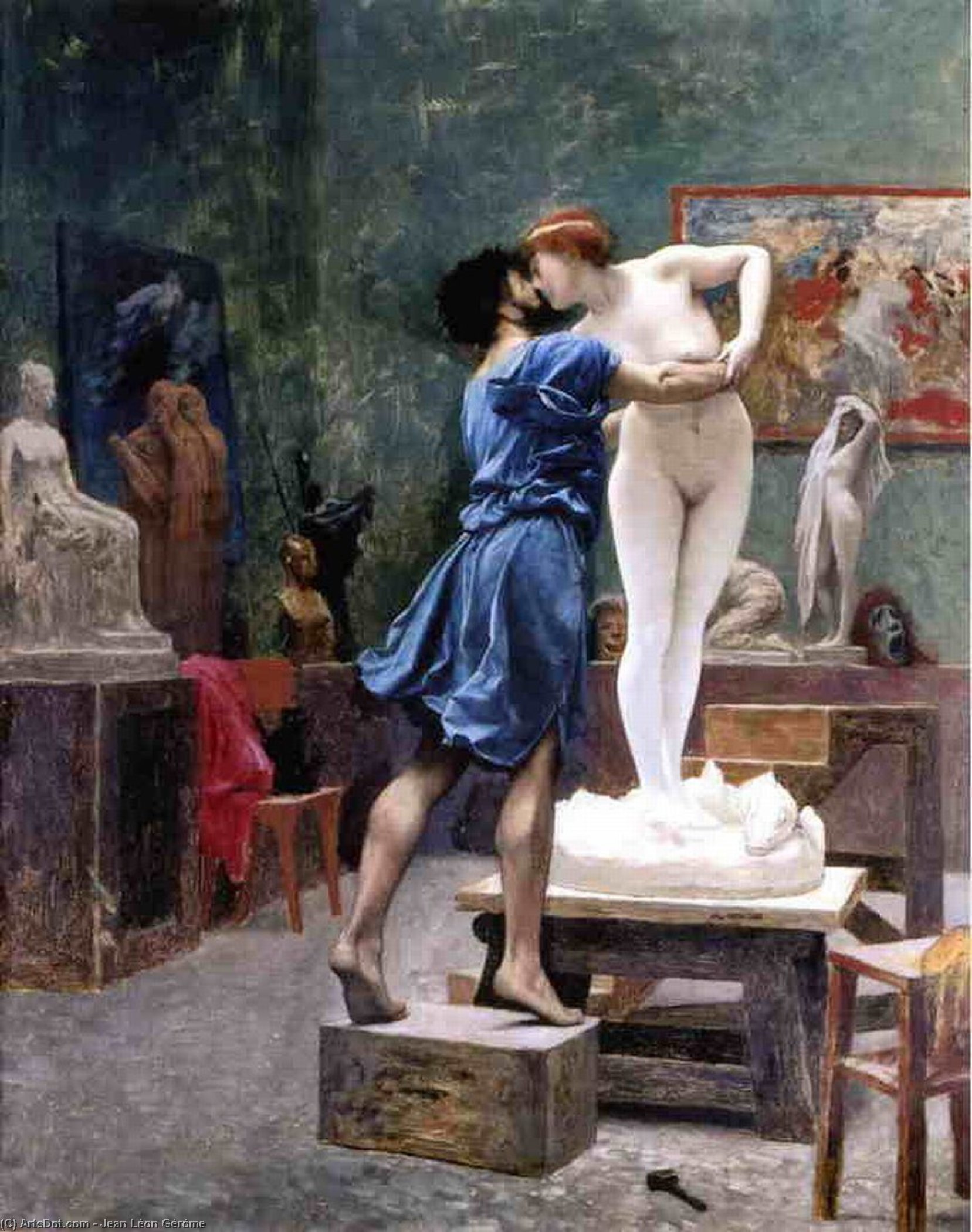
Jean-Léon Gérôme's *Pygmalion and Galatea (Study)*, painted in 1890, isn’t merely a depiction of a classical myth; it’s an exquisitely rendered tableau of longing, creation, and the potent magic of transformation. This intimate study, measuring a modest 94 x 74 cm, offers a rare glimpse into Gérôme's meticulous process – a testament to his dedication to capturing not just the likeness of figures but also the very essence of their emotions. The painting immediately draws the viewer in with its carefully orchestrated composition: a man, presumably Pygmalion himself, kneeling before a statue of Galatea, poised on a simple stool, and initiating a tender kiss. The scene unfolds within a studio setting, subtly suggesting the artist’s own fascination with the act of artistic creation and the blurring lines between reality and imagination.
The Narrative of Myth and Mastery
The story behind *Pygmalion and Galatea* is one of enduring appeal – a tale of a sculptor who, captivated by his own artistry, breathes life into a marble figure. Gérôme masterfully translates this narrative onto canvas, capturing the pivotal moment when Galatea awakens to Pygmalion’s touch. The painting avoids grand theatricality, instead favoring a quiet intimacy that underscores the profound emotional shift occurring within the scene. Gérôme's skill lies not just in his ability to accurately portray the human form – evident in the delicate musculature of Pygmalion and the graceful curve of Galatea’s pose – but also in his capacity to imbue these figures with a palpable sense of vulnerability and nascent joy. The inclusion of the simple chair and table, along with the vase, adds layers of realism and anchors the fantastical narrative within a believable domestic setting.
Technique and the Language of Detail
Gérôme was renowned for his painstaking attention to detail, a hallmark of the academic style he championed. *Pygmalion and Galatea (Study)* exemplifies this approach perfectly. Executed in oil on canvas, the painting boasts a rich, textured surface achieved through countless layers of glazing – a technique that allows Gérôme to build up subtle gradations of light and shadow, creating an astonishingly lifelike effect. Observe how he renders the marble statue itself; it’s not simply painted white but infused with veins and imperfections, suggesting its inherent materiality while simultaneously hinting at its potential for animation. The careful placement of folds in fabric, the sheen on Galatea's skin, and the subtle play of light across Pygmalion’s face all contribute to a remarkable sense of realism that belies the mythological subject matter. The use of warm earth tones – ochres, browns, and reds – further enhances the painting’s depth and richness.
Symbolism and Emotional Resonance
Beyond its narrative power, *Pygmalion and Galatea (Study)* is rich in symbolic meaning. The statue represents not just a creation but also the artist's own idealized vision – a projection of his desires and aspirations. The kiss itself symbolizes the merging of creator and creation, the transcendence of earthly limitations, and the birth of something new. The setting within a studio subtly elevates the work beyond a simple mythological scene; it speaks to the very process of artistic endeavor, highlighting the transformative power of imagination. Ultimately, Gérôme’s painting resonates with viewers on an emotional level, evoking feelings of wonder, longing, and the enduring human fascination with beauty, creation, and the possibility of bringing dreams to life.
A hand-painted reproduction of *Pygmalion and Galatea (Study)* offers a stunning opportunity to bring this captivating artwork into your home or office. Its rich detail and evocative imagery will serve as a constant reminder of the power of art to inspire, move, and transform our understanding of the world.
Pytania i odpowiedzi
Kto sprzedaje ręcznie malowane reprodukcje dzieła „Pygmalion and Galatea (study)” autorstwa Jean-Léon Gérôme?
Ręcznie malowaną reprodukcję dzieła „Pygmalion and Galatea (study)” autorstwa Jean-Léon Gérôme można zamówić bezpośrednio na stronie Ręcznie malowana reprodukcja: ręcznie malowana reprodukcja olejowa na płótnie lnianym, tworzoną na specjalne zamówienie.
Czy istnieją dzieła podobne do „Pygmalion and Galatea (study)”?
Dzieła podobne do „Pygmalion and Galatea (study)” znajdują się na stronie Podobne dzieła danego dzieła.
Ile lat miał(a) Jean-Léon Gérôme, tworząc "Pygmalion and Galatea (study)" w 1890 roku?
Jean-Léon Gérôme stworzył/a "Pygmalion and Galatea (study)" w wieku 66 lat. Artysta urodził/a się w 1824, a datowanie dzieła to 1890.
Biografia artysty
A Master of Narrative Detail: The Life and Art of Jean-Léon Gérôme
Jean-Léon Gérôme, a name synonymous with the academic painting of 19th-century France, was far more than just a technically skilled artist; he possessed a remarkable ability to weave compelling stories through his meticulously rendered scenes brimming with drama and exotic allure. Born in Vesoul in 1824, his artistic journey began under the guidance of local artist Claude-Basile Cariage, laying the foundation for a career that would ultimately establish him as arguably the most celebrated painter of his time within the Neo-Grec movement. Moving to Paris at sixteen, he initially sought instruction under Paul Delaroche, a master renowned for his historical paintings, and later benefited from formal training at the prestigious École des Beaux-Arts, absorbing the core principles of classical artistic tradition. However, Gérôme quickly distinguished himself not through mere imitation but by forging a unique style—a masterful blend of painstaking realism with dramatic narrative, a combination that would become instantly recognizable as his own. His early success with *The Cock Fight* in 1847 served as a powerful catalyst, catapulting him to immediate fame and firmly establishing him as a leading figure within the Neo-Grec movement, which sought to revive classical themes while simultaneously embracing a renewed focus on archaeological detail and historical accuracy.From Historical Grandeur to Orientalist Visions
Gérôme’s artistic range was remarkably broad and consistently impressive. He tackled historical subjects with an almost cinematic flair, imbuing them with a palpable sense of immediacy and profound psychological depth. His monumental mural commission, *The Age of Augustus, the Birth of Christ*, undertaken as a deliberate and flattering allegory for Napoleon III, showcased his exceptional ability to orchestrate complex compositions and convey grand narratives—a testament to his meticulous planning and masterful control over scale. Yet, it was perhaps in his depictions of the Orient that Gérôme truly captivated the public imagination. Inspired by extensive travels throughout Turkey, Egypt, and North Africa, he created a series of paintings depicting scenes of harems, bustling marketplaces overflowing with vibrant activity, and vast, desolate desert landscapes—all rendered with an exoticism that simultaneously fascinated and, viewed through a modern lens, occasionally reflects problematic stereotypes prevalent during his time. Paintings such as *Harem Women Feeding Pigeons in a Courtyard* became immensely popular, offering European audiences a tantalizing glimpse into a world perceived as mysterious, sensual, and profoundly different from their own. These works weren’t simply straightforward reproductions of what he observed; rather, they were carefully constructed fantasies—a skillful synthesis of direct observation with imaginative embellishment designed to create visually arresting and emotionally resonant narratives. He wasn't merely documenting the Orient; he was actively *creating* it for Western consumption, a practice that would later invite critical scrutiny but undeniably contributed significantly to his widespread appeal and artistic recognition.A Pedagogue and Influential Teacher
Beyond his prolific output as an artist, Jean-Léon Gérôme exerted considerable influence as a teacher at the École des Beaux-Arts in Paris. His atelier became a vibrant hub for aspiring artists from across Europe and America, attracting students eager to learn under his tutelage. He instilled within them not only technical proficiency but also a deep appreciation for composition, draftsmanship, and the importance of studying directly from life—a rigorous approach that prioritized observation and meticulous detail. Among his most notable pupils were Thomas Eakins, John Singer Sargent, and Mary Cassatt – artists who would each ultimately forge their own distinctive artistic paths, yet whose foundational training was undeniably shaped by Gérôme’s demanding standards and unwavering commitment to academic principles. His legacy as a mentor extended far beyond the confines of his studio, shaping the course of American art in particular through the influence of his students who returned home carrying his techniques and philosophies.Key Moments in a Remarkable Career
- 1824: Born in Vesoul, France.
- 1840: Moves to Paris to study under Paul Delaroche.
- 1847: Achieves early recognition with *The Cock Fight* at the Paris Salon.
- 1852-1854: Receives commission for *The Age of Augustus, the Birth of Christ* and undertakes extensive travels to Constantinople, Greece, and Turkey.
- Late Career: Transitions to sculpture, creating polychrome works inspired by classical antiquity.
- 1904: Dies in Paris, leaving behind a significant artistic legacy.
Legacy and Controversy: A Complex Artistic Inheritance
Jean-Léon Gérôme passed away in Paris in 1904, leaving behind an extraordinarily extensive body of work that continues to be subject to ongoing discussion and critical evaluation. While his technical mastery—his ability to render textures, light, and form with breathtaking precision—is universally acknowledged, his artistic legacy remains a complex and multifaceted one. His meticulous realism, once celebrated as the epitome of academic achievement, has since been viewed by some as overly focused on superficial detail and lacking in genuine emotional depth. The Orientalist paintings, while undeniably visually stunning, have also faced criticism for perpetuating colonial stereotypes and presenting a romanticized, often distorted, view of the East. However, it is crucial to consider Gérôme’s work within its historical context—a product of 19th-century European society grappling with issues of colonialism, cultural exchange, and evolving artistic sensibilities. His art offers invaluable insights into the prevailing attitudes and fantasies of that era, even as it compels us to critically examine the underlying assumptions embedded within his depictions. Today, Jean-Léon Gérôme’s paintings are admired not only for their technical brilliance but also for their ability to transport viewers across time and space, inviting contemplation on the complexities of history, culture, and the very nature of representation. His work stands as a testament to both the enduring power of narrative detail and the ongoing challenge of interpreting art within its historical context.
Jean-Léon Gérôme
1824 - 1904 , Francja
Najważniejsze informacje
- Artistic Movement Or Style: Akademizm, Orientalizm
- Artists Or Movements Influenced By This Artist: ['Neo-Grec']
- Artists Who Influenced This Artist: ['Paul Delaroche']
- Date Of Birth: 11 maja 1824
- Date Of Death: 10 stycznia 1904
- Full Name: Jean-Léon Gérôme
- Nationality: Francuz
- Notable Artworks:
- Walka kogutów
- Harem kobiety
- Śmierć Cezara
- Place Of Birth: Vesoul, Francja
Zobacz także powiązane artykuły

Jean-Léon Gérôme: Academic Rigor & Orientalist Visions Shaping 19th-Century French Painting
Explore the captivating world of Jean-Léon Gérôme, a master of 19th-century academic painting & orientalism. Discover his historical works, artistic techniques, and lasting influence on art history.

Trwała Forma: Rzeźba w Historii – Technika i Rezonans Emocjonalny
Poznaj historię rzeźby od antyku do współczesności! Ekspercka analiza technik, stylów i emocjonalnego wpływu arcydzieł. Inspiracje dla kolekcjonerów i miłośników sztuki.

Trwałe Formy: Ewolucja Technik i Tematów w Rzeźbie Przez Wieki – Od Antyku do Renesansu
Poznaj fascynującą historię rzeźby od antyku do renesansu! Odkryj techniki, wybitnych artystów i wpływ na współczesną sztukę. Ekspercka analiza dla kolekcjonerów i miłośników.

10 Legendarnych Brązów, Które Zrewolucjonizowały Sztukę | OriginalUniqueArt
Odkryj 10 legendarnych rzeźb brązowych, które zrewolucjonizowały sztukę! Poznaj historie Rodina, Donatello i innych mistrzów. Inspiracje wnętrzarskie & reprodukcje najwyższej jakości na OriginalUniqueArt.com.

10 Legendarnych Brązów Rzeźbiarskich, Które Zmieniły Sztukę | OriginalUniqueArt
Odkryj 10 legendarnych rzeźb brązowych od Rodina, Degasa i innych mistrzów! Poznaj historię powstania arcydzieł sztuki i inspiruj się do dekoracji wnętrz. Reprodukcje najwyższej jakości na OriginalUniqueArt.com – zobacz kolekcję!