Zobacz w skali 1:1
 Wyślij
 Udostępnij
 Szczegóły
 Przewodnik

 Pobierz plik obrazu
 Podobne obiekty
 RTG
RTG Pokaz slajdów
 Statystyki
Night


 Czytaj więcej
Ręcznie malowana reprodukcja olejowa
Ręcznie malowany obraz olejny na płótnie, wykonany na zamówienie przez naszych artystów w wybranym przez Ciebie wymiarze i oprawie. ( Przełącz na wersję drukowaną Przełącz na wersję cyfrową)




P118B zł10

P118H zł10

P118W zł10

P438Z zł10

P508JH zł12

P508YH zł12

P805H zł10

P805Z zł10

P919BZ zł10

P919G zł10

P919XJ zł10

P959ZH zł10

P968JZ zł12

W106C zł8

W218G zł10

W218JH zł8

W218Y zł10

W307PJ zł10

W316G zł10

W316PJ zł8

W316Y zł10

W398PJ zł8

W4111J zł10

W500HY zł15

W500JH zł15

W692G zł12

W849H zł8

W940BG zł15

W953PJ zł8




Wybierz spośród naszych standardowych rozmiarów, które zachowują oryginalne proporcje dzieła sztuki.

Wpisz wymaganą szerokość i wysokość, aby obraz pasował do Twojej ramy lub ściany. Ponieważ jest to dzieło malowane ręcznie, w przypadku rozmiaru o innym proporcji artysta może domalować nieco więcej wokół obrazu lub przyciąć fragmenty — wybór należy do Ciebie. Przed rozpoczęciem pracy prześlemy Ci cyfrową wizualizację do zatwierdzenia. Obraz widoczny na tej stronie nie przedstawia rzeczywistego efektu — jedynie wizualizacja oddaje realny rezultat.
Po złożeniu zamówienia zespół OriginalUniqueArt.com skontaktuje się z klientem drogą mailową w celu uzyskania instrukcji i prześle wizualizację projektu
Dostawa na całym świecie () w ciągu 3–4 tygodni zamiast standardowych 5 tygodni. (23 Październik). Bez kompromisów w kwestii jakości.

Bezpłatna ekspresowa wysyłka na cały świat

Wysokiej jakości płótno lniane

Pełne ubezpieczenie transportowe

Gwarancja zwrotu należności celnych i podatków importowych

Gwarancja idealnego odwzorowania barw

100-dniowy okres na zwrot dzieła w przypadku wykrycia wad produkcyjnych

Gwarancja 100% zwrotu pieniędzy

Oferta przy zakupie wielu sztuk
 Opcja ze szkłem jest dostępna wyłącznie w rozmiarach poniżej 110 cm

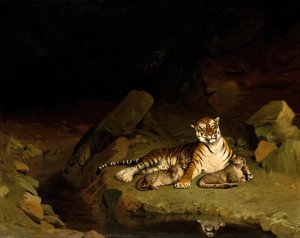
Night
Technika wykonania
Rozmiar reprodukcji
-


Suma do zapłaty
zł 1151
A Celestial Ascent: The Ethereal Majesty of Gérôme’s Night
In the vast, swirling tapestry of nineteenth-century Romanticism, few works capture the profound tension between earthly weight and spiritual transcendence as poignantly as Jean-Léon Gérôme’s "Night." Executed in 1850, this masterpiece serves as a breathtaking window into the human soul's yearning for the infinite. At its heart lies a solitary female figure, caught in a moment of sublime metamorphosis. As she ascends through a turbulent, cloud-swept sky, her arms are outstretched in a gesture that oscillates between desperate defiance and ecstatic surrender. The painting does not merely depict a scene; it captures a state of being—a visceral exploration of aspiration and the vulnerability inherent in seeking liberation from the constraints of our physical existence.
The narrative depth of the piece is enriched by the presence of secondary figures, partially obscured by the atmospheric drama. These silhouettes, drifting within the same ethereal realm, suggest a collective human odyssey, perhaps echoing the mythological descent and ascent of Persephone. Gérost, ever the master storyteller, uses these figures to ground the fantastical elements in a shared emotional reality, inviting the viewer to contemplate their own place within the grand, often overwhelming, cycles of life and myth.
The Alchemy of Light and Shadow
Technically, "Night" is a triumph of academic precision infused with an almost cinematic dynamism. Gérôme, a student of the legendary Paul Delaroche, utilized the technique of chiaroscuro to sculpt his subjects out of the darkness. The interplay of light and shadow is not merely a stylistic choice but the very engine of the painting's drama. A luminous glow seems to emanate from within the central figure, cutting through a palette dominated by somber, moody blues and heavy greys. This deliberate contrast creates a sense of depth that pulls the observer into the swirling vortex of the heavens.
The artist’s meticulous attention to detail—the way the fabric of the woman's dark dress clings to her form, the fluid motion of her trailing hair, and the subtle textures of the encroaching clouds—demonstrates a level of craftsmanship that is essential for any high-quality reproduction. For the discerning collector or interior designer, this painting offers more than just visual beauty; it provides a focal point of intense intellectual and emotional gravity. The way the light catches the edges of the figures creates a shimmering effect that brings a sense of movement to any space, making it an ideal centerpiece for a room designed to inspire contemplation and awe.
A Timeless Vision for the Modern Collector
Beyond its historical significance as a cornerstone of the academic tradition, "Night" possesses a timeless emotional resonance that transcends the era of its creation. It speaks to the universal human experience of navigating through darkness toward a perceived light. In an age often characterized by noise and distraction, the quiet, powerful intensity of Gérôme’s vision offers a sanctuary of profound thought.
For those seeking to curate a collection that balances classical elegance with evocative storytelling, this work stands as an incomparable choice. Whether placed in a grand gallery setting or used to add a layer of sophisticated drama to a contemporary living space, a hand-painted reproduction of "Night" brings with it the prestige of the 19th-century French masters. It is an investment in atmosphere, a piece that does not merely decorate a wall but breathes life and myth into the very architecture of a home.
Pytania i odpowiedzi
Czy "Night" wykazuje silne kontrasty światłocienia?
Kontrast jasności w dziele "Night" wynosi Statement. Kontrast określa stopień zróżnicowania między obszarami jasnymi a ciemnymi.
Do jakiego wnętrza polecane jest dzieło „Night” autorstwa Jean-Léon Gérôme?
Dzieło „Night” autorstwa Jean-Léon Gérôme jest rekomendowane do Living Room. Sugestia ta opiera się na tematyce, kolorystyce oraz nastroju pracy.
Któremu artyście przypisuje się "Night"?
Dzieło "Night" przypisuje się Jean-Léon Gérôme.
Biografia artysty
A Master of Narrative Detail: The Life and Art of Jean-Léon Gérôme
Jean-Léon Gérôme, a name synonymous with the academic painting of 19th-century France, was far more than just a technically skilled artist; he possessed a remarkable ability to weave compelling stories through his meticulously rendered scenes brimming with drama and exotic allure. Born in Vesoul in 1824, his artistic journey began under the guidance of local artist Claude-Basile Cariage, laying the foundation for a career that would ultimately establish him as arguably the most celebrated painter of his time within the Neo-Grec movement. Moving to Paris at sixteen, he initially sought instruction under Paul Delaroche, a master renowned for his historical paintings, and later benefited from formal training at the prestigious École des Beaux-Arts, absorbing the core principles of classical artistic tradition. However, Gérôme quickly distinguished himself not through mere imitation but by forging a unique style—a masterful blend of painstaking realism with dramatic narrative, a combination that would become instantly recognizable as his own. His early success with *The Cock Fight* in 1847 served as a powerful catalyst, catapulting him to immediate fame and firmly establishing him as a leading figure within the Neo-Grec movement, which sought to revive classical themes while simultaneously embracing a renewed focus on archaeological detail and historical accuracy.From Historical Grandeur to Orientalist Visions
Gérôme’s artistic range was remarkably broad and consistently impressive. He tackled historical subjects with an almost cinematic flair, imbuing them with a palpable sense of immediacy and profound psychological depth. His monumental mural commission, *The Age of Augustus, the Birth of Christ*, undertaken as a deliberate and flattering allegory for Napoleon III, showcased his exceptional ability to orchestrate complex compositions and convey grand narratives—a testament to his meticulous planning and masterful control over scale. Yet, it was perhaps in his depictions of the Orient that Gérôme truly captivated the public imagination. Inspired by extensive travels throughout Turkey, Egypt, and North Africa, he created a series of paintings depicting scenes of harems, bustling marketplaces overflowing with vibrant activity, and vast, desolate desert landscapes—all rendered with an exoticism that simultaneously fascinated and, viewed through a modern lens, occasionally reflects problematic stereotypes prevalent during his time. Paintings such as *Harem Women Feeding Pigeons in a Courtyard* became immensely popular, offering European audiences a tantalizing glimpse into a world perceived as mysterious, sensual, and profoundly different from their own. These works weren’t simply straightforward reproductions of what he observed; rather, they were carefully constructed fantasies—a skillful synthesis of direct observation with imaginative embellishment designed to create visually arresting and emotionally resonant narratives. He wasn't merely documenting the Orient; he was actively *creating* it for Western consumption, a practice that would later invite critical scrutiny but undeniably contributed significantly to his widespread appeal and artistic recognition.A Pedagogue and Influential Teacher
Beyond his prolific output as an artist, Jean-Léon Gérôme exerted considerable influence as a teacher at the École des Beaux-Arts in Paris. His atelier became a vibrant hub for aspiring artists from across Europe and America, attracting students eager to learn under his tutelage. He instilled within them not only technical proficiency but also a deep appreciation for composition, draftsmanship, and the importance of studying directly from life—a rigorous approach that prioritized observation and meticulous detail. Among his most notable pupils were Thomas Eakins, John Singer Sargent, and Mary Cassatt – artists who would each ultimately forge their own distinctive artistic paths, yet whose foundational training was undeniably shaped by Gérôme’s demanding standards and unwavering commitment to academic principles. His legacy as a mentor extended far beyond the confines of his studio, shaping the course of American art in particular through the influence of his students who returned home carrying his techniques and philosophies.Key Moments in a Remarkable Career
- 1824: Born in Vesoul, France.
- 1840: Moves to Paris to study under Paul Delaroche.
- 1847: Achieves early recognition with *The Cock Fight* at the Paris Salon.
- 1852-1854: Receives commission for *The Age of Augustus, the Birth of Christ* and undertakes extensive travels to Constantinople, Greece, and Turkey.
- Late Career: Transitions to sculpture, creating polychrome works inspired by classical antiquity.
- 1904: Dies in Paris, leaving behind a significant artistic legacy.
Legacy and Controversy: A Complex Artistic Inheritance
Jean-Léon Gérôme passed away in Paris in 1904, leaving behind an extraordinarily extensive body of work that continues to be subject to ongoing discussion and critical evaluation. While his technical mastery—his ability to render textures, light, and form with breathtaking precision—is universally acknowledged, his artistic legacy remains a complex and multifaceted one. His meticulous realism, once celebrated as the epitome of academic achievement, has since been viewed by some as overly focused on superficial detail and lacking in genuine emotional depth. The Orientalist paintings, while undeniably visually stunning, have also faced criticism for perpetuating colonial stereotypes and presenting a romanticized, often distorted, view of the East. However, it is crucial to consider Gérôme’s work within its historical context—a product of 19th-century European society grappling with issues of colonialism, cultural exchange, and evolving artistic sensibilities. His art offers invaluable insights into the prevailing attitudes and fantasies of that era, even as it compels us to critically examine the underlying assumptions embedded within his depictions. Today, Jean-Léon Gérôme’s paintings are admired not only for their technical brilliance but also for their ability to transport viewers across time and space, inviting contemplation on the complexities of history, culture, and the very nature of representation. His work stands as a testament to both the enduring power of narrative detail and the ongoing challenge of interpreting art within its historical context.
Jean-Léon Gérôme
1824 - 1904 , Francja
Najważniejsze informacje
- Artistic Movement Or Style: Akademizm, Orientalizm
- Artists Or Movements Influenced By This Artist: ['Neo-Grec']
- Artists Who Influenced This Artist: ['Paul Delaroche']
- Date Of Birth: 11 maja 1824
- Date Of Death: 10 stycznia 1904
- Full Name: Jean-Léon Gérôme
- Nationality: Francuz
- Notable Artworks:
- Walka kogutów
- Harem kobiety
- Śmierć Cezara
- Place Of Birth: Vesoul, Francja
Zobacz także powiązane artykuły

OriginalUniqueArt.com F.A.Q.: Elevate Your Decor with Premium Textured Giclée Prints
Discover the distinction of OriginalUniqueArt.com premium textured Giclée prints. Expertly crafted with archival 12-color pigments and museum-grade substrates, our prints offer unparalleled vividness for the discerning collector seeking luxury, durability, and timeless elegance.