Podgląd w skali 1:1
 Wyślij jako kartkę
 Udostępnij
 Szczegóły dzieła
 Przewodnik

 Pobierz obraz
 Podobne obiekty
 RTG
RTG Pokaz slajdów
 Pytania i odpowiedzi
 Statystyki
Lorenzo Bartolini

- 108.0 x 86.0 cm


 Rozwiń treść
Giclée / Wydruk artystyczny
Wydruki giclée lub płótna o jakości muzealnej, szybka realizacja i szeroki wybór opcji wykończenia. ( Zamów ręcznie malowaną reprodukcję Przejdź do wersji cyfrowej)




P118B zł10

P118H zł10

P118W zł10

P438Z zł10

P508JH zł12

P508YH zł12

P805H zł10

P805Z zł10

P919BZ zł10

P919G zł10

P919XJ zł10

P959ZH zł10

P968JZ zł12

W106C zł8

W218G zł10

W218JH zł8

W218Y zł10

W307PJ zł10

W316G zł10

W316PJ zł8

W316Y zł10

W398PJ zł8

W4111J zł10

W500HY zł15

W500JH zł15

W692G zł12

W849H zł8

W940BG zł15

W953PJ zł8




Wybierz spośród naszych standardowych rozmiarów, które zachowują oryginalne proporcje dzieła sztuki.

Wpisz wymaganą szerokość i wysokość, aby dopasować grafikę do ramy lub ściany. Wydruk można jedynie przyciąć, nigdy nie powiększając go poza oryginalny obraz, dlatego format o innych proporcjach spowoduje utratę części kompozycji. Przed rozpoczęciem druku prześlemy Ci cyfrowy podgląd do zatwierdzenia. Obraz wyświetlany na tej stronie nie pokazuje rzeczywistego przycięcia — jedynie podgląd oddaje ten efekt.
Dostawa na cały świat () w ciągu 2 tygodni zamiast standardowych 4/5 tygodni. (9 Listopad)

Bezpłatna ekspresowa wysyłka na cały świat

Wysokiej jakości płótno lniane

Pełne ubezpieczenie przesyłki

Gwarancja zwrotu należności celnych i podatków importowych

Gwarancja wiernego odwzorowania kolorów

100-dniowa polityka zwrotów (tylko w przypadku wad)

Gwarancja 100% zwrotu pieniędzy

Zniżka przy zakupie wielu sztuk
 Opcja ze szkłem jest dostępna wyłącznie w rozmiarach poniżej 110 cm

Lorenzo Bartolini
Giclée / Wydruk artystyczny
Wymiary reprodukcji
-


Cena całkowita
zł 317
A Portrait of Scholarly Serenity: Ingres’ Lorenzo Bartolini
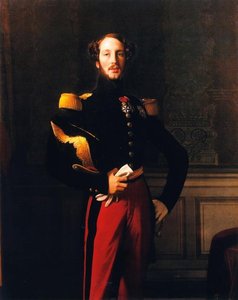
Jean-Auguste-Dominique Ingres's 1820 painting, *Lorenzo Bartolini*, is more than simply a likeness; it’s a carefully constructed meditation on intellect, tradition, and the quiet dignity of a man immersed in his pursuits. Housed within the hallowed halls of the Louvre Museum, this oil-on-canvas masterpiece exemplifies Ingres's signature Neoclassical style – a deliberate return to the principles of ancient Greek and Roman art, filtered through a distinctly French sensibility. The painting immediately commands attention with its formal composition: Bartolini, rendered in meticulous detail, occupies the majority of the frame, his posture suggesting both contemplation and authority. His slight turn towards the viewer invites engagement, while the dark, almost impenetrable background serves to amplify the subject’s presence, drawing our focus entirely onto his face and bearing.
The Language of Line and Shadow: Ingres' Technique
Ingres was a master of line, and *Lorenzo Bartolini* is a testament to this. The artist employs precise, clean lines to define every contour of Bartolini’s features – the sharp angles of his jawline, the delicate curve of his nose, the subtle folds in his clothing. This linear accuracy isn't merely about representation; it’s integral to the painting’s overall effect, creating a sense of order and control that is characteristic of Neoclassicism. Furthermore, Ingres utilizes dramatic chiaroscuro – the stark contrast between light and shadow – with remarkable skill. The strong directional lighting highlights Bartolini’s face, emphasizing his features and lending depth to the portrait. Notice how the shadows subtly sculpt his form, suggesting a powerful physique beneath the refined exterior. This masterful manipulation of light and dark isn't simply an aesthetic choice; it speaks to Ingres’ deep understanding of anatomy and his ability to convey volume and texture through subtle shifts in tone.
A Study in Restraint: Symbolism and Context
The setting within the painting is laden with symbolic meaning. Bartolini stands before a table laden with books and a bust – objects that immediately evoke intellectual pursuits, artistic patronage, and a connection to classical learning. The presence of these items suggests Bartolini’s role as a scholar or perhaps an artist himself, deeply engaged in the traditions of the past. The muted color palette—dominated by blacks, grays, whites, touches of gold, and a hint of red – contributes to the painting's somber yet elegant atmosphere. This restrained use of color reinforces the sense of seriousness and refinement that permeates the work. Considering Ingres’ own artistic lineage, tracing back to Jacques-Louis David, it’s clear this piece is not just an independent creation but a deliberate echo of a powerful artistic legacy.
The Portrait's Emotional Resonance
Beyond its technical brilliance and symbolic richness, *Lorenzo Bartolini* possesses a subtle emotional resonance. Bartolini’s stern expression – a carefully controlled gaze that suggests both intelligence and perhaps a touch of melancholy – invites contemplation. He isn’t overtly expressive, but there is an undeniable sense of dignity and self-assuredness radiating from him. The painting speaks to the enduring power of intellect, tradition, and the quiet satisfaction derived from pursuing one's passions. It’s a portrait that lingers in the mind long after viewing, prompting us to consider the complexities of human character and the timeless appeal of classical ideals.
Bringing *Lorenzo Bartolini* Home: High-Quality Reproductions
OriginalUniqueArt offers meticulously crafted, hand-painted oil painting reproductions of Ingres’ *Lorenzo Bartolini*. Our skilled artists utilize traditional techniques and archival-quality materials to faithfully capture the essence of this iconic masterpiece. Whether you're an art collector, a design enthusiast seeking inspiration for your interior space, or simply captivated by the beauty of Neoclassical art, a OriginalUniqueArt reproduction provides an authentic and stunning representation of Ingres’ enduring legacy. Explore our collection at https://OriginalUniqueArt.com to discover the perfect *Lorenzo Bartolini* for your home or office.
Pytania i odpowiedzi
W jakiej technice wykonano "Lorenzo Bartolini" i jakie są jego wymiary?
"Lorenzo Bartolini" powstało przy użyciu Obraz olejny na płótnie i w swojej oryginalnej formie ma wymiary 108 x 86 cm.
W jaki sposób "Lorenzo Bartolini" balansuje światło i cień?
Jasność dzieła „Lorenzo Bartolini” – Jean-Auguste-Dominique Ingres wynosi głębokie cienie, przy luminancji na poziomie Najciemniejszy.
Jakie są wymiary oryginału "Lorenzo Bartolini"?
Wymiary dzieła „Lorenzo Bartolini” – Jean-Auguste-Dominique Ingres to 108 x 86 cm. Reprodukcje można zamówić w innych rozmiarach, zachowując te same proporcje.
Biografia artysty
A Legacy of Line and Form: The World of Jean-Auguste-Dominique Ingres
Jean-Auguste-Dominique Ingres, a name synonymous with Neoclassical precision and an almost sculptural approach to painting, occupies a unique position in the history of art. Born in Montauban, France, in 1780, his artistic journey was one of unwavering dedication to classical ideals, tempered by a burgeoning sensuality and a willingness to challenge convention. Ingres wasn’t merely replicating the past; he was engaging in a profound dialogue with it, forging a style that would both define an era and anticipate the revolutions to come. His work stands as a testament to the power of line, form, and idealized beauty—qualities that continue to captivate viewers centuries later.Early Influences and Artistic Training
Ingres’s artistic sensibilities were nurtured from a remarkably young age. His father, Jean-Marie-Joseph Ingres, was himself an artist and sculptor, instilling in Dominique a deep appreciation for form and technique—a foundation built upon meticulous observation and a love of the visual world. This early exposure to art was further solidified by his studies at the Académie Royale de Peinture, Sculpture et Architecture in Toulouse, under the guidance of Guillaume-Joseph Roques. However, it was his move to Paris in 1797 and subsequent apprenticeship with Jacques-Louis David, the leading figure of Neoclassicism, that truly shaped his artistic trajectory. David imparted a rigorous discipline—a focus on line, form, and historical subject matter—principles that would remain central to Ingres’s work throughout his career. The influence of David is undeniable, yet Ingres ultimately developed a distinct style, one characterized by a subtle sensuality and psychological depth that set him apart from his mentor.The Pursuit of Ideal Beauty and Early Masterpieces
Ingres' artistic philosophy was profoundly rooted in admiration for the Italian Renaissance masters—Raphael, in particular, served as a constant source of inspiration. He believed in the power of line to define form and convey emotion, striving for an idealized beauty that transcended mere representation. This pursuit is vividly evident in his early works, such as *The Ambassadors of Agamemnon in the Tent of Achilles* (1801), which earned him the prestigious Prix de Rome. The painting showcases Ingres’s meticulous attention to detail, precise draftsmanship, and a clear narrative focus—hallmarks of Neoclassical style. The composition is remarkably balanced, the figures rendered with an almost sculptural quality, reflecting Ingres's fascination with classical antiquity. This early success established him as a rising star in the Parisian art scene, setting the stage for his subsequent explorations of form and beauty.Beyond Raphael: Experimentation and Innovation
While deeply influenced by Raphael, Ingres didn’t simply imitate his style. He gradually developed a distinctive voice, infusing classical principles with a unique blend of sensuality and psychological insight. His portraits, in particular, demonstrate this evolution. He wasn't content to merely depict the outward appearance of his subjects; he sought to capture their inner lives, their emotions, and their personalities. This is particularly evident in *Portrait of Monsieur Bertin* (1833-1834), where the subject’s intense gaze and elongated hands convey a sense of both power and vulnerability. Ingres's use of line—particularly his emphasis on precise contours and subtle gradations of tone—creates an effect that is both elegant and unsettling, foreshadowing the expressive distortions of later movements like Cubism.Orientalism and Late Masterpieces
Beyond his historical and mythological paintings, Ingres also explored other genres, most notably Orientalism. His depictions of exotic scenes and female nudes, such as *The Turkish Bath* (1862), completed when he was an astonishing 83 years old, reveal a fascination with the sensual and the mysterious. These works, though sometimes criticized for their idealized representations, demonstrate his continued willingness to experiment and push boundaries. Ingres’s late period is characterized by a remarkable intensity of color and a heightened sense of drama—qualities that are particularly evident in *Grande Odalisque* (1814). The painting captures the essence of an exotic beauty, rendered with a masterful command of line and form.A Lasting Influence on Art History
Jean-Auguste-Dominique Ingres died in Paris in 1867, leaving behind a legacy that continues to resonate today. His emphasis on line, form, and idealized beauty profoundly influenced artists across generations. Remarkably, his work captivated even those who championed radically different styles—artists like Henri Matisse and Pablo Picasso admired his innovative approach to composition and his ability to imbue classical forms with a sense of vitality and emotion. Ingres’s paintings are now housed in major museums around the world, serving as testaments to his enduring artistic vision. He remains a pivotal figure in art history—a master who not only preserved the traditions of the past but also paved the way for the future. His work invites us to contemplate the nature of beauty, the power of line, and the timeless allure of classical ideals.Notable Works
- The Ambassadors of Agamemnon in the Tent of Achilles (1801)
- The Vow of Louis XIII (1827)
- Portrait of Monsieur Bertin (1833-1834)
- The Turkish Bath (1862)
- Grande Odalisque (1814)

Jean-Auguste-Dominique Ingres
1780 - 1867 , Francja
Krótka nota
- Artistic Movement Or Style: Neoklasycyzm
- Artists Or Movements Influenced By This Artist:
- Henri Matisse
- Pablo Picasso
- Artists Who Influenced This Artist:
- Jacques-Louis David
- Raphael
- Nicolas Poussin
- Date Of Birth: 29 sierpnia 1780
- Date Of Death: 14 stycznia 1867
- Full Name: Jean-Auguste-Dominique Ingres
- Nationality: Francuz
- Notable Artworks:
- Ambasadorzy Agamemnona
- Przymiarki króla Ludwika XIII
- Portret Mon. Bertina
- Prywatny kąpiel
- Place Of Birth: Montauban, Francja
Powiązane artykuły

25 Arcydzieł Luwru: Podróż przez Historie Sztuki i Inspiracje dla Domu
Odkryj 25 arcydzieł Luwru! Poznaj historie Mona Lisy, Wenus z Milo i innych ikonicznych dzieł sztuki. Reprodukcje obrazów najwyższej jakości – inspiracje dla Twojego wnętrza na OriginalUniqueArt.com.

Neoclassical Portraiture: The Timeless Elegance of Order, Grace, and Academic Mastery
Explore the refined world of Neoclassical portraiture. Discover the mastery of line, light, and order through an expert exploration of academic art history, from Jacques-Louis David to Jean-Antoine Houdon. Immerse yourself in the timeless elegance of classical realism.

Olej na płótnie: Historia, techniki i ponadczasowy urok malarskiego medium
Poznaj historię i techniki malarstwa olejowego! Od renesansowych mistrzów po współczesne zastosowania – wszystko o oleju na płótnie. Poradniki, konserwacja i inspiracje dla pasjonatów sztuki.

Trwała Spuścizna Malarstwa Olejnego: Technika, Historia i Estetyczny Wpływ
Poznaj historię i technikę malarstwa olejnego! Eksperckie artykuły o konserwacji, renowacji oraz współczesnych zastosowaniach. Dowiedz się więcej o mistrzach i trwałości obrazów olejnych.
Neoclassical Portraiture: A Procurement Guide to Timeless Elegance for Luxury Hotel Interiors
A professional procurement guide for hotel designers sourcing Neoclassical portraiture. Discover how to integrate timeless elegance into luxury interiors with high-volume, hand-painted oil reproductions, custom sizing, and reliable global logistics for large-scale hospitality projects.