

 Podgląd w skali 1:1
 Wyślij jako kartkę
 Udostępnij
 Szczegóły dzieła
 Przewodnik

 Pobierz obraz
 Podobne obiekty
 RTG
RTG Pokaz slajdów
 Q&A
Q&A Statystyki
Stańczyk
 Oil On Canvas
- WallArt
- Romanticism
 1862
1862- 19th Century
 88.0 x 120.0 cm
 Muzeum Narodowe w Warszawie
 Rozwiń treść
Giclée / Wydruk artystyczny
Wydruki giclée lub płótna o jakości muzealnej, szybka realizacja i szeroki wybór opcji wykończenia. ( Zamów ręcznie malowaną reprodukcję Przejdź do wersji cyfrowej)




P118B zł10

P118H zł10

P118W zł10

P438Z zł10

P508JH zł12

P508YH zł12

P805H zł10

P805Z zł10

P919BZ zł10

P919G zł10

P919XJ zł10

P959ZH zł10

P968JZ zł12

W106C zł8

W218G zł10

W218JH zł8

W218Y zł10

W307PJ zł10

W316G zł10

W316PJ zł8

W316Y zł10

W398PJ zł8

W4111J zł10

W500HY zł15

W500JH zł15

W692G zł12

W849H zł8

W940BG zł15

W953PJ zł8




Wybierz spośród naszych standardowych rozmiarów, które zachowują oryginalne proporcje dzieła sztuki.

Wpisz wymaganą szerokość i wysokość, aby dopasować grafikę do ramy lub ściany. Wydruk można jedynie przyciąć, nigdy nie powiększając go poza oryginalny obraz, dlatego format o innych proporcjach spowoduje utratę części kompozycji. Przed rozpoczęciem druku prześlemy Ci cyfrowy podgląd do zatwierdzenia. Obraz wyświetlany na tej stronie nie pokazuje rzeczywistego przycięcia — jedynie podgląd oddaje ten efekt.
Dostawa na cały świat () w ciągu 2 tygodni zamiast standardowych 4/5 tygodni. (28 Październik)

Bezpłatna ekspresowa wysyłka na cały świat

Wysokiej jakości płótno lniane

Pełne ubezpieczenie przesyłki

Gwarancja zwrotu należności celnych i podatków importowych

Gwarancja wiernego odwzorowania kolorów

100-dniowa polityka zwrotów (tylko w przypadku wad)

Gwarancja 100% zwrotu pieniędzy

Zniżka przy zakupie wielu sztuk
 Opcja ze szkłem jest dostępna wyłącznie w rozmiarach poniżej 110 cm

Stańczyk
Giclée / Wydruk artystyczny
Wymiary reprodukcji
-


Cena całkowita
zł 308
A Portrait of Solitude and National Soul
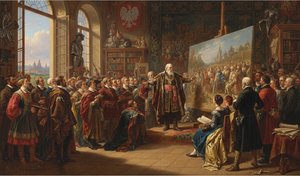
In the quiet, heavy atmosphere of Jan Matejko’s 1862 masterpiece, Stańczyk, one does not merely encounter a portrait, but a profound psychological landscape. The painting presents us with the legendary court jester, not in the midst of a comedic performance or a moment of levity, but captured in a state of deep, melancholic introspection. Seated alone amidst the opulence of a grand interior, his hands are tightly clasped, and his gaze wanders toward an unseen horizon, heavy with the weight of foreknowledge. This is not the face of a fool, but that of a visionary—a man who perceives the gathering shadows of political decline while those around him remain lost in the festivities of the moment.
The composition is a masterclass in Romantic Grandeur, where every element serves to heighten the emotional tension. Matejko utilizes a striking color palette dominated by the vibrant, commanding crimson of Stańczyk’s robe. This deep red acts as the visual heartbeat of the canvas, symbolizing both the resilience of the Polish spirit and the simmering passion of a man burdened by duty. The brilliance of this hue is set against a backdrop of somber, shadowy drapery and muted tones, creating a chiaroscuro effect that pulls the viewer’s eye directly into the sitter's contemplative expression. Through his expert use of impasto, Matejko breathes life into the fabric; the thick, textured layers of paint give the heavy velvet of the cloak a palpable weight, making the physical presence of the figure feel almost overwhelming.
Historical Echoes and Symbolic Depth
To understand Stańczyk is to understand the heartbeat of 19th-century Poland. Painted during a period of profound national mourning following the territorial losses of the Austro-Prussian War, the work serves as a silent, powerful protest. The setting—a scholarly and courtly environment suggested by the presence of manuscripts and fine furniture—contrasts sharply with the internal turmoil of the protagonist. While figures in the distant background appear engaged in the trivialities of social life, Stańczyk remains isolated by his wisdom. He embodies the "intellectual's burden," representing a nation that possesses the dignity and history to endure, yet faces an uncertain, fragmented future.
For the discerning collector or interior designer, this painting offers more than mere decoration; it provides a focal point of intellectual and emotional gravity. The meticulous attention to detail—from the intricate patterns on the floor to the subtle light reflecting off the scholarly documents—makes it an ideal centerpiece for spaces that demand character and narrative depth. Whether placed in a private library or a sophisticated contemporary salon, a high-quality reproduction of this work brings with it an aura of historical importance and a timeless conversation about resilience, wisdom, and the enduring strength of the human spirit.
Pytania i odpowiedzi
Jaki kolor dominuje w dziele "Stańczyk"?
„Stańczyk” skłania się ku Warm Sunset Tones tonacji.
Kto stworzył "Stańczyk" i kiedy?
Jan Matejko, "Stańczyk", 1862 rok
W jakiej technice wykonano "Stańczyk" i jakie są jego wymiary?
Technika wykonania dzieła „Stańczyk” – Jan Matejko to Oil On Canvas, a jego wymiary to 88 x 120 cm.
Biografia artysty
Early Life and Education
Jan Alojzy Matejko, a renowned Polish painter, was born on June 24, 1838, in Krakow, Poland. His father, Franciszek Ksawery Matejko, was a Czech-born tutor and music teacher. Jan’s early life was marked by the Kraków Revolution of 1846 and the 1848 siege of Kraków by the Austrians, events that would later influence his artistic themes. Matejko attended St. Ann's High School but dropped out in 1851 due to poor grades. However, he showed exceptional talent for art from an early age. He studied at the School of Fine Arts in Krakow from 1852 to 1858, specializing in historical painting under the tutelage of Wojciech Korneli Stattler and Władysław Łuszczkiewicz. His father’s influence instilled in him a love for music and fostered his artistic sensibilities. The turbulent political climate surrounding his formative years undoubtedly shaped his worldview and fueled his desire to depict significant moments in Polish history.Artistic Career
Matejko's first major work, *Tsars Shuyski Before Zygmunt III*, was completed in 1853. It immediately established him as a prodigious talent within the Kraków artistic community. He began exhibiting his historical paintings at the Kraków Society of Friends of Fine Arts in 1855, garnering critical acclaim and attracting considerable attention. Notable works include:- *Rejtan (1866)*: A monumental oil on canvas painting depicting a pivotal moment in Polish history – the Battle of Rejów between Poles and Russians in 1863. Matejko skillfully captured the dynamism and emotional intensity of the scene, utilizing dramatic lighting and vibrant colors to convey the heroism and sacrifice of the Polish defenders.
- *Union of Lublin (1869)*: This ambitious canvas portrays the signing ceremony of the Union of Lublin in 1863 – a crucial step towards establishing Poland as a unified state after centuries of division. Matejko’s meticulous attention to detail and masterful composition effectively communicate the grandeur and solemnity of the occasion, reflecting his deep understanding of Polish political history.
- *Battle of Grunwald (1878)*: Considered by many to be Matejko's magnum opus, *Battle of Grunwald* is a breathtaking depiction of the decisive battle between Poland and Lithuania against Teutonic Knights in 1410. The painting’s sheer scale—over six meters wide—is matched by its unparalleled artistic achievement. Matejko employed innovative techniques to convey the overwhelming force of the battlefield, utilizing chiaroscuro (contrast between light and dark) to heighten dramatic tension and create a palpable sense of immediacy.
- *The Astronomer Kopernik, czyli Rozmowa z Bogiem (1874)*: This monumental painting explores philosophical themes alongside historical narrative. Matejko’s depiction of Nicolaus Copernicus contemplating the cosmos embodies the spirit of scientific inquiry and challenges conventional beliefs.
Museological Contributions and Legacy
Matejko dedicated his life to artistic pursuits, becoming a director at the Jan Matejko Academy of Fine Arts, formerly known as the Kraków Academy of Fine Arts, from 1873 until his death in 1893. He nurtured the talents of numerous prominent painters who would go on to shape Polish art history, including Maurycy Gottlieb, Jacek Malczewski, Józef Mehoffer, and Stanisław Wyspiański. His influence extended beyond teaching; he championed artistic innovation and encouraged students to delve into complex historical subjects. Matejko’s unwavering commitment to portraying Polish history with uncompromising realism cemented his reputation as “the National Painter” of Poland.Notable Works Available on OriginalUniqueArt:
- Jan Matejko: Varna (romanticism)
- Jan Matejko: Still Life (romanticism)
- Jan Matejko: The Union of Lublin (298 x 512 cm, romanticism, oil on canvas)

Jan Matejko
1838 - 1893 , Polska
Krótka nota
- Artistic Movement Or Style: Romanticizm
- Artists Or Movements Influenced By This Artist: ['Maurycy Gottlieb']
- Artists Who Influenced This Artist:
- Wojciech Korneli Stattler
- Łuszczkiewicz
- Date Of Birth: 24 czerwca 1838
- Date Of Death: 1 listopada 1893
- Full Name: Jan Alojzy Matejko
- Nationality: Polak
- Notable Artworks:
- Bitwa pod Grunwaldem
- Unia Lubelska
- Place Of Birth: Kraków, Polska
Powiązane artykuły
Jan Matejko: Historical Narrative & National Identity in 19th-Century Polish Painting
Explore the powerful historical paintings of Jan Matejko, Poland's national artist. Discover his iconic works & learn how he shaped Polish identity in the 19th century. High-quality reproductions available.

Olej na płótnie: Historia, techniki i ponadczasowy urok malarskiego medium
Poznaj historię i techniki malarstwa olejowego! Od renesansowych mistrzów po współczesne zastosowania – wszystko o oleju na płótnie. Poradniki, konserwacja i inspiracje dla pasjonatów sztuki.

Crimson Threads of Narrative: Exploring Symbolism & Representation in Artworks Featuring the Red Dress
Explore the rich symbolism of the red dress in art history! From ancient power displays to iconic portraits like Cézanne’s 'Madame Cezanne', discover the cultural and artistic significance behind this captivating color. Expert analysis & insights.

The Enduring Power of Painting: A Historical & Contemporary Exploration of Form and Emotion
Explore the rich history & enduring techniques of oil painting with OriginalUniqueArt. Discover masterpieces, learn about art collecting, and find authentic handmade reproductions crafted by skilled artists.

Trwała Spuścizna Malarstwa Olejnego: Technika, Historia i Estetyczny Wpływ
Poznaj historię i technikę malarstwa olejnego! Eksperckie artykuły o konserwacji, renowacji oraz współczesnych zastosowaniach. Dowiedz się więcej o mistrzach i trwałości obrazów olejnych.

