

 Podgląd w skali 1:1
 Wyślij jako kartkę
 Udostępnij
 Szczegóły dzieła
 Przewodnik

 Pobierz obraz
 Podobne obiekty
 RTG
RTG Pokaz slajdów
 Statystyki
Italian Landscape
 Oil On Canvas
- WallArt
- Italianate Landscape
 31.0 x 40.0 cm
 Fitzwilliam College
 Rozwiń treść
Giclée / Wydruk artystyczny
Wydruki giclée lub płótna o jakości muzealnej, szybka realizacja i szeroki wybór opcji wykończenia. ( Zamów ręcznie malowaną reprodukcję Przejdź do wersji cyfrowej)




P118B zł10

P118H zł10

P118W zł10

P438Z zł10

P508JH zł12

P508YH zł12

P805H zł10

P805Z zł10

P919BZ zł10

P919G zł10

P919XJ zł10

P959ZH zł10

P968JZ zł12

W106C zł8

W218G zł10

W218JH zł8

W218Y zł10

W307PJ zł10

W316G zł10

W316PJ zł8

W316Y zł10

W398PJ zł8

W4111J zł10

W500HY zł15

W500JH zł15

W692G zł12

W849H zł8

W940BG zł15

W953PJ zł8




Wybierz spośród naszych standardowych rozmiarów, które zachowują oryginalne proporcje dzieła sztuki.

Wpisz wymaganą szerokość i wysokość, aby dopasować grafikę do ramy lub ściany. Wydruk można jedynie przyciąć, nigdy nie powiększając go poza oryginalny obraz, dlatego format o innych proporcjach spowoduje utratę części kompozycji. Przed rozpoczęciem druku prześlemy Ci cyfrowy podgląd do zatwierdzenia. Obraz wyświetlany na tej stronie nie pokazuje rzeczywistego przycięcia — jedynie podgląd oddaje ten efekt.
Dostawa na cały świat () w ciągu 2 tygodni zamiast standardowych 4/5 tygodni. (26 Październik)

Bezpłatna ekspresowa wysyłka na cały świat

Wysokiej jakości płótno lniane

Pełne ubezpieczenie przesyłki

Gwarancja zwrotu należności celnych i podatków importowych

Gwarancja wiernego odwzorowania kolorów

100-dniowa polityka zwrotów (tylko w przypadku wad)

Gwarancja 100% zwrotu pieniędzy

Zniżka przy zakupie wielu sztuk
 Opcja ze szkłem jest dostępna wyłącznie w rozmiarach poniżej 110 cm

Italian Landscape
Giclée / Wydruk artystyczny
Wymiary reprodukcji
-


Cena całkowita
zł 307
A Glimpse of Italian Pastoral: Jan Asselijn’s “Italian Landscape”
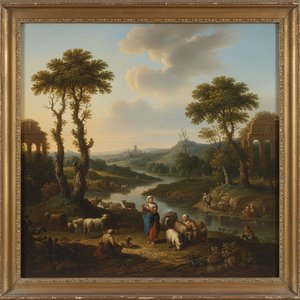
Jan Asselijn's "Italian Landscape," painted circa 1625-1652, isn’t merely a depiction of a picturesque vista; it’s an invitation to step into a carefully constructed world of serene beauty and subtle drama. This oil on canvas transports the viewer to a hypothetical Italian landscape – a deliberate choice by Asselijn that speaks volumes about the evolving artistic sensibilities of the Dutch Golden Age. The painting, now housed in collections like Bonhams, exemplifies the influence of both the Venetian masters and the burgeoning tradition of “pure” landscape painting emerging from Italy itself.
Asselijn’s style is distinctly characterized by a meticulous attention to detail and a masterful command of atmospheric perspective. He leans heavily into the techniques pioneered by Bamboccio – a contemporary painter known for his evocative, almost dreamlike landscapes – creating an image that feels both familiar and subtly unsettling. The composition unfolds with deliberate grace: a modest, classically-inspired building anchors the left foreground, its geometric solidity providing a grounding element against the undulating hills and hazy distance. The artist skillfully employs a muted palette of browns, ochres, and blues, avoiding bright colors to emphasize the painting’s contemplative mood. This restrained approach allows the subtle shifts in tone – from the dark shadows cast by distant trees to the luminous highlights reflecting off water – to create a remarkably convincing sense of depth and atmosphere.
The Influence of Venetian Masters and Italianate Tradition
Asselijn's work is deeply rooted in the artistic currents flowing through Italy at the time. He was profoundly influenced by the Venetian landscape painters, particularly those who favored a looser, more atmospheric style than their predecessors. However, unlike many of his contemporaries who simply copied Italian scenes directly, Asselijn imbued them with a distinctly Dutch sensibility – a focus on light, texture, and a carefully considered composition. This blending of influences is evident in the painting’s balanced structure, its subtle use of color, and its overall sense of quiet contemplation.
Furthermore, “Italian Landscape” reflects the broader trend toward what became known as "Italianate landscape" within Dutch art circles. This style sought to emulate the idealized landscapes depicted by artists like Claude Lorrain, who had established a dominant visual language for representing Italian scenery in Northern Europe. Asselijn’s painting isn't a literal transcription of an Italian vista; rather, it’s a carefully constructed fantasy – a “imaginary Italian Landscape” as described in some historical sources – designed to evoke the spirit and beauty of Italy while adhering to Dutch artistic conventions.
Symbolism and Emotional Resonance
Beyond its technical merits, "Italian Landscape" is rich in symbolic meaning. The solitary building, often interpreted as a villa or farmhouse, suggests themes of rural life, tranquility, and perhaps even isolation. The distant mountains, shrouded in mist, evoke a sense of mystery and the sublime – a recognition of nature’s power and grandeur. The figures scattered across the foreground, riding horses and walking along the riverbank, add a touch of human presence to the scene, reminding us of our connection to the natural world.
The painting's overall effect is one of profound serenity and contemplative beauty. It invites the viewer to slow down, to appreciate the subtle details of the landscape, and to lose themselves in its timeless atmosphere. It’s a testament to Asselijn’s skill as an artist – his ability to capture not just the appearance of a scene but also its emotional essence.
A Reproduction for Today's Spaces
Reproductions of “Italian Landscape” offer a beautiful addition to any interior space. The painting’s calming colors and evocative imagery create a sense of tranquility and sophistication, making it ideal for living rooms, bedrooms, or studies. The detailed depiction of the landscape invites contemplation and provides a visual connection to the natural world – a welcome respite from the stresses of modern life. Consider framing this piece in a classic wooden frame to further enhance its timeless appeal.
Pytania i odpowiedzi
Jaką paletę barw i jakie emocje łączy ze sobą "Italian Landscape"?
Paleta Dark dzieła „Italian Landscape” – Jan Asselijn współgra z jego Melancholic wydźwiękiem emocjonalnym. Kolor jest jednym ze sposobów, w jakie praca przekazuje emocje.
Co przedstawia i jaką atmosferę oddaje „Italian Landscape” – Jan Asselijn?
"Italian Landscape" przedstawia landscape, figures, ruin, italy, asselijn, pastoral, tranquility, scenic, a jego nastrojowy charakter można określić jako Calm.
Czy „Italian Landscape” – Jan Asselijn to jasne czy ciemne dzieło?
Ogólnie rzecz biorąc, poziom jasności dzieła „Italian Landscape” określany jest jako shadow. Postrzegana jasność opisuje, jak jasne lub ciemne wydaje się dane dzieło.
Biografia artysty
A Life Forged in Landscape: The World of Jan Asselijn
Born Jean Asselin around 1610 in Dieppe, France, Jan Asselijn’s life unfolded against the backdrop of religious upheaval and artistic transformation—a formative experience that would ultimately define his distinctive contribution to the Dutch Golden Age. His family, Huguenots fleeing persecution, relocated to Amsterdam in 1621, a vibrant epicenter of commerce and burgeoning artistic innovation during this period. This pivotal move immersed young Jean into an environment where landscape painting was undergoing a profound metamorphosis, surpassing traditional representations toward scenes imbued with heightened atmospheric intensity and emotional resonance. Initially apprenticed under Jan Martszen the Younger, Asselijn honed his skills in battle paintings before discovering his true vocation—the art of capturing the splendor and drama inherent in both natural vistas and animal life. The Dutch light – expansive skies brimming with color and luminosity – swiftly became a cornerstone of his artistic vision, an element that would permeate his oeuvre throughout his career.The Italianate Embrace & The Bentvueghels
Like many ambitious Northern European painters of the era, Asselijn recognized the importance of refinement in Italy, likely arriving sometime after 1635. This journey proved transformative, propelling him into the orbit of the *Bentvueghels*, a remarkable society comprised of Dutch and Flemish artists operating in Rome. These “Birds of a Feather,” as they affectionately termed themselves, defied convention with their unorthodox behavior—characterized by spirited nicknames and unwavering dedication to painting directly from observation—rejecting the constraints imposed by studio practice. Within this lively community, Asselijn earned the moniker "Krabbetje" (little crab) due to a congenital deformity affecting his left hand, yet he persevered creatively, absorbing influences from luminaries such as Pieter van Laer (Bamboccio), whose depictions of Roman peasant life and landscapes resonated deeply with Asselijn’s evolving aesthetic sensibilities. This period solidified his mastery of capturing light and color—a technique that would become synonymous with the Italianate style and distinguish his work from many contemporaries.Mastering Light & Symbolism: Key Works
Asselijn's artistic output reflected a profound engagement with both formal innovation and symbolic interpretation. His paintings are distinguished by remarkable clarity of execution and an unparalleled sensitivity to light—qualities that swiftly garnered him acclaim among fellow artists and critics alike. While he produced historical and battle scenes, it was his landscapes and animal paintings that truly cemented his reputation as one of the era’s foremost practitioners. The Threatened Swan, completed around 1645-1652, stands as Asselijn's most celebrated masterpiece—a work that transcends mere visual representation to embody a powerful allegory of Dutch national resilience against external pressures. More than simply depicting a bird defending its nest against a predator, this painting became a poignant emblem of Johan de Witt’s leadership during the siege of Dunkirk—a moment of crisis that galvanized patriotic fervor. The swan's defiant posture and unwavering determination mirrored the spirit of resistance prevalent throughout the Netherlands at the time, prompting scholarly debate regarding its symbolic significance. Further exemplifying his artistic prowess is Cavalry Charge at Sunset, showcasing his formative training in battle painting with dramatic flair—a testament to his ability to convey movement and emotion through meticulous detail. Asselijn’s explorations of rural life extended beyond mere topographical accuracy; he sought to infuse his canvases with a sense of atmosphere and narrative—characteristics that elevated his work above the commonplace and imbued it with enduring artistic merit. Notable among his landscapes are depictions of serene waterways, expansive meadows dotted with wildflowers, and dramatic mountain vistas—each rendered with meticulous observation and infused with subtle tonal harmonies.Influence & Legacy: A Lasting Impression
Jan Asselijn’s influence extended far beyond his own prolific output, shaping the artistic landscape of his time and inspiring subsequent generations of painters. He was particularly admired by Rembrandt van Rijn, who even created an etching portraying Asselijn at work—a gesture that subtly acknowledged the artist's physical disability while simultaneously recognizing his exceptional talent. Furthermore, Asselijn served as a mentor to Frederik de Moucheron, another prominent Dutch landscape painter whose style mirrored Asselijn’s own distinctive approach. His unwavering commitment to capturing the beauty and drama of nature established him as a pivotal figure within the Italianate tradition—a movement that championed idealized vistas and luminous color palettes. Today, Asselijn's paintings reside in prestigious collections worldwide—most notably the Rijksmuseum in Amsterdam—ensuring his legacy endures as a cornerstone of Dutch Golden Age art and cementing his place among the most accomplished artists of his era.
Jan Asselijn
1610 - 1652 , Francja
Krótka nota
- Artistic Movement Or Style: Italianate pejzażysty
- Artists Or Movements Influenced By This Artist: ['Rembrandt']
- Artists Who Influenced This Artist:
- Esaias van de Velde
- Claude Lorraine
- Pieter van Laer
- Date Of Birth: ok. 1610
- Date Of Death: 1652
- Full Name: Jan Asselijn
- Nationality: Holenderski
- Notable Artworks:
- Świętego Antoniego Dykę Przepięć nad Amsterdami
- Żołnierze przy sztandarze
- Atak kawalerii
- Place Of Birth: Dieppe, Francja
Powiązane artykuły

Mastering Light & Land: An Art Historian's Guide to the Dutch Golden Age Landscape
Explore the breathtaking mastery of Dutch Golden Age landscapes. From Italianate light to atmospheric realism, discover the techniques of 17th-century masters and learn how to bring these timeless, museum-quality masterpieces into your home through expert oil reproductions.

Złoty Wiek Holandii: 10 arcydzieł, które zmieniły historię sztuki | OriginalUniqueArt.com
Odkryj 10 arcydzieł Złotego Wieku Holandii! Poznaj historię Rembrandta, Vermeera i innych mistrzów. Reprodukcje obrazów najwyższej jakości do Twojego wnętrza – OriginalUniqueArt.com.

Golden Light & Dutch Skies: The Timeless Magic of Dutch Golden Age Landscapes
Discover the breathtaking beauty of Dutch Golden Age landscapes. Explore the mastery of light, chiaroscuro, and 17th-century realism through an expert art history lens, celebrating the enduring legacy of the Dutch Masters for discerning collectors and art lovers.

Golden Light & Dutch Skies: Bringing the Magic of Dutch Golden Age Landscapes into Your Home
Transform your home with the breathtaking light of Dutch Golden Age landscapes. Discover how hand-painted oil reproductions of masterworks like Ruisdael and Vermeer bring timeless elegance, atmosphere, and soulful texture to modern interiors. Elevate your space with museum-quality art.
Nicolaes Berchem: Dutch Golden Age Pastoralism & the Evolution of Landscape Painting
Explore the captivating world of Nicolaes Berchem, a leading Dutch Golden Age painter. Discover his idyllic landscapes, masterful technique & lasting influence on art history. Learn more at OriginalUniqueArt.
