

 Podgląd w skali 1:1
 Wyślij jako kartkę
 Udostępnij
 Szczegóły dzieła
 Przewodnik

 Pobierz obraz
 Podobne obiekty
 RTG
RTG Pokaz slajdów
 Statystyki
Gloucestershire Old Spot
 Oil On Panel
- Romantic Landscape
 1805
1805 30.0 x 38.0 cm
 Yale Center for British Art
 Rozwiń treść
Ręcznie malowana reprodukcja olejowa
Ręcznie malowany obraz olejny na płótnie, wykonany na zamówienie przez naszych artystów w wybranym przez Ciebie wymiarze i oprawie. ( Przełącz na wydania drukowane Przejdź do wersji cyfrowej)




P118B zł10

P118H zł10

P118W zł10

P438Z zł10

P508JH zł12

P508YH zł12

P805H zł10

P805Z zł10

P919BZ zł10

P919G zł10

P919XJ zł10

P959ZH zł10

P968JZ zł12

W106C zł8

W218G zł10

W218JH zł8

W218Y zł10

W307PJ zł10

W316G zł10

W316PJ zł8

W316Y zł10

W398PJ zł8

W4111J zł10

W500HY zł15

W500JH zł15

W692G zł12

W849H zł8

W940BG zł15

W953PJ zł8




Wybierz spośród naszych standardowych rozmiarów, które zachowują oryginalne proporcje dzieła sztuki.

Wpisz wymaganą szerokość i wysokość, aby obraz pasował do Twojej ramy lub ściany. Ponieważ jest to dzieło malowane ręcznie, w przypadku rozmiaru o innych proporcjach artysta może domalować nieco więcej wokół obrazu lub przyciąć jego fragmenty — wybór należy do Ciebie. Przed rozpoczęciem pracy prześlemy Ci cyfrową wizualizację do zatwierdzenia. Obraz widoczny na tej stronie nie przedstawia rzeczywistego efektu — jedynie wizualizacja oddaje realny rezultat.
Po złożeniu zamówienia zespół OriginalUniqueArt.com skontaktuje się z klientem drogą mailową w celu uzyskania instrukcji i prześle wizualizację projektu
Dostawa na całym świecie () w ciągu 3–4 tygodni zamiast standardowych 5 tygodni. (25 Październik). Bez kompromisów w kwestii jakości.

Bezpłatna ekspresowa wysyłka na cały świat

Wysokiej jakości płótno lniane

Pełne ubezpieczenie przesyłki

Gwarancja zwrotu należności celnych i podatków importowych

Gwarancja wiernego odwzorowania kolorów

100-dniowa polityka zwrotów (tylko w przypadku wad)

Gwarancja 100% zwrotu pieniędzy

Zniżka przy zakupie wielu sztuk
 Opcja ze szkłem jest dostępna wyłącznie w rozmiarach poniżej 110 cm

Gloucestershire Old Spot
Technika reprodukcji
Wymiary reprodukcji
-


Cena całkowita
zł 1151
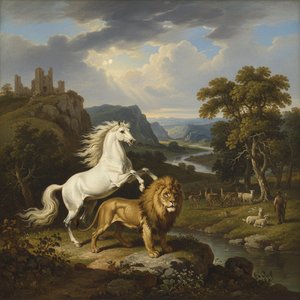
James Ward’s Gloucestershire Old Spot: A Romantic Vision of Rural England
James Ward (1769-1859) stands as a pivotal figure in British Romantic landscape painting, often overshadowed by his more celebrated contemporaries yet undeniably influential in shaping the aesthetic sensibilities of his era. This monumental oil on panel depiction – “Gloucestershire Old Spot” – exemplifies Ward’s distinctive approach: capturing not merely visual beauty but also an idealized representation of pastoral life and imbued with subtle symbolic resonance. Let's delve into what makes this artwork so remarkable.A Masterstroke of Genre Painting
Initially, Ward’s artistic trajectory mirrored that of his brother-in-law George Morland, focusing on genre scenes depicting everyday rural life – farmers tending their livestock, bustling market squares, and convivial gatherings around hearth fires. However, by the early 1800s, Ward decisively shifted towards a grander scale, embracing monumental landscapes inspired by Rubens’ masterful compositions. This stylistic evolution is powerfully evident in “Gloucestershire Old Spot,” where Ward abandons Morland's intimate perspective for a panoramic vista that commands attention and invites contemplation. The painting skillfully blends observation with imagination, presenting a scene brimming with activity yet underpinned by an overarching sense of serenity.Technique and Composition: Rubensian Influence
Ward’s technique owes considerable debt to Rubens—a conscious decision reflecting his admiration for the Flemish master's ability to convey emotion through dramatic lighting and masterful brushwork. Notice the thick impasto – heavily textured paint application – particularly prominent in the pig’s coat, creating a palpable physicality that transcends mere representation. This textural richness contributes significantly to the painting’s atmospheric depth, simulating the hazy light of a Gloucestershire afternoon. The composition is carefully balanced, guiding the viewer's eye across the canvas from left to right, punctuated by figures and dogs strategically positioned within the landscape. The placement of the central pig amidst the expansive field underscores its importance as both subject matter and symbolic emblem—representing fertility, prosperity, and the harmonious relationship between humanity and nature.Symbolism Within Pastoral Beauty
Beyond its technical prowess, “Gloucestershire Old Spot” resonates with deeper symbolic meanings characteristic of Romantic art. The idyllic setting – a sunlit Gloucestershire meadow populated by livestock and people – embodies the Romantic ideal of unspoiled wilderness untouched by industrial progress. The pig itself is not merely an animal; it symbolizes abundance and fecundity—a visual shorthand for the promise of future generations. Furthermore, the presence of dogs adds to the narrative complexity, representing loyalty, guardianship, and companionship. They serve as silent witnesses to the unfolding drama of rural life, reinforcing Ward’s overarching message about the beauty and sanctity of the natural world.A Legacy Enduring Through Reproduction
Today, “Gloucestershire Old Spot” resides in the Yale Center for British Art's collection, a testament to Ward’s enduring artistic legacy. Reproductions offer an opportunity to experience this masterpiece firsthand—to appreciate its textural brilliance and immerse oneself in the evocative atmosphere of Victorian England. OriginalUniqueArt.com presents exceptional quality reproductions that faithfully capture the essence of Ward’s vision, allowing art lovers everywhere to bring a piece of Romantic landscape painting into their homes.Pytania i odpowiedzi
Jaki rozmiar "Gloucestershire Old Spot" jest sugerowany do Living Room?
W pomieszczeniu typu Living Room sugerowany jest wydruk dzieła „Gloucestershire Old Spot” w rozmiarze Large.
Czy w „Gloucestershire Old Spot” – James Ward zastosowano silne kontrasty czy raczej łagodne harmonie?
Kompozycja kolorystyczna „Gloucestershire Old Spot” – James Ward łączy w sobie Balanced kontrast z Strong Color Unity harmonią.
Gdzie mogę kupić ręcznie malowaną reprodukcję dzieła „Gloucestershire Old Spot” – James Ward?
"Gloucestershire Old Spot" jest dostępny jako ręcznie malowana reprodukcja olejowa na płótnie lnianym. Zamówienie można złożyć na stronie Ręcznie malowana reprodukcja, wybierając preferowany rozmiar.
Biografia artysty
Early Life and Artistic Beginnings
James Ward, a name perhaps less familiar than some of his contemporaries, nevertheless holds a significant place in the history of British art during the 19th century. Born on October 23rd, 1769, in the bustling heart of London, he was not born into an artistic dynasty but rather nurtured within a family that valued craftsmanship and observation – a foundation crucial to his future success. His elder brother, William Ward, was already established as a skilled engraver, and it was through this apprenticeship that young James first encountered the world of visual representation, learning the meticulous techniques of line and shading.
While formal artistic training remained largely absent from his early life, James’s innate talent quickly became apparent. He possessed an exceptional eye for detail and a deep appreciation for the natural world – qualities he would later translate into his celebrated animal paintings. Crucially, his brother-in-law, George Morland, a prominent genre painter known for his charming depictions of rural life, served as a formative influence during this initial period. Ward’s early works mirrored Morland's style, capturing scenes of everyday life and the simple pleasures of the countryside – a testament to the powerful impact of observation and imitation.
The Influence of Rubens and Artistic Transformation
Around 1803, a pivotal moment occurred in James Ward’s artistic development. A transformative encounter with the paintings of Peter Paul Rubens proved to be a catalyst for profound change. Viewing Rubens' *Chateau de Steen* at the British Institution, Ward was captivated by the master’s dynamic compositions, rich color palettes, and dramatic use of light and shadow – elements that fundamentally altered his approach to painting. This exposure ignited a desire to move beyond the static realism of Morland’s style and embrace a more expressive and emotionally charged aesthetic.
The shift was deliberate and marked a significant departure from his earlier work. Ward began to incorporate Rubensian techniques into his paintings, injecting a sense of movement, drama, and heightened emotion into his compositions. He experimented with looser brushstrokes, bolder colors, and a greater emphasis on capturing the essence of his subjects rather than simply replicating their appearance. This transition marked the beginning of a new chapter in his career – one characterized by a more ambitious and individualistic style.
Notable Works and Artistic Style
James Ward’s artistic versatility is evident in the breadth of his subject matter, encompassing history painting, portraiture, landscape, and, most famously, animal art. His paintings are distinguished by an extraordinary level of detail, particularly in their rendering of animals – a testament to his meticulous observation and deep understanding of anatomy. However, it's not merely technical skill that sets Ward apart; he possessed a remarkable ability to imbue his subjects with personality and emotion.
Among his most celebrated works is undoubtedly Gordale Scar (1814/15), a dramatic depiction of the Yorkshire gorge that exemplifies the sublime qualities of English Romanticism. The painting captures the raw power and beauty of nature, evoking a sense of awe and wonder in the viewer. Other notable achievements include The Deer Stealer (1823), commissioned by Theophilus Levett, which showcases Ward’s skill in narrative storytelling and his ability to capture the essence of animal behavior; and John Levett Hunting at Wychnor, Staffordshire (1817), a portrait that skillfully blends likeness with atmospheric detail.
Patronage, Exhibitions, and Legacy
James Ward’s artistic career was supported by a network of patrons, including members of the landed gentry and prominent figures in society. His commissions from Theophilus Levett, for example, provided him with financial stability and opportunities to develop his skills. He regularly exhibited his work at the Royal Academy, gaining recognition for his talent and establishing himself as a respected artist within the British art establishment.
Despite facing personal tragedies – including the loss of his wife and daughter – Ward continued to paint prolifically until 1859. His later years were marked by a shift towards religious painting, reflecting a deepening sense of spirituality. James Ward’s legacy extends beyond his individual works; he played a crucial role in bridging the gap between Neoclassical and Romantic art, paving the way for future generations of animal painters and landscape artists. Today, his paintings are held in prestigious collections such as Tate Britain and the Yale Center for British Art, ensuring that his contributions to British art continue to be appreciated and celebrated.
Historical Significance
James Ward occupies a unique position within the artistic landscape of 19th-century Britain. He was not merely a skilled painter; he was an innovator who skillfully blended traditional techniques with emerging Romantic ideals. His work reflects a growing interest in the natural world and a desire to capture its beauty and power – themes that resonated deeply with contemporary audiences. Furthermore, Ward’s commitment to portraying animals with sensitivity and realism contributed significantly to the development of animal art as a distinct genre.

James Ward
1769 - 1859 , Wielka Brytania
Krótka nota
- Artistic Movement Or Style: Romantyzm
- Artists Or Movements Influenced By This Artist: ['Morland']
- Artists Who Influenced This Artist:
- George Morland
- Rubens
- Date Of Birth: 23 października 1769
- Date Of Death: 17 listopada 1859
- Full Name: James Ward
- Nationality: Brytyjski
- Notable Artworks:
- Gordale Scar
- The Deer Stealer
- John Levett Hunting
- Place Of Birth: Londyn, Wielka Brytania
Powiązane artykuły

James Abbott McNeill Whistler: 25 Arcydzieł Sztuki Pejzażowej i Portretowej | OriginalUniqueArt
Odkryj 25 arcydzieł Jamesa Abbotta McNeilla Whistler'a! Poznaj historię impresjonistycznych pejzaży, portretów i słynnych 'Nokturnów'. Reprodukcje obrazów najwyższej jakości na OriginalUniqueArt.com – inspiracje dla Twojego wnętrza.

Sir Alfred James Munnings: 25 Arcydzieł Malarstwa Koni i Angielskiej Wsi | OriginalUniqueArt.com
Odkryj 25 arcydzieł Sir Alfreda Jamesa Munningsa – mistrza malarstwa koni i angielskiego krajobrazu. Poznaj historię, technikę i piękno jego obrazów. Reprodukcje najwyższej jakości na OriginalUniqueArt.com! Eksploruj pełną kolekcję online.
James Ward: A Study in British Romantic Landscape and Animal Painting
Explore the captivating world of James Ward (1769-1859), a master of British Romantic landscape & animal painting. Discover his iconic 'Gordale Scar' and exquisite portraits – a timeless art investment. Learn about his influences, style, and enduring legacy.

Romantyczny Krajobraz w Malarstwie: 10 Arcydzieł, Które Zdefiniowały Epokę | OriginalUniqueArt.com
Odkryj 10 arcydzieł romantyzmu w malarstwie! Poznaj historie Caspara Davida Friedricha, Turnera i innych mistrzów. Inspiracje wnętrzarskie & reprodukcje obrazów najwyższej jakości na OriginalUniqueArt.com. Eksploruj kolekcję online!
Zwierzęta w Sztuce: Wprowadzanie Życia do Twojej Przestrzeni
Odkryj fascynujący świat zwierząt w sztuce! Poznaj symbolikę, historię i współczesne interpretacje. Znajdź idealny obraz ze zwierzęciem do swojego wnętrza z .

