Wersja olejowa
 Wszystko o Carnival







































 W przypadku dzieł sztuki lub reprodukcji, których którykolwiek z boków przekracza 105 cm (około 41 cali), rama zostanie wysłana w formie zestawu do samodzielnego montażu. Metoda ta zapewnia bezpieczną dostawę i zapobiega uszkodzeniom podczas transportu.


The Composition of Chaos
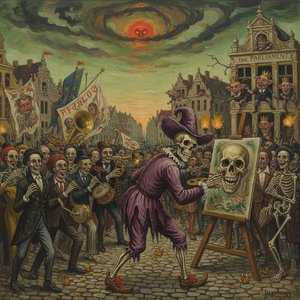
The canvas presents a dense arrangement of figures that occupy a shallow, crowded space. Within this composition, distorted faces and mask-like features emerge from a sea of movement. The palette relies on heavy applications of yellow, red, and white, which are set against dark outlines and deep shadows. Thick, jagged lines define the edges of the characters, creating a sense of physical friction between the overlapping forms. Ribbon-like shapes swirl through the frame, contributing to a flattened perspective where depth is difficult to discern.
The texture of the oil paint is tactile, with visible brushstrokes that remain prominent across the surface. These strokes follow organic, often irregular paths, reinforcing the movement of the crowd. Light falls unevenly across the scene, casting strange shadows upon the faces of the individuals. This lighting creates a theatrical effect, highlighting certain features while leaving others in murky obscurity. The figures themselves appear as a collection of grotesque and exaggerated shapes, their features rendered with a heavy, expressionistic hand.
Themes of Disguise and Social Unrest
The subject matter centers on a gathering of masked individuals, suggesting the atmosphere of a masquerade or a carnival. This choice of imagery draws from the artist's early life in Ostend, Belgium, where his parents operated a souvenir shop filled with shells and carnival masks. These objects provided a visual vocabulary for exploring themes of hidden identity and the fragility of outward appearances. The presence of these masks introduces an element of psychological tension, as the faces of the crowd are obscured by artificial layers.
The painting functions as a window into a nightmarish vision of social decay. Through the use of distorted anatomy and unsettling color contrasts, the work communicates a sense of profound unrest. The crowded nature of the composition mirrors the frantic energy of a festival, yet the underlying tone remains one of disorientation. By utilizing the medium of oil on canvas to create these heavy, textured forms, the artist captures a moment of intense, raw emotion that avoids traditional notions of beauty in favor of a more unsettling reality.
Pytania i odpowiedzi
Czy Carnival jest dziełem namalowanym ręcznie, czy wydrukiem?
Malowane ręcznie: wykwalifikowany artysta wykonuje olejną kopię Carnival na płótnie lnianym.
Jaki rozmiar wybrać dla Carnival?
Wymiary oryginału to 66.7 x 83.2cm. Dostępne rozmiary obejmują zakres od 28.2 x 35.4 cm (zł1857) do 196.4 x 246.1 cm (zł8003); tabela na tej stronie przedstawia główne warianty oraz ich ceny.
Ile trwa dostawa?
Czas dostawy wynosi od 4 do 5 tygodni, przy czym oferujemy bezpłatną ekspresową wysyłkę na cały świat; na tej stronie dostępna jest również opcja pilnej produkcji. Możesz dokonać zwrotu w ciągu 100 dni z pełnym zwrotem kosztów, bez żadnych dodatkowych warunków.
Gdzie znajduje się oryginał Carnival?
Oryginał znajduje się w zbiorach Harvard Art Museums w Cambridge.
Jakiej techniki użył/a James Ensor w pracy Carnival?
Oil On Canvas
 Podgląd w skali 1:1

 Wyślij jako kartkę
 Udostępnij
 Szczegóły dzieła
 Karta informacyjna


 Pobierz obraz
 Podobne obiekty
 RTG
 Pokaz slajdów
 Pytania i odpowiedzi

 Statystyki