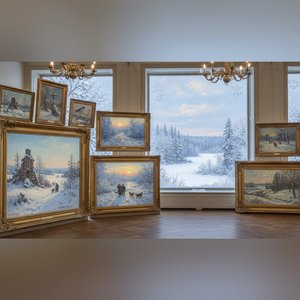
March
Oil On Canvas
WallArt
Mood Landscape
1895
60.0 x 75.0 cm
Галерея Третьякова
Ręcznie malowana reprodukcja olejowa
Ręcznie malowany obraz olejny na płótnie, wykonany na zamówienie przez naszych artystów w wybranym przez Ciebie wymiarze i oprawie. ( Przełącz na wydruk
Przełącz na obraz)
P118B $10
P118H $10
P118W $10
P438Z $10
P508JH $12
P508YH $12
P805H $10
P805Z $10
P919BZ $10
P919G $10
P919XJ $10
P959ZH $10
P968JZ $12
W106C $8
W218G $10
W218JH $8
W218Y $10
W307PJ $10
W316G $10
W316PJ $8
W316Y $10
W398PJ $8
W4111J $10
W500HY $15
W500JH $15
W692G $12
W849H $8
W940BG $15
W953PJ $8
Wybierz spośród naszych standardowych rozmiarów, które zachowują oryginalne proporcje dzieła sztuki.
Możesz wprowadzić własne wymiary, aby dopasować obraz do konkretnej ramy lub przestrzeni. Jeśli wybrany rozmiar nie będzie odpowiadał proporcjom oryginału, przytniecie dzieło sztuki lub rozszerzymy je o dodatkowe elementy, ręcznie domalowane przez artystę. Przed rozpoczęciem produkcji wyślemy projekt cyfrowy do Twojej akceptacji.
Należy pamiętać, że podgląd na ekranie nie odzwierciedla rzeczywistego przycinania ani rozszerzania obrazu. Tylko projekt dokładnie pokaże ostateczną kompozycję.
Choć oferujemy możliwość zamówienia niestandardowych rozmiarów, zalecamy wybór wymiaru z gotowej listy, aby zachować oryginalne proporcje dzieła.
Po złożeniu zamówienia zespół OriginalUniqueArt.com skontaktuje się z klientem drogą mailową w celu uzyskania instrukcji i prześle wizualizację projektu
Dostawa na całym świecie () w ciągu 3–4 tygodni zamiast standardowych 5 tygodni. (1 Sierpień). Bez kompromisów w kwestii jakości.
Bezpłatna ekspresowa wysyłka na cały świat
Wysokiej jakości płótno lniane
Pełne ubezpieczenie transportowe
Gwarancja zwrotu należności celnych i podatków importowych
Gwarancja pełnego odwzorowania kolorów
Polityka 60-dniowego zwrotu (tylko w przypadku wad)
Gwarancja 100% zwrotu pieniędzy
Oferta rabatowa przy większych zamówieniach
March
Technika wykonania
Rozmiar reprodukcji
-
Suma do zapłaty
$ 300
Opis dzieła
The Essence of Russian Moodscapes
Isaac Ilyich Levitan's "March" isn't merely a depiction of a winter landscape; it’s a profound distillation of the Russian soul, captured in oil on canvas with an almost palpable sense of melancholy and quiet contemplation. Painted in 1895 during his time in the Gorka estate near Vyshnevolotsky, this work embodies Levitan's signature style – what he himself termed “mood landscapes.” He wasn’t interested in grand vistas or dramatic events; instead, he sought to convey the emotional atmosphere of a place, imbuing it with a feeling that resonated deeply within him. The painting isn’t about the coldness of winter, but rather the introspection and solitude it evokes – a theme central to much of his oeuvre.
A Symphony of Light and Color
Levitan's masterful technique is immediately apparent in "March." He employs a restrained palette dominated by muted blues, greys, and browns, punctuated by subtle hints of ochre and the stark white of the snow. The light, diffused and soft, seems to emanate from an unseen source, bathing the scene in a gentle glow. Notice how he builds up layers of paint – delicate washes for the sky, textured strokes for the trees, and precise details for the dog and the distant house. This layering creates a remarkable sense of depth and atmosphere, drawing the viewer into the heart of the winter landscape. The brushwork is loose and expressive, reflecting the artist’s emotional response to his subject matter – not a photographic representation, but an interpretation.
Historical Context: Levitan and the Peredvizhniki
To fully appreciate "March," it's crucial to understand its place within the broader context of Russian art at the end of the 19th century. Levitan was a key figure in the *Peredvizhniki* (Wanderers), a group of artists who rejected the academic traditions of the Imperial Academy of Arts and instead sought to depict everyday life and rural Russia with honesty and empathy. The *Peredvizhniki* championed realism, often focusing on scenes of hardship and social injustice, but Levitan’s work transcends mere social commentary. He was deeply influenced by the Barbizon School in France, particularly their emphasis on capturing the essence of nature through light and color. His connection to Chekhov, a prominent writer of the time, further shaped his artistic vision – both men shared a sensitivity to the beauty and melancholy of the Russian landscape.
Symbolism and Emotional Resonance
The inclusion of the dog, walking along the snow-covered road, is particularly evocative. It represents not just companionship but also a sense of journey and perhaps even loneliness. The distant house suggests a refuge, a place of warmth and security, yet it’s dwarfed by the vastness of the winter landscape, reinforcing the feeling of isolation. The two birds, perched high in the trees, offer a fleeting moment of beauty and hope amidst the prevailing stillness. "March" isn't simply a winter scene; it’s an exploration of human emotions – solitude, longing, and the quiet dignity of existence—a reflection on the Russian soul itself.
A Legacy of Moodscapes
“March” stands as one of Levitan’s most celebrated works, exemplifying his unique ability to capture the emotional heart of the Russian landscape. It's a testament to his profound understanding of light, color, and atmosphere, and his remarkable sensitivity to the human condition. Reproductions of this painting continue to resonate with viewers today, offering a glimpse into a world of quiet beauty and enduring contemplation. It’s a piece that invites us to slow down, breathe deeply, and connect with the timeless power of nature.
Biografia artysty
A Symphony of the Russian Soul: The Life and Art of Isaak Ilyich Levitan
Isaak Ilyich Levitan, a name synonymous with the evocative power of Russian landscape painting, was more than just a chronicler of nature; he was a poet of the land, a translator of its moods into visual form. Born in 1860 in Kibarty (present-day Lithuania) to a Jewish family who later settled in Moscow, Levitan’s life was marked by both profound hardship and an unwavering dedication to his art. The early loss of his mother and father cast a long shadow, instilling within him a sensitivity that would permeate his canvases with a melancholic beauty. This sense of longing, coupled with the restrictions imposed upon Jewish communities in Tsarist Russia, fueled a desire to find solace and expression in the natural world. He entered the Moscow School of Painting, Sculpture and Architecture in 1873, where he came under the tutelage of Alexei Savrasov, whose influence would prove pivotal in shaping Levitan’s artistic vision. It was Savrasov who nurtured his student's innate ability to capture not merely the appearance of nature, but its very essence—its atmosphere, its emotional resonance.The Early Years and a Foundation of Sorrow
Levitan’s childhood was one of profound displacement and loss. Born into a modest Jewish family in Kibarty – now part of Lithuania – he experienced early hardship following the deaths of his parents. This early exposure to sorrow undoubtedly shaped his artistic sensibility, imbuing his landscapes with an undercurrent of melancholy and introspection. The restrictions faced by Jewish communities within Tsarist Russia further contributed to this sense of isolation and longing, driving him towards nature as a source of refuge and emotional release. His relocation to Moscow in the late 1870s, seeking a better life for his family, marked a significant turning point. Despite the challenges, he enrolled at the prestigious Moscow School of Painting, Sculpture and Architecture, where he was immediately drawn to Alexei Savrasov’s teachings. Savrasov recognized Levitan's exceptional talent and fostered his ability to move beyond mere representation, encouraging him to capture not just what *looked* like nature, but how it *felt*. This emphasis on emotional resonance would become a defining characteristic of Levitan’s work.The Birth of a ‘Mood Landscape’
Levitan quickly distinguished himself as an artist capable of conveying profound emotion through landscape. He wasn't interested in topographical accuracy for its own sake; rather, he sought to imbue his paintings with a sense of *mood*, a feeling that resonated deep within the viewer's soul. This approach earned him the title of pioneer of the “mood landscape,” a genre that moved beyond simple representation to explore the spiritual connection between humanity and nature. His palette was often subdued, favoring naturalistic colors and poetic elements over vibrant displays. He masterfully employed light and shadow, creating atmospheric effects that evoked feelings of tranquility, solitude, or even quiet despair. Works like *Autumn Day. Sokolniki* (1879), painted when he was just nineteen years old, already demonstrated this remarkable ability to capture the subtle nuances of the Russian countryside. The painting’s muted tones and delicate rendering of light create a sense of wistful nostalgia, hinting at the transience of beauty and the inevitability of change. Later masterpieces such as *The Vladimirka Road* (1892) and *Eternal Rest* (1894), prominently displayed in the Tretyakov Gallery, further solidified his reputation as a master of emotional landscape painting.Influences and Artistic Kinships
While deeply indebted to Savrasov’s influence, Levitan was also receptive to other artistic currents. He collaborated with fellow artists like Konstantin Korovin, Mikhail Nesterov, and Nikolai Chekhov—the brother of the renowned playwright Anton Chekhov, who became a lifelong friend. This circle fostered an environment of creative exchange and mutual support. Though he briefly experimented with Impressionistic techniques, Levitan never fully embraced the movement, maintaining a uniquely Russian sensibility in his work. He found inspiration not only in the visual world but also in music and literature, seeking to translate their emotional power into his paintings. His designs for scenery for Savva Mamontov’s private Russian Opera demonstrate his versatility and willingness to explore different artistic mediums. The influence of these collaborations and experiences can be seen in works like *Spring Flood*, *Stormy Day*, *Vesper Chimes* and *Silent Cloister*, each a testament to his evolving style and deepening understanding of the emotional landscape.Major Achievements and Legacy
In 1897, Levitan was elected to the Imperial Academy of Arts, a recognition of his growing stature within the Russian art world. This honor signified not only his artistic merit but also the increasing acceptance of his “mood landscapes” as a legitimate and significant form of artistic expression. He subsequently became head of the landscape studio at his alma mater in 1898, dedicating himself to nurturing the next generation of Russian landscape painters. His influence extended far beyond his students, however. Levitan’s work played a crucial role in shaping the development of Russian landscape painting, elevating it from mere depiction to a powerful vehicle for emotional and spiritual expression. He instilled within his canvases a sense of national identity and an appreciation for the beauty of the Russian countryside that continues to resonate with audiences today. His untimely death in 1900 at the age of thirty-nine left a void in the art world, but his legacy endures as a master of atmospheric landscape painting and a profound interpreter of the Russian soul. In 1941, a poignant tribute was paid to his memory when his remains were moved to the Novodevichy Cemetery in Moscow, where he rests beside Anton Chekhov—a symbolic union of two artistic kindred spirits who captured the essence of their time and place with unparalleled sensitivity and grace.Isaak Ilyich Levitan
1860 - 1900 , Rosja
Najważniejsze informacje
- Artistic Movement Or Style: Krajobraz nastrójowy
- Artists Or Movements Influenced By This Artist:
- Peredwijnicy
- Impressionizm
- Artists Who Influenced This Artist:
- Savrasow
- Perow
- Polenov
- Date Of Birth: 30 VIII 1860
- Date Of Death: 22 VII 1900
- Full Name: Isaak Ilyich Levitan
- Nationality: Rosyjski
- Notable Artworks:
- Sokolniki
- Droga Włodzimierz
- Spoczynek
- Powodź wiosenny
- Place Of Birth: Kibarty, Lithuania

Opcja ze szkłem jest dostępna wyłącznie w rozmiarach poniżej 110 cm