
 Podgląd w skali
 Wyślij jako kartkę
 Udostępnij
 Szczegóły dzieła

 Pobierz
 Podobne obiekty
 RTG
RTG Pokaz slajdów
Landscape


 Rozwiń treść
Giclée / Wydruk artystyczny
Druk giclée lub płótno o jakości muzealnej, szybka realizacja i szeroki wybór opcji wykończenia. ( Zamów ręcznie malowaną reprodukcję Kup obraz wysokiej rozdzielczości)




P118B $10

P118H $10

P118W $10

P438Z $10

P508JH $12

P508YH $12

P805H $10

P805Z $10

P919BZ $10

P919G $10

P919XJ $10

P959ZH $10

P968JZ $12

W106C $8

W218G $10

W218JH $8

W218Y $10

W307PJ $10

W316G $10

W316PJ $8

W316Y $10

W398PJ $8

W4111J $10

W500HY $15

W500JH $15

W692G $12

W849H $8

W940BG $15

W953PJ $8




Wybierz spośród naszych standardowych rozmiarów, które zachowują oryginalne proporcje dzieła sztuki.

Możesz wprowadzić własne wymiary, aby dopasować dzieło do konkretnej ramy lub przestrzeni. Jeśli wybrany rozmiar nie będzie odpowiadał proporcjom oryginalnego obrazu, przytniecie dzieło lub rozszerzymy obraz za pomocą odbicia lustrzanego lub jednolitego wypełnienia krawędzi. Przed rozpoczęciem produkcji prześlemy cyfrową wizualizację do Twojej akceptacji.
Prosimy pamiętać, że podgląd na ekranie nie odzwierciedla faktycznego przycinania ani rozszerzania. Tylko wizualizacja dokładnie pokaże końcową kompozycję.
Mimo dostępności niestandardowych rozmiarów, zalecamy wybór wymiaru z listy zdefiniowanej, aby zachować oryginalne proporcje.
Dostawa na cały świat () w ciągu 2 tygodni zamiast standardowych 4/5 tygodni. (18 Sierpień)

Bezpłatna ekspresowa wysyłka na cały świat

Wysokiej jakości płótno lniane

Pełne ubezpieczenie przesyłki

Gwarancja zwrotu należności celnych i podatków importowych

Gwarancja wiernego odwzorowania kolorów

Polityka 60-dniowego zwrotu (tylko w przypadku wad)

Gwarancja 100% zwrotu kosztów

Zniżka przy zamówieniu wielu produktów
 Opcja ze szkłem jest dostępna wyłącznie w rozmiarach poniżej 110 cm

Landscape
Giclée / Wydruk artystyczny
Wymiary reprodukcji
-


Cena całkowita
$ 80
Opis kolekcjonerski
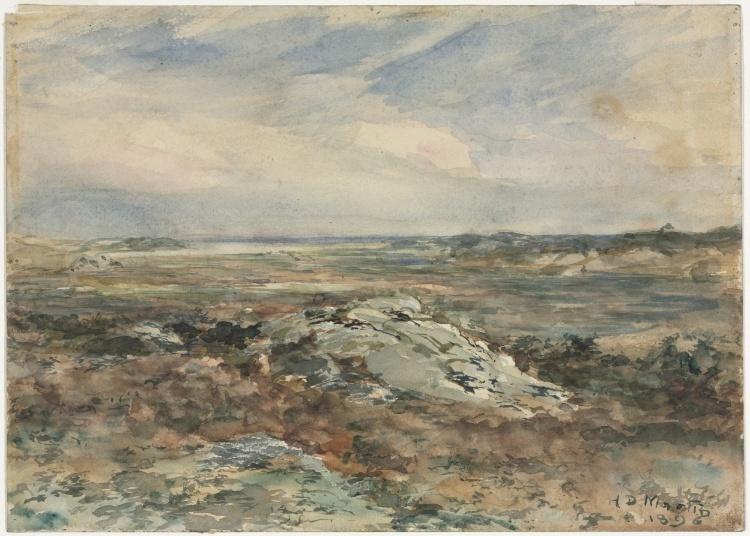
A Moment Frozen: The Poetic Landscape of Homer Dodge Martin
Homer Dodge Martin's "Landscape," painted circa 1865, isn’t merely a depiction of a vista; it’s an immersion into a specific mood—a quiet contemplation of the vastness and solitude of nature. Born in Albany, New York, in 1836, Martin navigated the shifting currents between the established realism of the Hudson River School and the burgeoning possibilities of Impressionism, forging a unique style characterized by a profound sensitivity to light, atmosphere, and the emotional resonance of the natural world. This particular work exemplifies his mastery of capturing fleeting impressions, prioritizing feeling over precise representation – a hallmark of his artistic journey.
The scene unfolds across rolling hills that recede into a hazy horizon, dominated by an overcast sky pregnant with suggestion rather than explicit detail. There’s no dramatic sun or sharp delineation of form; instead, Martin employs a masterful use of wet-on-wet watercolor techniques, allowing colors to bleed and mingle seamlessly. The brushstrokes are loose and expressive, creating a sense of movement and fluidity that mirrors the gentle undulations of the landscape itself. The foreground is particularly textured, utilizing dry brushwork to suggest the roughness of rocks and vegetation – tangible elements grounding the viewer in this imagined space.
Echoes of the Barbizon School: Light, Color, and a Sense of Place
Martin’s approach bears a clear kinship with the Barbizon school of French landscape painters, who sought to capture the essence of nature through direct observation and a focus on atmospheric effects. Like his contemporaries, he eschewed meticulous detail in favor of conveying the *feeling* of a place – its light, its air, its inherent stillness. The muted palette—dominated by browns, greens, grays, and subtle blues—contributes significantly to this effect. The colors aren’t vibrant or saturated; they are subdued and atmospheric, creating a sense of depth and distance through the application of *atmospheric perspective*. Distant elements appear paler and less distinct, reinforcing the illusion of vastness.
Furthermore, Martin's work reflects a growing interest in capturing the ephemeral qualities of light. The overcast sky casts a diffuse glow across the landscape, softening edges and lending an air of melancholy to the scene. The lack of strong highlights or shadows creates a sense of quiet contemplation, inviting the viewer to lose themselves in the atmosphere. It’s a deliberate choice that elevates the painting beyond a simple topographical representation, transforming it into a meditation on light, color, and the sublime beauty of nature.
Symbolism and Emotional Resonance: Solitude and the Vastness of Nature
“Landscape” isn't simply a pretty picture; it’s imbued with a subtle sense of symbolism. The solitary hills and distant horizon evoke feelings of solitude, introspection, and perhaps even a touch of melancholy. The vastness of the landscape can be interpreted as a metaphor for the power and indifference of nature – a reminder of humanity’s smallness in the face of the immense forces that shape our world. The painting's quietude speaks to a deeper longing for connection with something larger than oneself, a sentiment deeply resonant within the Romantic tradition.
Considered alongside Martin’s biography—a man who sought to bridge the gap between traditional and modern artistic approaches—this work becomes more than just a landscape; it's a testament to his artistic vision. It invites us to pause, breathe, and contemplate the beauty and mystery of the natural world, offering a moment of quiet reflection in an increasingly complex world.
O artyście
A Bridge Between Worlds: The Life and Art of Homer Dodge Martin
Homer Dodge Martin, born in Albany, New York, on October 28, 1836, stands as a pivotal figure in the evolution of American landscape painting. He wasn’t merely a painter; he was a translator – bridging the established grandeur of the Hudson River School with the nascent, vibrant innovations of Impressionism. His early life, steeped in artistic promise and nurtured by a thriving community of artists in Albany, including George Boughton and Edward Gay, laid the foundation for his unique vision. These formative years instilled within him a deep respect for nature’s majesty, yet even in his earliest works, subtle hints of a more personal and atmospheric approach began to emerge – a foreshadowing of the artistic transformation that lay ahead. He spent countless summers sketching in the breathtaking Adirondacks, the rugged Catskills, and the majestic White Mountains, meticulously translating these plein air studies into finished canvases within his New York City studio—a common practice among artists seeking both inspiration from nature’s raw beauty and the practical advantages of urban life. This dedication quickly garnered recognition; he was elected as an associate, and later a full academician, of the National Academy of Design, solidifying his standing within the art world of the late 19th century.European Awakening and Artistic Transformation
A truly transformative moment in Martin’s artistic journey arrived with a trip to Europe in 1876. This wasn't simply a leisurely excursion; it was an immersive experience—a deep dive into the heart of avant-garde art movements. Exposure to the Barbizon School, with its emphasis on direct observation and naturalistic depictions of rural life, profoundly impacted his sensibilities. Simultaneously, he encountered the burgeoning Impressionist movement, witnessing firsthand their revolutionary techniques for capturing light and color. The carefully constructed compositions and polished surfaces of his earlier work began to subtly shift. He wasn’t abandoning realism entirely; rather, he was absorbing these new influences, filtering them through his own unique artistic lens. This evolution wasn't immediate or dramatic; it was a gradual process—a quiet but significant departure from the rigid conventions of the Hudson River School. The Barbizon’s focus on capturing the essence of everyday life and the Impressionists’ exploration of fleeting moments of light and color resonated deeply with Martin, prompting him to experiment with looser brushstrokes, more evocative use of color, and a heightened sensitivity to atmospheric effects. He sought to capture not just what he *saw*, but also what he *felt* – the mood, the atmosphere, the very soul of the landscape.Years in Normandy and the Essence of Place
The culmination of this artistic awakening occurred during a four-year sojourn in France, primarily in Normandy, from 1882 to 1886. He became part of a vibrant artist colony at Étaples, exchanging ideas with fellow painters and immersing himself in the beauty of the French countryside. This period proved exceptionally fruitful, yielding some of his most celebrated works. Paintings like *The Harbour at Étaples* showcase his growing mastery of topographical detail combined with an atmospheric depth that was becoming increasingly characteristic of his style. However, it’s Cottage in the Forest that truly exemplifies this transformation – a poignant depiction of a solitary dwelling nestled within a vibrant forest, bathed in the golden light of the setting sun. The painting captures not just the physical appearance of the scene but also its emotional resonance—a sense of quiet solitude and peaceful contemplation. Martin’s time in Normandy wasn't merely about copying French techniques; it was about developing his own unique voice – a harmonious blend of observation, emotion, and artistic skill. Harp of the Winds, painted at Villerville on the Seine, stands as perhaps the most iconic example of this period, now housed in the Metropolitan Museum of Art. This painting is a masterful synthesis of his earlier realism with the Impressionist’s focus on light and color, capturing the essence of a windswept shoreline with remarkable sensitivity and poetic beauty.Later Years, Legacy, and Enduring Appeal
Despite achieving considerable recognition during his lifetime, Martin faced significant hardship in his later years. Poverty and increasingly poor eyesight forced him to relocate to St. Paul, Minnesota, in 1893, where he lived with relatives. Remarkably, even as his vision diminished, his creative spirit remained undeterred. His final masterpiece, *Adirondack Scenery*, painted from memory while nearly blind, stands as a testament to his unwavering passion and artistic skill—a poignant reminder that true artistry transcends physical limitations. The painting captures the rugged beauty of the Adirondacks with remarkable detail and emotional depth, conveying a sense of both grandeur and melancholy. Martin died on February 12, 1897, leaving behind a legacy that was only fully appreciated after his death. Shortly thereafter, *Adirondack Scenery* sold for an impressive $5500, signaling a belated recognition of his talent and the enduring appeal of his work. Today, Martin’s paintings are held in numerous prestigious American museums—the Metropolitan Museum of Art, the Smithsonian American Art Museum, the Addison Gallery of American Art, and many others—ensuring that his art continues to inspire and captivate audiences for generations to come. Homer Dodge Martin is rightfully recognized as a transitional figure – a bridge between the Hudson River School’s meticulous realism and the atmospheric poetry of American Impressionism. His innovative approach to landscape painting, characterized by its evocative moodiness and loose brushwork, secures his place as a significant and enduring voice in 19th-century American art.
Homer Dodge Martin
1836 - 1897 , Stany Zjednoczone
Krótka nota
- Artistic Movement Or Style: Hudson River & Imp.
- Artists Or Movements Influenced By This Artist: ['Impressionizm']
- Artists Who Influenced This Artist:
- Hart William
- Barbizon
- Corot
- Date Of Birth: 28 października 1836
- Date Of Death: 12 lutego 1897
- Full Name: Homer Dodge Martin
- Nationality: Amerykański
- Notable Artworks:
- Harp Winds
- Most Leeds
- Near Newport
- Place Of Birth: Albany, USA
Powiązane artykuły
Winslow Homer: 25 Arcydzieł Malarstwa Amerykańskiego | OriginalUniqueArt.com
Poznaj 25 arcydzieł Winslowa Homera – amerykańskiego mistrza realizmu i malarstwa morskiego. Odkryj historie, techniki i inspiracje z jego najsłynniejszych obrazów. Reprodukcje najwyższej jakości na OriginalUniqueArt.com! Eksploruj kolekcję online.

10 Legendarnych Akwareli, Które Zmieniły Sztukę. Inspiracje do Dekoracji Domu.
Odkryj 10 legendarnych akwareli Turner'a, Monet'a i innych mistrzów! Poznaj historie, techniki i inspiracje tych ponadczasowych dzieł. Reprodukcje obrazów najwyższej jakości na OriginalUniqueArt.com – idealne do dekoracji wnętrz.

Amerykański Realizm: 10 Arcydzieł, Które Zdefiniowały Epokę | OriginalUniqueArt
Poznaj 10 arcydzieł amerykańskiego realizmu! Odkryj historie Winslowa Homera, Edwarda Hoppera i innych mistrzów. Reprodukcje obrazów najwyższej jakości – inspiracje do Twojego wnętrza na OriginalUniqueArt.com

Efemeryczne Wizje: Historia i Współczesna Praktyka Malarstwa Akwarelowego
Poznaj historię i techniki malarstwa akwarelowego! Odkryj inspiracje mistrzów, współczesne trendy oraz praktyczne porady dotyczące materiałów. Rozwiń swoją pasję z naszym przewodnikiem.
Krajobraz w sztuce: 10 arcydzieł, które inspirują (malarstwo, dekoracje wnętrz)
Odkryj 10 arcydzieł krajobrazu w sztuce! Poznaj historie Moneta, van Gogha i Turnera. Inspiracje pejzażami, techniki malarskie i reprodukcje najwyższej jakości na OriginalUniqueArt.com. Znajdź idealny obraz do Twojego wnętrza!

