
() ·
A painting made for you, by hand
Ręcznie malowana reprodukcja olejowa
Ręcznie malowany obraz olejny na płótnie, wykonany na zamówienie przez naszych artystów w wybranym przez Ciebie wymiarze i oprawie. ( Przełącz na wydania drukowane Przejdź do wersji cyfrowej)
Opis obiektu
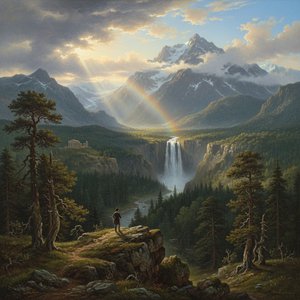
Explore 'Mountain Landscape with Flowers' by Hans Andreas Dahl (1877). A serene Norwegian Romantic landscape painting featuring wildflowers & textured hills. Discover 19th-century art.
Biografia artysty
Hans Dahl – norweski malarz krajobrazowy z epoki romantyzmu, znany z pięknych obrazów fiordów i scen z udziałem młodych kobiet w tradycyjnych strojach. Jego dzieła oddają ducha Norwegii i są cenione za atmosferę oraz realizm.
 Rozwiń treść
from ·
Chapter 1
How large should it be?
Slide to change the size; the picture on the left shows the frame at its real width. The proportions of the original are kept.
Wybierz spośród naszych standardowych rozmiarów, które zachowują oryginalne proporcje dzieła sztuki.

Wpisz wymaganą szerokość i wysokość, aby obraz pasował do Twojej ramy lub ściany. Ponieważ jest to dzieło malowane ręcznie, w przypadku rozmiaru o innych proporcjach artysta może domalować nieco więcej wokół obrazu lub przyciąć jego fragmenty — wybór należy do Ciebie. Przed rozpoczęciem pracy prześlemy Ci cyfrową wizualizację do zatwierdzenia. Obraz widoczny na tej stronie nie przedstawia rzeczywistego efektu — jedynie wizualizacja oddaje realny rezultat.
Chapter 2
How should it arrive?
Choose the edges of the stretched canvas
Choose your frame

White zł1

Blurside zł1

Extended zł1

P118B zł10

P118H zł10

P118W zł10

P438Z zł10

P508JH zł12

P508YH zł12

P805H zł10

P805Z zł10

P919BZ zł10

P919G zł10

P919XJ zł10

P959ZH zł10

P968JZ zł12

W106C zł8

W218G zł10

W218JH zł8

W218Y zł10

W307PJ zł10

W316G zł10

W316PJ zł8

W316Y zł10

W398PJ zł8

W4111J zł10

W500HY zł15

W500JH zł15

W692G zł12

W849H zł8

W940BG zł15

W953PJ zł8

H24-GOLD zł30

H24-SILVER zł30

H36-GOLD zł45

H36-SILVER zł45
W oprawie
Moulding: . Overall size with the frame: .
Chapter 3
Who paints it, and should anything change?
After order, OriginalUniqueArt.com team will email client for instructions and provide a mockup preview
Dostawa na całym świecie () w ciągu 3–4 tygodni zamiast standardowych 5 tygodni. (31 Październik). Bez kompromisów w kwestii jakości.
Chapter 4
The finishing touches
A nameplate, as in a museum?
Szczegóły grawerowanej brązowej tabliczki
This elegant plaque features the artist's name and the title of the artwork, finely engraved for a timeless presentation.
It is made from bronze with a refined, elegant finish. The text is precisely laser-engraved for a sharp and permanent result. Measuring 9x2 cm, the plaque is compact yet easy to read. It's built to be durable and scratch-resistant, offering a professional, museum-quality look. Mounting is simple thanks to the included adhesive backing.
Szczegóły przezroczystej tabliczki akrylowej
The plaque includes essential engraved details such as the artist's name, the title of the artwork, the date it was created, the type of media used-like oil on canvas or watercolor-a brief description of the piece, and a QR code that links to the complete artwork information.
It is crafted from clear acrylic, offering a sleek, modern appearance. The text is UV-engraved in black to ensure strong visual contrast. With a size of 10x15 cm, it ensures optimal readability. It comes equipped with two metal hooks for secure wall mounting. The plaque is designed to be weather-resistant, making it suitable for various environments, and it includes interactive features that work seamlessly with smartphone scanning.
Szczegóły czarnej tabliczki akrylowej
This elegant plaque includes engraved information such as the artist's name, the title of the artwork, the date it was created, the type of media used (like oil on canvas or watercolor), a short description of the artwork, and a QR code for quick access to more information.
The plaque itself is made from refined black acrylic with a premium finish. The text is laser-engraved in white for high contrast and readability. Its size is 10x15 cm, designed to be easy to read. It comes with two metal hooks for professional mounting. The design is sleek and fits any interior style. It is also weather-resistant and durable, with built-in digital integration for mobile compatibility.
A protective varnish?
When do you need it?
Chapter 5
Your painting, as you ordered it

Mountain Landscape with Flowers
Technika reprodukcji
Wymiary reprodukcji
-

Wybitny mistrz artystyczny
Większa szczegółowość, finezja i dodatkowy czas na realizację
-

Opcje oprawy reprodukcji
-
-
W przypadku dzieł sztuki lub reprodukcji, których którykolwiek z boków przekracza 105 cm (około 41 cali), rama zostanie wysłana w formie zestawu do samodzielnego montażu. Metoda ta zapewnia bezpieczną dostawę i zapobiega uszkodzeniom podczas transportu.
Wymagany profesjonalny montaż – nie jest to produkt typu DIY.
Zestaw musi zostać złożony, a płótno naciągnięte przez doświadczonego profesjonalnego ramiarza, przy użyciu kleju do drewna (brak w zestawie), kleszczy do naciągania płótna oraz ścisków, które utrzymają krosna w równej pozycji podczas schnięcia kleju. Nieprawidłowy montaż lub nierównomierne napięcie płótna może trwale uszkodzić dzieło sztuki i nie podlega naszej gwarancji.
 W przypadku dzieł sztuki lub reprodukcji, których którykolwiek z boków przekracza 105 cm (około 41 cali), rama zostanie wysłana w formie zestawu do samodzielnego montażu. Metoda ta zapewnia bezpieczną dostawę i zapobiega uszkodzeniom podczas transportu.
W zestawie znajdują się wszystkie listwy z litego drewna, precyzyjnie docięte do wymiarów.
Montaż odbywa się przy użyciu dołączonych wkrętów oraz kleju do drewna do łączenia narożników, którego zestaw nie zawiera i który musi zostać dostarczony przez ramiarza.
Wymagane są profesjonalne narzędzia, których nie ma w zestawie: kleszcze do naciągania płótna (napinacz) oraz zaciski, które pozwolą utrzymać listwy w równej pozycji podczas schnięcia kleju.
Ważne:
Do połączenia narożników niezbędny jest klej do drewna, listwy należy unieruchomić za pomocą ścisków do momentu całkowitego wyschnięcia kleju, a naciągnięcie płótna na złożoną ramę wymaga użycia kleszczy do naciągania płótna. Żaden z tych elementów nie jest dołączony do zestawu. Przed zamówieniem tego rozmiaru zalecamy konsultację z doświadczonym ramiarzem.

Etykieta obiektu
-
-

Lakier ochronny
Lakier z połyskiem (pogłębia kolory, chroni przed światłem i wilgocią)
-

Personalizacja dzieła
Przykłady możliwości personalizacji: zastąp twarz zdjęciem klienta; dodaj zwierzę domowe (np. zamień kota na psa); umieść ukrytą wiadomość w tle; zmień krajobraz lub elementy tła.
-

Ekspresowa
Dostawa na cały świat () w ciągu 3–4 tygodni zamiast standardowych 5 tygodni. (31 Październik). Bez kompromisów w kwestii jakości.
-
Przesyłka ekspresowa
Dostawa na cały świat () w ciągu 5 tygodni. (7 Listopad).
W cenie
Cena całkowita
zł 1167
Opcja ze szkłem jest dostępna wyłącznie w rozmiarach poniżej 110 cm
Included with every order
- Bezpłatna ekspresowa wysyłka na cały świat
- Wysokiej jakości płótno lniane
- Pełne ubezpieczenie przesyłki
- Gwarancja zwrotu należności celnych i podatków importowych
- Gwarancja wiernego odwzorowania kolorów
- 100-dniowa polityka zwrotów (tylko w przypadku wad)
- Gwarancja 100% zwrotu pieniędzy
- Zniżka przy zakupie wielu sztuk


 Podgląd w skali 1:1
 Wyślij jako kartkę
 Udostępnij
 Szczegóły dzieła
 Przewodnik

 Pobierz obraz
 Podobne obiekty
 RTG
RTG Pokaz slajdów
 Q&A
Q&A Statystyki
In numbers
- 1877the year it was painted
- 29frames to choose from
- standard sizes, in its own proportions
- 5weeks to paint and deliver it
About the original

- 39.0 x 40.0 cm


Hans Dahl
1849 - 1937, Norwegia
Quick facts about Hans Dahl
- Artistic Movement Or Style: Romantyzm
- Artists Or Movements Influenced By This Artist: ['Düsseldorf szkoła malarstwa']
- Artists Who Influenced This Artist:
- Johan Eckersberg
- Knud Bergslien
- Hans Gude
- Date Of Birth: 1849
- Date Of Death: 1937
- Full Name: Hans Andreas Dahl
- Nationality: Norweskie
- Notable Artworks:
- Krajobraz górski
- Świeże bryza
- Dziewczyna nad fiordem
- Place Of Birth: Granvin, Norwegia
Biografia artysty
A Life Embracing the Norwegian Sublime
Hans Dahl, a name inextricably linked to the romantic allure of Norway’s fjords and landscapes, was far more than simply a painter; he served as a chronicler of national identity, a master of capturing atmospheric light, and an embodiment of his country's spirit. Born in 1849 in the idyllic village of Granvin, nestled within the breathtaking Hardangerfjord region, Dahl’s artistic journey began not with brushes and canvases, but with aspirations towards a military career – a path that ultimately yielded to the irresistible call of art. His service as a lieutenant in the Bergenske Brigade from 1871 to 1874 instilled within him a discipline and observational acuity that would later profoundly inform his meticulous approach to landscape painting. However, the siren song of artistic expression proved too powerful to resist; leaving behind the structured life of a soldier, Dahl embarked on formal training, initially with Johan Fredrik Eckersberg and Knud Bergslien in Norway, then venturing abroad to Karlsruhe under Hans Fredrik Gude and Wilhelm Riefstahl, and finally to Düsseldorf where he studied under Eduard von Gebhardt and Wilhelm Sohn.
These formative years spent within the Düsseldorf school of painting were pivotal. This artistic environment, steeped in tradition yet open to innovation, emphasized a detailed realism combined with a touch of imaginative romanticism – a potent blend that would become the defining characteristic of Dahl’s unique style. He meticulously absorbed the techniques for rendering light, atmosphere, and intricate detail championed by his Düsseldorf instructors, but always filtered them through his own distinctly Norwegian sensibility. It was in capturing the essence of his homeland—the dramatic fjords carved by ancient glaciers, the towering mountains shrouded in mist, and the vibrant hues of wildflowers clinging to rocky slopes—that Dahl truly discovered his artistic voice, transforming mere observation into a deeply felt expression of national identity.
The Painter of National Sentiment
Dahl’s paintings resonated profoundly with a burgeoning sense of Norwegian national pride during the 19th century. While landscapes undeniably dominated his oeuvre, he became particularly celebrated for his depictions of young Norwegian women adorned in traditional *bunad* (national costumes), often set against the backdrop of idyllic fjord scenery bathed in golden sunlight. These weren’t merely portraits; they were visual embodiments of cultural heritage and romanticized rural life – a deliberate strategy to evoke nostalgia for a simpler time, celebrating the beauty of Norwegian traditions and fostering a deep connection to the land. His work served as a powerful symbol of national identity, capturing a cherished vision of Norway's past.
His commitment to Romantic ideals—emphasizing emotion, beauty, and the sublime power of nature—set him apart from many of his contemporaries. He wasn’t simply recording what he saw; he was interpreting it through a lens of feeling, imbuing his landscapes with a sense of awe and wonder. This emotional resonance, coupled with his technical skill, made his work immensely popular with the public, solidifying his position as one of Norway's most beloved landscape painters.
Influences and Artistic Development
Dahl’s artistic development was shaped by a confluence of influences. His early training in Norway exposed him to the Romantic traditions of Eckersberg and Bergslien, instilling a love for dramatic landscapes and evocative light. The Düsseldorf school, however, provided him with a more rigorous technical foundation, emphasizing detailed realism and atmospheric perspective. He particularly admired the work of Hans Gude, known for his luminous depictions of Norwegian nature, and Wilhelm Sohn, who taught him to capture the subtle nuances of light and shadow. The influence of Eduard von Gebhardt, a master of historical painting, is also evident in Dahl’s meticulous attention to detail and his ability to create a sense of depth and perspective.
Despite these diverse influences, Dahl never lost sight of his own unique vision. He skillfully blended the Romantic ideals he had absorbed with his own distinctly Norwegian sensibility, creating landscapes that were both beautiful and deeply evocative. His paintings are characterized by their meticulous detail, atmospheric lighting, and a palpable sense of emotion – qualities that contributed to their enduring appeal.
Villa Strandheim and Royal Patronage
In 1893, Dahl realized a long-held dream by commissioning the construction of Villa Strandheim on the banks of the Sognefjord in Balestrand. This magnificent residence, built in the distinctive Scandinavian Dragestil (Dragon Style) architecture, became not only his summer home but also a vibrant hub for artistic gatherings – a sanctuary where fellow painters like Adelsteen Normann could collaborate and exchange ideas. The villa’s location, overlooking the breathtaking fjord, provided Dahl with an unparalleled vantage point from which to capture the beauty of his surroundings.
Dahl’s talent did not go unnoticed by royalty either. He garnered significant patronage from German Emperor Kaiser Wilhelm II, who was captivated by his paintings and frequently visited him at Villa Strandheim. In 1910, Wilhelm bestowed upon Dahl a professorship, recognizing his artistic contributions and solidifying his position as a prominent figure in the art world – a testament to the enduring appeal of his work.
A Legacy Amidst Shifting Tides
Despite his widespread popularity, Dahl faced criticism from some contemporary art historians who viewed his adherence to Romanticism as overly conservative in an era of rapidly evolving artistic trends. Critics like Jens Thiis argued that he resisted the move towards naturalism and modernism, clinging to a style they considered outdated. Christian Krohg echoed this sentiment, suggesting Dahl should have embraced newer approaches. However, Dahl remained steadfast in his artistic vision, believing in the power of Romantic ideals to convey beauty and emotion.
His unwavering commitment ensured that the Romantic tradition continued to thrive in Norwegian art during a period of transition. Today, Hans Dahl’s paintings are highly sought after for their technical brilliance, evocative atmosphere, and nostalgic portrayal of Norwegian life. His legacy extends beyond his canvases; he helped shape a national identity through his art, capturing the spirit of Norway's landscapes and people for generations to come. The artistic flame was carried on by his son, Hans Andreas Dahl (1881-1919), who also pursued painting, ensuring that the family’s creative tradition endured.
Powiązane artykuły

Romantyczny Krajobraz w Malarstwie: 10 Arcydzieł, Które Zdefiniowały Epokę | OriginalUniqueArt.com
Odkryj 10 arcydzieł romantyzmu w malarstwie! Poznaj historie Caspara Davida Friedricha, Turnera i innych mistrzów. Inspiracje wnętrzarskie & reprodukcje obrazów najwyższej jakości na OriginalUniqueArt.com. Eksploruj kolekcję online!

Johan Christian Dahl: Pioneering Norwegian Romantic Landscape Painting
Explore the life & art of Johan Christian Dahl, Norway's first great Romantic painter. Discover his iconic landscapes, cultural impact, and lasting legacy with OriginalUniqueArt.
Evoking Nature's Sublime: A Comprehensive Exploration of 19th-Century Landscape Painting
Explore the captivating world of 19th-century landscape painting! Discover renowned artists like Friedrich & Monet, key movements, and find the perfect artwork to bring nature's serenity into your home. Expert insights at OriginalUniqueArt.

Sublime i malowniczość w krajobrazie romantycznym: Emocje, natura i duchowość w sztuce XIX wieku
Odkryj fascynujący świat romantycznego krajobrazu! Poznaj filozofię Sublime, arcydzieła Friedricha i Turnera oraz wpływ tego nurtu na sztukę. Inspiracje i reprodukcje najwyższej jakości – OriginalUniqueArt.