

 Podgląd w skali 1:1
 Wyślij jako kartkę
 Udostępnij
 Szczegóły dzieła
 Przewodnik

 Pobierz obraz
 Podobne obiekty
 RTG
RTG Pokaz slajdów
 Q&A
Q&A Statystyki
Kobieta grająca na lutni
 Obraz olejny na płótnie
- Sztuka ścienna
- Baroque
 1624
1624 82.0 x 58.0 cm
 Luwr
Luwr
 Rozwiń treść
Giclée / Wydruk artystyczny
Wydruki giclée lub płótna o jakości muzealnej, szybka realizacja i szeroki wybór opcji wykończenia. ( Zamów ręcznie malowaną reprodukcję Przejdź do wersji cyfrowej)




P118B zł10

P118H zł10

P118W zł10

P438Z zł10

P508JH zł12

P508YH zł12

P805H zł10

P805Z zł10

P919BZ zł10

P919G zł10

P919XJ zł10

P959ZH zł10

P968JZ zł12

W106C zł8

W218G zł10

W218JH zł8

W218Y zł10

W307PJ zł10

W316G zł10

W316PJ zł8

W316Y zł10

W398PJ zł8

W4111J zł10

W500HY zł15

W500JH zł15

W692G zł12

W849H zł8

W940BG zł15

W953PJ zł8




Wybierz spośród naszych standardowych rozmiarów, które zachowują oryginalne proporcje dzieła sztuki.

Wpisz wymaganą szerokość i wysokość, aby dopasować grafikę do ramy lub ściany. Wydruk można jedynie przyciąć, nigdy nie powiększając go poza oryginalny obraz, dlatego format o innych proporcjach spowoduje utratę części kompozycji. Przed rozpoczęciem druku prześlemy Ci cyfrowy podgląd do zatwierdzenia. Obraz wyświetlany na tej stronie nie pokazuje rzeczywistego przycięcia — jedynie podgląd oddaje ten efekt.
Dostawa na cały świat () w ciągu 2 tygodni zamiast standardowych 4/5 tygodni. (29 Październik)

Bezpłatna ekspresowa wysyłka na cały świat

Wysokiej jakości płótno lniane

Pełne ubezpieczenie przesyłki

Gwarancja zwrotu należności celnych i podatków importowych

Gwarancja wiernego odwzorowania kolorów

100-dniowa polityka zwrotów (tylko w przypadku wad)

Gwarancja 100% zwrotu pieniędzy

Zniżka przy zakupie wielu sztuk
 Opcja ze szkłem jest dostępna wyłącznie w rozmiarach poniżej 110 cm

Kobieta grająca na lutni
Giclée / Wydruk artystyczny
Wymiary reprodukcji
-


Cena całkowita
zł 308
Gerard van Honthorst’s “Woman Playing the Guitar” – A Baroque Masterpiece of Light and Intrigue
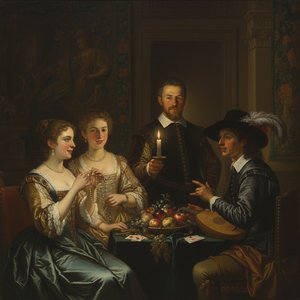
Gerard van Honthorst’s “Woman Playing the Guitar,” painted in 1624, is more than just a portrait; it's a carefully constructed tableau brimming with symbolism and bathed in the dramatic chiaroscuro that defined his signature style. This captivating work, now housed within the Louvre Museum in Paris, offers a glimpse into the vibrant world of the Dutch Golden Age – a period of artistic flourishing fueled by Italian influences and a burgeoning sense of national identity. Honthorst, nicknamed “Gherardo delle Notti” for his masterful manipulation of light and shadow, transports us to a private moment, an intimate scene rendered with astonishing realism and emotional depth.
The painting immediately draws the eye to its central figure: a young woman lost in the act of playing a lute. Her pose is subtly engaging – her head turned slightly away, creating a sense of intimacy while simultaneously inviting us into her world. The composition is meticulously balanced, utilizing a one-point perspective that directs our gaze towards her, anchoring the scene within a dark and undefined background. This strategic use of darkness isn’t merely decorative; it amplifies the luminosity of her face and upper body, highlighting her beauty and drawing attention to the details of her attire and expression.
The Language of Light: Honthorst's Caravaggistic Technique
Honthorst’s genius lies in his ability to evoke a powerful sense of drama through light. He was deeply influenced by Caravaggio, adopting his technique of *tenebrism* – the dramatic contrast between intensely bright areas and deep shadows. This isn’t simply about creating visual interest; it's about conveying emotion and atmosphere. Notice how the single, unseen light source illuminates her face, casting long, suggestive shadows that envelop the rest of the composition. These shadows aren’t merely absences of light; they actively shape our perception of the scene, adding a layer of mystery and intrigue.
The artist's meticulous attention to detail is equally remarkable. The textures of the fabrics – the flowing gown, the feathered headdress – are rendered with astonishing realism. The skin tones possess a subtle warmth, achieved through careful layering of pigments. Even the lute itself—a symbol of music and artistry—is depicted with painstaking accuracy. The use of organic lines follows the contours of the woman’s face, hair, and clothing, creating a harmonious and visually pleasing composition. This deliberate control over form and texture speaks to Honthorst's mastery of his craft.
Symbolism and Context: A Portrait of Status and Grace
Beyond its technical brilliance, “Woman Playing the Guitar” is rich in symbolic meaning. The lute itself represents music, artistry, and perhaps even romantic longing. The feathers adorning her headdress are particularly significant – they suggest nobility, connection to nature, or possibly a reference to the theatrical world, where musicians were often considered performers of great skill and allure. These details hint at a complex social context, reflecting the importance of patronage and status within 17th-century Dutch society.
Considering the historical period, this painting likely served as more than just a simple portrait. It was a carefully crafted statement about beauty, grace, and perhaps even the role of women in society. The lighting, the pose, and the symbolic elements all contribute to a sense of heightened drama and emotional intensity – qualities that are characteristic of Baroque art and deeply resonate with viewers today. The work’s placement within the Louvre Museum underscores its enduring significance as a masterpiece of Dutch Golden Age painting.
A Reproduction for Your Collection
OriginalUniqueArt offers exquisite, hand-painted reproductions of Gerard van Honthorst's “Woman Playing the Guitar,” allowing you to bring this captivating Baroque masterpiece into your home or office. Our skilled artists meticulously recreate every detail – from the subtle nuances of light and shadow to the intricate textures of fabric and feathers – ensuring that your reproduction captures the essence of the original painting. Whether you’re an art collector, interior designer, or simply someone who appreciates beauty and artistry, a OriginalUniqueArt reproduction is a stunning addition to any space.
Pytania i odpowiedzi
Jaki poziom kontrastu prezentuje „Kobieta grająca na lutni” – Gerard van Honthorst?
Poziom kontrastu dzieła „Kobieta grająca na lutni” – Gerard van Honthorst wynosi Oświadczenie.
Czy mogę użyć rozszerzonej rzeczywistości, aby zobaczyć „Kobieta grająca na lutni” – Gerard van Honthorst w swoim pokoju?
Dzieło „Kobieta grająca na lutni” – Gerard van Honthorst możesz zobaczyć na własnej ścianie dzięki stronie Podgląd w AR, wykorzystując rozszerzoną rzeczywistość na kompatybilnym urządzeniu.
W jaki sposób „Kobieta grająca na lutni” – Gerard van Honthorst łączy Baroque z krajem pochodzenia artysty?
"Kobieta grająca na lutni" łączy nurt Baroque z Holandia poprzez miejsce urodzenia jego twórcy.
Biografia artysty
A Master of Light and Shadow: The Life and Art of Gerard van Honthorst
Gerard van Honthorst emerged from Utrecht in 1592, a pivotal figure poised to illuminate the Dutch Golden Age with his dramatic artistry. Initially guided by his father, a decorative painter, young Gerard’s talent blossomed under the tutelage of Abraham Bloemaert, establishing a solid foundation in draftsmanship and composition. However, it was a transformative journey to Rome that irrevocably altered the course of his artistic development. There, amidst the fervent energy of the Italian Baroque, he encountered the groundbreaking work of Caravaggio – an encounter that would define his signature style and earn him the evocative nickname “Gherardo delle Notti,” or Gerard of the Nights. The dramatic use of *tenebrism*, a technique employing stark contrasts between light and dark, became Honthorst’s hallmark, imbuing his canvases with a palpable sense of drama and emotional intensity. He wasn't merely imitating Caravaggio; he was translating the Italian master’s innovations into a distinctly Dutch sensibility, focusing on intimate scenes illuminated by artificial light sources – candles, lamps, and fires – creating an atmosphere both realistic and deeply theatrical. This mastery over light wasn’t simply technical skill; it was a means of revealing character, of drawing the viewer into the emotional core of each scene. Honthorst's early works in Rome showcased this talent brilliantly, establishing him as a rising star within the Italian art world.From Roman Acclaim to Dutch Mastery
Honthorst’s time in Rome was marked by considerable success and patronage. He found favor amongst the city’s elite, including Vincenzo Giustiniani, for whom he created the powerful “Christ Before the High Priest,” a work that exemplifies his masterful command of light and shadow. This painting, now residing in London’s National Gallery, showcases not only his technical skill but also his ability to convey profound psychological depth within his figures. The scene depicts Christ calmly awaiting judgment before the High Priest Caiaphas, bathed in a dramatic spotlight while the surrounding figures are shrouded in darkness – a masterful use of *tenebrism* that heightens the drama and emphasizes Christ’s serenity amidst impending doom. He further solidified his reputation by working for Cosimo II de' Medici, Grand Duke of Tuscany, demonstrating an adaptability and versatility that would serve him well throughout his career. Honthorst’s ability to capture not just physical likeness but also the character and social standing of his sitters made him highly sought after by wealthy merchants, nobles, and even royalty. This period saw a flourishing of commissions, allowing Honthorst to refine his style and establish a distinctive voice within Dutch painting. His portraits were particularly admired for their realism and psychological insight, capturing the nuances of personality with remarkable skill.The Utrecht Caravaggisti: A Distinctly Dutch Interpretation
Upon returning to Utrecht around 1620, Honthorst quickly established himself as a leading portrait painter in the Dutch Republic. He was a key figure in the *Utrecht Caravaggisti* movement – a group of Dutch painters who embraced Caravaggio’s dramatic realism and *tenebrism*. Alongside artists like Hendrick ter Brugghen and Dirck van Baburen, he helped to establish a distinctly Dutch interpretation of Italian Baroque style. The Utrecht Caravaggisti didn't simply copy Caravaggio; they adapted his techniques to the Dutch context, often incorporating elements of genre scenes and everyday life into their works. Honthorst’s emphasis on genre scenes illuminated by artificial light – candlelight, lamps, or fireplaces – became a hallmark of his style. These scenes weren’t merely decorative; they were imbued with emotional intensity and psychological depth, reflecting the complexities of human experience. His willingness to experiment with unusual lighting effects and dramatic compositions set him apart from other artists of his time.Courtly Artist: Commissions and Collaborations
The reach of Honthorst’s talent extended beyond the Netherlands. His work attracted the attention of Sir Dudley Carleton, who enthusiastically recommended him to prominent English aristocrats like the Earl of Arundel and Lord Dorchester. This led to commissions from Queen Elizabeth of Bohemia, sister of Charles I, who employed him as both a painter and drawing master for her children. These royal connections culminated in significant works such as the allegorical depiction of Charles and Henrietta Maria as Diana and Apollo, now housed at Hampton Court Palace – a grand composition that showcases Honthorst’s mastery of perspective and his ability to create visually stunning scenes. Honthorst’s willingness to collaborate with other artists also speaks to his open-mindedness and artistic generosity. He famously hosted Peter Paul Rubens during a visit to Utrecht, even painting him in a playful scene depicting Diogenes searching for an honest man – a testament to the mutual respect between these two Baroque giants. These collaborations weren't simply about sharing workload; they were intellectual exchanges that enriched the artistic landscape.Legacy and the Enduring Power of Light
Gerard van Honthorst’s influence resonated far beyond his lifetime. He was a key figure in the *Utrecht Caravaggisti* movement – a group of Dutch painters who embraced Caravaggio’s dramatic realism and *tenebrism*. His emphasis on genre scenes illuminated by artificial light, his masterful portraits, and his ability to convey emotional depth through skillful use of chiaroscuro left an indelible mark on the development of Dutch Golden Age painting. Even his brother, Willem van Honthorst, followed in his footsteps, though often with works initially misattributed to Gerard due to stylistic similarities. Van Honthorst died in Utrecht in 1656, leaving behind a body of work that continues to captivate audiences today and remind us of the enduring power of light and shadow to reveal the human condition. His paintings are celebrated for their dramatic beauty, psychological insight, and masterful use of *tenebrism*, solidifying his place as a pivotal figure in art history.
Gerard van Honthorst
1590 - 1656 , Holandia
Krótka nota
- Artistic Movement Or Style: Barok, Caravaggismo
- Artists Or Movements Influenced By This Artist: ['Utrecht Caravaggisti']
- Artists Who Influenced This Artist: ['Caravaggio']
- Date Of Birth: 1590
- Date Of Death: 1656
- Full Name: Gerard van Honthorst
- Nationality: Holender
- Notable Artworks:
- Chrystus przed Kajfaszem
- Sąd Midasa
- Place Of Birth: Utrecht, Holandia
Powiązane artykuły

Golden Light & Dutch Skies: The Timeless Magic of Dutch Golden Age Landscapes
Discover the breathtaking beauty of Dutch Golden Age landscapes. Explore the mastery of light, chiaroscuro, and 17th-century realism through an expert art history lens, celebrating the enduring legacy of the Dutch Masters for discerning collectors and art lovers.

Złoty Wiek Niderlandów: Światło, Realizm i Kulturowe Innowacje w Malarstwie Barokowym
Odkryj fascynujący świat malarstwa holenderskiego Złotego Wieku! Poznaj arcydzieła Rembrandta, Vermeera i innych mistrzów. Analiza technik, gatunków i wpływu na sztukę europejską.
Gerard van Honthorst: Illuminating the Dutch Golden Age with Caravaggism & Courtly Grace
Explore the captivating world of Gerard van Honthorst, a Dutch Golden Age master renowned for his dramatic chiaroscuro & courtly portraits. Discover his life, art, and lasting influence on Baroque painting.

Holenderski Barok: 10 Arcydzieł, Które Zdefiniowały Epokę | OriginalUniqueArt
Poznaj 10 arcydzieł holenderskiego baroku! Odkryj historie Rembrandta, Vermeera i innych mistrzów XVII wieku. Reprodukcje obrazów najwyższej jakości – idealne do Twojego wnętrza. OriginalUniqueArt.com

Złoty Wiek Holandii: 10 arcydzieł, które zmieniły historię sztuki | OriginalUniqueArt.com
Odkryj 10 arcydzieł Złotego Wieku Holandii! Poznaj historię Rembrandta, Vermeera i innych mistrzów. Reprodukcje obrazów najwyższej jakości do Twojego wnętrza – OriginalUniqueArt.com.

