

 Zobacz w skali 1:1
 Wyślij
 Udostępnij
 Szczegóły
 Przewodnik

 Pobierz plik obrazu
 Podobne obiekty
 RTG
RTG Pokaz slajdów
 Statystyki
St. Matthew


 Czytaj więcej
Giclée / Wydruk artystyczny
Wydruki giclée lub płótna o jakości muzealnej, szybka realizacja i szeroki wybór opcji wykończenia. ( Kup ręcznie malowany obraz Przełącz na wersję cyfrową)




P118B $10

P118H $10

P118W $10

P438Z $10

P508JH $12

P508YH $12

P805H $10

P805Z $10

P919BZ $10

P919G $10

P919XJ $10

P959ZH $10

P968JZ $12

W106C $8

W218G $10

W218JH $8

W218Y $10

W307PJ $10

W316G $10

W316PJ $8

W316Y $10

W398PJ $8

W4111J $10

W500HY $15

W500JH $15

W692G $12

W849H $8

W940BG $15

W953PJ $8




Wybierz spośród naszych standardowych rozmiarów, które zachowują oryginalne proporcje dzieła sztuki.

Możesz wprowadzić własne wymiary, aby dopasować dzieło do konkretnej ramy lub przestrzeni. Jeśli wybrany rozmiar nie będzie odpowiadał proporcjom oryginalnego obrazu, przytniecie dzieło lub rozszerzymy obraz za pomocą odbicia lustrzanego lub jednolitego wypełnienia krawędzi. Przed rozpoczęciem produkcji prześlemy cyfrową wizualizację do Twojej akceptacji.
Prosimy pamiętać, że podgląd na ekranie nie odzwierciedla faktycznego przycinania ani rozszerzania. Tylko wizualizacja dokładnie pokaże końcową kompozycję.
Mimo dostępności niestandardowych rozmiarów, zalecamy wybór wymiaru z listy zdefiniowanej, aby zachować oryginalne proporcje.
Dostawa na cały świat () w ciągu 2 tygodni zamiast standardowych 4/5 tygodni. (26 Wrzesień)

Bezpłatna ekspresowa wysyłka na cały świat

Wysokiej jakości płótno lniane

Pełne ubezpieczenie transportowe

Gwarancja zwrotu należności celnych i podatków importowych

Gwarancja idealnego odwzorowania barw

100-dniowy okres na zwrot dzieła w przypadku wykrycia wad produkcyjnych

Gwarancja 100% zwrotu pieniędzy

Oferta przy zakupie wielu sztuk
 Opcja ze szkłem jest dostępna wyłącznie w rozmiarach poniżej 110 cm

St. Matthew
Giclée / Wydruk artystyczny
Rozmiar reprodukcji
-


Suma do zapłaty
$ 80
A Moment of Reflection Illuminated: Georges de La Tour’s St. Matthew
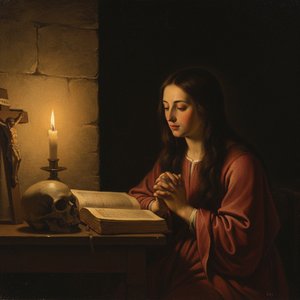
Georges de La Tour's "St. Matthew" isn’t merely a depiction of biblical scripture; it’s an embodiment of Baroque spirituality distilled into a single, exquisitely crafted tableau. Painted circa 1620, this artwork transcends the confines of its historical period—the turbulent reign of Louis XIII and Marie de Médicis—to speak to universal themes of faith, contemplation, and the profound beauty found within solitude. The painting captures Matthew, arguably one of Christendom’s most revered figures, absorbed in prayer at a simple wooden table bathed in the ethereal glow of candlelight. This deliberate use of illumination is paramount to La Tour's artistic vision, mirroring the theological concept of divine grace penetrating darkness—a technique he perfected and championed throughout his prolific career.- Style & Technique: La Tour’s signature style – known as tenebrism – distinguishes itself through dramatic contrasts between light and shadow. He eschewed conventional perspectival techniques, favoring instead a flattened space that prioritizes emotional impact over realistic representation. The artist meticulously builds up layers of pigment using glazing methods, creating an astonishingly luminous surface despite the predominantly dark palette. This painstaking process ensures that every speckle of light radiates warmth and conviction.
- Historical Context: Lorraine under Louis XIII was a region grappling with religious tensions between Catholics and Huguenots (Protestants). La Tour’s devout Catholicism profoundly influenced his artistic output, reflecting the pervasive piety of the era. Yet, he wasn't simply documenting religious dogma; he sought to convey an inner experience—the transformative power of faith—that resonated deeply with audiences.
- Symbolism & Composition: The solitary figure of Matthew is positioned centrally against a backdrop of deep browns and blacks, symbolizing the spiritual darkness from which divine illumination emerges. The open book represents scripture itself – the source of Matthew’s devotion – while the candlelight symbolizes God's grace illuminating the human soul. Notice how La Tour subtly directs our gaze upwards towards the flickering flame, inviting contemplation on the divine presence.
- Emotional Impact: Viewing “St. Matthew” evokes a palpable sense of serenity and introspection. The artist’s masterful manipulation of light creates an atmosphere of hushed reverence, transporting the viewer into the contemplative space inhabited by the Apostle. It's a painting that speaks to the yearning for spiritual solace—a timeless reminder of the beauty inherent in quiet devotion.
Further Exploration & Reproduction Considerations
For collectors and interior designers alike, acquiring a high-quality reproduction of Georges de La Tour’s “St. Matthew” offers an opportunity to bring this iconic Baroque masterpiece into any home. OriginalUniqueArt.com specializes in meticulously crafted reproductions utilizing archival inks on canvas or paper—capturing the nuances of La Tour's technique and preserving the artwork's luminous quality for generations to come. Consider pairing it with complementary furnishings – perhaps a muted palette of creams and browns – to enhance its contemplative mood and celebrate the enduring legacy of this extraordinary artist.Biografia artysty
A Life Bathed in Shadow: The Enigmatic World of Georges de La Tour
Georges de La Tour, a name that resonates with the hushed reverence reserved for masters of light and shadow, remains one of the most compelling figures of the French Baroque. Born in 1593 in Vic-sur-Seille, a small town nestled within the Duchy of Lorraine, his life unfolded against a backdrop of religious fervor and political upheaval. While details surrounding his early training remain somewhat elusive—scholars speculate about potential journeys to Italy or apprenticeships with local artists like Jacques Bellange—the seeds of his artistic vision were undoubtedly sown in this environment. He wasn’t born into an artistically established family; his father was a baker, yet the circumstances of his mother's lineage hint at a possible connection to nobility, a subtle influence perhaps reflected in the dignity and quiet grace that permeate his work. In 1617 he married Diane Le Nerf, establishing a stable home life in Lunéville, where he would spend much of his career serving both the French court and the Dukes of Lorraine. This dual patronage allowed him to flourish, yet it was within the intimate confines of domestic scenes and religious contemplation that his true genius found expression.The Dance of Light and Darkness: Artistic Influences and Development
De La Tour’s artistic journey wasn't one of radical innovation but rather a masterful synthesis of existing influences, transformed through the lens of his unique sensibility. The dramatic chiaroscuro—the stark contrast between light and dark—that defines his paintings owes an undeniable debt to Caravaggio, the Italian master who revolutionized painting with his intensely realistic and emotionally charged scenes. However, De La Tour didn’t simply imitate; he filtered Caravaggism through the prism of Dutch Caravaggisti, particularly those from the Utrecht School like Hendrick Terbrugghen. This fusion resulted in a style that was both powerful and restrained, characterized by a muted palette dominated by earth tones and subtle gradations of light. His early works, predating 1630, exhibit a greater vibrancy and dynamism, reflecting the influence of the Utrecht school. But as his career progressed, he moved towards an increasingly introspective and minimalist aesthetic. He began to pare down compositions, focusing on essential forms and reducing extraneous details, creating scenes that felt both timeless and deeply personal. This evolution wasn’t merely technical; it was a reflection of his growing spiritual depth and his desire to convey profound emotional truths through the simplest of means.Candlelight and Contemplation: Major Works and Recurring Themes
The hallmark of De La Tour's oeuvre is undoubtedly his masterful use of candlelight, which he employed not merely as a source of illumination but as a metaphor for divine grace and spiritual awakening. His paintings are often set at night, with figures bathed in the warm, flickering glow of a single candle or lamp. This creates an atmosphere of intimacy and quiet contemplation, drawing the viewer into the scene and inviting them to share in the emotional experience of the subjects. The Fortune-Teller, painted around 1630, exemplifies this early style—a lively genre scene rendered with sharp observation and dramatic lighting. But it is his later religious works that truly showcase his genius. Adoration of the Shepherds, created around 1640, demonstrates his ability to imbue a traditional subject with profound emotional resonance. The figures are not idealized or heroic; they are ordinary people, humbled by the presence of the divine. The Tears of Saint Peter, painted in the 1650s, is a particularly poignant example of his psychological insight—the apostle’s grief rendered with heartbreaking subtlety and realism. Saint Joseph the Carpenter, another iconic work, depicts a serene domestic scene, highlighting De La Tour's mastery of capturing the quiet dignity of everyday life. These paintings aren’t simply depictions of religious events; they are meditations on faith, doubt, and the human condition.A Rediscovered Legacy: Historical Significance and Enduring Appeal
Despite achieving recognition during his lifetime—he was appointed “Painter to the King” by Louis XIII in 1638—De La Tour’s work fell into relative obscurity after his death in 1652. For centuries, many of his paintings were misattributed to other artists, and his name faded from art historical memory. It wasn't until the early 20th century that a concerted effort was made to rediscover and re-evaluate his oeuvre, led by scholars like Hermann Voss. This rediscovery revealed an artist of extraordinary originality and depth, whose work bridged the gap between Caravaggism and French Classicism. De La Tour’s innovative use of light and shadow, combined with his psychological insight into his subjects, continues to captivate audiences today. His paintings offer a glimpse into 17th-century life and spirituality, reflecting both the religious fervor and the social realities of his time. *He remains celebrated for his ability to imbue everyday scenes with profound meaning and emotional depth*, reminding us that even in the darkest of times, there is always hope to be found in the flickering light of faith and human connection. His influence can be seen in later artists who explored similar themes of introspection and spiritual longing, solidifying his place as a pivotal figure in the history of European art.
Georges de La Tour
1593 - 1652 , Francja
Najważniejsze informacje
- Artistic Movement Or Style: Barok, Tenebrism
- Artists Or Movements Influenced By This Artist: ['Francuska Klasyka']
- Artists Who Influenced This Artist:
- Caravaggio
- Terbrugghen
- Date Of Birth: 13 marca 1593
- Date Of Death: 30 stycznia 1652
- Full Name: Georges de La Tour
- Nationality: Francuz
- Notable Artworks:
- Fortune Teller
- Uznanie Syna
- Święty Sebastian
- Place Of Birth: Vic-le-Comte, Francja
Zobacz także powiązane artykuły

Georges Seurat: 25 Arcydzieł Punktalizmu dla Twojego Domu | OriginalUniqueArt.com
Odkryj 25 arcydzieł Georges'a Seurata! Poznaj historię punktalizmu, impresjonistyczne pejzaże i fascynującą technikę malarską. Reprodukcje obrazów najwyższej jakości na OriginalUniqueArt.com – inspiracje do Twojego wnętrza. Eksploruj pełną kolekcję online!

Georges Braque: 25 Arcydzieł Kubizmu i Nowoczesnej Sztuki | OriginalUniqueArt.com
Odkryj 25 arcydzieł Georges'a Braque – pioniera kubizmu i malarstwa nowoczesnego. Poznaj historię, techniki i inspiracje za jego najsłynniejszymi obrazami. Reprodukcje najwyższej jakości na OriginalUniqueArt.com! Eksploruj pełną kolekcję online.

Francisco Goya: 25 Arcydzieł Genialnego Malarza Hiszpańskiego | OriginalUniqueArt.pl
Odkryj 25 arcydzieł Francisco Goyi – od portretów królewskich po dramatyczne 'Czarne Malowidła'. Poznaj historię, technikę i emocje hiszpańskiego mistrza. Reprodukcje obrazów najwyższej jakości na OriginalUniqueArt.com! Eksploruj kolekcję online.

Maurice Quentin de La Tour: Light, Shadow & the Rococo Portrait
Explore the captivating world of Maurice Quentin de La Tour, a master of Rococo portraiture. Discover his innovative pastel techniques, intimate depictions of French aristocracy, and lasting artistic legacy. Learn more at OriginalUniqueArt.
Georges de La Tour: Luminosity, Spirituality & Realism in Baroque Painting
Discover the captivating world of Georges de La Tour, a Baroque master renowned for his dramatic chiaroscuro & spiritual realism. Explore key works, influences, and his remarkable rediscovery. Learn more at OriginalUniqueArt.


