Cubist
untitled (Georges Braque)
Georges Braque (1882–1963) stworzył untitled. Należy do nurtu Cubist. Wykonano w technice Oil On Canvas.
- Oil On Canvas

 Podgląd w skali 1:1

 Ręcznie malowany obraz olejny
 Wyślij jako kartkę
 Udostępnij
 Karta informacyjna


 Pobierz obraz
 Podobne obiekty
 RTG
 Pokaz slajdów
 Pytania i odpowiedzi

 Statystyki
untitled w skrócie
- Tytuł
- untitled
- Artysta
- Georges Braque (1882–1963)
- Miejsce urodzenia artysty
- Argenteuil, Francja
- Technika wykonania
- Oil On Canvas
- Ruch
- Cubist
- Epoka
- Modern
- Temat
- geometric shapes, monochrome palette, fragmented composition, chair arrangement, analytical cubism, spatial illusion
Co przedstawia untitled?
The Architecture of Perception: Deconstructing Reality in Braque’s Vision
In the quiet revolution that redefined the boundaries of modern vision, Georges Braque’s “untitled (7718)” emerges as a profound meditation on the nature of sight itself. This seminal work of Analytic Cubism does not merely present a still life; it orchestrates a complex symphony of fragmented forms and muted tones that challenge the viewer to look beyond the surface. At first glance, one perceives the familiar—a chair, perhaps, adorned with the humble artifacts of daily existence: vases, books, bottles, and a bowl. Yet, as the eye lingers, the solidity of these objects begins to dissolve into a rhythmic dance of geometric planes. Braque invites us into a world where the boundaries between object and space are intentionally blurred, creating an immersive experience that transcends mere representation.
The mastery of this piece lies in its radical technique, a meticulous deconstruction of form that was revolutionary for the dawn of the 20th century. Eschewing the vibrant, emotive colors of Fauvism, Braque employs an austere and sophisticated palette dominated by grayscale, subtle browns, and soft beiges. This monochromatic approach serves a higher intellectual purpose: it strips away the distraction of color to focus the viewer's attention on the structural integrity of the composition. Through layered brushstrokes and a careful interplay of light and shadow, the artist creates a sense of depth through overlapping triangles, rectangles, and cubes. The result is a tactile, textured surface that feels both intellectually rigorous and deeply contemplative.
A Legacy of Innovation and Emotional Resonance
To understand this artwork is to understand the historical seismic shift occurring in Paris around 1908. Influenced by the structural lessons of Cézanne, Braque sought to capture the essence of an object from multiple viewpoints simultaneously. This was not a pursuit of visual accuracy, but an exploration of how we perceive reality through time and movement. The painting embodies the scientific and mathematical fascinations of its era, reflecting a desire to find the underlying geometric truth within the chaos of the physical world. There is a profound sense of order hidden within the apparent fragmentation, a structured logic that guides the gaze across the canvas along vertical axes and angular intersections.
For the discerning collector or interior designer, this reproduction offers more than just a decorative element; it provides a focal point of intellectual depth and quiet elegance. The somber, muted atmosphere of the piece lends itself beautifully to sophisticated spaces, where its complex textures can interact with natural light to create an aura of timelessness. Whether placed in a contemporary studio or a classic study, Braque’s work evokes a sense of introspection and stability. It is a piece that does not shout for attention but rather commands it through its subtle complexity, making it an enduring choice for those who appreciate art that stimulates the mind as much as it delights the eye.
Zdjęcia w wysokiej rozdzielczości dzieła untitled
Chronione prawem autorskim: pliki te służą wyłącznie do osobistego wglądu i nie stanowią licencji na ich powielanie.
Georges Braque, untitled.
Odpowiedzi na pytania dotyczące untitled
W jakiej technice wykonano „untitled” – Georges Braque?
„untitled” wykonano w technice Oil On Canvas.
Co przedstawia „untitled” – Georges Braque?
Tematyka dzieła "untitled" to geometric shapes, monochrome palette, fragmented composition, chair arrangement, analytical cubism, spatial illusion, texture variation.
Czy dzieło "untitled" znajduje się w domenie publicznej?
Status praw autorskich dla „untitled” – Georges Braque: dzieło znajduje się w nadal objęte ochroną prawa autorskiego. Określa to, czy reprodukcje obrazu mogą być sporządzane swobodnie.
Kto stworzył "untitled"?
Autorstwo dzieła "untitled" przypisuje się Georges Braque.
Do jakiego nurtu artystycznego należy „untitled” – Georges Braque?
„untitled” – Georges Braque należy do nurtu Cubist. Nurt ten stanowi stylistyczny kontekst dzieła.
Do którego okresu twórczości Georges Braque należy dzieło „untitled”?
"untitled" reprezentuje Mature Period twórczości Georges Braque.
Z czego wynika obecny status praw autorskich dzieła "untitled"?
Dzieło "untitled" autorstwa Georges Braque znajduje się w nadal objęte ochroną prawa autorskiego. Okres ochrony praw autorskich liczony jest od daty śmierci artysty, a Georges Braque zmarł(a) w 1963.
W jaki sposób "untitled" wpisuje się w tematykę i styl twórczości Georges Braque?
"untitled" dzieli z innymi dziełami Georges Braque styl właściwy dla Cubist oraz powracające motywy: analytical cubism, formal experimentation, spatial distortion, geometric reduction, legacy braque’s contribution.
Jakie miejsce zajmuje „untitled” wśród powracających motywów w twórczości Georges Braque?
„untitled” przedstawia geometric shapes, monochrome palette, fragmented composition, chair arrangement, analytical cubism, spatial illusion, texture variation, podczas gdy powracające motywy u Georges Braque to analytical cubism, formal experimentation, spatial distortion, geometric reduction, legacy braque’s contribution. Porównanie tych dwóch elementów ukazuje, jak dzieło nawiązuje do typowej dla tego artysty tematyki.
O artyście: Georges Braque
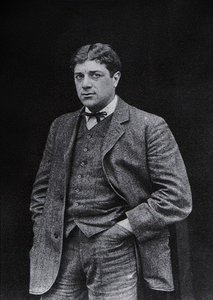
1882–1963, Francja
Georges Braque
Wczesne lata, rodzina i wykształcenie Georges Braque urodził się w 1882 roku w Argenteuil we Francji. Jego wczesne lata upłynęły w Le Havre, w domu, którego codzienność definiowały praktyczne aspekty dekoracji i koloru. Dorastając w rodzinie malarzy i dekoratorów domów, od najmłodszych lat był zanurzony w namacalnej rzeczywistości swojego rzemiosła. To wychowanie zapewniło mu fundament technicznego warsztatu, który w późniejszych latach nadał głębi jego podejściu do płótna.
Inne prace Georges Braque
 Mandolina1910
 Mężczyzna z gitarą1914
 Domki Przy Estace
 Harbor w Normandii1909
Eseje o untitled
 From Cézanne to Cubism: The Revolutionary Evolution of Modern Art's Structural VisionExplore the profound transition from Cézanne’s structural Post-Impressionism to the revolutionary fractured forms of Cubism. A sophisticate…
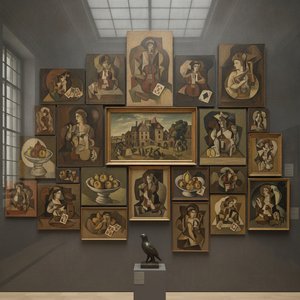 Mastering Cubism: The Top 25 Georges Braque ArtworksJourney through the revolutionary world of Georges Braque. Explore 25 iconic Cubist masterpieces, from geometric abstractions to timeless s…
 Georges Braque: The Architect of Form and the Soul of Cubist RevolutionExplore the profound legacy of Georges Braque, a master of Cubism. Discover how his technical craftsmanship and collaboration with Picasso …