 Podgląd w skali
 Wyślij jako kartkę
 Udostępnij
 Szczegóły dzieła

 Pobierz
 Podobne obiekty
 RTG
RTG Pokaz slajdów
Winter in Union Square


 Rozwiń treść
Ręcznie malowana reprodukcja olejowa
Ręcznie malowany obraz olejny na płótnie, wykonany na zamówienie przez naszych artystów w wybranym przez Ciebie wymiarze i oprawie. ( Zamów wydruk Kup obraz wysokiej rozdzielczości)




P118B $10

P118H $10

P118W $10

P438Z $10

P508JH $12

P508YH $12

P805H $10

P805Z $10

P919BZ $10

P919G $10

P919XJ $10

P959ZH $10

P968JZ $12

W106C $8

W218G $10

W218JH $8

W218Y $10

W307PJ $10

W316G $10

W316PJ $8

W316Y $10

W398PJ $8

W4111J $10

W500HY $15

W500JH $15

W692G $12

W849H $8

W940BG $15

W953PJ $8




Wybierz spośród naszych standardowych rozmiarów, które zachowują oryginalne proporcje dzieła sztuki.

Możesz wprowadzić własne wymiary, aby dopasować obraz do konkretnej ramy lub przestrzeni. Jeśli wybrany rozmiar nie będzie odpowiadał proporcjom oryginału, przytniecie dzieło sztuki lub rozszerzymy je o dodatkowe elementy, ręcznie domalowane przez artystę. Przed rozpoczęciem produkcji wyślemy projekt cyfrowy do Twojej akceptacji.
Należy pamiętać, że podgląd na ekranie nie odzwierciedla rzeczywistego przycinania ani rozszerzania obrazu. Tylko projekt dokładnie pokaże ostateczną kompozycję.
Choć oferujemy możliwość zamówienia niestandardowych rozmiarów, zalecamy wybór wymiaru z gotowej listy, aby zachować oryginalne proporcje dzieła.
Po złożeniu zamówienia zespół OriginalUniqueArt.com skontaktuje się z klientem drogą mailową w celu uzyskania instrukcji i prześle wizualizację projektu
Dostawa na całym świecie () w ciągu 3–4 tygodni zamiast standardowych 5 tygodni. (14 Sierpień). Bez kompromisów w kwestii jakości.

Bezpłatna ekspresowa wysyłka na cały świat

Wysokiej jakości płótno lniane

Pełne ubezpieczenie przesyłki

Gwarancja zwrotu należności celnych i podatków importowych

Gwarancja wiernego odwzorowania kolorów

Polityka 60-dniowego zwrotu (tylko w przypadku wad)

Gwarancja 100% zwrotu kosztów

Zniżka przy zamówieniu wielu produktów
 Opcja ze szkłem jest dostępna wyłącznie w rozmiarach poniżej 110 cm

Winter in Union Square
Technika reprodukcji
Wymiary reprodukcji
-


Cena całkowita
$ 300
Opis dzieła
A Winter’s Embrace in Union Square – A Glimpse of Hassam's New York
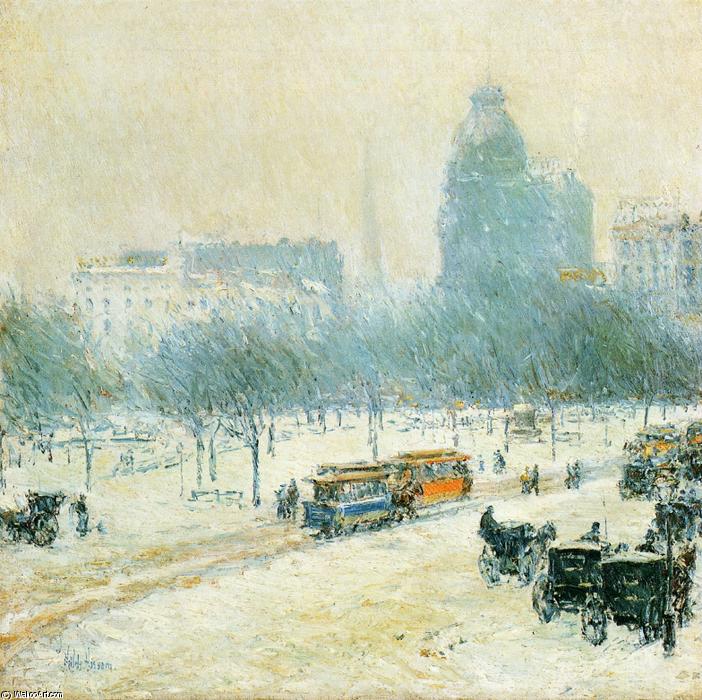
Frederick Childe Hassam’s “Winter in Union Square,” painted in 1892, isn’t merely a depiction of a snowy street scene; it’s a poignant distillation of urban life and the quiet beauty found within its everyday moments. This oil on canvas captures a specific time and place – New York City at the cusp of a new century – imbued with a sense of both melancholy and understated charm. The painting immediately draws the eye to the trolley car, a symbol of burgeoning modernity threading its way through the established landscape, while figures bundled in coats and hats navigate the snow-dusted sidewalks. It’s a scene brimming with potential narratives, inviting the viewer to imagine the stories unfolding amongst the buildings that frame the composition.
The Impressionistic Palette – Light, Shadow, and Texture
Hassam's masterful technique firmly places “Winter in Union Square” within the realm of American Impressionism. He eschews sharp outlines and photographic realism in favor of a looser, more suggestive approach to form and color. Notice how he employs broken brushstrokes – short, visible dabs of paint – to build up layers of texture and create an atmospheric effect. The snow itself isn’t rendered as a uniform white; instead, it's fragmented with hints of blue and gray, reflecting the diffused light of a winter afternoon. The buildings are painted with similar sensitivity, their forms dissolving into the background through subtle gradations of color and value. This deliberate blurring emphasizes the ephemeral quality of the moment, capturing not just what is seen but also how it *feels* – cold, still, and imbued with a certain stillness.
A City in Transition: Context and Symbolism
Painted during a period of rapid industrialization and urbanization, “Winter in Union Square” reflects the evolving character of New York. The trolley car represents the increasing reliance on public transportation and the expansion of the city’s reach. The presence of horses alongside automobiles hints at the ongoing tension between tradition and progress. Beyond the literal depiction, the painting speaks to a broader theme: the human experience within an increasingly complex urban environment. The figures are largely anonymous, yet their postures and movements suggest a quiet engagement with the world around them – a sense of observation and perhaps even contemplation. The snow itself can be interpreted as a metaphor for cleansing or renewal, suggesting a fresh start amidst the bustle of city life.
Capturing Emotion: The Power of Atmosphere
Perhaps the most compelling aspect of “Winter in Union Square” is its ability to evoke a specific mood. Hassam masterfully uses light and shadow to create a sense of coldness and quietude, drawing the viewer into the scene’s contemplative atmosphere. The limited activity – just a few figures moving along the street – contributes to this feeling of stillness. The painting isn't loud or dramatic; it’s quietly evocative, inviting us to pause and reflect on the beauty of a simple winter day in New York City. It’s a testament to Hassam’s skill in capturing not just a visual image but also the emotional resonance of a particular moment in time.
At OriginalUniqueArt.com, we are proud to offer meticulously crafted oil painting reproductions of “Winter in Union Square,” allowing you to bring this iconic work into your home or office. Each reproduction is created using the finest materials and techniques, ensuring that it faithfully captures the artistry and spirit of Frederick Childe Hassam’s masterpiece.
O artyście
A Pioneer of American Impressionism: The Life and Art of Frederick Childe Hassam
Frederick Childe Hassam, born in Boston on October 17, 1859, stands as a pivotal figure in the development of American Impressionism. His artistic journey, beginning with an early inclination towards drawing and culminating in recognition as one of the nation’s most celebrated painters, is a testament to his dedication and unique vision. Unlike many of his contemporaries who sought formal training exclusively abroad, Hassam largely honed his skills through self-study and practical experience, initially finding work as an illustrator for prominent magazines such as *Harper's Weekly* and *Scribner’s Monthly*. This formative period instilled within him a keen observational eye and a talent for narrative composition—qualities that would consistently characterize his distinctive style. While he did eventually travel to Europe in 1886, undertaking brief studies in Paris, it was the American landscape and urban life that truly ignited his artistic imagination. He wasn’t merely replicating European techniques; rather, he adapted them to capture a distinctly *American* experience, imbuing his work with a fresh perspective and vibrant energy.Early Years and Artistic Foundations
Hassam's early years were marked by a burgeoning interest in art, nurtured through informal lessons and a keen eye for detail. Born into a family of modest means—his father was a cutlery merchant—he initially pursued an accounting career but quickly realized his true calling lay in the visual arts. A pivotal moment arrived in 1872 when a devastating fire ravaged much of Boston’s commercial district, including his father's business. To assist his family financially, Hassam secured employment as a draftsman at Little, Brown & Company, where he honed his technical skills and developed a reputation for precision. Simultaneously, he continued to cultivate his artistic talent through classes at the Lowell Institute and the Boston Art Club, absorbing influences from various movements while simultaneously forging his own distinctive style. His early work primarily consisted of watercolor landscapes, often depicting scenes of rural New England—a period marked by a deep appreciation for the region’s natural beauty and picturesque charm. The influence of J.M.W. Turner, with his masterful use of light and atmosphere, proved particularly formative during his European studies in 1886.Capturing Light and Modern Life
Hassam's art is immediately recognizable for its luminous quality, achieved through a meticulous manipulation of light and color. He embraced the core principles of Impressionism—capturing fleeting moments and atmospheric effects—but infused his work with a uniquely American sensibility. Rather than simply replicating European techniques, he sought to depict scenes that resonated with the experiences of everyday life in America. His paintings frequently portray bustling urban environments like New York City and Boston, showcasing fashionable ladies strolling along Fifth Avenue, horse-drawn carriages navigating crowded streets, or quiet moments within domestic interiors. These weren’t merely depictions of places; they were insightful portraits of a rapidly evolving society, capturing the dynamism and vibrancy of late 19th and early 20th century America. Works such as *The Sonata* (1893) exemplify his ability to evoke mood and atmosphere through subtle color harmonies and delicate brushwork, creating an intimate and contemplative experience for the viewer. Similarly, his coastal scenes, like *Gloucester* (1899), transform ordinary harbors into shimmering visions of tranquility—a testament to his sensitivity to light and atmospheric conditions.The Ten American Painters and Artistic Independence
A defining moment in Hassam’s career was his involvement with “The Ten American Painters,” a group formed in 1897 as a direct response to the conservative policies of the Society of American Artists. This collective, comprised of artists like John Henry Twachtman, Willard Leroy Metcalf, and Edmund Tarbell, sought to establish an independent platform for exhibiting their work and promoting a more progressive approach to art. Hassam assumed the role of the group’s first president, solidifying his position as a leader within the American art world. This period marked a significant shift towards artistic independence—a deliberate rejection of academic constraints and a commitment to exploring individual styles without compromise. The exhibitions organized by “The Ten” played a crucial role in elevating Impressionism's status as a legitimate and respected movement within the United States, providing a vital alternative to established art institutions.Patriotism and Later Years: The Flag Paintings
With the outbreak of World War I, Hassam’s artistic focus underwent a dramatic transformation. Inspired by a surge of patriotic fervor sweeping across America, he embarked on a series of paintings depicting American flags waving proudly along Fifth Avenue in New York City. These “Flag” paintings, created between 1916 and 1919, represent perhaps his most iconic works—powerful expressions of civic pride and wartime solidarity. Far from being mere symbolic representations, these canvases convey an intense sense of energy and optimism amidst the turmoil of global conflict. *Victory Day, May 1919*, a particularly striking example, captures the jubilant atmosphere of New York City following the armistice. Throughout his later years, Hassam continued to paint prolifically, experimenting with etching and lithography alongside his oil paintings—demonstrating an enduring commitment to his artistic principles and a willingness to adapt to evolving techniques.Legacy and Enduring Influence
Frederick Childe Hassam passed away in East Hampton, New York, on August 27, 1935, leaving behind a vast and influential body of work. His legacy extends far beyond his technical mastery—he played a pivotal role in establishing American Impressionism as a distinct artistic movement. He demonstrated that American artists could not only embrace European techniques but also adapt them to create something uniquely their own. Hassam’s paintings continue to resonate with audiences today, offering glimpses into a bygone era and reminding us of the enduring power of art to capture the spirit of a time and place. His influence can be seen in the work of countless artists who followed him, solidifying his position as one of the most important figures in American art history. His dedication to capturing light, color, and the essence of modern life ensures that his paintings will continue to inspire and captivate generations to come.
Frederick Childe Hassam
1859 - 1935 , Stany Zjednoczone
Krótka nota
- Artistic Movement Or Style: Impresjonizm, Tonalizm
- Artists Or Movements Influenced By This Artist: ['Amerykański Impresjonizm']
- Artists Who Influenced This Artist: ['Monet']
- Date Of Birth: 17 października 1859
- Date Of Death: 27 sierpnia 1935
- Full Name: Frederick Childe Hassam
- Nationality: Amerykański
- Notable Artworks:
- Maidy w Mist
- Mt. Beacon
- Sona
- Gloucester
- Place Of Birth: Boston, USA
Powiązane artykuły

Frederick Childe Hassam: American Impressionism's Chronicler of Light & Modern Life
Explore the captivating world of Frederick Childe Hassam, a pioneer of American Impressionism. Discover his iconic paintings capturing light, urban life & coastal beauty. Learn about his legacy and influence on American art history.
25 Arcydzieł Metropolitańskiego Muzeum Sztuki: Inspiracje dla Twojego Domu
Odkryj 25 arcydzieł Metropolitańskiego Muzeum Sztuki! Van Gogh, Monet, Renoir i inni – historie artystów, techniki i inspiracje dla Twojego wnętrza. Reprodukcje najwyższej jakości na OriginalUniqueArt.com. Eksploruj kolekcję online!

The Ashcan School: Capturing the Raw Spirit and Urban Realism of New York City Life
Explore the raw, evocative beauty of the Ashcan School. Discover how masters like Bellows and Glackens captured New York's urban soul through American Realism, and learn to bring this gritty, historical elegance into your modern art collection.

Paul Cézanne: 25 Arcydzieł, które Zrewolucjonizowały Świat Sztuki | OriginalUniqueArt
Odkryj 25 arcydzieł Paula Cézanne'a – od impresjonizmu po postimpresjonizm. Poznaj historie, techniki i inspiracje malarza, który zrewolucjonizował sztukę. Reprodukcje obrazów najwyższej jakości na OriginalUniqueArt.com!

Impressionizm w Obrazach: 10 Arcydzieł Pełnych Światła i Koloru | OriginalUniqueArt
Odkryj 10 arcydzieł impresjonizmu! Poznaj historie Claude Moneta, Degasa i Van Gogha. Reprodukcje obrazów najwyższej jakości – pejzaże pełne światła i koloru do Twojego wnętrza. OriginalUniqueArt.