 Podgląd w skali 1:1
 Wyślij jako kartkę
 Udostępnij
 Szczegóły dzieła
 Przewodnik

 Pobierz obraz
 Podobne obiekty
 RTG
RTG Pokaz slajdów
 Q&A
Q&A Statystyki
Parasol ogrodowy


 Rozwiń treść
Giclée / Wydruk artystyczny
Wydruki giclée lub płótna o jakości muzealnej, szybka realizacja i szeroki wybór opcji wykończenia. ( Zamów ręcznie malowaną reprodukcję Przejdź do wersji cyfrowej)




P118B zł10

P118H zł10

P118W zł10

P438Z zł10

P508JH zł12

P508YH zł12

P805H zł10

P805Z zł10

P919BZ zł10

P919G zł10

P919XJ zł10

P959ZH zł10

P968JZ zł12

W106C zł8

W218G zł10

W218JH zł8

W218Y zł10

W307PJ zł10

W316G zł10

W316PJ zł8

W316Y zł10

W398PJ zł8

W4111J zł10

W500HY zł15

W500JH zł15

W692G zł12

W849H zł8

W940BG zł15

W953PJ zł8




Wybierz spośród naszych standardowych rozmiarów, które zachowują oryginalne proporcje dzieła sztuki.

Wpisz wymaganą szerokość i wysokość, aby dopasować grafikę do ramy lub ściany. Wydruk można jedynie przyciąć, nigdy nie powiększając go poza oryginalny obraz, dlatego format o innych proporcjach spowoduje utratę części kompozycji. Przed rozpoczęciem druku prześlemy Ci cyfrowy podgląd do zatwierdzenia. Obraz wyświetlany na tej stronie nie pokazuje rzeczywistego przycięcia — jedynie podgląd oddaje ten efekt.
Dostawa na cały świat () w ciągu 2 tygodni zamiast standardowych 4/5 tygodni. (31 Październik)

Bezpłatna ekspresowa wysyłka na cały świat

Wysokiej jakości płótno lniane

Pełne ubezpieczenie przesyłki

Gwarancja zwrotu należności celnych i podatków importowych

Gwarancja wiernego odwzorowania kolorów

100-dniowa polityka zwrotów (tylko w przypadku wad)

Gwarancja 100% zwrotu pieniędzy

Zniżka przy zakupie wielu sztuk
 Opcja ze szkłem jest dostępna wyłącznie w rozmiarach poniżej 110 cm

Parasol ogrodowy
Giclée / Wydruk artystyczny
Wymiary reprodukcji
-


Cena całkowita
zł 311
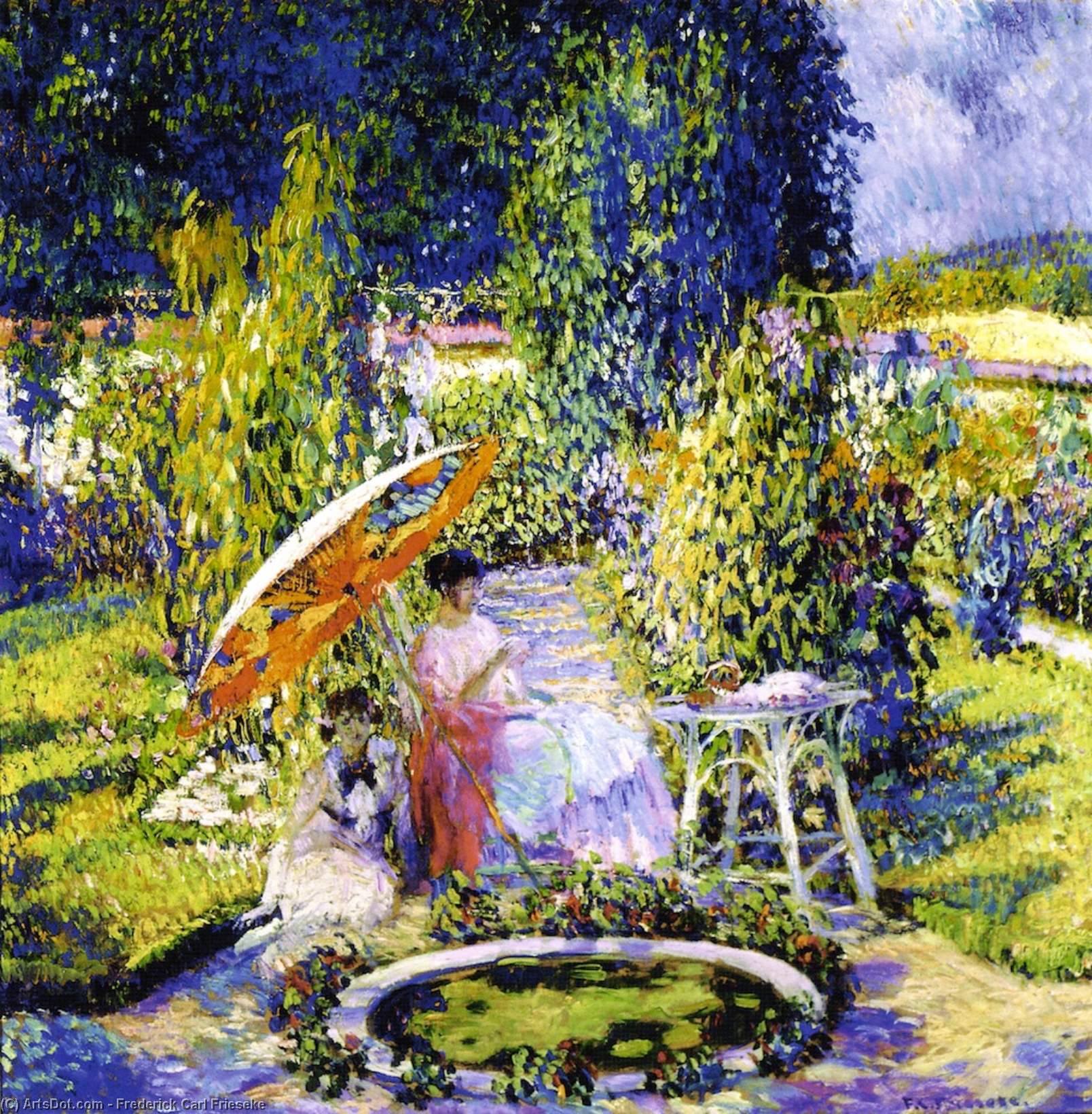
The Garden Umbrella – A Moment of Tranquility Captured in Impressionism
Frederick Carl Frieseke’s “The Garden Umbrella” (1910) stands as a quintessential example of American Impressionism, embodying the movement's fascination with capturing fleeting moments of beauty and emotion through vibrant color palettes and loose brushstrokes. Currently residing at the Telfair Museum of Art in Savannah, Georgia, this painting offers more than just a picturesque depiction; it’s an invitation into a serene landscape infused with subtle symbolism reflecting the artistic spirit of its time.A Landscape Illuminated by Sunlight
The canvas portrays a tranquil garden scene bathed in dappled sunlight—a hallmark characteristic of Frieseke's oeuvre and directly influenced by his observations of Claude Monet’s Giverny gardens. Frieseke meticulously renders the foliage, blossoms, and shadows using broken brushstrokes of pure color, mirroring Monet’s groundbreaking approach to painting light and atmosphere. The artist skillfully blends shades of green, yellow, and pink to convey the vibrancy of the natural world, creating an immersive experience for the viewer.The Woman Under Shade – Symbolism of Domestic Harmony
At the heart of the composition sits a woman seated beneath an umbrella—a deliberate choice by Frieseke that speaks volumes about the artistic preoccupations of his era. Sadie Frieseke, his wife, is depicted in repose, reading and enjoying tea amidst the garden’s splendor. This image encapsulates the idealized vision of domestic life prevalent during Impressionism – a celebration of femininity, comfort, and connection with nature. The umbrella itself serves as a powerful symbol of protection from the sun's glare, representing not only physical respite but also emotional solace and inner peace.Japanese Influence: Japonisme and Decorative Art
“The Garden Umbrella” exemplifies the broader trend known as Japonisme—the European fascination with Japanese art and design during the late 19th century. Frieseke’s inclusion of a Japanese parasol reflects this cultural exchange, mirroring the decorative arts movement's embrace of exotic motifs and techniques. The parasol’s elegant form and intricate patterns demonstrate the influence of Japanese craftsmanship on Western artistic sensibilities.Frederick Carl Frieseke: An Artist Dedicated to Light and Emotion
Born in Owosso, Michigan, in 1874, Frederick Carl Frieseke pursued a lifelong passion for painting, establishing himself as one of America’s foremost Impressionist artists. His dedication to capturing the ephemeral qualities of light and emotion—traits shared with Monet and Renoir—solidifies his place within art history. Frieseke's work continues to inspire collectors and interior designers alike who appreciate its luminous beauty and understated elegance.- Artist: Frederick Carl Frieseke
- Year Created: 1910
- Location: Telfair Museum of Art, Savannah, Georgia
- Style: Impressionism
- Medium: Oil on Canvas
Pytania i odpowiedzi
Jaki kolor najbardziej dominuje w "Parasol ogrodowy"?
Dominującym kolorem dzieła „Parasol ogrodowy” – Frederick Carl Frieseke jest Szary (#63677a).
Jaka jest technika i data powstania „Parasol ogrodowy” – Frederick Carl Frieseke?
"Parasol ogrodowy" powstało w 1910 roku przy użyciu Akryl na płótnie.
Jakie wnętrze najlepiej współgra z kolorystyką „Parasol ogrodowy” – Frederick Carl Frieseke?
Kolorystyka Ciemne tony w dziele „Parasol ogrodowy” – Frederick Carl Frieseke idealnie współgra z rekomendowanym wnętrzem: Salon lub strefa dzienna.
Biografia artysty
A Life Bathed in Sunlight: The Artistic Journey of Frederick Carl Frieseke
Born in the small Michigan town of Owosso on April 7, 1874, Frederick Carl Frieseke embarked on a path that would lead him to become a pivotal figure in American Impressionism. His early life, marked by a move to Florida following his mother’s passing and nurtured by an artistically inclined aunt, instilled within him a sensitivity to light and form that would define his oeuvre. Though initially involved in his family's brick manufacturing business, Frieseke’s true calling resonated with the artistic spirit of the age. A formative visit to the 1893 World’s Columbian Exposition ignited a passion that propelled him towards formal training at the Art Institute of Chicago and, crucially, a relocation to Paris in 1898 – a decision that irrevocably shaped his artistic destiny. It was in France that Frieseke truly found his voice, immersing himself in the vibrant art scene and absorbing the influences that would blossom into his signature style.The Allure of Giverny and the Development of “Decorative Impressionism”
Paris proved to be more than just a place of study; it became Frieseke’s adopted home, a sanctuary where he could refine his technique and explore his artistic vision. Early influences included James Abbott McNeill Whistler, whose tonal harmonies left an indelible mark on Frieseke's work. However, it was the allure of Giverny – Claude Monet’s idyllic haven – that truly unlocked his potential. In 1906, Frieseke rented a house adjacent to Monet’s, becoming part of a thriving artistic community and immersing himself in the very essence of Impressionism. This proximity fostered a unique style often described as “decorative impressionism.” Unlike the more spontaneous brushwork of some Impressionists, Frieseke's paintings exhibit a refined elegance, characterized by luminous colors, dappled sunlight filtering through foliage, and an emphasis on graceful female figures. He wasn’t merely capturing a fleeting moment; he was crafting scenes of serene beauty, imbued with a sense of intimate tranquility. His work began to showcase sensual, rounded forms reminiscent of Pierre-Auguste Renoir, blended with the bolder color palettes inspired by Post-Impressionists like Paul Gauguin and Pierre Bonnard. Frieseke’s paintings often depicted women in idyllic settings – sunlit gardens, elegant interiors – creating a sense of timeless beauty and quiet contemplation.Themes and Techniques: Capturing Light and Femininity
Frieseke’s artistic focus consistently revolved around two central themes: the captivating effects of light and the portrayal of women. He was fascinated by how sunlight transformed ordinary scenes into moments of ethereal beauty, and he masterfully captured this interplay in his paintings. His female subjects, often depicted in gardens or interiors, are not merely portraits but embodiments of grace, sensuality, and quiet contemplation. Hélène, painted in 1901, exemplifies this approach – a captivating portrait showcasing Impressionistic beauty and intimate detail. Similarly, works like The Garden at Giverny demonstrate his ability to blend Impressionist techniques with Post-Impressionist color sensibilities. Frieseke’s technique involved layering delicate brushstrokes to create a shimmering effect, evoking the sensation of sunlight dancing on skin and foliage. He often incorporated geometric elements – parasols, patterned fabrics – to provide contrast and enhance the visual harmony of his compositions. His dedication to capturing these nuances earned him recognition; Before the Glass (1904) was purchased by the French Government and displayed at the Luxembourg Gallery, a testament to his growing reputation.Notable Works
- Portrait of a Girl (also known as Pensive Model): A stunning blend of realism and beauty capturing quiet contemplation.
- Hélène: Showcasing Impressionistic beauty and intimate detail, painted in 1901.
- Self-Portrait: Reveals the artist’s contemplative nature amidst his studio, showcasing masterful technique.
- The Garden at Giverny: A prime example of his blend of Impressionist and Post-Impressionist styles.
- Woman in a Garden: A quintessential representation of his decorative impressionism.
- Before the Glass (1904): Purchased by the French Government, displayed at the Luxembourg Gallery.
- Torn Lingerie (1920): Awarded two gold medals and the popular prize at the Chicago Art Institute.
Recognition and Legacy: A Lasting Impression on American Art
Throughout his career, Frieseke garnered numerous accolades, including silver medals at the St. Louis Exposition in 1904, the Temple Gold Medal from the Pennsylvania Academy of Fine Arts in 1913, and the Grand Prize at the Panama-Pacific International Exposition in 1915. His painting Torn Lingerie (1920) achieved particular acclaim, winning two gold medals and the popular prize at the Chicago Art Institute. Despite his success, Frieseke remained a committed expatriate, preferring the artistic freedom he found in France. He passed away on August 24, 1939, leaving behind a legacy of luminous paintings that continue to captivate audiences today. His contribution to American Impressionism is significant not only for his technical skill but also for his ability to create scenes of enduring beauty and tranquility. Frieseke’s work serves as a reminder of the power of art to transport us to idyllic realms, bathed in sunlight and filled with grace.
Frederick Carl Frieseke
1874 - 1939 , Stany Zjednoczone
Krótka nota
- Artistic Movement Or Style: Impresjonizm amerykański
- Artists Or Movements Influenced By This Artist:
- Impresjonizm
- Postimpresjonizm
- Artists Who Influenced This Artist:
- Renoir
- Whistler
- Gauguin
- Date Of Birth: 7 kwietnia 1874
- Date Of Death: 24 sierpnia 1939
- Full Name: Frederick Carl Frieseke
- Nationality: Amerykański
- Notable Artworks:
- Kwiaty w koszyku
- Kobieta w ogrodzie
- Przed szklanym lusterkiem
- Place Of Birth: Owosso, USA
Powiązane artykuły
Capturing the Light: A Journey Through the Soul of American Impressionism and the Hudson River School
Explore the luminous beauty of American Impressionism and the Hudson River School. Discover a curated journey through light, landscape, and history, celebrating the enduring legacy of masters through exquisite, hand-painted oil reproductions for the discerning art lover.
10 Arcydzieł Impresjonizmu, które Zrewolucjonizowały Świat Sztuki | OriginalUniqueArt
Odkryj 10 arcydzieł impresjonizmu – Monet, Renoir, Degas i inni. Poznaj historie powstania kultowych obrazów, techniki malarskie i paletę barw tego fascynującego ruchu artystycznego. Reprodukcje najwyższej jakości na OriginalUniqueArt.com!
Cultivating Paradise: A Historical & Artistic Exploration of Gardens in Painting
Explore the rich history of gardens in painting! Discover masterpieces from Renaissance to Impressionism & beyond. Learn about symbolism, artists like Monet & Klimt, and find your perfect artwork at OriginalUniqueArt.
Uchwycenie Światła Narodu: Amerykański Impresjonizm – Ewolucja i Dziedzictwo Ruchu
Odkryj fascynujący świat amerykańskiego impresjonizmu! Poznaj historię, kluczowych artystów i unikalne cechy tego wyjątkowego ruchu. Ekspercka analiza i piękne reprodukcje obrazów na OriginalUniqueArt.com.

Frederick Childe Hassam: American Impressionism's Chronicler of Light & Modern Life
Explore the captivating world of Frederick Childe Hassam, a pioneer of American Impressionism. Discover his iconic paintings capturing light, urban life & coastal beauty. Learn about his legacy and influence on American art history.