
 Podgląd w skali
 Wyślij jako kartkę
 Udostępnij
 Szczegóły dzieła

 Pobierz
 Podobne obiekty
 RTG
RTG Pokaz slajdów
 Stats
StatsSicilian Vespers scene 3


 Rozwiń treść
Giclée / Wydruk artystyczny
Druk giclée lub płótno o jakości muzealnej, szybka realizacja i szeroki wybór opcji wykończenia. ( Zamów ręcznie malowaną reprodukcję Switch to Digital Image)




P118B $10

P118H $10

P118W $10

P438Z $10

P508JH $12

P508YH $12

P805H $10

P805Z $10

P919BZ $10

P919G $10

P919XJ $10

P959ZH $10

P968JZ $12

W106C $8

W218G $10

W218JH $8

W218Y $10

W307PJ $10

W316G $10

W316PJ $8

W316Y $10

W398PJ $8

W4111J $10

W500HY $15

W500JH $15

W692G $12

W849H $8

W940BG $15

W953PJ $8




Wybierz spośród naszych standardowych rozmiarów, które zachowują oryginalne proporcje dzieła sztuki.

Możesz wprowadzić własne wymiary, aby dopasować dzieło do konkretnej ramy lub przestrzeni. Jeśli wybrany rozmiar nie będzie odpowiadał proporcjom oryginalnego obrazu, przytniecie dzieło lub rozszerzymy obraz za pomocą odbicia lustrzanego lub jednolitego wypełnienia krawędzi. Przed rozpoczęciem produkcji prześlemy cyfrową wizualizację do Twojej akceptacji.
Prosimy pamiętać, że podgląd na ekranie nie odzwierciedla faktycznego przycinania ani rozszerzania. Tylko wizualizacja dokładnie pokaże końcową kompozycję.
Mimo dostępności niestandardowych rozmiarów, zalecamy wybór wymiaru z listy zdefiniowanej, aby zachować oryginalne proporcje.
Dostawa na cały świat () w ciągu 2 tygodni zamiast standardowych 4/5 tygodni. (8 Wrzesień)

Bezpłatna ekspresowa wysyłka na cały świat

Wysokiej jakości płótno lniane

Pełne ubezpieczenie przesyłki

Gwarancja zwrotu należności celnych i podatków importowych

Gwarancja wiernego odwzorowania kolorów

100-dniowa polityka zwrotów (tylko w przypadku wad)

Gwarancja 100% zwrotu kosztów

Zniżka przy zamówieniu wielu produktów
 Opcja ze szkłem jest dostępna wyłącznie w rozmiarach poniżej 110 cm

Sicilian Vespers scene 3
Giclée / Wydruk artystyczny
Wymiary reprodukcji
-


Cena całkowita
$ 80
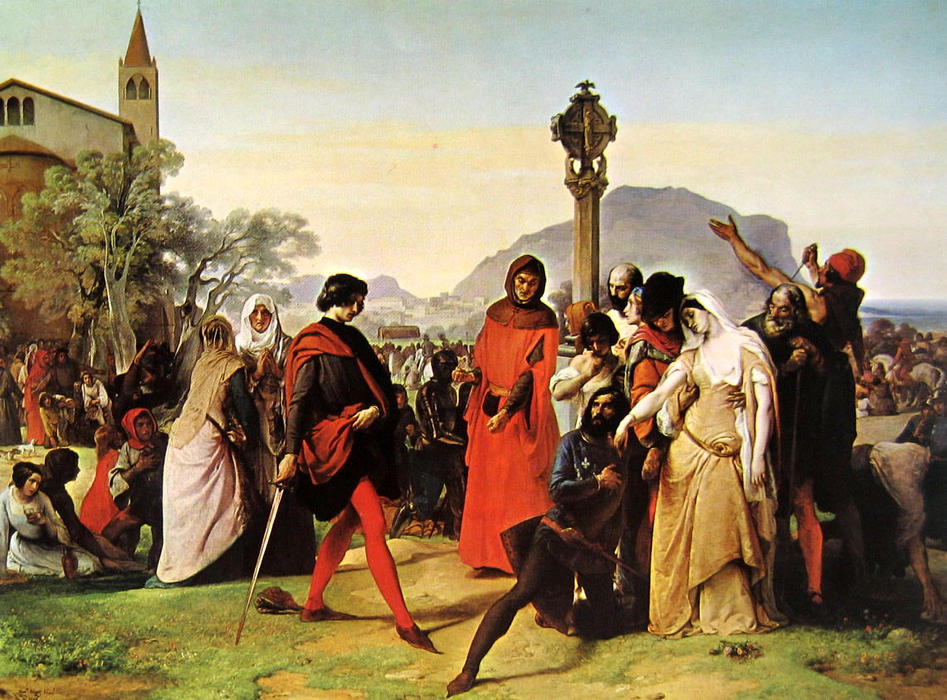
A Tempestuous Vision: Hayez’s “Sicilian Vespers”
Francesco Hayez's "Sicilian Vespers" (1846) isn’t merely a historical painting; it’s a visceral eruption of conflict, a meticulously crafted tableau of political intrigue and simmering rebellion. The canvas explodes with the energy of a sudden uprising, capturing not just an event but the very essence of chaos and determination. It's a scene ripped from the annals of 13th-century Sicily, where dynastic ambitions collided with papal authority, resulting in a protracted and bloody struggle for control. More than a chronicle of events, Hayez delivers a potent allegory about power, loyalty, and the volatile nature of governance – themes that resonate powerfully even today.
The painting immediately commands attention through its dramatic composition. The central figure, clad in scarlet, leads a charge against a wall of defenders, his posture radiating both aggression and a desperate urgency. Around him, a swirling mass of soldiers, nobles, and commoners – all rendered with remarkable detail – surge forward, their faces contorted in expressions of fury and resolve. Hayez masterfully employs diagonal lines to create a sense of dynamic movement, pulling the viewer directly into the heart of the fray. The use of light is particularly striking; it illuminates the advancing figures while casting deep shadows over the retreating defenders, further amplifying the painting’s dramatic intensity.
Romanticism and Historical Narrative
Hayez was a pivotal figure in the Italian Romantic movement, and “Sicilian Vespers” exemplifies this style perfectly. Rejecting the cool detachment of Neoclassicism, Romantic artists sought to evoke strong emotions through vivid imagery and dynamic compositions. Hayez’s work is characterized by its theatricality, heightened drama, and focus on emotionally charged subjects – a hallmark of the era. He wasn't interested in simply depicting historical events; he aimed to capture their emotional core, translating them into a powerful visual narrative.
The painting draws heavily on medieval chronicles detailing the Sicilian Vespers revolt, which saw a group of Sicilian nobles overthrow King Peter III and demand the deposition of Pope Innocent IV. This event was fueled by resentment over papal interference in local affairs and a desire to restore Sicily’s independence. Hayez skillfully weaves together historical fact with elements of dramatic license, creating a compelling narrative that transcends mere documentation.
Technique and Symbolism
Hayez's technical skill is evident in every brushstroke. He employs a rich, dark palette dominated by reds, browns, and blacks, which contribute to the painting’s somber mood. The figures are rendered with meticulous detail, capturing their individual expressions and gestures with remarkable accuracy. The artist utilizes a technique of *sfumato*, subtly blurring edges and creating a sense of atmospheric depth, particularly in the background, adding to the overall feeling of chaos and uncertainty.
Beyond its historical subject matter, “Sicilian Vespers” is laden with symbolism. The scarlet garment worn by the leader represents courage, passion, and perhaps even rebellion against established authority. Conversely, the defenders’ armor symbolizes loyalty, tradition, and the weight of the past. The very act of fighting – a brutal, chaotic melee – speaks to the destructive consequences of political conflict and the erosion of social order. The inclusion of the papal banner amongst the defeated highlights the central role of the papacy in this tumultuous episode.
Emotional Resonance and Legacy
“Sicilian Vespers” is not simply a historical painting; it’s an emotionally resonant work that continues to captivate viewers today. Hayez masterfully conveys the sense of urgency, conflict, and human drama inherent in the subject matter. The painting's depiction of a passionate struggle for power—a theme that has resonated throughout history—makes it timeless and universally relatable.
Reproductions of this iconic artwork offer a stunning way to bring Hayez’s dramatic vision into any space. Whether adorning a grand salon or a more intimate setting, “Sicilian Vespers” serves as a powerful reminder of the complexities of human ambition, loyalty, and the enduring legacy of historical conflict. Its vibrant colors and dynamic composition make it an exceptional choice for collectors and interior designers seeking to infuse their surroundings with both beauty and intellectual depth.
O artyście
Early Life and Artistic Foundations
Francesco Hayez, born on February 10th, 1791, in the heart of Venice, was steeped in an artistic lineage that profoundly shaped his destiny. His father, Giovanni, a man of French descent, brought a cosmopolitan sensibility to their family, while his mother, Chiara Torcella, hailed from Murano, the famed island known for its exquisite glassmaking traditions. From a young age, Francesco exhibited a remarkable aptitude for drawing – a talent nurtured by his uncle, who apprenticed him to an art restorer. This early exposure instilled in him a deep understanding of materials and techniques, laying the groundwork for his future artistic endeavors. His family’s modest circumstances fostered a spirit of resourcefulness and a keen appreciation for beauty, values that would later permeate his work. In 1806, he enrolled at the newly established Academy of Fine Arts in Milan, where he received formal training under the guidance of Teodoro Matteini, a respected figure in the Venetian art scene. This period marked a crucial turning point, exposing him to the principles of Neoclassicism and providing him with the foundational skills necessary for his artistic development.The Roman Years: Influences and Experimentation
Following his studies in Milan, Hayez embarked on a transformative journey to Rome in 1809. Here, he benefited from a year’s intensive study at the Accademia di San Luca, an institution renowned for its rigorous curriculum and exposure to diverse artistic influences. The Roman atmosphere proved profoundly stimulating, allowing him to immerse himself in the works of masters such as Raphael and Caravaggio, absorbing their techniques and stylistic approaches. This period witnessed a significant evolution in Hayez’s artistic sensibilities, as he began to experiment with different styles and develop his own unique voice. He was particularly drawn to the dramatic lighting and emotional intensity characteristic of Baroque painting, which would later become a defining feature of his oeuvre. The intellectual and cultural ferment of Rome fueled his creativity, shaping his perspective on art and its role in society.Rise to Prominence: Milan and the Romantic Movement
Returning to Milan in 1823, Hayez quickly established himself as a leading figure in the burgeoning Italian Romantic movement. The city’s vibrant artistic community provided fertile ground for his creative exploration, and he soon gained recognition for his dramatic historical paintings and evocative portraits. He became associated with the “Salotto Maffei,” a salon hosted by Clara Maffei, a prominent intellectual and patron of the arts, alongside other notable artists and intellectuals. This environment fostered a spirit of innovation and debate, pushing Hayez to refine his style and explore new themes. His early works often reflected the political and social currents of the Risorgimento – the movement for Italian unification – capturing the patriotic fervor and national aspirations of the time. His paintings frequently depicted scenes of heroism, sacrifice, and romantic idealism, resonating deeply with a public yearning for independence and self-determination.Notable Works and Lasting Legacy
Francesco Hayez’s artistic legacy is defined by a remarkable range of subjects and styles. Among his most celebrated works are *The Kiss*, an iconic depiction of a couple locked in an embrace that has become synonymous with Italian Romanticism; *Pope Urban II Preaching the First Crusade*, a monumental historical painting showcasing his mastery of composition and dramatic storytelling; and *Portrait of Matilde Juva-Branca*, a captivating portrait that reveals his exceptional ability to capture the essence of his subjects. His paintings frequently employed allegorical symbolism, imbuing them with layers of meaning and inviting viewers to contemplate complex themes such as love, patriotism, and faith. Hayez’s influence extended far beyond his own lifetime, shaping the course of Italian art for generations to come. He remains a pivotal figure in the Romantic movement, celebrated for his dramatic flair, emotional intensity, and enduring artistic vision. His works are displayed in prestigious museums throughout Italy, including the Civic Gallery of Modern Art in Milan, where *Pope Urban II Preaching the First Crusade* resides. He died on December 21st, 1882, leaving behind a rich and multifaceted body of work that continues to captivate audiences today.
Francesco Hayez
1791 - 1882 , Włochy
Krótka nota
- Artistic Movement Or Style: Romanticizm
- Artists Or Movements Influenced By This Artist: ['Neoklasycyzm']
- Artists Who Influenced This Artist: ['Teodoro Matteini']
- Date Of Birth: 10 lutego 1791
- Date Of Death: 12 lutego 1882
- Full Name: Francesco Hayez
- Nationality: Włoski
- Notable Artworks:
- Pocałunek
- Papież Urban II
- Portret Matylda
- Place Of Birth: Wenecja, Włochy
Powiązane artykuły
Late Medieval Masterpieces: 10 Artworks That Defined an Era | OriginalUniqueArt
Journey through 10 defining Late Medieval masterpieces – from Giotto's frescoes to Jan van Eyck’s realism. Explore the stories, techniques & vibrant colors of Gothic art. Find museum-quality reproductions and elevate your home decor with OriginalUniqueArt.com! Discover all masterpieces on OriginalUniqueArt.com

Pre-Raphaelite Romanticism: A Guide to Vivid Detail and Medieval Beauty in Victorian Art
Explore the vivid detail and medieval beauty of Pre-Raphaelite Romanticism. Discover the history of masters like Rossetti and Millais through our expert guide to Victorian art, perfect for collectors and professionals seeking authentic, museum-quality reproductions.

High Medieval Art: 10 Masterpieces That Shaped an Era | OriginalUniqueArt
Journey through High Medieval Art! Explore 10 iconic masterpieces – from Giotto's frescoes to stunning Gothic cathedrals. Discover the stories behind these timeless paintings, sculptures & illuminated manuscripts. Find museum-quality art reproductions at OriginalUniqueArt.com.
Timeless Elegance: How to Integrate High Medieval Art into Your Modern Interior Design
Discover how to infuse your modern home with the divine light of High Medieval art. From gilded illuminated manuscripts to Gothic-inspired textures, learn expert tips for integrating timeless elegance and historical grandeur into contemporary interior design.

Divine Light & Golden Splendor: A Journey Through the Sacred Grandeur of High Medieval Art
Embark on a soulful journey through High Medieval art. Explore the divine light of Gothic cathedrals, Byzantine splendor, and sacred masterpieces that shaped Western history with our expert-led cultural reflections.


