Cubist · 1948
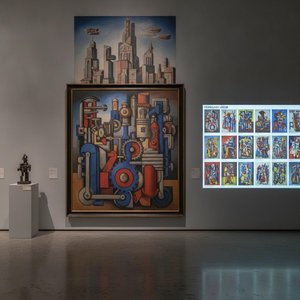
Mechanical Elements on a blue background (Fernand Léger, 1948)
Fernand Léger (1881–1955) stworzył Mechanical Elements on a blue background. Dzieło pochodzi z 1948. Należy do nurtu Cubist. Wykonano w technice Collage. Wymiary to 65 × 50 cm.
- 1948
- Collage
- 65 × 50 cm

 Podgląd w skali 1:1

 Ręcznie malowany obraz olejny
 Wyślij jako kartkę
 Udostępnij
 Karta informacyjna


 Pobierz obraz
 Podobne obiekty
 RTG
 Pokaz slajdów
 Pytania i odpowiedzi

 Statystyki
Mechanical Elements on a blue background w skrócie
- Tytuł
- Mechanical Elements on a blue background
- Artysta
- Fernand Léger (1881–1955)
- Miejsce urodzenia artysty
- Argentan, Francja
- Data powstania
- 1948
- Technika wykonania
- Collage
- Wymiary
- 65 × 50 cm
- Ruch
- Cubist
- Epoka
- Modern
- Temat
- mechanical forms, collage, gears, bird, texture, assemblage
Co przedstawia Mechanical Elements on a blue background?
A Symphony of Gears and Birdsong
In the quiet tension of Fernand Léger’s 1948 masterpiece, Mechanical Elements on a blue background, we encounter a visual dialogue that transcends the mere arrangement of shapes. This work, often referred to as part of his "Composition VIII" series, serves as a profound embodiment of the anxieties and aspirations defining post-reconstruction Europe. As the world grappled with the debris of World War II, Léger sought to find beauty within the industrial fragments of a rebuilding civilization. The canvas explodes with a calculated chaos of interlocking circles, squares, and triangles, all set against a deep, atmospheric blue that provides both a sense of infinite space and a somber, reflective weight.
What makes this composition truly captivating for the modern observer is the unexpected intrusion of the organic into the mechanical. Amidst the rigid logic of gears, screws, and metallic fragments, a single bird perches atop a central structure. This delicate juxtaposition establishes a poignant tension between the cold, unyielding precision of machine construction and the fragile, ephemeral beauty of nature. It is a moment of dreamlike irrationality—a Surrealist whisper within a Constructivist shout—that invites the viewer to contemplate whether technology serves to suppress life or to provide a new stage upon which it might flourish.
The Art of Industrial Alchemy
Léger’s technique in this period was nothing short of revolutionary, moving beyond traditional brushwork to embrace the tactile reality of the machine age. He employed a sophisticated collage-like approach, meticulously assembling fragments that mimic metal sheeting and industrial components. This method was not merely decorative; it was an essential conceptual tool used to bridge the gap between fine art and the physical world. By integrating textures that suggest steel and iron onto the canvas, Léger transforms the act of painting into an act of engineering, creating a sense of depth and complexity that draws the eye into its intricate layers.
For the discerning collector or interior designer, this piece offers a unique aesthetic versatility. Its style—a masterful blend of Constructivist abstraction and Surrealist whimsy—allows it to anchor a room with its bold, geometric energy while maintaining a sophisticated, contemplative mood through its cool color palette. The interplay of blue and grey tones provides a calming foundation, making it an ideal centerpiece for contemporary spaces that value intellectual depth and structural elegance. To possess a reproduction of this work is to bring into one's home a piece of history that celebrates the resilience of the human spirit amidst the relentless march of progress.
Zdjęcia w wysokiej rozdzielczości dzieła Mechanical Elements on a blue background
Domena publiczna: artysta zmarł w 1955.
Fernand Léger, Mechanical Elements on a blue background (1948). Domena publiczna
Odpowiedzi na pytania dotyczące Mechanical Elements on a blue background
W którym roku powstało „Mechanical Elements on a blue background” – Fernand Léger?
"Mechanical Elements on a blue background" powstało w 1948 roku. Data ta pozwala umiejscowić dzieło w kontekście twórczości Fernand Léger oraz epoki, w której powstało.
W jakiej technice wykonano „Mechanical Elements on a blue background” – Fernand Léger?
Fernand Léger wykorzystał/a technikę Collage w pracy „Mechanical Elements on a blue background”. Technika ta definiuje materię oryginalnego dzieła.
Jakie są wymiary oryginalnego dzieła „Mechanical Elements on a blue background” – Fernand Léger?
Oryginalny utwór „Mechanical Elements on a blue background” – Fernand Léger ma wymiary 65 x 50 cm.
Co przedstawia „Mechanical Elements on a blue background” – Fernand Léger?
Tematyka dzieła "Mechanical Elements on a blue background" to mechanical forms, collage, gears, bird, texture, assemblage, industrial age.
Czy obraz „Mechanical Elements on a blue background” – Fernand Léger można swobodnie reprodukować?
Status praw autorskich dla „Mechanical Elements on a blue background” – Fernand Léger: dzieło znajduje się w należy do domeny publicznej – autorskie prawa majątkowe wygasły. Określa to, czy reprodukcje obrazu mogą być sporządzane swobodnie.
Któremu artyście przypisuje się "Mechanical Elements on a blue background"?
„Mechanical Elements on a blue background” zostało stworzone przez Fernand Léger. Informacje na tej stronie dotyczą oryginalnego dzieła autorstwa Fernand Léger.
Do jakiego nurtu należy "Mechanical Elements on a blue background"?
„Mechanical Elements on a blue background” – Fernand Léger należy do nurtu Cubist. Nurt ten stanowi stylistyczny kontekst dzieła.
Do którego okresu twórczości Fernand Léger należy dzieło "Mechanical Elements on a blue background"?
„Mechanical Elements on a blue background” pochodzi z okresu Mature Period w twórczości Fernand Léger. Klasyfikacja ta wiąże dzieło z rozwojem artysty.
W jakim wieku Fernand Léger stworzył(a) "Mechanical Elements on a blue background"?
Fernand Léger miał 67 lat w momencie powstania „Mechanical Elements on a blue background” w 1948. Wiek ten obliczono na podstawie roku urodzenia artysty, 1881.
O artyście: Fernand Léger

1881–1955, Francja
Fernand Léger
Życie Fernanda Légera Historia Fernanda Légera rozpoczyna się w wiosce Argentan, położonej w departamencie Orne w Dolnej Normandii. Na świat przyszedł 4 lutego 1881 roku jako jedyny syn. Jego wczesne lata zostały ukształtowane przez spokój francuskiej prowincji oraz obecność matki, Marie-Adèle Daunou. Jego ojciec, człowiek żyjący z handlu bydłem, odszedł, gdy Fernand był jeszcze małym chłopcem, pozostawiając dziecko pod opieką matki, w domu naznaczonym jej pobożnością i pewną skromnością.
Inne prace Fernand Léger
 Miasto1919
 Mechanik1920
 Trzy kobiety1921
 Nudy w Lesie1910
Eseje o Mechanical Elements on a blue background
 Przemysł w Sztuce: 10 Arcydzieł Oddających Klimat Fabryk i Maszyn | OriginalUniqueArtOdkryj 10 arcydzieł sztuki przemysłowej! Poznaj historie Hopper'a, Caillebotte'a i innych mistrzów. Reprodukcje obrazów w stylu industrialn…
 Mastering the Machine Age: The 25 Best Artworks by Fernand LégerImmerse yourself in the vibrant world of Fernand Léger. Explore 25 iconic masterpieces of Cubism and Tubism, from bold geometric forms to m…
 10 Iconic Masterpieces to Elevate Your Coworking Space DesignTransform your workspace with timeless elegance. Discover 10 iconic masterpieces, from Impressionist classics to modern abstracts, curated …