
 Podgląd w skali 1:1
 Wyślij jako kartkę
 Udostępnij
 Szczegóły dzieła
 Przewodnik

 Pobierz obraz
 Podobne obiekty
 RTG
RTG Pokaz slajdów
 Pytania i odpowiedzi
 Statystyki
Interior with a Lady Playing the Virginal


 Rozwiń treść
Giclée / Wydruk artystyczny
Wydruki giclée lub płótna o jakości muzealnej, szybka realizacja i szeroki wybór opcji wykończenia. ( Zamów ręcznie malowaną reprodukcję Przejdź do wersji cyfrowej)




P118B zł10

P118H zł10

P118W zł10

P438Z zł10

P508JH zł12

P508YH zł12

P805H zł10

P805Z zł10

P919BZ zł10

P919G zł10

P919XJ zł10

P959ZH zł10

P968JZ zł12

W106C zł8

W218G zł10

W218JH zł8

W218Y zł10

W307PJ zł10

W316G zł10

W316PJ zł8

W316Y zł10

W398PJ zł8

W4111J zł10

W500HY zł15

W500JH zł15

W692G zł12

W849H zł8

W940BG zł15

W953PJ zł8




Wybierz spośród naszych standardowych rozmiarów, które zachowują oryginalne proporcje dzieła sztuki.

Wpisz wymaganą szerokość i wysokość, aby dopasować grafikę do ramy lub ściany. Wydruk można jedynie przyciąć, nigdy nie powiększając go poza oryginalny obraz, dlatego format o innych proporcjach spowoduje utratę części kompozycji. Przed rozpoczęciem druku prześlemy Ci cyfrowy podgląd do zatwierdzenia. Obraz wyświetlany na tej stronie nie pokazuje rzeczywistego przycięcia — jedynie podgląd oddaje ten efekt.
Dostawa na cały świat () w ciągu 2 tygodni zamiast standardowych 4/5 tygodni. (7 Listopad)

Bezpłatna ekspresowa wysyłka na cały świat

Wysokiej jakości płótno lniane

Pełne ubezpieczenie przesyłki

Gwarancja zwrotu należności celnych i podatków importowych

Gwarancja wiernego odwzorowania kolorów

100-dniowa polityka zwrotów (tylko w przypadku wad)

Gwarancja 100% zwrotu pieniędzy

Zniżka przy zakupie wielu sztuk
 Opcja ze szkłem jest dostępna wyłącznie w rozmiarach poniżej 110 cm

Interior with a Lady Playing the Virginal
Giclée / Wydruk artystyczny
Wymiary reprodukcji
-


Cena całkowita
zł 317
A Glimpse into Dutch Golden Age Intimacy
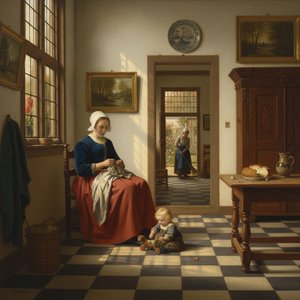
Emanuel de Witte’s “Interior with a Lady Playing the Virginal” isn't merely a painting; it’s a carefully constructed invitation. Completed around 1665, this oil on canvas transports us to a private chamber within a grand Dutch house, radiating an atmosphere of quiet contemplation and subtle drama. De Witte, a master of capturing the essence of space and light, eschews the meticulous architectural documentation favored by his contemporary, Pieter Saenredam, instead focusing on the *feeling* of being present within this intimate scene. The painting whispers stories of domestic life, musical performance, and perhaps even a touch of melancholy – all rendered with an exquisite sensitivity to color, texture, and the play of light.
The composition is immediately arresting. A woman, elegantly dressed and absorbed in her music, dominates the central space. She plays a virginal, a keyboard instrument popular during the period, its intricate workings hinted at by the surrounding instruments – a violin resting against a wall and a harpsichord subtly visible in the background. The room itself is richly detailed: a checkered floor suggesting a sense of order, a chandelier casting a warm glow, and two figures observing the performance from doorways—one standing, one seated. De Witte’s skill lies not just in depicting these objects but in creating an illusion of depth and perspective that draws us into the scene.
The Language of Light and Shadow
De Witte's mastery of chiaroscuro – the dramatic contrast between light and shadow – is central to the painting’s power. He doesn’t simply illuminate the room; he sculpts it with light, creating a sense of intimacy and drawing our attention to key elements. The light source, unseen but implied, casts long shadows that define the forms of the furniture and figures, adding a layer of mystery and sophistication. Notice how the light catches the woman's face, highlighting her expression of concentration, while leaving other areas in soft shadow. This technique isn’t just aesthetic; it contributes to the painting’s overall mood – a blend of serenity and quiet introspection.
The use of color is equally deliberate. De Witte employs a restrained palette of browns, golds, and reds, creating a harmonious and refined atmosphere. The rich hues of the fabrics and furniture are subtly contrasted with the cooler tones of the walls and floor, further enhancing the sense of depth and perspective. He avoids bright, flashy colors, opting instead for muted shades that evoke the warmth and comfort of a domestic setting.
Symbolism and Context
“Interior with a Lady Playing the Virginal” is more than just a snapshot of 17th-century life; it’s laden with symbolism. The virginal itself represents refinement, education, and musical skill – qualities highly valued in aristocratic society. The presence of multiple instruments suggests a gathering or performance, hinting at social interaction and cultural pursuits. Some art historians interpret the scene as a meditation on love and erotic melancholy, perhaps referencing the fleeting nature of beauty and pleasure. The figure observing from the doorway could represent an unspoken longing or a detached contemplation of domestic life.
Created during the Dutch Golden Age, a period of unprecedented prosperity and artistic flourishing, the painting reflects the values and sensibilities of the time. De Witte’s work aligns with the broader trends of the era – a fascination with interior spaces, an interest in capturing fleeting moments of everyday life, and a commitment to realism and naturalism. The painting is currently housed at the Museum Boijmans Van Beuningen in Rotterdam, offering visitors a chance to experience this remarkable masterpiece firsthand.
A Timeless Masterpiece
Emanuel de Witte’s “Interior with a Lady Playing the Virginal” remains a captivating work of art, demonstrating his exceptional skill and artistic vision. Its evocative atmosphere, masterful use of light and shadow, and subtle symbolism continue to resonate with viewers today. Whether you're an art enthusiast, a collector seeking a piece of Dutch history, or simply someone looking for a beautiful addition to your home, this painting offers a glimpse into a bygone era – a world of refined elegance, quiet contemplation, and enduring artistic beauty.
Pytania i odpowiedzi
Jaki poziom kontrastu prezentuje „Interior with a Lady Playing the Virginal” – Emanuel De Witte?
Poziom kontrastu dzieła „Interior with a Lady Playing the Virginal” – Emanuel De Witte wynosi Serene.
Jak można wykorzystać „Interior with a Lady Playing the Virginal” – Emanuel De Witte w dekoracji wnętrz?
„Interior with a Lady Playing the Virginal” idealnie sprawdzi się w Statement, a rekomendowanym miejscem jego ekspozycji jest Living Room.
Gdzie mogę kupić wydruk „Interior with a Lady Playing the Virginal” – Emanuel De Witte?
Aby zamówić wydruk dzieła „Interior with a Lady Playing the Virginal” – Emanuel De Witte, wystarczy przejść na jego stronę Wydruk artystyczny premium: szlachetna odbitka na płótnie bawełnianym lub archiwalnym papierze o strukturze płótna.
Biografia artysty
A Life in Perspective: The World of Emanuel de Witte
Emanuel de Witte, a name perhaps less instantly recognizable than some of his Dutch Golden Age contemporaries, nevertheless occupies a significant and fascinating niche within the pantheon of 17th-century masters. Born in Alkmaar in 1617, De Witte’s artistic journey was one marked by both remarkable talent and considerable personal turmoil – a duality that seems to subtly infuse itself into the very atmosphere of his paintings. He wasn't driven by meticulous architectural documentation like Pieter Saenredam; instead, he sought to capture the *feeling* of space, the quality of light, and the subtle drama unfolding within sacred interiors. His canvases aren’t merely representations of churches; they are immersive experiences, inviting viewers into a world of quiet contemplation and spiritual resonance.From Delft Training to Amsterdam's Embrace
De Witte’s early life provided a solid foundation for his artistic pursuits. His father, a schoolmaster, instilled in him an appreciation for learning and intellectual curiosity – qualities that would later manifest in his careful observation of perspective and light. He formally entered the art world by joining the Guild of St Luke in Alkmaar in 1636, but it was his subsequent apprenticeship with Evert van Aelst in Delft that proved particularly formative. Van Aelst, a renowned still-life painter, imparted to De Witte a keen eye for detail and a masterful command of light and shadow – skills that would become hallmarks of his mature style. Initially, De Witte explored various genres—portraits, mythological scenes, religious narratives—but it was upon relocating to Amsterdam in 1651 that he truly found his calling. The city’s wealth of magnificent churches provided an inexhaustible source of inspiration, and he began to specialize in depicting their awe-inspiring interiors. He didn't simply replicate existing church spaces; rather, he skillfully synthesized elements from different buildings, creating idealized interiors that felt both familiar and subtly otherworldly.Master of Atmosphere and Imaginary Spaces
Amsterdam proved pivotal for De Witte's artistic development. He didn’t just paint what he saw; he painted *how* it felt to be in those spaces. The Oude Kerk in Amsterdam became a frequent subject, appearing repeatedly on his canvases from various vantage points. But these weren’t straightforward depictions. De Witte manipulated perspective, played with light and shadow, and populated the spaces with carefully arranged figures – often anonymous worshippers – to evoke a specific mood or atmosphere. As Walter Liedtke noted, his primary interest lay not in the architecture itself but in “the space itself – its light, color, sheer extent, and mood.” This emphasis on atmospheric effect distinguishes him from more rigidly topographical painters of the era. He wasn’t concerned with precise accuracy; he was interested in creating a *feeling* of grandeur, reverence, and spiritual depth. His paintings are filled with a sense of quiet solemnity, as if one were stepping into a sacred space themselves.The Influence of Light and Perspective
De Witte's technique was deceptively simple yet profoundly effective. He often employed a limited palette – predominantly browns, grays, and ochres – to create a sense of muted depth and atmosphere. He meticulously studied the effects of light filtering through stained glass windows, casting dramatic shadows and highlighting architectural details. His use of perspective wasn't always mathematically precise; he sometimes exaggerated certain elements to heighten the emotional impact of the scene. He frequently used *chiaroscuro* – the contrast between light and dark – to draw the viewer’s eye to key figures or focal points within the composition. This masterful manipulation of light and perspective is what truly sets his work apart, transforming ordinary churches into extraordinary realms of spiritual contemplation.A Life Marked by Shadows
Despite his artistic success, De Witte's personal life was plagued by hardship. The death of his first wife brought profound grief, and subsequent legal troubles involving his second wife and daughter cast a long shadow over his later years. Financial difficulties led him to the humiliating position of indentured servitude to an art dealer, Joris de Wijs, a situation he ultimately breached, leading to further complications. Contemporary accounts paint a picture of a volatile temperament – a man prone to shouting at clients and engaging in disputes. This inner turmoil perhaps contributed to the unevenness of his later work, but it also adds another layer of complexity to our understanding of the artist and his creations. Tragically, De Witte’s life came to a devastating end in 1692 when he reportedly attempted suicide by hanging himself from a canal bridge; the rope broke, and he drowned. It was a grim finale for a man who had dedicated his life to capturing the beauty and serenity of sacred spaces.Legacy and Enduring Influence
Emanuel de Witte stands as an important figure in the last phase of architectural painting in the Netherlands, bridging the gap between meticulous documentation and atmospheric interpretation. His innovative use of light and perspective influenced subsequent generations of artists, and his paintings continue to offer valuable insights into 17th-century Dutch religious life and social customs. Today, works by De Witte are held in prestigious collections worldwide – at the Metropolitan Museum of Art, the National Gallery of Art, and the Rijksmuseum, among others—testifying to his enduring legacy as a master of perspective, atmosphere, and emotional resonance. He reminds us that art is not merely about what we see but how we *feel* when we look.
Emanuel De Witte
1617 - 1692 , Holandia
Krótka nota
- Artistic Movement Or Style: Barok
- Artists Or Movements Influenced By This Artist: ['Późniejsi artyści']
- Artists Who Influenced This Artist: ['Evert van Aelst']
- Date Of Birth: 1617
- Date Of Death: 1692
- Full Name: Emanuel de Witte
- Nationality: Holenderski
- Notable Artworks:
- Oude Kerk Amsterdam
- Wnętrze kościoła
- Place Of Birth: Alkmaar, Holandia
Powiązane artykuły

Złoty Wiek Holandii: 10 arcydzieł, które zmieniły historię sztuki | OriginalUniqueArt.com
Odkryj 10 arcydzieł Złotego Wieku Holandii! Poznaj historię Rembrandta, Vermeera i innych mistrzów. Reprodukcje obrazów najwyższej jakości do Twojego wnętrza – OriginalUniqueArt.com.

Mastering Light & Shadow: A Journey Through the Dutch Golden Age's Luminous Legacy
Embark on a cultural journey through the Dutch Golden Age. Explore the masterful interplay of light and shadow in 17th-century masterpieces, from Rembrandt to Vermeer, and discover how this era of profound realism continues to inspire fine art collectors today.

Golden Light & Dutch Skies: The Timeless Magic of Dutch Golden Age Landscapes
Discover the breathtaking beauty of Dutch Golden Age landscapes. Explore the mastery of light, chiaroscuro, and 17th-century realism through an expert art history lens, celebrating the enduring legacy of the Dutch Masters for discerning collectors and art lovers.

Złoty Wiek Niderlandów: Światło, Realizm i Kulturowe Innowacje w Malarstwie Barokowym
Odkryj fascynujący świat malarstwa holenderskiego Złotego Wieku! Poznaj arcydzieła Rembrandta, Vermeera i innych mistrzów. Analiza technik, gatunków i wpływu na sztukę europejską.
Pieter de Hooch: Illuminating Dutch Domestic Life & Golden Age Charm
Explore the captivating world of Pieter de Hooch, a master of Dutch Golden Age painting. Discover his innovative use of light, intimate domestic scenes, and lasting influence on art history. Learn more at OriginalUniqueArt.