Menu
Zobacz w skali 1:1 Zobacz w AR Przełącz na wersję drukowaną Przełącz na wersję cyfrową Wyślij
Szczegóły Guide Dodaj do ulubionych Pobierz plik obrazu Podobne obiekty RTG Pokaz slajdów Statystyki

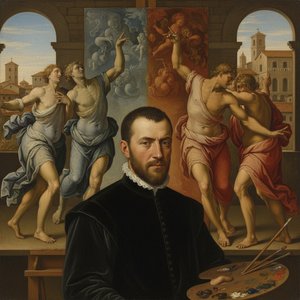
Trinity (detail)

Domenico Beccafumi's 'Trinity' (1513) is a monumental High Renaissance masterpiece depicting the Holy Trinity, showcasing dynamic figures and innovative composition within a richly detailed panel.

Domenico Beccafumi (1486-1551) był siennym malarzem znanym ze stylu manierystycznego – charakteryzującego się dramatycznym emocjami i zniekształconymi figurami oraz bogatą dekoracją, szczególnie w monumentalnych freskach takich jak „Przebudzenie Maryi” i „Patriotyzm”.

Ręcznie malowana reprodukcja olejowa

Ręcznie malowany obraz olejny na płótnie, wykonany na zamówienie przez naszych artystów w wybranym przez Ciebie wymiarze i oprawie. ( Przełącz na wersję drukowaną Przełącz na wersję cyfrową)

P118B $10
P118H $10
P118W $10
P438Z $10
P508JH $12
P508YH $12
P805H $10
P805Z $10
P919BZ $10
P919G $10
P919XJ $10
P959ZH $10
P968JZ $12
W106C $8
W218G $10
W218JH $8
W218Y $10
W307PJ $10
W316G $10
W316PJ $8
W316Y $10
W398PJ $8
W4111J $10
W500HY $15
W500JH $15
W692G $12
W849H $8
W940BG $15
W953PJ $8

Standardowy
na zamówienie
CM
INCH

Wybierz spośród naszych standardowych rozmiarów, które zachowują oryginalne proporcje dzieła sztuki.

szerokość
wysokość

Możesz wprowadzić własne wymiary, aby dopasować obraz do konkretnej ramy lub przestrzeni. Jeśli wybrany rozmiar nie będzie odpowiadał proporcjom oryginału, przytniecie dzieło sztuki lub rozszerzymy je o dodatkowe elementy, ręcznie domalowane przez artystę. Przed rozpoczęciem produkcji wyślemy projekt cyfrowy do Twojej akceptacji.
Należy pamiętać, że podgląd na ekranie nie odzwierciedla rzeczywistego przycinania ani rozszerzania obrazu. Tylko projekt dokładnie pokaże ostateczną kompozycję.
Choć oferujemy możliwość zamówienia niestandardowych rozmiarów, zalecamy wybór wymiaru z gotowej listy, aby zachować oryginalne proporcje dzieła.

Przykłady możliwych zmian: Zamień twarz na zdjęcie klienta; Dodaj zwierzę domowe (np. zamień kota na psa); Ukryj wiadomość w tle; Zmień krajobraz lub elementy tła.
Po złożeniu zamówienia zespół OriginalUniqueArt.com skontaktuje się z klientem drogą mailową w celu uzyskania instrukcji i prześle wizualizację projektu

Dostawa na całym świecie () w ciągu 3–4 tygodni zamiast standardowych 5 tygodni. (20 Wrzesień). Bez kompromisów w kwestii jakości.

why_choose_icon
Bezpłatna ekspresowa wysyłka na cały świat
why_choose_icon
Wysokiej jakości płótno lniane
why_choose_icon
Pełne ubezpieczenie transportowe
why_choose_icon
Gwarancja zwrotu należności celnych i podatków importowych
why_choose_icon
Gwarancja idealnego odwzorowania barw
why_choose_icon
100-dniowy okres na zwrot dzieła w przypadku wykrycia wad produkcyjnych
why_choose_icon
Gwarancja 100% zwrotu pieniędzy
why_choose_icon
Oferta przy zakupie wielu sztuk

Cena całkowita

$ 300

reproduction

Trinity (detail)

Technika wykonania

Rozmiar reprodukcji

-

Suma do zapłaty

$ 300

Kluczowe informacje

  • Year: 1513
  • Medium: Oil on panel
  • Notable elements: Cherubs, dynamic figures
  • Artistic style: Expressive, detailed
  • Influences:
    • Raphael
    • Fra Bartolomeo
  • Title: Trinity
  • Artist: Domenico Beccafumi

Quiz wiedzy o sztuce

Do każdego pytania dotyczy tylko jedna poprawna odpowiedź.

Pytanie 1:
What is the primary subject depicted in Domenico Beccafumi’s ‘Trinity’?
Pytanie 2:
In what city is Domenico Beccafumi’s ‘Trinity’ currently housed?
Pytanie 3:
The ‘Trinity’ triptych was originally commissioned for which religious space?
Pytanie 4:
Which artistic movement does Domenico Beccafumi’s ‘Trinity’ exemplify?
Pytanie 5:
What is a notable stylistic feature of Beccafumi's 'Trinity' that reflects his influence from other artists?

The Genesis of a Vision: Domenico Beccafumi's Trinity

Domenico di Pace Beccafumi, a name often overshadowed by the titans of Florence, nevertheless stands as a crucial bridge between the High Renaissance and the burgeoning complexities of Mannerism. Born in the modest Tuscan town of Montaperto around 1486, his artistic journey was one defined not just by technical skill but by an intensely individual vision—a deeply rooted sensibility informed by the traditions of Siena yet boldly reaching towards new expressive possibilities. His story is a testament to how regional artistry could simultaneously embrace and subtly transform broader stylistic trends, culminating in works of profound emotional resonance.

The “Trinity,” painted circa 1513, offers an immediate glimpse into this unique perspective. Commissioned for the Cappella del Manto within the venerable Santa Maria della Scala hospital complex in Siena – a space steeped in history and dedicated to healing – the altarpiece transcends mere devotional representation; it becomes a carefully constructed meditation on faith, sacrifice, and divine presence. Beccafumi’s decision to depict Jesus Christ on the cross as a young man, rather than the more conventional aged figure, immediately establishes a dynamic tension within the composition, injecting a palpable sense of vulnerability and nascent power into the scene.

A Synthesis of Influences: Style and Technique

Beccafumi’s style is remarkably complex, a skillful synthesis of influences from Siena, Florence, and Rome. He inherited the Sienese tradition's emphasis on rich color palettes, dramatic lighting, and a heightened sense of emotional intensity – qualities evident in his masterful use of chiaroscuro to sculpt form and draw the viewer’s eye towards the central figure. Yet, he was also deeply influenced by the Florentine artists who had recently returned from Rome, absorbing their innovations in perspective, anatomical accuracy, and a more dynamic approach to composition. The subtle distortions of figures, particularly in the depiction of the angels, hint at the emerging Mannerist aesthetic – a deliberate departure from the idealized forms of the High Renaissance.

Technically, Beccafumi demonstrates remarkable control over his medium. The oil paint is applied with meticulous detail, creating a surface texture that is both luminous and tactile. The layering of colors—the deep blues and purples of the background contrasted against the vibrant reds and golds of the garments—further enhances the sense of depth and drama. Note also the intricate detailing in the drapery, which flows with an almost sculptural quality, adding to the overall dynamism of the scene.

Symbolism and Spiritual Depth

The “Trinity” is rich in symbolic meaning. The central image of Christ on the cross represents sacrifice and redemption—the core tenets of Christian theology. Above him, the figures of God the Father and the Holy Spirit are rendered with a subtle elegance, suggesting a divine hierarchy while simultaneously conveying a sense of profound unity. The inclusion of two cherubs in the foreground adds an element of innocence and hope, anchoring the scene within a narrative of salvation. The choice of saints flanking Christ—Cosmas and Damian, known for their healing abilities – further reinforces the altarpiece’s connection to the hospital complex where it was originally displayed.

Interestingly, the composition echoes elements found in Raphael's “Foligno Madonna,” suggesting a conscious engagement with contemporary artistic trends. However, Beccafumi transcends mere imitation; he imbues the scene with his own distinctive emotional intensity and spiritual depth. The restless movement of figures, the dramatic lighting, and the carefully orchestrated symbolism all contribute to a powerful and unforgettable visual experience.

A Legacy of Dramatic Emotion

Domenico Beccafumi’s “Trinity” is more than just a religious painting; it's a profound exploration of faith, sacrifice, and the human condition. It stands as a testament to his unique artistic vision—a synthesis of Sienese tradition, Florentine innovation, and personal expression. The work’s enduring appeal lies in its ability to evoke a powerful emotional response, inviting viewers to contemplate the mysteries of life, death, and redemption. Reproductions of this masterpiece capture not only its visual splendor but also the spirit of its creator—a true Sienese visionary who left an indelible mark on the history of Italian Renaissance art.


Biografia artysty

Domenico di Pace Beccafumi (1486 – May 18, 1551) – A Sienese Visionary

Domenico di Pace Beccafumi, a name that resonates less immediately than those of his Florentine contemporaries, nonetheless occupies a pivotal position in the narrative of Italian Renaissance art. Born around 1486 in Montaperto, near Siena, Beccafumi’s artistic journey was one of remarkable development, culminating in a style that bridged the High Renaissance and the burgeoning complexities of Mannerism. His story isn't simply about technical skill; it is about a deeply individual vision—a sensibility steeped in the traditions of his Sienese heritage yet boldly reaching towards new expressive possibilities. His origins were humble: the son of Giacomo di Pace, a peasant who worked on the estate of Lorenzo Beccafumi, his talent was recognized by Lorenzo Beccafumi, who adopted him and provided for his initial artistic training with Mechero, a local Sienese artist. This early grounding in the Sienese school would prove foundational, even as he ventured beyond its established conventions. The Sienese tradition, already diverging from the classical ideals embraced elsewhere in Italy, fostered an environment where emotional intensity and decorative detail were valued, qualities that would become hallmarks of Beccafumi’s unique style.

Early Life and Artistic Training

Domenico’s formative years instilled within him a profound appreciation for Sienese artistic sensibilities—a preference for expressive color palettes and dynamic compositions that contrasted sharply with the idealized forms favored in Florence during this period. Lorenzo Beccafumi, recognizing his son's exceptional aptitude for drawing, ensured he received comprehensive instruction from Mechero, a respected Sienese artist who championed the stylistic conventions of their region. This mentorship solidified Beccafumi’s connection to the Sienese school and established a bedrock of artistic principles that would inform his subsequent endeavors. The influence of Giotto—a pivotal figure in Sienese art—was palpable in Mechero's teachings, emphasizing naturalism and conveying emotion through gesture and facial expression—elements that would become central to Beccafumi’s distinctive aesthetic.

Rome and the Encounter with Renaissance Giants

Around 1509, Domenico embarked on a transformative journey to Rome, a city pulsating with artistic innovation and intellectual ferment. Immediately upon arriving in the papal capital, he encountered the monumental works of Raphael and Michelangelo—artists who had revolutionized painting and sculpture through their mastery of perspective, anatomy, and dramatic narrative. Unlike many artists of his generation who sought to emulate these masters precisely, Beccafumi absorbed their groundbreaking techniques while simultaneously filtering them through his own Sienese artistic heritage. He didn’t merely copy the Roman style; he reimagined it—injecting into it a sense of psychological depth and emotional turbulence that distinguished it from its more serene counterparts. This synthesis resulted in an artistic idiom characterized by unsettling juxtapositions, distorted figures, and luminous colorations—a stylistic hallmark that would define Beccafumi’s oeuvre.

The Style of Siena: Decorative Detail and Emotional Intensity

Returning to Siena after his Roman sojourn, Beccafumi continued to develop his distinctive style—one marked by a preoccupation with decorative detail and an unwavering commitment to conveying profound emotional states. His paintings frequently employed shimmering surfaces and intricate patterns—techniques borrowed from Sienese craftsmanship—to heighten visual impact and create immersive environments for the viewer. Simultaneously, he infused his compositions with palpable tension and instability, reflecting a departure from the harmonious balance of High Renaissance ideals. This stylistic duality—the blending of decorative splendor with psychological complexity—became synonymous with Beccafumi’s artistic vision. He skillfully navigated the shifting currents of artistic taste, establishing himself as one of the last unwavering champions of Sienese tradition while simultaneously embracing the expressive innovations of Mannerism.

Major Works and Artistic Legacy

Domenico Beccafumi produced a prolific body of work encompassing painting, sculpture, mosaic design, and printmaking—demonstrating his remarkable versatility as an artist and craftsman. Among his most celebrated achievements are the frescoes adorning the Oratory of St. Benedict in Siena—a testament to his narrative skill and expressive power. The Trinity Triptych, housed in the Pinacoteca Nazionale di Siena, showcases Beccafumi’s mastery of oil painting and his ability to convey religious devotion with both grandeur and intimacy. The Annunciation, also at the Pinacoteca Nazionale, exemplifies his distinctive use of color and composition—creating a scene that is simultaneously serene and subtly unsettling. Furthermore, he directed the ambitious pavement design for Siena Cathedral between 1517 and 1544—a monumental undertaking involving intricate marble inlay and mosaics depicting biblical narratives. Beccafumi’s innovative techniques in mosaic production cemented his reputation as a pioneer of artistic craftsmanship. His prints—engravings and woodcuts—further disseminated his stylistic ideas beyond Siena's borders, influencing artists across Italy. Domenico di Pace Beccafumi remains an enduring symbol of Sienese artistic identity—a visionary who dared to challenge conventional norms and whose legacy continues to inspire admiration for its expressive power and psychological depth.
domenico di pace beccafumi

domenico di pace beccafumi

1486 - 1551 , Włochy

Najważniejsze informacje

  • Artistic Movement Or Style: Mannerizm
  • Artists Who Influenced This Artist:
    • Raphael
    • Michelangelo
  • Date Of Birth: c. 1486
  • Date Of Death: May 18, 1551
  • Full Name: Domenico di Pace Beccafumi
  • Nationality: Włoski
  • Notable Artworks:
    • Trinity Triptych
    • Św. Paweł na tronie
    • Zstąpienie Chrystusa do otchłani
  • Place Of Birth: Montaperto koło Sieny
Odkryj dzieła sztuki uporządkowane według tematów, stylów i cech charakterystycznych.