 Przełącz na wydania drukowane
 Rozwiń treść







































 W przypadku dzieł sztuki lub reprodukcji, których którykolwiek z boków przekracza 105 cm (około 41 cali), rama zostanie wysłana w formie zestawu do samodzielnego montażu. Metoda ta zapewnia bezpieczną dostawę i zapobiega uszkodzeniom podczas transportu.


A Symphony of Light and Color
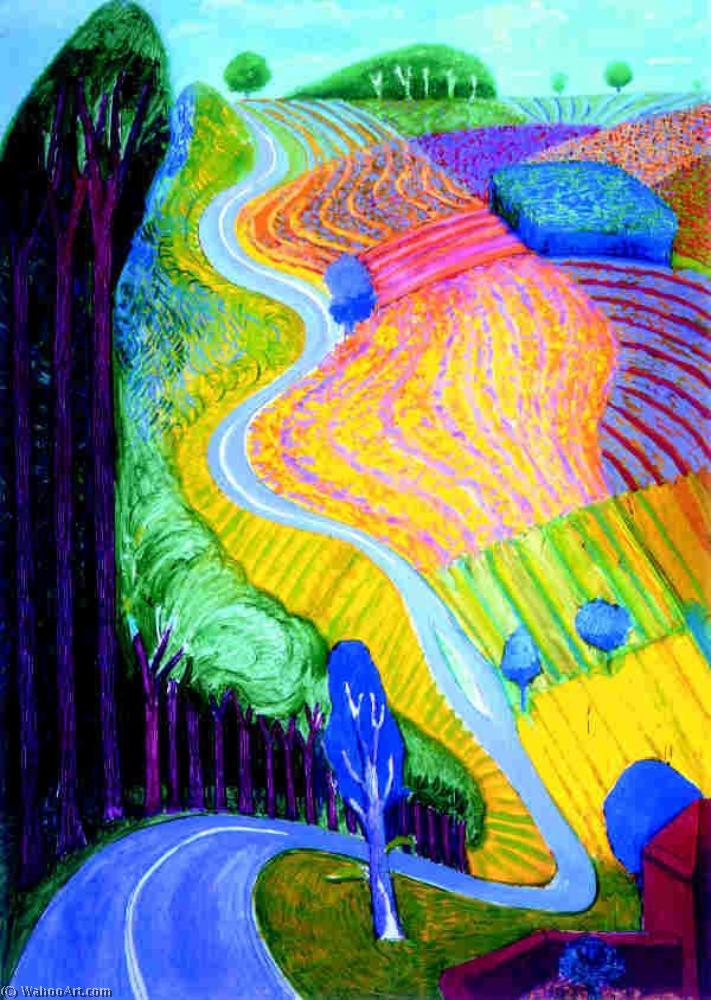
In the vast landscape of contemporary art, few names resonate with as much vibrancy and visual joy as David Hockney. His work, particularly in pieces like this breathtaking landscape, serves as a profound celebration of the act of seeing. The painting presents a sweeping, idyllic countryside where a winding road meanders through lush fields of crops, inviting the viewer to embark on a journey alongside the figures scattered throughout the scene. It is not merely a depiction of a place, but an invitation into a moment of pure, sun-drenched tranquility. Through a masterful use of color, Hockney captures the very essence of warmth, utilizing a bold palette of yellows and oranges that suggests sunlight filtering through dense foliage, evoking the radiant atmosphere of his beloved California as much as the rolling hills of England.
The emotional resonance of this work lies in its ability to bridge the gap between observation and feeling. While the subject matter—a peaceful pastoral setting—might appear simple at first glance, the execution is deeply complex. There is a palpable energy within the brushwork that mirrors the vitality of nature itself. For the collector or interior designer, this piece offers more than just decoration; it provides a window into a state of reverie. It possesses a quiet dignity that can anchor a room, offering a sense of optimism and light that transforms any space it inhabits.
Technique and the Art of Perspective
To understand the brilliance of this work, one must look closer at the innovative techniques that define Hockney’s late-career mastery. Moving away from the traditional single-canvas format, Hockney often employs a method he refers to as “joinery.” By meticulously layering multiple canvases together—sometimes up to six—he creates expansive, panoramic views that defy the standard boundaries of a frame. This technique allows for a synthesized perspective, mimicking the way the human eye naturally scans a horizon, capturing multiple viewpoints within a single, cohesive vision. The resulting surface is beautifully textured and subtly uneven, adding a physical dimension to the light and shadow depicted.
This approach places the work firmly within the lineage of Impressionism, yet it is infused with a distinctly Postmodern sensibility. Unlike the soft, hazy edges of the nineteenth-century masters, Hockney’s lines are often more defined and his colors more saturated, reflecting a modern fascination with clarity and visual sensation. He rejects the heavy intellectualism of much contemporary art in favor of a direct, visceral connection to the natural world. This makes the piece an ideal choice for those seeking high-quality reproductions that bring both sophisticated technique and an approachable, luminous beauty into their homes or galleries.
A Legacy of Observation
Historically, Hockney’s work emerged as a vital response to the dominance of Abstract Expressionism, reintroducing the importance of the figure and the landscape through a lens of stylized realism. His career has been a lifelong exploration of how light transforms reality, a pursuit that has made him one of the most influential artists of the twentieth and twenty-first centuries. This particular landscape stands as a testament to his ability to find extraordinary beauty in the ordinary, turning a simple country road into a monumental study of light, space, and human presence.
For those looking to invest in art that inspires wonder, this reproduction captures the soul of Hockney’s vision. It is a piece that celebrates the enduring beauty of our world and the profound importance of taking the time to truly observe it. Whether placed in a sunlit living area or a curated professional studio, the painting acts as a constant reminder of the warmth and vibrancy that can be found when we look at the world with open eyes.
Pytania i odpowiedzi
Skąd pochodzą odwiedzający „B1119d469eec73ca06a2d9f9e9f65708” – David Hockney?
Dla dzieła „B1119d469eec73ca06a2d9f9e9f65708” dostępna jest strona Statystyki wyświetleń. Przedstawia ona miesięczną liczbę odwiedzin tego dzieła oraz innych prac artysty, z podziałem na kraje i języki.
Jak mogę podejrzeć reprodukcję dzieła „B1119d469eec73ca06a2d9f9e9f65708” – David Hockney?
Aby podglądnąć reprodukcję dzieła „B1119d469eec73ca06a2d9f9e9f65708” – David Hockney, otwórz stronę Podgląd w pomieszczeniu danego utworu.
Pod jakimi innymi nazwiskami znany jest David Hockney?
Inne znane nazwiska David Hockney, twórcy "B1119d469eec73ca06a2d9f9e9f65708", to Dawid Hockney, David Hockney (Pełne Imię I Nazwisko).
 Podgląd w skali 1:1
 Wyślij jako kartkę
 Udostępnij
 Szczegóły dzieła
 Przewodnik

 Pobierz obraz
 Podobne obiekty
 RTG
RTG Pokaz slajdów
 Pytania i odpowiedzi
 Statystyki