Przełącz na wydania drukowane
 Rozwiń treść







































 W przypadku dzieł sztuki lub reprodukcji, których którykolwiek z boków przekracza 105 cm (około 41 cali), rama zostanie wysłana w formie zestawu do samodzielnego montażu. Metoda ta zapewnia bezpieczną dostawę i zapobiega uszkodzeniom podczas transportu.


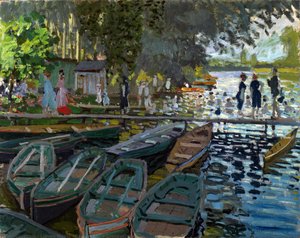
A Moment Frozen in Light: Claude Monet’s “River Scene at Bennecourt”
Claude Monet's "River Scene at Bennecourt," painted in 1868, transcends mere landscape depiction; it embodies the very essence of Impressionism—a deliberate attempt to capture not just what the eye sees but how light transforms perception. Currently residing within the prestigious Art Institute of Chicago, this oil on canvas invites viewers into a tranquil tableau where the gentle flow of the Seine mirrors the contemplative gaze of Camille Doncieux, Monet’s future wife, positioned beside a small boat. The artwork's brilliance isn’t found in meticulous detail but rather in Monet’s revolutionary mastery of color and brushstroke—a technique that elevates it to an experience of visual poetry. The composition abandons conventional artistic conventions, prioritizing spontaneity and immediacy. Instead of sharply defined contours or painstakingly rendered forms, Monet employs loose, expressive strokes that prioritize the interplay between illumination and shadow. Consider how the sky dominates the canvas, rendered in delicate washes of azure and lavender—a hue subtly mirroring the melancholic beauty of Doncieux’s expression. These ethereal colors bleed into the water surface, creating an illusion of boundless depth and hinting at the hidden movement beneath – a characteristic feature of Monet's groundbreaking approach. This purposeful blurring of edges is pivotal to conveying the Impressionist ideal: capturing *l’impression*, or “the impression,” rather than striving for photographic accuracy.Historical Context & Emotional Resonance
Painted during a period marked by personal upheaval—following Monet’s eviction from Gloton and grappling with recent bereavement—"River Scene at Bennecourt" serves as a poignant testament to resilience amidst adversity. Yet, paradoxically, it's precisely this turmoil that fuels the artwork’s profound emotional impact. Monet skillfully utilizes color and texture to convey not just visual beauty but also an underlying sense of longing and quiet contemplation. Camille Doncieux herself becomes more than simply a subject; she embodies a spirit of steadfastness—a woman finding solace in the restorative power of nature during challenging times. The painting speaks volumes about the artist’s ability to transform personal sorrow into artistic triumph.Technique & Impressionistic Innovation
Monet's technique is undeniably innovative for its time. He eschews traditional glazing methods, favoring instead layering thin washes of pigment—a process known as *plein air* painting—directly onto the canvas outdoors. This method allows him to capture the fleeting effects of sunlight on water and foliage with unparalleled fidelity. Observe how Monet’s brushstrokes vary in direction and pressure, creating a dynamic surface that vibrates with energy. The subtle variations in color temperature contribute to the overall atmosphere of hazy luminescence—a hallmark of Impressionism's quest to represent light as it perceives itself rather than as it appears to the eye.Symbolic Significance & Artistic Legacy
Beyond its aesthetic qualities, “River Scene at Bennecourt” carries symbolic weight. The Seine River, a recurring motif in Monet’s oeuvre, represents tranquility and renewal—themes that resonate deeply within the context of Doncieux's presence and Monet’s own emotional state. The boat symbolizes movement and aspiration, mirroring the artist’s desire to escape his difficulties and embrace beauty. Ultimately, Monet’s masterpiece stands as a cornerstone of Impressionism, demonstrating how art can transcend mere representation to evoke profound feelings and capture the intangible essence of experience—a legacy that continues to inspire artists and captivate audiences worldwide.Pytania i odpowiedzi
Jak można wykorzystać „Scena nad Seką” – Claude Monet w dekoracji wnętrz?
Zalecane zastosowanie (Punkt centralny) oraz przestrzeń (Salon lub strefa dzienna) to dwie rekomendacje dla dzieła „Scena nad Seką” – Claude Monet.
W którym roku powstało dzieło "Scena nad Seką"?
Powstanie „Scena nad Seką” – Claude Monet datuje się na 1868.
Z jakiego kraju pochodzi dzieło Impressionism pt. "Scena nad Seką"?
"Scena nad Seką" łączy nurt Impressionism z Francja poprzez miejsce urodzenia jego twórcy.
 Podgląd w skali 1:1
 Wyślij jako kartkę
 Udostępnij
 Szczegóły dzieła
 Przewodnik

 Pobierz obraz
 Podobne obiekty
 RTG
RTG Pokaz slajdów
 Q&A
Q&A Statystyki