Contemporary Realism · 1968
Big Self-Portrait (Chuck Close, 1968)
Chuck Close (1940–2021) stworzył Big Self-Portrait. Dzieło pochodzi z 1968. Należy do nurtu Contemporary Realism. Wykonano w technice Black and White Photography. Przechowywane jest w Walker Art Center w Minneapolis, Stany Zjednoczone Ameryki.
- 1968
- Black and White Photography
- Walker Art Center, Minneapolis

 Ręcznie malowany obraz olejny
 Wyślij jako kartkę
 Udostępnij
 Karta informacyjna


 Pobierz obraz
 Podobne obiekty
 Pokaz slajdów
 Pytania i odpowiedzi

 Statystyki
Big Self-Portrait w skrócie
- Tytuł
- Big Self-Portrait
- Artysta
- Chuck Close (1940–2021)
- Miejsce urodzenia artysty
- Monroe, Stany Zjednoczone
- Data powstania
- 1968
- Technika wykonania
- Black and White Photography
- Gdzie można je zobaczyć
- Walker Art Center, Minneapolis, Stany Zjednoczone Ameryki
- Temat
- self-portrait, hyperrealism, face, detail, grid, identity
Co przedstawia Big Self-Portrait?
The Unblinking Gaze: An Encounter with Chuck Close's Self-Portraiture
To stand before a work like Big Self-Portrait is not merely to observe a likeness; it is to confront an intensely rendered meditation on identity itself. Created in 1968, this piece by Chuck Close captures the artist at a pivotal moment, presenting a self that feels both intimately known and profoundly alien. The composition is a masterful study in compression, tightly framing the head and shoulders until the viewer has no escape from the subject’s direct, almost challenging gaze. It is a portrait stripped down to its most fundamental elements—the architecture of bone, the texture of skin, the weight of expression.
A Symphony of Detail: Technique and Hyperrealism
What immediately arrests the eye is the sheer, breathtaking level of detail. Close’s signature technique, which involves translating photographic reality onto canvas through a meticulous grid system, results in an effect that borders on the microscopic. Here, every pore, every strand of wavy hair falling across the forehead, and the subtle shadow beneath the jawline are rendered with painstaking precision. The work operates within a stark grayscale palette, forcing the viewer to appreciate value—the dramatic interplay between deep blacks and brilliant whites. This hyperrealistic approach transforms paint into an illusion of texture, making the flat surface seem palpably three-dimensional.
Symbolism in Shadow and Light
The subject matter, a self-portrait, inherently invites introspection. It becomes less about the man depicted and more about the act of representation itself—how we choose to see ourselves, and how others perceive us. The inclusion of the cigarette held between the lips adds a layer of potent symbolism; it can be read as an emblem of artistic rebellion, a momentary pause, or simply the casual accoutrement of a thinking mind at work. The lighting, diffused yet directional from above and slightly to the left, sculpts the features with gentle shadows, giving weight and narrative depth to what is fundamentally a study in visual data.
Bringing the Masterpiece Home: Reproduction for Modern Spaces
Owning a reproduction of Big Self-Portrait allows one to integrate this monumental piece of art history into a contemporary living space. While the original demands an appreciation for its scale and painstaking labor, our hand-painted reproductions capture the essence—the arresting gaze, the textural complexity, and the emotional weight—in a format suitable for any collector’s vision. Imagine this intense study anchoring a sophisticated drawing room or gallery wall; it serves not just as decoration, but as a focal point for deep contemplation, inviting conversation about art, selfhood, and the enduring power of the human portrait.
W którym muzeum znajduje się Big Self-Portrait?
Walker Art Center
Minneapolis, Stany Zjednoczone Ameryki
Narodziny i Ewolucja Wizji: Walker Art Center w Minneapolis Walker Art Center, położony w sercu tętniącego życiem Minneapolis w Minnesocie, jest świadectwem trwałej siły sztuki nowoczesnej i współczesnej – dziedzictwa zapoczątkowanego przez wizję Thomasa Barlowa Walkera w 1940 roku. Początkowo zrodzony jako skromna galeria w jego własnym domu, napędzana pasją do ekspresji artystycznej, szybko ewoluował w jedną z najbardziej wpływowych instytucji kulturalnych Ameryki: dynamiczną przestrzeń, gdzie przełomowe wystawy splatają się z kolekcją stałą obejmującą dekady i dyscypliny. Walker nie ogranicza się jedynie do zachowywania arcydzieł; aktywnie uczestniczy w artystycznej rozmowie, promując innowacje poprzez zamówienia, rezydencje oraz wyjątkowo angażujący program publiczny – zaangażowanie w dialog i odkrywanie, które definiuje jego etos.


Zdjęcia w wysokiej rozdzielczości dzieła Big Self-Portrait
Chronione prawem autorskim: pliki te służą wyłącznie do osobistego wglądu i nie stanowią licencji na ich powielanie.
Chuck Close, Big Self-Portrait (1968), Walker Art Center.
Odpowiedzi na pytania dotyczące Big Self-Portrait
Gdzie można obecnie zobaczyć dzieło „Big Self-Portrait” – Chuck Close?
Oryginał dzieła „Big Self-Portrait” – Chuck Close znajduje się w Walker Art Center, Minneapolis, Stany Zjednoczone Ameryki. Reprodukcja pozwala na eksponowanie pracy w domu.
W którym roku powstało dzieło „Big Self-Portrait” – Chuck Close?
Powstanie „Big Self-Portrait” – Chuck Close datuje się na 1968.
W jakiej technice wykonano „Big Self-Portrait” – Chuck Close?
Technika wykonania dzieła „Big Self-Portrait” – Chuck Close to Black and White Photography. Reprodukcje mają na celu wierne oddanie wyglądu tej techniki.
Co przedstawia "Big Self-Portrait"?
„Big Self-Portrait” – Chuck Close przedstawia: self-portrait, hyperrealism, face, detail, grid, identity, cigarette.
Czy dzieło "Big Self-Portrait" znajduje się w domenie publicznej?
Status praw autorskich dla „Big Self-Portrait” – Chuck Close: dzieło znajduje się w nadal objęte ochroną prawa autorskiego. Określa to, czy reprodukcje obrazu mogą być sporządzane swobodnie.
Kto jest autorem dzieła "Big Self-Portrait"?
Autorem dzieła „Big Self-Portrait” jest Chuck Close. Praca ta figuruje w katalogu pod nazwiskiem Chuck Close.
Do jakiego nurtu w sztuce należy „Big Self-Portrait” – Chuck Close?
„Big Self-Portrait” – Chuck Close należy do nurtu Contemporary Realism. Nurt ten stanowi stylistyczny kontekst dzieła.
Do którego etapu twórczości Chuck Close należy dzieło „Big Self-Portrait”?
W dorobku artystycznym Chuck Close dzieło „Big Self-Portrait” przypada na Late Period. Ten etap pozwala zestawić je z innymi pracami twórcy.
W jakim wieku Chuck Close stworzył(a) "Big Self-Portrait"?
Chuck Close miał 28 lat w momencie powstania „Big Self-Portrait” w 1968. Wiek ten obliczono na podstawie roku urodzenia artysty, 1940.
O artyście: Chuck Close

1940–2021, Stany Zjednoczone
Chuck Close
Życie wykute w detalu: Świat Chucka Close'a Charles Thomas Close, urodzony 5 lipca 1940 roku w Monroe w stanie Waszyngton, a zmarły 19 sierpnia 2021 roku w Oceanside w Nowym Jorku, był monumentalną postacią w krajobrazie sztuki współczesnej. Jego droga, naznaczona zarówno głęboką innowacją artystyczną, jak i osobistymi przeciwnościami, przedefiniowała portret dla przyszłych pokoleń. Od najmłodszych lat Close mierzył się ze znacznymi wyzwaniami – schorzenie neurologiczne połączone z dysleksją stworzyło przeszkody, które ukształtowały jego unikalną perspektywę. Te trudności sprzyjały głębokiej obserwacji otaczającego go świata, co stało się fundamentem jego praktyki artystycznej.
Inne prace Chuck Close
 Barack Obama by Chuck Close2013
 Alex1994
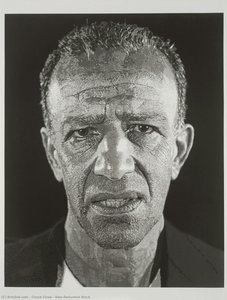 Alex Reduction Block1993
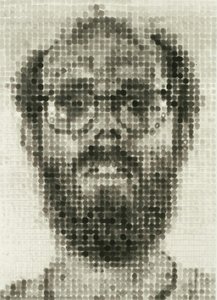 Self-Portrait1988
Eseje o Big Self-Portrait
 The Introspective Gaze: Tracing the Evolution and Psychological Depth of the Self-PortraitExplore the psychological evolution of self-portraiture from Dürer to modern masters. Trace the history of the human gaze with us.
 Polish artworks of the 1900sPolish Symbolism in the 1900s features masterpieces by Jacek Malczewski, Olga Boznańska, and Józef Mehoffer. View the full collection at Or…
 Precision in Portraiture: The Technical Rigor of Anatomical Mastery and Hyper-RealismMaster the technical rigor of hyper-realism and anatomical precision. Explore the evolution of portraiture mastery now.