

 Podgląd w skali 1:1
 Wyślij jako kartkę
 Udostępnij
 Szczegóły dzieła
 Przewodnik

 Pobierz obraz
 Podobne obiekty
 RTG
RTG Pokaz slajdów
 Statystyki
Spring Maiden


 Rozwiń treść
Giclée / Wydruk artystyczny
Wydruki giclée lub płótna o jakości muzealnej, szybka realizacja i szeroki wybór opcji wykończenia. ( Zamów ręcznie malowaną reprodukcję Przejdź do wersji cyfrowej)




P118B zł10

P118H zł10

P118W zł10

P438Z zł10

P508JH zł12

P508YH zł12

P805H zł10

P805Z zł10

P919BZ zł10

P919G zł10

P919XJ zł10

P959ZH zł10

P968JZ zł12

W106C zł8

W218G zł10

W218JH zł8

W218Y zł10

W307PJ zł10

W316G zł10

W316PJ zł8

W316Y zł10

W398PJ zł8

W4111J zł10

W500HY zł15

W500JH zł15

W692G zł12

W849H zł8

W940BG zł15

W953PJ zł8




Wybierz spośród naszych standardowych rozmiarów, które zachowują oryginalne proporcje dzieła sztuki.

Wpisz wymaganą szerokość i wysokość, aby dopasować grafikę do ramy lub ściany. Wydruk można jedynie przyciąć, nigdy nie powiększając go poza oryginalny obraz, dlatego format o innych proporcjach spowoduje utratę części kompozycji. Przed rozpoczęciem druku prześlemy Ci cyfrowy podgląd do zatwierdzenia. Obraz wyświetlany na tej stronie nie pokazuje rzeczywistego przycięcia — jedynie podgląd oddaje ten efekt.
Dostawa na cały świat () w ciągu 2 tygodni zamiast standardowych 4/5 tygodni. (28 Październik)

Bezpłatna ekspresowa wysyłka na cały świat

Wysokiej jakości płótno lniane

Pełne ubezpieczenie przesyłki

Gwarancja zwrotu należności celnych i podatków importowych

Gwarancja wiernego odwzorowania kolorów

100-dniowa polityka zwrotów (tylko w przypadku wad)

Gwarancja 100% zwrotu pieniędzy

Zniżka przy zakupie wielu sztuk
 Opcja ze szkłem jest dostępna wyłącznie w rozmiarach poniżej 110 cm

Spring Maiden
Giclée / Wydruk artystyczny
Wymiary reprodukcji
-


Cena całkowita
zł 307
Spring Maiden: A Portrait of Transient Beauty
Charles Webster Hawthorne’s “Spring Maiden,” painted in 1925, isn't merely a depiction of a young woman; it’s a carefully constructed meditation on the fleeting nature of youth and the poignant beauty found within moments of quiet contemplation. This oil-on-canvas work, currently residing at the High Museum of Art in Atlanta, exemplifies Hawthorne’s signature Luminist style – a deliberate rejection of dramatic lighting and bold brushstrokes in favor of subtle tonal gradations and an emphasis on capturing the ephemeral quality of light and atmosphere. The painting immediately draws the viewer in with its muted palette dominated by earthy browns, soft greens, and delicate creams, creating a sense of serene stillness that belies the emotional depth at its core.
Hawthorne’s technique is remarkably restrained, yet profoundly effective. He employs a layering approach, building up color slowly to achieve a velvety texture and an almost photographic realism. Notice how he renders the fabric of her dress – not with sharp outlines but with delicate washes of color that suggest both its weight and its fluidity. The loose brushwork in the background, particularly around the suggestion of trees and foliage, contributes to the painting’s overall sense of atmospheric depth, pulling the viewer into a dreamlike state. Hawthorne's training under William Merritt Chase is evident in his masterful use of light and shadow, creating an illusion of three-dimensionality that elevates the portrait beyond a simple likeness.
The Luminist Influence and New England Roots
To fully appreciate “Spring Maiden,” it’s crucial to understand Hawthorne's artistic lineage. He was deeply influenced by the Luminist movement, which originated in post-Civil War America and sought to capture the quiet beauty of everyday life – particularly landscapes bathed in soft light. This movement rejected the grand narratives and dramatic scenes favored by earlier generations of American painters, instead focusing on capturing the subtle nuances of nature and human experience. Hawthorne’s upbringing in Maine, steeped in the traditions of shipbuilding and ice farming—his father a captain—provided him with an intimate connection to the rugged coastline and its ever-changing light, themes that would permeate his work throughout his career.
Born in Lodi, Illinois, in 1872, Hawthorne’s early years were far removed from the coastal landscapes he would later immortalize. However, a return to Maine as a child profoundly shaped his artistic vision. This connection to the sea—its power, its beauty, and its inherent melancholy—became a recurring motif in his paintings, informing both subject matter and aesthetic sensibility. His work is often described as embodying the spirit of New England, capturing not just the physical landscape but also the emotional resonance of its history and culture.
Symbolism and the Portrait’s Essence
The young woman depicted in “Spring Maiden” possesses an enigmatic quality that invites interpretation. Her slightly downturned gaze suggests a pensive mood—a moment of introspection amidst the beauty of springtime. The white flower she holds, likely a lily or similar bloom, symbolizes purity, innocence, and new beginnings – fitting themes for a portrait celebrating youth and renewal. Hawthorne’s careful attention to detail extends beyond mere representation; he imbues the painting with a sense of quiet dignity and understated grace.
The composition itself is carefully balanced, drawing the eye to the woman's face while simultaneously creating a sense of spaciousness around her. The muted colors and soft lighting contribute to this feeling of tranquility, suggesting a moment suspended in time—a fleeting glimpse of beauty that will inevitably fade with the passage of seasons. It’s a portrait not just of a young woman, but of an entire mood, a captured essence of springtime itself.
A Legacy of Light and Observation
Charles Webster Hawthorne's “Spring Maiden” stands as a testament to his skill as a painter and his deep understanding of the Luminist aesthetic. His dedication to capturing light and atmosphere, combined with his masterful technique and evocative symbolism, has secured its place as a significant work in American art history. The painting’s enduring appeal lies not only in its technical brilliance but also in its ability to evoke a sense of quiet contemplation and appreciation for the beauty of the natural world – qualities that continue to resonate with viewers today. Reproductions of this piece offer a wonderful opportunity to bring Hawthorne's evocative style into any space, capturing the spirit of New England’s coastal landscapes and the poignant beauty of fleeting moments.
Pytania i odpowiedzi
Czy kolory dzieła "Spring Maiden" są intensywne czy stonowane?
Kolory dzieła „Spring Maiden” – Charles Webster Hawthorne charakteryzują się Subtle Color nasyceniem oraz Monochromatic intensywnością.
Co przedstawia „Spring Maiden” – Charles Webster Hawthorne?
Tematyka obecna w „Spring Maiden” – Charles Webster Hawthorne obejmuje new england, coastline, landscape, figure, painting, hawthorne, 1925. Razem stanowią one podsumowanie tematyki dzieła.
Na którym etapie kariery Charles Webster Hawthorne znajduje się dzieło „Spring Maiden”, biorąc pod uwagę jego datę powstania?
Data powstania dzieła (1925) sytuuje "Spring Maiden" w Mature Period rozwoju twórczości Charles Webster Hawthorne.
Biografia artysty
A Luminist of the New England Coast
Charles Webster Hawthorne, born in Lodi, Illinois, on January 8th, 1872, represents a pivotal moment in American art—a bridge between the waning traditions of academic painting and the burgeoning spirit of modernism. Though his early years unfolded amidst the rolling fields of the Midwest, it was the rugged, windswept coastline of Maine—to which his parents relocated shortly after his birth—that irrevocably shaped his artistic vision and became the enduring subject of his most celebrated works. This profound connection to the sea, nurtured through childhood experiences with his father’s profession as a ship captain and ice farmer, permeated every aspect of his art, informing not only the scenes he depicted but also the very philosophy that guided his approach to painting. Hawthorne's artistic journey was one marked by dedicated study, an unwavering commitment to capturing the ephemeral qualities of light and form, and a revolutionary method of art education that would leave an indelible mark on American painting for decades to come. Initially pursuing formal training in New York City, he skillfully balanced the demands of his work as an office boy with evening classes at the prestigious Art Students League under the tutelage of George de Forest Brush and H. Siddons Mowbray, followed by further studies at the National Academy of Design. Crucially, his exposure to William Merritt Chase—first as a student and later as an assistant at Shinnecock Hills—proved transformative, instilling in him a deep appreciation for *plein air* painting and the expressive potential inherent within brushwork. These formative experiences laid the groundwork for Hawthorne’s distinctive style – characterized by its robust handling of paint, luminous tonal qualities, and a remarkable ability to evoke the atmosphere and spirit of New England's coastal landscapes.The Cape Cod School and a Philosophy of Painting
Recognizing a critical need for a dedicated space where artists could immerse themselves in direct observation of nature—a vital component often lacking in traditional art academies—Hawthorne established the Cape Cod School of Art in Provincetown, Massachusetts, in 1899. This innovative institution quickly became a vibrant hub for aspiring painters from across the country, attracting those seeking an alternative to the rigid constraints of academic training and a chance to develop their artistic voices through direct engagement with the natural world. Hawthorne’s pedagogical approach was profoundly unconventional yet remarkably effective. He eschewed formal instruction in technique, instead focusing on cultivating genuine artistic vision—a belief that true artistry stemmed from careful observation, intuitive understanding, and a willingness to experiment. His teachings emphasized simplifying forms, prioritizing tonal values, and capturing the fleeting effects of light – principles deeply rooted in his own artistic practice and informed by the lessons he learned from Chase and the legacy of Dutch masters like Frans Hals. Hawthorne’s approach wasn't about dictating a specific style but rather empowering students to develop their individual perspectives through rigorous observation and bold experimentation. He famously urged them to “go out like a savage,” embracing a fresh, uninhibited approach to painting—stripping away preconceived notions and allowing the immediacy of experience to guide their hand. The school’s location in Provincetown – a small fishing village on the tip of Cape Cod – provided an ideal setting for this philosophy, offering artists access to unspoiled landscapes, vibrant local life, and a sense of community that fostered creativity and collaboration.Capturing Light and Life: Themes and Techniques
Hawthorne's paintings are immediately recognizable for their rich color palettes and masterful handling of light—a hallmark of the Luminist movement. He frequently depicted scenes from the seaside around Provincetown, portraying fishermen, families, and everyday life with a remarkable sensitivity to atmosphere and character. His portraits, in particular, stand out for their psychological depth and expressive brushwork; he wasn’t interested in merely replicating likeness but rather sought to capture the inner essence of his subjects—their personalities, their stories, and their connection to the world around them. He achieved this through meticulous observation of light and shadow, utilizing tonal variations to model form and create a sense of volume and depth. His technique often involved applying paint with broad, confident strokes, allowing the texture of the canvas itself to contribute to the overall effect—a deliberate departure from the smooth, polished surfaces favored by academic painters. Influenced by Chase’s emphasis on *plein air* painting and the legacy of Dutch masters like Rembrandt, Hawthorne sought to capture the fleeting beauty of a moment in time, imbuing his canvases with a sense of immediacy and vitality. His work also reflected an interest in genre painting—depicting scenes of everyday life with a keen eye for detail and social commentary – elevating humble subjects to the level of art through his skillful execution and empathetic portrayal. His First Voyage, for example, captures a poignant moment of youthful potential, while works like *The Red Dress* demonstrate his ability to imbue even simple compositions with emotional resonance.Major Achievements and Legacy
Throughout the early decades of this century, the name Charles Webster Hawthorne was virtually synonymous with the thriving community of painters, sculptors, and writers that gathered each summer in Provincetown, Massachusetts. He became a leading figure in the burgeoning American art scene, not only as an artist but also as a teacher and mentor—inspiring generations of young painters to pursue their artistic dreams. His establishment of the Cape Cod School of Art cemented his legacy as a pioneer of modern art education, advocating for direct observation, personal expression, and a deep connection to nature. Hawthorne’s works are now held in prestigious collections across the United States, including the Art Institute of Chicago, the Metropolitan Museum of Art in New York, and the Smithsonian American Art Museum in Washington D.C., ensuring their accessibility to future generations. His influence can be seen in the work of countless artists who followed him—particularly those associated with the Cape Cod School of Art and the broader American Impressionist movement. Charles Webster Hawthorne passed away on November 29th, 1930, in Baltimore, Maryland, leaving behind a rich artistic legacy that continues to inspire and captivate viewers today.- Born: January 8, 1872, Lodi, Illinois
- Founded Cape Cod School of Art: 1899
- Died: November 29, 1930, Baltimore, Maryland

Charles Webster Hawthorne
1872 - 1930 , Stany Zjednoczone
Krótka nota
- Artistic Movement Or Style: Impressionizm, Luminizm
- Artists Or Movements Influenced By This Artist: ['Norman Rockwell']
- Artists Who Influenced This Artist: ['William Merritt Chase']
- Date Of Birth: 8 stycznia 1872
- Date Of Death: 29 listopada 1930
- Full Name: Charles Webster Hawthorne
- Nationality: Amerykanin
- Notable Artworks:
- His First Voyage
- The Red Dress
- Place Of Birth: Lodi, Illinois, USA
Powiązane artykuły

Alfred Thompson Bricher: Luminism & the American Landscape Tradition
Explore the luminous landscapes of Alfred Thompson Bricher (1837-1908), a key figure in American Luminism and the Hudson River School. Discover his masterful maritime paintings & legacy.

Grahame Sydney: Evoking Otago's Soul Through Light & Landscape
Explore the captivating landscapes of Sir Grahame Sydney, a leading New Zealand artist renowned for his magic realism & evocative depictions of Otago's beauty. Discover key works and delve into his artistic legacy.
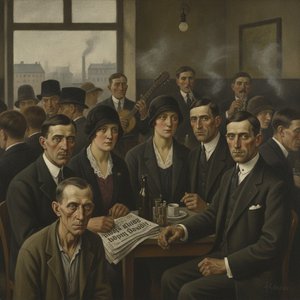
Neue Sachlichkeit: The Unflinching Realism and Social Critique of German New Objectivity
Explore the raw realism of Neue Sachlichkeit. Discover how German New Objectivity artists like Otto Dix and George Grosz captured the turbulent Weimar Republic through unflinching social critique and precise detail. A definitive guide for art historians and collectors.

Willard Leroy Metcalf: Capturing the Intimacy of American Rural Life
Explore the serene landscapes of Willard Leroy Metcalf, a key figure in American Impressionism. Discover his tranquil New England scenes & vibrant art reproductions at OriginalUniqueArt.

The Ashcan School: Capturing the Raw Spirit and Urban Realism of New York City Life
Explore the raw, evocative beauty of the Ashcan School. Discover how masters like Bellows and Glackens captured New York's urban soul through American Realism, and learn to bring this gritty, historical elegance into your modern art collection.
