- Strona główna

- Druk na płótnie
- Charles Burchfield
- Szczęka Świata
 Podgląd w skali
 Udostępnij
 Udostępnij
 Szczegóły dzieła

 Pobierz
 Podobne obiekty
 RTG
RTG Pokaz slajdów
Szczęka Świata

 Rozwiń treść
Giclée / Wydruk artystyczny
Druk giclée lub płótno o jakości muzealnej z szybką realizacją i szerokim wyborem opcji wykończenia. ( Przejdź do ręcznie malowanego obrazu Przełącz na obraz)




P118B $10

P118H $10

P118W $10

P438Z $10

P508JH $12

P508YH $12

P805H $10

P805Z $10

P919BZ $10

P919G $10

P919XJ $10

P959ZH $10

P968JZ $12

W106C $8

W218G $10

W218JH $8

W218Y $10

W307PJ $10

W316G $10

W316PJ $8

W316Y $10

W398PJ $8

W4111J $10

W500HY $15

W500JH $15

W692G $12

W849H $8

W940BG $15

W953PJ $8




Wybierz spośród naszych predefiniowanych rozmiarów, które zachowują oryginalne proporcje dzieła sztuki.

Możesz wprowadzić własne wymiary, aby dopasować dzieło do konkretnej ramy lub przestrzeni. Jeśli wybrany rozmiar nie będzie odpowiadał proporcjom oryginalnego obrazu, przytniecie dzieło lub rozszerzymy obraz za pomocą odbicia lustrzanego lub jednolitego wypełnienia krawędzi. Przed rozpoczęciem produkcji prześlemy cyfrową wizualizację do Twojej akceptacji.
Prosimy pamiętać, że podgląd na ekranie nie odzwierciedla faktycznego przycinania ani rozszerzania. Tylko wizualizacja dokładnie pokaże końcową kompozycję.
Mimo dostępności niestandardowych rozmiarów, zalecamy wybór wymiaru z listy zdefiniowanej, aby zachować oryginalne proporcje.
Dostawa na cały świat () w ciągu 2 tygodni zamiast standardowych 4/5 tygodni. (30 Lipiec)

Bezpłatna ekspresowa wysyłka na cały świat

Wysokiej jakości płótno lniane

Pełne ubezpieczenie przesyłki

Gwarancja zwrotu należności celnych

Gwarancja pełnego zgodności kolorystycznej

Polityka 60-dniowego zwrotu (tylko w przypadku wad)

Gwarancja 100% zwrotu pieniędzy

Zniżka przy większych zamówieniach
 Opcja szkła jest dostępna wyłącznie w rozmiarach poniżej 110 cm

Szczęka Świata
Giclée / Wydruk artystyczny
Wymiary reprodukcji
-


Cena całkowita
$ 80
Opis obiektu kolekcjonerskiego
Charles Burchfield’s “Jaws Of The World”: A Landscape of Anxiety and Transcendence
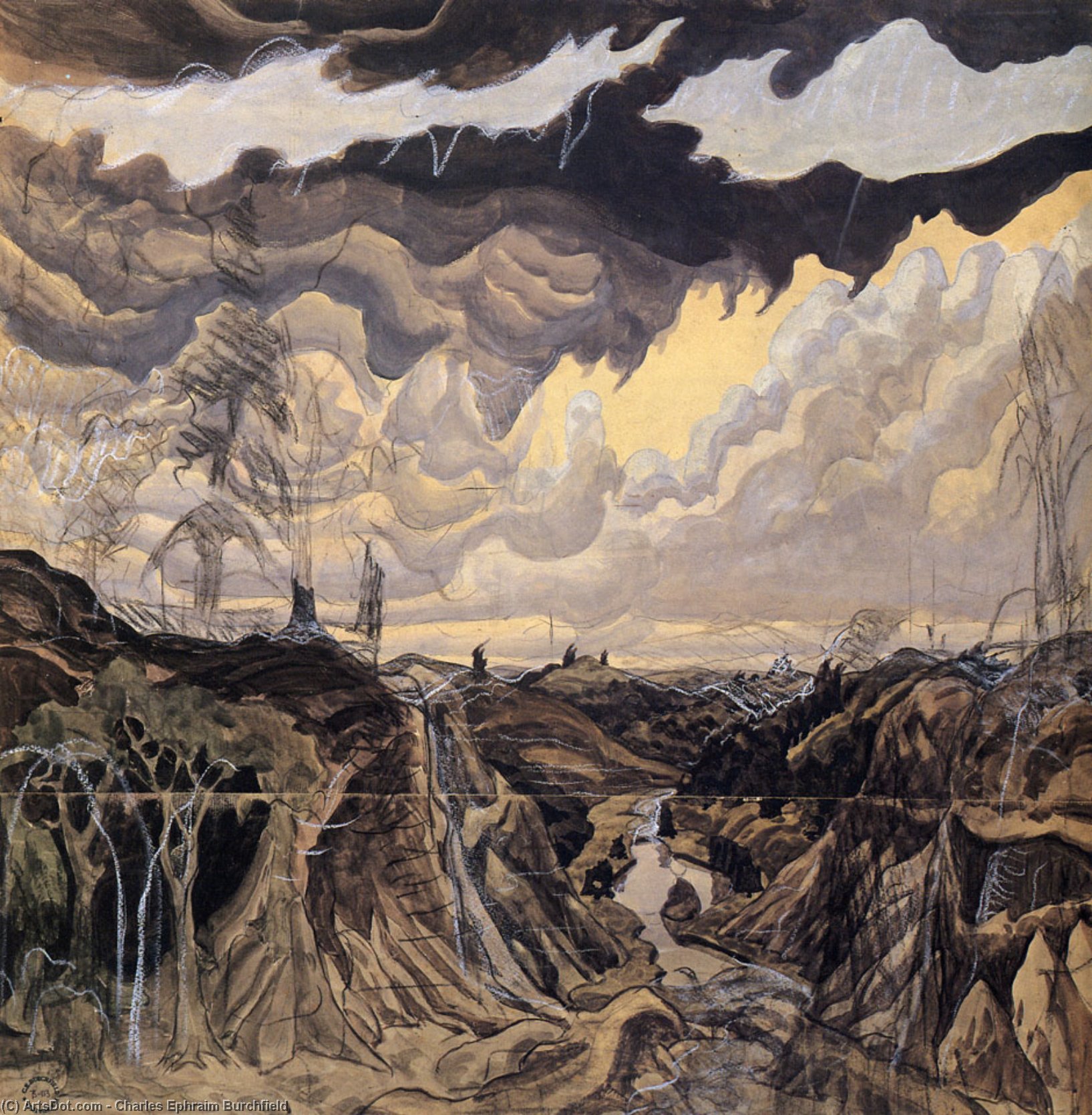
The artwork "Jaws Of The World" by Charles Burchfield stands as a testament to the artist's singular ability to translate profound emotional experience into visual form. More than just a depiction of Ohio’s rural landscape, it embodies a complex tapestry of anxieties about the natural world intertwined with an underlying yearning for spiritual understanding—a characteristic hallmark of American Modernism and particularly influential in the Regionalist movement. Born in Ashtabula Harbor, Ohio, in 1893, Burchfield developed a lifelong fascination with observing and interpreting the subtle energies of his surroundings, shaping his artistic vision from its inception.- Subject Matter & Context: Burchfield’s inspiration stemmed directly from his observations of the Ohio countryside—rolling hills, meandering rivers, and dense woodlands. However, he wasn't merely documenting these familiar vistas; he sought to capture their inherent dynamism and psychological significance. The painting reflects a broader cultural preoccupation with confronting the forces of nature during the early 20th century, mirroring anxieties about industrialization and urbanization alongside an enduring belief in the restorative power of wilderness.
- Style & Technique: Burchfield’s artistic style is undeniably expressive—a deliberate rejection of photographic realism in favor of conveying emotional states through heightened visual language. He employed watercolor washes combined with meticulous pen and ink drawing, layering colors and lines to achieve remarkable textural depth and atmospheric luminescence. This technique allowed him to capture not just what he *saw*, but what he *felt*.
- Composition & Visual Language: The artwork’s composition is deliberately unbalanced, mirroring the turbulent emotional landscape it portrays. A dominant sky filled with brooding clouds commands attention, visually overshadowing a lower section depicting rugged terrain and waterways. Thick, expressive lines delineate major landforms and cloud shapes, while finer lines suggest intricate details within the scene—a masterful use of visual cues to heighten dramatic tension.
- Symbolism & Emotional Impact: The title itself—“Jaws Of The World”—immediately establishes a tone of apprehension and impending danger, reflecting Burchfield’s preoccupation with confronting existential anxieties. Recurring motifs of jagged rocks and swirling clouds symbolize instability and chaos, yet simultaneously evoke a sense of awe and reverence for the sublime beauty of nature.
- Historical Significance: “Jaws Of The World” aligns seamlessly with the tenets of Transcendentalism and Regionalism—movements that championed individualism and celebrated the spiritual resonance of American landscapes. Burchfield’s work anticipates later explorations in Abstract Expressionism, demonstrating a pioneering spirit in prioritizing emotional intensity over formal accuracy.
Biografia artysty
A Visionary of the American Landscape: The Life and Art of Charles Burchfield
Charles Ephraim Burchfield, born in Ashtabula Harbor, Ohio, in 1893, was an artist deeply attuned to the rhythms and mysteries of the natural world. His life unfolded against the backdrop of a rapidly changing America, yet his artistic vision remained steadfastly rooted in a profound connection to the land—a connection that transcended mere representation and ventured into realms of spiritual and emotional resonance. Raised primarily by his widowed mother in Salem, Ohio, Burchfield’s early years were marked by an intense observation of nature, fostering a sensibility that would define his entire artistic career. He wasn't simply *seeing* the landscape; he was experiencing it with an almost mystical intensity, registering not just its visual forms but also its moods, energies, and hidden meanings. This sensitivity found early expression in detailed journals filled with both written observations and sketches—a practice he continued throughout his life, treating these notebooks as vital extensions of his creative process.
Early Influences and Artistic Formation
From a young age, Burchfield demonstrated an extraordinary aptitude for drawing and painting, fueled by a fascination with the natural world around him. His mother encouraged his artistic pursuits, recognizing his innate talent and fostering his passion for capturing the beauty of Ohio’s rural landscapes. Despite facing considerable hardship during the Great Depression—a period marked by economic instability and social upheaval—Burchfield persevered in his artistic endeavors, honing his skills through self-discipline and unwavering dedication. His formal training at the Cleveland Institute of Art from 1916 proved pivotal, exposing him to modernist trends while simultaneously reinforcing his commitment to a uniquely personal artistic path. He studied under George Ives and William Bischoff, absorbing influences from Impressionism and Cubism—though he quickly rejected these styles in favor of developing his own distinctive visual language.
The Evolution of a Style: From Realism to Transcendental Vision
Burchfield’s artistic development wasn't linear; it was characterized by distinct phases reflecting his evolving inner world and responses to external influences. Initially, his work leaned towards realism, depicting the everyday scenes of small-town Ohio with meticulous detail—scenes rendered in muted tones and precise linework that conveyed a palpable sense of place. However, even in these early pieces, a subtle undercurrent of emotion and symbolic weight began to emerge. As he moved westward to Buffalo, New York, in 1921—seeking respite from the hardships of Depression-era Ohio—Burchfield’s artistic vision underwent another transformative shift. He embraced a more expressive style, experimenting with bold colors and swirling brushstrokes that captured the dynamism of urban life and the grandeur of Niagara Falls.
The “Haunted House” Paintings and Transcendental Symbolism
Perhaps Burchfield's most recognizable achievement was his series of paintings known as "Haunted Houses," which began in 1930. These evocative depictions of vernacular architecture—often decaying barns and abandoned dwellings—were imbued with an unsettling atmosphere that resonated deeply with viewers. Unlike traditional architectural studies, these canvases explored themes of memory, nostalgia, and the hidden anxieties lurking beneath the surface of American life. Burchfield’s artistic sensibilities were profoundly influenced by Transcendentalist writers like Thoreau and Ralph Waldo Emerson—figures who championed individualism, contemplation, and a reverence for nature's sublime beauty. He sought to convey not just what he *saw*, but what he *felt*—transforming landscapes into vibrant expressions of inner experience.
Legacy and Recognition
Charles Burchfield’s work remained relatively underappreciated during his lifetime, overshadowed by the dominant trends of American art in the mid-20th century. However, in recent decades, his reputation has steadily risen among scholars and critics—who recognize him as a major figure in American Modernism and a pioneer of visionary painting. His distinctive style—characterized by its meticulous detail, expressive color palettes, and symbolic imagery—continues to inspire artists today. The largest collection of Burchfield’s paintings, archives, and journals is housed at the Burchfield Penney Art Center in Buffalo, New York—a testament to his enduring connection to that city and a vital resource for furthering research into his life and art. His legacy extends beyond his artistic achievements; he also left behind a wealth of writings—journals, essays, and letters—that offer invaluable insights into his creative process and philosophical beliefs. His paintings stand as powerful reminders that art can transcend mere representation, communicating profound truths about human experience and our relationship to the natural world.

Charles Burchfield
1893 - 1967 , Stany Zjednoczone
Kluczowe informacje
- Artistic Movement Or Style: Visionarny, Akwarele
- Artists Or Movements Influenced By This Artist: ['Frederick Hassam']
- Artists Who Influenced This Artist:
- Thoreau
- Willa Cather
- Date Of Birth: 9 kwietnia 1893
- Date Of Death: 10 stycznia 1967
- Full Name: Charles Ephraim Burchfield
- Nationality: Amerykański
- Notable Artworks:
- Przez dolinę
- Farma holenderska
- Place Of Birth: Ashtabula, USA
Powiązane artykuły
George Inness: Transcendental Landscapes & the American Search for Spiritual Harmony
Explore the profound landscapes of George Inness, a leading American artist-philosopher. Discover his spiritual approach to painting, influences, and lasting legacy with OriginalUniqueArt.
Jamie Wyeth: A Legacy of Realism, Regionalism & American Landscapes
Explore the captivating world of Jamie Wyeth, heir to the Brandywine School tradition! Discover his realist paintings of portraits, animals & Maine landscapes – a legacy of American art. Learn more at OriginalUniqueArt.

Concrete Visions: Exploring the Urban Landscape in Painting – From Realism to Contemporary Art
Explore the evolution of cityscape painting from Realism to contemporary art with OriginalUniqueArt. Discover key artists & invest in timeless urban visions. Expert guidance, museum-quality reproductions.

Grant Wood & American Regionalism: Identity, Myth & the Rural Landscape
Explore the world of Grant Wood & American Regionalism with OriginalUniqueArt. Discover the symbolism behind 'American Gothic', recurring themes, and the movement's lasting impact on art history. High-quality reproductions available.
Frederick William Hayes: Transcendental Landscapes & the American Sublime
Explore the captivating landscapes of Frederick William Hayes, a Victorian artist influenced by the Hudson River School & literary utopias. Discover his legacy and artistic techniques at OriginalUniqueArt.



