Forest Path (Bertalan Pór)
Bertalan Pór (1880–1964) stworzył Forest Path.

 Podgląd w skali 1:1

 Ręcznie malowany obraz olejny
 Wyślij jako kartkę
 Udostępnij
 Karta informacyjna


 Pobierz obraz
 Podobne obiekty
 RTG
 Pokaz slajdów
 Pytania i odpowiedzi

 Statystyki
Forest Path w skrócie
- Tytuł
- Forest Path
- Artysta
- Bertalan Pór (1880–1964)
- Miejsce urodzenia artysty
- Babiná, Słowacja
- Temat
- forests, roads
Zdjęcia w wysokiej rozdzielczości dzieła Forest Path
Chronione prawem autorskim: pliki te służą wyłącznie do osobistego wglądu i nie stanowią licencji na ich powielanie.
Bertalan Pór, Forest Path.
Odpowiedzi na pytania dotyczące Forest Path
Co przedstawia "Forest Path"?
Tematyka dzieła "Forest Path" to forests, roads.
Czy „Forest Path” – Bertalan Pór znajduje się w domenie publicznej?
„Forest Path” – Bertalan Pór znajduje się w domenie publicznej (nadal objęte ochroną prawa autorskiego). Status ten określa zasady reprodukcji obrazu tego dzieła.
Kto stworzył "Forest Path"?
„Forest Path” zostało stworzone przez Bertalan Pór. Informacje na tej stronie dotyczą oryginalnego dzieła autorstwa Bertalan Pór.
Z czego wynika obecny status praw autorskich dzieła "Forest Path"?
„Forest Path” – Bertalan Pór jest nadal objęte ochroną prawa autorskiego. Okres ochrony praw autorskich liczony jest od śmierci artysty, która nastąpiła w 1964.
O artyście: Bertalan Pór

1880–1964, Słowacja
Bertalan Pór
A Pioneer of Hungarian Modernism: The Life and Art of Bertalan Pór Bertalan Pór, born in Budapest on November 4th, 1880, emerged as a pivotal figure in the landscape of early twentieth-century Hungarian art. His journey, spanning from his formative years amidst the burgeoning artistic fervor of fin-de-siècle Hungary to his eventual embrace of Parisian modernism and return to contribute to his homeland’s cultural revival, embodies a commitment to innovation and a profound engagement with the evolving aesthetic sensibilities of his time. From an early age, Pór demonstrated a natural aptitude for drawing, setting him on a path that would lead him through rigorous academic training and ultimately into the heart of avant-garde artistic circles. He initially honed his skills at the School of Industrial Design in Budapest under László Gyulay, but recognizing the limitations of local instruction, he sought further development abroad.
Inne prace Bertalan Pór
 Selt-portrait
 Trait Of Ödön Lechner
 Trait Of My Mother
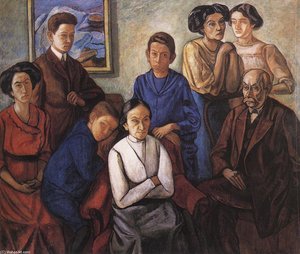 The Family
Eseje o Forest Path
 Tracing the Way: A Study of Winding Paths and Scenic Roads in Landscape ArtExplore the history of winding paths in art from the Renaissance to Expressionism. Discover the soul of the landscape through every bend.
 Masterpieces of Nature: The Top 25 Artworks by Théodore RousseauExplore 25 iconic works by Théodore Rousseau, the soul of the Barbizon School. Discover his masterpieces on OriginalUniqueArt.com.
 Master of the Forest: The Top 25 Ivan Shishkin ArtworksExplore 25 iconic Ivan Shishkin masterpieces. Discover the soul of Russian landscape art. Explore the full collection online at OriginalUni…