
 Podgląd w skali 1:1
 Wyślij jako kartkę
 Udostępnij
 Szczegóły dzieła
 Przewodnik

 Pobierz obraz
 Podobne obiekty
 RTG
RTG Pokaz slajdów
 Q&A
Q&A Statystyki
Market in Tunis II

- 20.0 x 25.0 cm


 Rozwiń treść
Otrzymaj plik gotowy do druku, którego jakość znacznie przewyższa podgląd internetowy. Każdy sprzedawany przez nas obraz cyfrowy pochodzi z wysokorozdzielczego pliku wzorcowego w naszej bazie — zazwyczaj o szerokości od 5 000 do 15 000 pikseli — dzięki czemu możesz drukować w dużym formacie, mocno kadrować lub z pełnym przekonaniem odwzorowywać najdrobniejsze detale.
Żaden plik nie opuszcza naszego studia bez odpowiedniej obróbki. Ekspert ds. cyfrowej edycji sprawdza zgodność kolorów z oryginałem i w razie potrzeby je koryguje, a następnie za pomocą profesjonalnych narzędzi do retuszu poprawia ostrość oraz szczegółowość — zawsze zachowując wierność pociągnięciom pędzla i stylowi artysty. Rezultatem jest obraz, który wygląda jak prawdziwe dzieło, a nie jak przefiltrowany skan.
Zatwierdzasz przed finalizacją zamówienia: nasz ekspert prześle obraz drogą mailową w ciągu 72 godzin do Twojego wglądu. Nie jesteś zadowolony? Poproś o poprawki lub korektę, bądź o zwrot kosztów, jeśli jakość nie spełnia oczekiwań.
To jakość, na której polegają wydawcy, studia projektowe, galerie oraz drukarnie.
Obraz cyfrowy
Pobierz plik o wysokiej rozdzielczości do osobistego użytku, druku oraz projektów kreatywnych. ( Przełącz na wydania drukowane Zamów ręcznie malowaną reprodukcję)
W każdym zamówieniu na obraz cyfrowy znajduje się
Profesjonalna dostawa cyfrowa z gwarancją
Wybierając OriginalUniqueArt.com, nie otrzymujesz jedynie obrazu – otrzymujesz profesjonalnie udoskonalone cyfrowe dzieło sztuki, stworzone z najwyższą precyzją i objęte gwarancją satysfakcji. Oto wszystko, co automatycznie dołączane jest do Twojego zamówienia:

Błyskawiczna wysyłka e-mailowa
Plik z obrazem cyfrowym w wysokiej rozdzielczości zostanie przesłany na Twój adres e-mail w ciągu 72 godzin od złożenia zamówienia – gotowy do natychmiastowego użycia.

Plik cyfrowy wzbogacony przez AI
Twoja grafika została profesjonalnie zoptymalizowana przy użyciu zaawansowanych narzędzi AI oraz ręcznej edycji, co zapewnia maksymalną szczegółowość, klarowność i wierność kolorów.

Darmowe ponowne przesyłki dożywotnio
Przypadkowo usunąłeś lub zgubiłeś swój plik? Bez obaw – prześlemy go Tobie ponownie w dowolnym momencie, bez żadnych opłat.

Bez opłat importowych – zawsze
Ciesz się swoją sztuką natychmiast, bez żadnych opłat celnych, należności ani kosztów dostawy – pliki cyfrowe są zawsze wolne od podatku.

Gwarancja wierności kolorów
Dzięki zastosowaniu profesjonalnych narzędzi i procesów zarządzania barwą zapewniamy, że Twoje cyfrowe zdjęcie odzwierciedla oryginalne kolory tak wiernie, jak to tylko możliwe.

Gwarancja satysfakcji przez 100 dni
Jeśli nie będziesz zadowolony ze swojego cyfrowego obrazu, dokonamy jego poprawki lub zwrócimy 100% kosztów w ciągu 100 dni – bez zbędnych pytań.

100% Gwarancja zwrotu pieniędzy
Nie jesteś zadowolony? Otrzymaj pełny zwrot kosztów w ciągu 100 dni od otrzymania pliku cyfrowego – bez zbędnych pytań.

Rabaty przy zamówieniach hurtowych
Kup 3 obrazy, oszczędź 10% - Kup 5, oszczędź 15% - Kup 10+, oszczędź 20%. Idealne do projektów kreatywnych, galerii i agencji.
A Snapshot of Tunisian Life: August Macke’s Vibrant Market Scene
August Macke's “Market in Tunis II,” painted just months before his untimely death in 1914, isn’t merely a depiction of a bustling marketplace; it’s an immersive experience. Created during a pivotal journey with Paul Klee and Louis Moilliet to the North African city of Tunis, the painting captures a fleeting moment of vibrant energy and social interaction against a backdrop of intense light and color. Macke, already experimenting with Fauvist techniques – bold, non-naturalistic colors – found himself utterly captivated by the sensory overload of Tunis, translating this experience onto canvas with remarkable immediacy.
The scene unfolds within a tightly packed market square, dominated by a complex interplay of figures and structures. Buildings lean precariously, their facades rendered in planar segments that deliberately clash with the traditional perspective, hinting at Macke’s experimentation with geometric abstraction. This deliberate disruption of linear space isn't about creating illusion; it’s about conveying the overwhelming density and dynamism of the market itself – a feeling of being enveloped by movement and sound.
Color as Emotion: The Fauvist Influence
Macke’s masterful use of color is arguably the painting’s most striking feature. He abandons naturalistic hues, opting instead for intense, saturated tones—deep blues, fiery oranges, vibrant reds, and yellows—that seem to pulse with life. These aren't colors that simply describe; they evoke emotion. The warm palette dominates the foreground, drawing the eye towards the central figures while simultaneously suggesting a sense of heat and activity. Notice how the deep greens and browns of the surrounding buildings provide a grounding contrast, anchoring the scene within its Tunisian context.
The influence of Fauvism is undeniable here. Macke, like his contemporaries, sought to liberate color from its descriptive function, using it purely for expressive effect. This bold approach aligns with the broader artistic currents of the early 20th century, reflecting a desire to capture subjective experience rather than objective reality.
Details and Storytelling: A Moment Frozen in Time
Despite the flattened perspective and vibrant colors, Macke meticulously renders details that bring the scene to life. The richly textured camel-hair coats worn by the two Arab figures in the foreground are particularly noteworthy – their thick seams and deep hues immediately conveying a sense of warmth and practicality. The inclusion of episodic events, such as the man leaning on a column, adds layers of narrative complexity, suggesting that this is not simply a snapshot but a carefully constructed tableau.
Furthermore, the painting’s composition subtly guides the viewer's eye through the scene. The diagonal lines created by the stalls and figures create a sense of movement, while the central figure acts as a focal point, drawing attention to the heart of the market activity. Macke’s ability to capture both the overall atmosphere and individual details is a testament to his artistic skill.
A Legacy of Light and Emotion
“Market in Tunis II” stands as a powerful example of August Macke's unique artistic vision. It’s a painting that transcends its subject matter, offering viewers a glimpse into the vibrant culture and sensory experience of early 20th-century Tunisia. The painting’s emotional intensity, combined with Macke’s innovative use of color and perspective, continues to resonate with audiences today, cementing its place as a significant work in the history of modern art. Reproductions capture only a fraction of the original's impact, but offer an accessible way to appreciate this remarkable artist’s ability to translate fleeting moments into enduring works of beauty.
Pytania i odpowiedzi
Czy dzieło "Market in Tunis II" pozostało w ojczyźnie swojego artysty?
Tak – dzieło znajduje się w kraju pochodzenia artysty. Dzieło "Market in Tunis II" znajduje się w zbiorach Niemcy, podczas gdy August Macke urodził(a) się w Niemcy.
Jaki jest dominujący kolor w „Market in Tunis II” – August Macke?
Kolorem, który najbardziej wyróżnia się w "Market in Tunis II", jest Putty (#d8d4c8). Dominujący kolor ułatwia dopasowanie dzieła sztuki do wnętrza.
Gdzie i w jakim celu zaleca się użycie "Market in Tunis II"?
„Market in Tunis II” idealnie sprawdzi się w Statement, a rekomendowanym miejscem jego ekspozycji jest Living Room.
Biografia artysty
A Life Cut Short: The Vibrant World of August Macke
August Robert Ludwig Macke, a name inextricably linked to the brief but intensely vibrant flowering of German Expressionism, lived a life tragically curtailed by the horrors of the First World War. Born in 1887 in Meschede, a small town nestled within the Westphalian countryside, his artistic journey was one of rapid evolution and profound exploration – a relentless pursuit of capturing not just what he *saw*, but how he *felt* about it. Macke’s early years were marked by a restless spirit and an innate curiosity, leading him to abandon formal schooling at the age of seventeen to dedicate himself entirely to his artistic ambitions. He initially supplemented his income through stage design work in Bonn, honing his compositional skills and developing a keen eye for color – experiences that would prove invaluable as he navigated the complex landscape of early 20th-century art.Early Influences and Artistic Foundations
Macke’s formative years were deeply shaped by encounters with key artistic movements and individuals. His relocation to Bonn, alongside his family, provided a crucial foundation for his development. He immersed himself in the works of Hans Thuar, a fellow artist who fostered Macke's appreciation for Impressionism and its emphasis on capturing fleeting moments of light and color. Crucially, he also studied at the Düsseldorf Art Academy from 1904 to 1906 under Adolf Maennchen, though he found the academy’s rigid curriculum restrictive. Seeking a more liberating approach, Macke supplemented his formal training with independent study and travel, particularly a transformative trip to Paris in 1907. This experience exposed him to the revolutionary ideas of Impressionism, Post-Impressionism, and the burgeoning Fauvist movement – artists like Henri Matisse who were boldly experimenting with color and form. He was profoundly influenced by Matisse’s use of vibrant hues and simplified shapes, a departure from the traditional academic approach. Simultaneously, he developed a close friendship with Franz Marc, a fellow artist and a key figure in the influential group Der Blaue Reiter (The Blue Rider). Their shared interest in spirituality and their exploration of symbolism would profoundly impact Macke’s artistic vision.Der Blaue Reiter and the Embrace of Modernity
Macke's arrival in Munich in 1909 marked his full integration into the orbit of Der Blaue Reiter, a group dedicated to pushing the boundaries of art and exploring new modes of expression. This association proved pivotal, introducing him to Wassily Kandinsky and other avant-garde thinkers who championed abstraction and spiritual themes. He began experimenting with broken planes of color and increasingly simplified forms, moving away from strict representational accuracy towards a more emotive and subjective approach. The group’s emphasis on “inner necessity” – the driving force behind artistic creation – resonated deeply with Macke's own creative impulses. His style began to evolve rapidly, incorporating elements of Cubism, Orphism (influenced by Robert Delaunay’s exploration of simultaneous contrast), and even hints of Futurism’s dynamism. He wasn’t simply imitating these movements; he was synthesizing them into a uniquely personal language of color and form. His paintings became increasingly infused with a sense of movement, light, and atmosphere – capturing the essence of modern experience rather than merely depicting it.A Luminist Vision: Landscapes and Everyday Life
Despite his engagement with abstract tendencies, Macke remained fundamentally rooted in the observation of the natural world. He developed a distinctive style that he termed “luminism,” characterized by an intense focus on light, color, and atmosphere. His landscapes – particularly those depicting the Sauerland region of Westphalia – are imbued with a palpable sense of joy and vitality. Figures are often rendered as simplified silhouettes against vibrant backgrounds, creating a dreamlike quality. He also found inspiration in everyday life, capturing scenes of family gatherings, children at play, and intimate moments between lovers. These paintings, such as *Woman in a Green Jacket*, radiate warmth and optimism through their bold color palettes and confident brushwork. His ability to convey emotion through the subtle interplay of light and color was truly remarkable. The influence of Robert Delaunay’s “Orphism” is particularly evident in works like *Shop Windows*, where he employed broken planes of color to create a dazzling, kaleidoscopic effect.A Tragic Interruption: Death on the Western Front
The outbreak of World War I tragically cut short Macke's promising career. Driven by patriotic fervor, he enlisted as a soldier in 1914 and was killed in action near Champagne, France, on September 26th at the young age of 27. His final painting, *Farewell*, is a haunting testament to the horrors of war – a somber depiction of departing soldiers that foreshadows his own untimely demise. Despite his brief life, August Macke left behind a remarkable body of work that continues to captivate and inspire artists and art lovers alike. His paintings are celebrated for their vibrant colors, dynamic compositions, and enduring optimism—a testament to the power of art to transcend even the darkest of times.Exploring Macke’s World Today
Today, August Macke's works are held in prominent collections across Europe, including the Staatsgalerie Moderner Kunst in Munich, the Museum Ludwig in Cologne, and the Kunsthaus Zürich. Numerous museums dedicated to Expressionism showcase his paintings prominently, offering visitors a chance to experience the emotional intensity and visual brilliance of his art firsthand. The Westfälisches Landesmuseum Münster and the Kunstmuseum Bonn are particularly noteworthy for their extensive holdings of Macke’s oeuvre. His influence can be seen in the continued exploration of color and emotion by contemporary artists, solidifying his place as a pivotal figure in the history of modern art. Resources like Artnet and Wikipedia provide valuable biographical information and insights into his artistic development, allowing us to delve deeper into the life and legacy of this tragically short-lived but profoundly influential artist.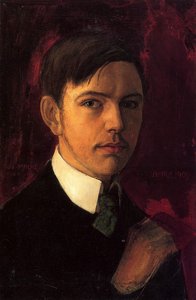
August Macke
1887 - 1914 , Niemcy
Krótka nota
- Artistic Movement Or Style: Ekspresjonizm
- Artists Or Movements Influenced By This Artist: ['Der Blaue Reiter']
- Artists Who Influenced This Artist:
- Robert Delaunay
- Franz Marc
- Date Of Birth: 3 stycznia 1887
- Date Of Death: 26 września 1914
- Full Name: August Robert Ludwig Macke
- Nationality: Niemiecki
- Notable Artworks:
- Bathing girls z miastem
- Woman in a Green Jacket
- Farewell
- Place Of Birth: Meschede, Niemcy