Przełącz na wydania drukowane
 Rozwiń treść







































 W przypadku dzieł sztuki lub reprodukcji, których którykolwiek z boków przekracza 105 cm (około 41 cali), rama zostanie wysłana w formie zestawu do samodzielnego montażu. Metoda ta zapewnia bezpieczną dostawę i zapobiega uszkodzeniom podczas transportu.


The Multifaceted Self in Archie Byron's "Anatomy I"
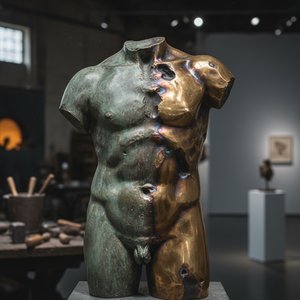
To stand before Archie Byron’s Anatomy I is to confront not merely a figure, but a profound meditation on the nature of identity itself. This captivating piece, rendered in 1987, immediately draws the eye into its complex surface. The subject matter—a man adorned with multiple faces scattered across his body—is arresting. It suggests that the self is never singular, but rather a mosaic assembled from countless expressions, roles, and moments of being. Byron invites us to look beyond the superficial portraiture and contemplate the layered reality of human experience.
A Dialogue Between Form and Technique
What makes this work so uniquely compelling is the masterful interplay between its subject matter and the artist's signature technique. While the painting presents a vivid, almost visceral depiction, one must remember Byron’s renowned medium: his innovative relief sculptures crafted from sawdust, water, and glue. Even when painted upon, the echo of that raw, textured material remains palpable. The inclusion of the two distinct bowls—one near the upper left and another anchoring the bottom right—serves not merely as compositional balance, but perhaps as symbolic vessels, holding or containing aspects of this fragmented self. The overall composition is a rich tapestry where every painted curve and shadowed recess demands closer inspection.
Symbolism of Fragmentation and Wholeness
The recurring motif of the multiple faces speaks volumes about the psychological landscape. Are these different masks worn in society? Are they echoes of past selves that refuse to fade? Byron seems to suggest that true anatomy is not skeletal or singular, but rather a collection of perspectives. The piece challenges the viewer's preconceived notions of unity. It whispers secrets about duality and multiplicity, transforming what might seem like chaos into a deeply structured visual poem. For the collector or designer, this depth offers an intellectual anchor for any space.
Bringing Byron’s Vision Home
Owning a reproduction of Anatomy I is to invite a conversation about complexity and acceptance into your living space. It is art that does not whisper softly but speaks with the resonant voice of lived experience. The rich, textured quality inherent in Byron's work—whether through its original sawdust relief or a high-quality painted reproduction—ensures that the piece catches the light and the eye from every angle. It serves as a powerful focal point, encouraging contemplation during quiet moments and sparking lively discussion among guests. It is an emblem of enduring human complexity, beautifully rendered.
Pytania i odpowiedzi
Czy mogę zobaczyć „Anatomy I” – Archie Byron w różnym oświetleniu?
"Anatomy I" można badać warstwa po warstwie na stronie Analiza rentgenowska, która oferuje interaktywny podgląd inspirowany stołem świetlnym konserwatora, prezentujący jedenaście optycznych odczytów obrazu.
Czy istnieje karta informacyjna o „Anatomy I” – Archie Byron przeznaczona dla studentów?
Przewodnik po "Anatomy I" to strona Karta informacyjna dla uczniów dzieła sztuki – nadrukowalna karta informacyjna zawierająca opis utworu, informacje o autorstwie oraz tabelę danych (artysta, daty, technika, wymiary oryginału, kolekcja).
Jaki rozmiar wydruku jest zalecany dla „Anatomy I” – Archie Byron?
Zalecany rozmiar wydruku dla „Anatomy I” – Archie Byron to Medium.
 Podgląd w skali 1:1
 Wyślij jako kartkę
 Udostępnij
 Szczegóły dzieła
 Przewodnik

 Pobierz obraz
 Podobne obiekty
 RTG
RTG Pokaz slajdów
 Pytania i odpowiedzi
 Statystyki