Menu

() ·

A painting made for you, by hand

Monastyr An oil painting, painted by hand for you alone

Ręcznie malowana reprodukcja olejowa

Ręcznie malowany obraz olejny na płótnie, wykonany na zamówienie przez naszych artystów w wybranym przez Ciebie wymiarze i oprawie. ( Przełącz na wydania drukowane Przejdź do wersji cyfrowej)

Opis obiektu

Podziwiaj "Monastyr" Aleksandra Bogoliubowa – piękny obraz rosyjskiego krajobrazu przedstawiający ruchliwą przystań nad wodą. Eksploruj realistyczne widoki morskie i ponadczasową urodę.

Biografia artysty

"meta_description": "Aleksiej Bogoliubov (1824-1896) – rosyjski malarz krajobrazów i portów, znany z realistycznych obrazów morskich i widoków Wolgi. Połączył realizm i romantyzm, tworząc unikalną wizję sztuki."

from ·

Chapter 1

How large should it be?

Slide to change the size; the picture on the left shows the frame at its real width. The proportions of the original are kept.

Standardowy format
personalizowane
CM
INCH

Wybierz spośród naszych standardowych rozmiarów, które zachowują oryginalne proporcje dzieła sztuki.

szerokość
wysokość

Wpisz wymaganą szerokość i wysokość, aby obraz pasował do Twojej ramy lub ściany. Ponieważ jest to dzieło malowane ręcznie, w przypadku rozmiaru o innych proporcjach artysta może domalować nieco więcej wokół obrazu lub przyciąć jego fragmenty — wybór należy do Ciebie. Przed rozpoczęciem pracy prześlemy Ci cyfrową wizualizację do zatwierdzenia. Obraz widoczny na tej stronie nie przedstawia rzeczywistego efektu — jedynie wizualizacja oddaje realny rezultat.

Chapter 2

How should it arrive?

Choose the edges of the stretched canvas

Choose your frame

Corner sample of the WhiteWrap canvas edge finish, stretched on lite drewno bars
White zł1
Corner sample of the BlurSideWrap canvas edge finish, stretched on lite drewno bars
Blurside zł1
Corner sample of the ExtendedWrap canvas edge finish, stretched on lite drewno bars
Extended zł1
Corner sample of the P118B picture frame: polistyren formowany, 5 cm wide and 3 cm thick
P118B zł10
Corner sample of the P118H picture frame: polistyren formowany, 5 cm wide and 3 cm thick
P118H zł10
Corner sample of the P118W picture frame: polistyren formowany, 5 cm wide and 3 cm thick
P118W zł10
Corner sample of the P438Z picture frame: polistyren formowany, 5.5 cm wide and 3.5 cm thick
P438Z zł10
Corner sample of the P508JH picture frame: polistyren formowany, 7 cm wide and 3.5 cm thick
P508JH zł12
Corner sample of the P508YH picture frame: polistyren formowany, 7 cm wide and 3.5 cm thick
P508YH zł12
Corner sample of the P805H picture frame: polistyren formowany, 5 cm wide and 3.5 cm thick
P805H zł10
Corner sample of the P805Z picture frame: polistyren formowany, 5 cm wide and 3.5 cm thick
P805Z zł10
Corner sample of the P919BZ picture frame: polistyren formowany, 7 cm wide and 3.5 cm thick
P919BZ zł10
Corner sample of the P919G picture frame: polistyren formowany, 7 cm wide and 3.5 cm thick
P919G zł10
Corner sample of the P919XJ picture frame: polistyren formowany, 7 cm wide and 3.5 cm thick
P919XJ zł10
Corner sample of the P959ZH picture frame: polistyren formowany, 5 cm wide and 3 cm thick
P959ZH zł10
Corner sample of the P968JZ picture frame: polistyren formowany, 6 cm wide and 4 cm thick
P968JZ zł12
Corner sample of the W106C picture frame: lite drewno, 5 cm wide and 3 cm thick
W106C zł8
Corner sample of the W218G picture frame: lite drewno, 5 cm wide and 3 cm thick
W218G zł10
Corner sample of the W218JH picture frame: lite drewno, 5 cm wide and 3 cm thick
W218JH zł8
Corner sample of the W218Y picture frame: lite drewno, 5 cm wide and 3 cm thick
W218Y zł10
Corner sample of the W307PJ picture frame: lite drewno, 6 cm wide and 3 cm thick
W307PJ zł10
Corner sample of the W316G picture frame: lite drewno, 6 cm wide and 3 cm thick
W316G zł10
Corner sample of the W316PJ picture frame: lite drewno, 6 cm wide and 3 cm thick
W316PJ zł8
Corner sample of the W316Y picture frame: lite drewno, 6 cm wide and 3 cm thick
W316Y zł10
Corner sample of the W398PJ picture frame: lite drewno, 5 cm wide and 3 cm thick
W398PJ zł8
Corner sample of the W4111J picture frame: lite drewno, 6.5 cm wide and 3.5 cm thick
W4111J zł10
Corner sample of the W500HY picture frame: lite drewno, 7 cm wide and 5 cm thick
W500HY zł15
Corner sample of the W500JH picture frame: lite drewno, 7 cm wide and 5 cm thick
W500JH zł15
Corner sample of the W692G picture frame: lite drewno, 8 cm wide and 4 cm thick
W692G zł12
Corner sample of the W849H picture frame: lite drewno, 5 cm wide and 3 cm thick
W849H zł8
Corner sample of the W940BG picture frame: lite drewno, 7.5 cm wide and 4.5 cm thick
W940BG zł15
Corner sample of the W953PJ picture frame: lite drewno, 6 cm wide and 3.5 cm thick
W953PJ zł8
Corner sample of the H24-GOLD picture frame: rzeźbione drewno pokryte gipsem, 10 cm wide and 6 cm thick
H24-GOLD zł30
Corner sample of the H24-SILVER picture frame: rzeźbione drewno pokryte gipsem, 10 cm wide and 6 cm thick
H24-SILVER zł30
Corner sample of the H36-GOLD picture frame: rzeźbione drewno pokryte gipsem, 15 cm wide and 6.5 cm thick
H36-GOLD zł45
Corner sample of the H36-SILVER picture frame: rzeźbione drewno pokryte gipsem, 15 cm wide and 6.5 cm thick
H36-SILVER zł45

Moulding: . Overall size with the frame: .

Chapter 3

Who paints it, and should anything change?

Examples of what can be changed: Replace face with customer photo; Add pet (e.g., replace cat with dog); Include hidden message in background; Change background landscape or elements.
After order, OriginalUniqueArt.com team will email client for instructions and provide a mockup preview

Dostawa na całym świecie () w ciągu 3–4 tygodni zamiast standardowych 5 tygodni. (29 Październik). Bez kompromisów w kwestii jakości.

Chapter 4

The finishing touches

A nameplate, as in a museum?

Szczegóły grawerowanej brązowej tabliczki

This elegant plaque features the artist's name and the title of the artwork, finely engraved for a timeless presentation.

It is made from bronze with a refined, elegant finish. The text is precisely laser-engraved for a sharp and permanent result. Measuring 9x2 cm, the plaque is compact yet easy to read. It's built to be durable and scratch-resistant, offering a professional, museum-quality look. Mounting is simple thanks to the included adhesive backing.

Szczegóły przezroczystej tabliczki akrylowej

The plaque includes essential engraved details such as the artist's name, the title of the artwork, the date it was created, the type of media used-like oil on canvas or watercolor-a brief description of the piece, and a QR code that links to the complete artwork information.

It is crafted from clear acrylic, offering a sleek, modern appearance. The text is UV-engraved in black to ensure strong visual contrast. With a size of 10x15 cm, it ensures optimal readability. It comes equipped with two metal hooks for secure wall mounting. The plaque is designed to be weather-resistant, making it suitable for various environments, and it includes interactive features that work seamlessly with smartphone scanning.

Szczegóły czarnej tabliczki akrylowej

This elegant plaque includes engraved information such as the artist's name, the title of the artwork, the date it was created, the type of media used (like oil on canvas or watercolor), a short description of the artwork, and a QR code for quick access to more information.

The plaque itself is made from refined black acrylic with a premium finish. The text is laser-engraved in white for high contrast and readability. Its size is 10x15 cm, designed to be easy to read. It comes with two metal hooks for professional mounting. The design is sleek and fits any interior style. It is also weather-resistant and durable, with built-in digital integration for mobile compatibility.

A protective varnish?

When do you need it?

Chapter 5

Your painting, as you ordered it

Monastyr

Technika reprodukcji

Wymiary reprodukcji

-

Wybitny mistrz artystyczny

Większa szczegółowość, finezja i dodatkowy czas na realizację

-

Opcje oprawy reprodukcji

-

-

W przypadku dzieł sztuki lub reprodukcji, których którykolwiek z boków przekracza 105 cm (około 41 cali), rama zostanie wysłana w formie zestawu do samodzielnego montażu. Metoda ta zapewnia bezpieczną dostawę i zapobiega uszkodzeniom podczas transportu.

Wymagany profesjonalny montaż – nie jest to produkt typu DIY.
Zestaw musi zostać złożony, a płótno naciągnięte przez doświadczonego profesjonalnego ramiarza, przy użyciu kleju do drewna (brak w zestawie), kleszczy do naciągania płótna oraz ścisków, które utrzymają krosna w równej pozycji podczas schnięcia kleju. Nieprawidłowy montaż lub nierównomierne napięcie płótna może trwale uszkodzić dzieło sztuki i nie podlega naszej gwarancji.

  • W zestawie znajdują się wszystkie listwy z litego drewna, precyzyjnie docięte do wymiarów.

  • Montaż odbywa się przy użyciu dołączonych wkrętów oraz kleju do drewna do łączenia narożników, którego zestaw nie zawiera i który musi zostać dostarczony przez ramiarza.

  • Wymagane są profesjonalne narzędzia, których nie ma w zestawie: kleszcze do naciągania płótna (napinacz) oraz zaciski, które pozwolą utrzymać listwy w równej pozycji podczas schnięcia kleju.

Ważne:
Do połączenia narożników niezbędny jest klej do drewna, listwy należy unieruchomić za pomocą ścisków do momentu całkowitego wyschnięcia kleju, a naciągnięcie płótna na złożoną ramę wymaga użycia kleszczy do naciągania płótna. Żaden z tych elementów nie jest dołączony do zestawu. Przed zamówieniem tego rozmiaru zalecamy konsultację z doświadczonym ramiarzem.

Etykieta obiektu

-

-

Lakier ochronny

Lakier z połyskiem (pogłębia kolory, chroni przed światłem i wilgocią)

-

Personalizacja dzieła

Przykłady możliwości personalizacji: zastąp twarz zdjęciem klienta; dodaj zwierzę domowe (np. zamień kota na psa); umieść ukrytą wiadomość w tle; zmień krajobraz lub elementy tła.

-

Ekspresowa

Dostawa na cały świat () w ciągu 3–4 tygodni zamiast standardowych 5 tygodni. (29 Październik). Bez kompromisów w kwestii jakości.

-

Przesyłka ekspresowa

Dostawa na cały świat () w ciągu 5 tygodni. (5 Listopad).

W cenie

Cena całkowita

zł 1155

Suma całkowita zł 1155

Opcja ze szkłem jest dostępna wyłącznie w rozmiarach poniżej 110 cm

Included with every order

  • Bezpłatna ekspresowa wysyłka na cały świat
  • Wysokiej jakości płótno lniane
  • Pełne ubezpieczenie przesyłki
  • Gwarancja zwrotu należności celnych i podatków importowych
  • Gwarancja wiernego odwzorowania kolorów
  • 100-dniowa polityka zwrotów (tylko w przypadku wad)
  • Gwarancja 100% zwrotu pieniędzy
  • Zniżka przy zakupie wielu sztuk

A Monastery – Alexei Petrovich Bogoliubov’s Vision of Tranquility Amidst Coastal Life

Alexei Petrovich Bogoliubov (1824-1896), a figure whose artistic legacy resides firmly within the Romantic landscape tradition, nevertheless possessed an unwavering commitment to capturing the essence of Russian realism. His oeuvre is characterized by meticulously rendered depictions of Volga River vistas and breathtaking marine panoramas – landscapes imbued with both grandeur and palpable emotion. Bogoliubov’s work stands as a testament to his ability to synthesize stylistic influences from luminaries like Ivan Ayvazovsky, the celebrated Barbizon School, and ultimately forging his own distinctive artistic voice. This remarkable artist skillfully blended Romantic idealism with observational accuracy, resulting in images that resonate deeply with viewers today.
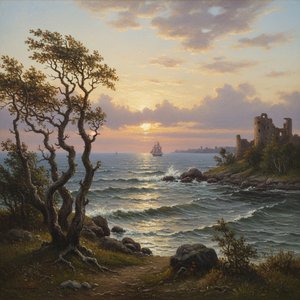
  • Subject Matter: Bogoliubov’s “A Monastery” presents a captivating tableau of coastal life – specifically, the picturesque town nestled alongside the Volga River's waterfront. The painting captures a vibrant scene populated by figures engaged in daily activities; individuals strolling along the promenade, carrying backpacks laden with provisions for exploration and leisure. Scattered throughout the composition are two dogs—one positioned centrally, adding to the dynamism of the setting, while another occupies a spot on the right side, subtly enhancing the visual narrative.
  • Style & Technique: The painting exemplifies Bogoliubov’s signature style – a masterful blend of Romanticism and realism. Employing meticulous brushwork and layering techniques, he achieved remarkable tonal gradations that convey the atmospheric subtleties of the Volga landscape. Light plays a crucial role in shaping the mood, casting dappled shadows across the cobblestone streets and illuminating the faces of passersby with warmth.

Historical Context – The Spirit of Romantic Landscape Painting

Bogoliubov’s artistic endeavors unfolded during a period marked by significant intellectual and cultural transformations within Russia. The Romantic movement, fueled by ideals of individualism, emotion, and reverence for nature, exerted considerable influence on artists across Europe—and Bogoliubov was no exception. Like many of his contemporaries, he sought to express the sublime beauty of the Russian wilderness, capturing its grandeur and conveying a profound connection between humanity and the natural world. This artistic impulse aligns perfectly with the broader cultural preoccupation of the era – a yearning for escape from urban pressures and an embrace of untamed landscapes as sources of inspiration and spiritual renewal.

Symbolism & Emotional Impact – Tranquility Amidst Movement

Beyond its descriptive accuracy, “A Monastery” carries symbolic weight. The monastery itself represents stability, faith, and contemplation—contrasting sharply with the bustling activity of the waterfront town. Bogoliubov’s deliberate placement of figures and animals contributes to this juxtaposition, prompting viewers to consider themes of harmony versus discordance. The painting evokes a feeling of serene beauty – an invitation to pause and appreciate the simple pleasures of life while simultaneously acknowledging the passage of time. It's a scene designed to inspire contemplation and evoke memories of peaceful summers by the river.

Reproductions & Interior Design Considerations

A high-quality reproduction of “A Monastery” offers an exceptional opportunity to bring Bogoliubov’s evocative vision into any interior space. OriginalUniqueArt.com provides meticulously crafted reproductions utilizing archival pigments and printing methods, guaranteeing color fidelity and preserving the artist's original textural qualities. Consider framing this artwork in a neutral palette—perhaps linen or oak—to complement its understated elegance and allow its tranquil beauty to shine through.

Pytania i odpowiedzi

Jak kolory w dziele "Monastyr" współgrają ze sobą?

„Monastyr” – Aleksiej Bogoliubov prezentuje Silna spójność kolorystyczna harmonię kolorystyczną.

Kto jest autorem dzieła "Monastyr"?

Autorstwo dzieła "Monastyr" przypisuje się Aleksiej Bogoliubov.

Czy mogę zobaczyć „Monastyr” – Aleksiej Bogoliubov na własnej ścianie przed zakupem?

Dzieło „Monastyr” – Aleksiej Bogoliubov możesz zobaczyć na własnej ścianie dzięki stronie Podgląd w AR, wykorzystując rozszerzoną rzeczywistość na kompatybilnym urządzeniu.

In numbers

  • 29frames to choose from
  • standard sizes, in its own proportions
  • 5weeks to paint and deliver it
Aleksiej Bogoliubov

Aleksiej Bogoliubov

1824 - 1896, Rosja

Quick facts about Aleksiej Bogoliubov

  • Artistic Movement Or Style: Realizm, Romantyzm
  • Artists Or Movements Influenced By This Artist: ['Peredvizhniki']
  • Artists Who Influenced This Artist:
    • Ivan Ayvazovsky
    • Camille Corot
    • Andreas Achenbach
  • Date Of Birth: 16 marca 1824
  • Date Of Death: 7 lutego 1896
  • Full Name: Alexei Petrovich Bogoliubov
  • Nationality: Rosyjski
  • Notable Artworks:
    • Portret
    • Sinop
    • Volga
  • Place Of Birth: Novgorod, Rosja

Biografia artysty

A Life Painted by Sea and Sky: The World of Alexei Petrovich Bogoliubov

Alexei Petrovich Bogolyubov, a name resonating with the romantic spirit of 19th-century Russian landscape painting, was an artist whose life mirrored the breadth of his artistic vision. Born in 1824 in the Pomeranian village of Novgorod Gubernia, Russia, into a family steeped in both military tradition and intellectual ferment – his father a retired colonel, his maternal grandfather the celebrated philosopher Alexander Radishchev – Bogoliubov’s path was uniquely poised between discipline and free thought. This duality would profoundly shape not only his life choices but also the very essence of his artistic expression. His early years were marked by formal education at military school, followed by service in the Imperial Russian Navy, a period that carried him across vast oceans and introduced him to diverse cultures. These voyages weren’t merely geographical explorations; they were formative experiences that instilled within him a deep reverence for the sea, a subject that would become central to his oeuvre. It was during this naval career that Bogoliubov began to seriously pursue his artistic inclinations, eventually enrolling at the prestigious Saint Petersburg Academy of Arts in 1849 under the tutelage of Maxim Vorobiev.

From Naval Officer to Master of Atmosphere

Bogoliubov’s transition from naval officer to full-time artist was a testament to his unwavering dedication and burgeoning talent. He completed his studies at the Academy in 1853, earning a major gold medal – a prestigious recognition that immediately established him within the Russian art world. His early work already hinted at the style he would become known for: a blend of realism and romanticism, capturing not just the visual appearance of landscapes and seascapes but also their emotional resonance. The influence of Ivan Ayvazovsky, the renowned master of marine painting, was particularly significant during this period. Bogoliubov absorbed Ayvazovsky’s technical prowess in depicting light, water, and atmosphere, yet he quickly developed his own distinctive voice. He meticulously studied Ayvazovsky's brushwork, color palettes, and ability to convey the power and unpredictability of the sea, but he wasn’t simply a copyist. Bogoliubov sought to capture not just *what* he saw, but *how* it felt – the cold spray on his face, the roar of the waves, the vastness of the horizon. This pursuit of emotional truth informed every stroke of his brush. Following his formal training, Bogoliubov embarked on an extended period of travel throughout Europe, from 1854 to 1860. These years were crucial for his artistic development, exposing him to a wide range of influences. In Rome, he encountered Alexander Ivanov, who encouraged a greater focus on drawing and foundational skills – a grounding that proved invaluable in developing his technical mastery. Düsseldorf provided the opportunity to study under Andreas Achenbach, whose emphasis on atmospheric perspective and tonal modeling profoundly influenced Bogoliubov’s approach to landscape painting. And finally, Paris introduced him to the Barbizon school – artists like Camille Corot and Charles-François Daubigny – whose commitment to *plein air* painting (working directly from nature) and a focus on capturing the essence of light and atmosphere resonated deeply with his own artistic sensibilities.

Bridging Realism and Romanticism: The Essence of His Style

Bogoliubov's paintings are characterized by a remarkable ability to capture the mood and atmosphere of a scene, whether it be the turbulent energy of a naval battle or the serene tranquility of a Volga River landscape. He wasn’t simply recording what he saw; he was conveying how it *felt* to be present in that moment. His seascapes are particularly noteworthy for their dramatic lighting effects, often depicting stormy skies and crashing waves with breathtaking realism. Yet, even within these dynamic compositions, there's a sense of poetic beauty, a romantic sensibility that elevates his work beyond mere documentation. He skillfully balanced meticulous detail with a looser, more expressive brushstroke, creating paintings that are both visually compelling and emotionally evocative. His landscapes, particularly those depicting the Volga River – a symbol of national identity and spiritual significance for the Russian people – showcase his mastery of color and composition, capturing the vastness and beauty of the Russian countryside with remarkable sensitivity. Bogoliubov’s compositions often feature a sense of scale and grandeur, reflecting both the power of nature and the human spirit's capacity to appreciate it. He frequently employed a muted palette, dominated by blues, grays, and browns, creating a somber yet captivating atmosphere that perfectly complemented his subject matter. His work is not defined by bright colors or dramatic contrasts, but rather by subtle shifts in tone and light that evoke a profound sense of mood and emotion.

Major Achievements and Artistic Engagement

Throughout his career, Bogolyubov remained actively engaged with the evolving artistic landscape of Russia. He became closely associated with the *Peredvizhniki* (The Wanderers), a group of realist artists who sought to bring art closer to the people through exhibitions held outside of traditional academic institutions. While he participated in their exhibitions and even served on their board, Bogoliubov maintained a degree of independence, occasionally expressing reservations about the movement’s more overtly social and political agendas. In 1873, he left the Academy in solidarity with his fellow itinerants, demonstrating his commitment to artistic freedom and innovation. He established a studio in Paris, where he continued to paint prolifically, attracting a diverse clientele of collectors and patrons. Bogoliubov’s dedication to art extended beyond his own creative endeavors; he was also a generous benefactor of the arts, establishing the Radishchev Museum in Saratov – named after his grandfather, the philosopher Alexander Radishchev – which served as a repository for Russian art and a center for artistic education. He actively supported young artists, providing them with opportunities to exhibit their work and develop their skills. His legacy is not just one of beautiful paintings but also of a commitment to fostering artistic community and promoting access to art for all.

A Lasting Legacy

Bogoliubov died on February 3, 1896, in Paris, leaving behind a substantial body of work that continues to be admired for its technical skill, emotional depth, and evocative power. His paintings are held in prominent museums throughout Russia and Europe, including the State Russian Museum in St. Petersburg and the Hermitage Museum in Moscow. His influence can be seen in the works of subsequent generations of Russian landscape painters, who built upon his foundation of realism and romanticism. Alexei Petrovich Bogoliubov’s contribution lies not only in the beauty and technical mastery of his paintings but also in his ability to bridge the gap between realism and romanticism, creating a uniquely Russian artistic vision that captured the spirit of his time – a vision that continues to resonate with viewers today.

Najważniejsze informacje

  • Movement: Realizm romantyczny
  • Artist: Aleksiej Petrovich Bogoliubov
  • Subject or theme: Żywa społeczność nadmorska
  • Title: A Monastery
  • Dimensions: Nieznane
  • Influences:
    • Awazyjski
    • Szkoła Barbizon

Quiz o sztuce

Do każdego pytania dotyczy tylko jedna poprawna odpowiedź.

Pytanie 1:
Jak nazywa się obraz?
Pytanie 2:
Kto jest twórcą tego obrazu?
Pytanie 3:
Czy obraz przedstawia scenę miejską?
Pytanie 4:
Czy obraz wykorzystuje elementy szkoły Barbizon?
Pytanie 5:
Jakie elementy krajobrazu znajdują się na obrazie?

More about this painting

Podgląd w skali 1:1 Podgląd AR Przełącz na wydania drukowane Przejdź do wersji cyfrowej Wyślij jako kartkę
Szczegóły dzieła Przewodnik Dodaj do ulubionych Pobierz obraz Podobne obiekty RTG Pokaz slajdów Q&A Statystyki