

 Zobacz w skali 1:1
 Wyślij
 Udostępnij
 Szczegóły

 Pobierz plik obrazu
 Podobne obiekty
 RTG
RTG Pokaz slajdów
 Statystyki
Christ on the mount olive


 Czytaj więcej
Kup wysokiej rozdzielczości, ulepszony obraz cyfrowy o jakości znacznie przewyższającej podgląd online.
Każdy plik jest starannie przygotowywany przez naszych specjalistów przy użyciu zaawansowanych narzędzi oraz profesjonalnej, ręcznej retuszy. Dbamy o to, aby każdy obraz cechował się wyjątkową ostrością, precyzyjnym odwzorowaniem kolorów i subtelnymi detalami.
Ostateczny plik dostarczany jest drogą mailową w ciągu 72 godzin, zoptymalizowany do natychmiastowego wykorzystania w profesjonalnych zastosowaniach redakcyjnych i poligraficznych. To ta sama jakość, której ufają czołowe studia projektowe, wydawnictwa oraz galerie sztuki.
Obraz cyfrowy
Pobierz plik o wysokiej rozdzielczości do osobistego użytku, druku oraz projektów kreatywnych. ( Przełącz na wersję drukowaną Kup ręcznie malowany obraz)
W każdym zamówieniu na obraz cyfrowy znajduje się
Profesjonalna dostawa cyfrowa z gwarancją
Wybierając OriginalUniqueArt.com, nie otrzymujesz jedynie obrazu – otrzymujesz profesjonalnie udoskonalone cyfrowe dzieło sztuki, stworzone z najwyższą precyzją i objęte gwarancją satysfakcji. Oto wszystko, co automatycznie dołączane jest do Twojego zamówienia:

Błyskawiczna dostawa e-mailowa
Plik z obrazem cyfrowym w wysokiej rozdzielczości zostanie przesłany na Twój adres e-mail w ciągu 72 godzin od złożenia zamówienia – gotowy do natychmiastowego użycia.

Plik cyfrowy ulepszony przez AI
Twoja grafika została profesjonalnie zoptymalizowana przy użyciu zaawansowanych narzędzi AI oraz ręcznej edycji, co zapewnia maksymalną szczegółowość, klarowność i wierność kolorów.

Bezpłatna dożywotnia ponowna dostawa
Przypadkowo usunąłeś lub zgubiłeś swój plik? Bez obaw – prześlemy go Tobie ponownie w dowolnym momencie, bez żadnych opłat.

Bez opłat importowych – zawsze
Ciesz się swoją sztuką natychmiast, bez żadnych opłat celnych, należności ani kosztów dostawy – pliki cyfrowe są zawsze wolne od podatku.

Gwarancja odwzorowania kolorów
Dzięki zastosowaniu profesjonalnych narzędzi i procesów zarządzania barwą zapewniamy, że Twoje cyfrowe zdjęcie odzwierciedla oryginalne kolory tak wiernie, jak to tylko możliwe.

100 dni na satysfakcję
Jeśli nie będziesz zadowolony ze swojego cyfrowego obrazu, poprawimy go lub zwrócimy 100% kosztów w ciągu 100 dni – bez zbędnych pytań.

100% Gwarancja zwrotu pieniędzy
Nie jesteś zadowolony? Otrzymaj pełny zwrot kosztów w ciągu 100 dni od otrzymania pliku cyfrowego – bez zbędnych pytań.

Rabaty przy zamówieniach hurtowych
Kup 3 obrazy, oszczędź 10% - Kup 5, oszczędź 15% - Kup 10+, oszczędź 20%. Idealne do projektów kreatywnych, galerii i agencji.
A Moment of Profound Sorrow: Albrecht Dürer's ‘Christ on Mount Olive’
Albrecht Dürer’s “Christ on Mount Olive” is not merely a depiction of a biblical scene; it’s an embodiment of human grief, spiritual contemplation, and the masterful execution that defined the Northern Renaissance. Executed as a monochrome woodcut print around 1507, this work transcends its technical limitations to deliver a powerfully emotive image that continues to resonate with viewers centuries later. The sheer density of detail, characteristic of Dürer’s meticulous approach, immediately draws the eye into a scene teeming with figures responding to the agonizing presence of Christ lying prone on the hillside. The composition itself – horizontal emphasis on the lifeless form contrasted against the vertical thrust of the angel bearing the cross – creates a dynamic tension that speaks directly to the viewer's own feelings of vulnerability and awe.
Technical Mastery: The Alchemy of Woodcut
- The Process: Dürer’s skill is breathtakingly evident in the intricate detail achieved through the laborious process of woodcut printing. A meticulously carved block of boxwood – a material prized for its fine grain and ability to hold sharp lines – served as the foundation for this image.
- Line Work: The artwork relies almost entirely on Dürer’s masterful use of line. Hatching, cross-hatching, and delicate scoring create a remarkable illusion of texture, from the rough wool of the mourners' garments to the smooth surface of Christ’s skin. The precision is astonishing; each line contributes not just to form but also to tonal variation.
- Depth Through Layering: Despite being a monochrome print, Dürer cleverly employs layering and diminishing detail in the background to create a convincing sense of depth – a testament to his understanding of perspective and spatial relationships.
Symbolism and Emotional Resonance
“Christ on Mount Olive” is steeped in religious symbolism, reflecting Dürer’s profound faith and humanist concerns. The scene depicts the moments following Christ's arrest, a pivotal event leading to his crucifixion. The angel holding aloft the cross isn’t simply an observer; it represents divine intervention, foreshadowing both suffering and eventual resurrection. The expressions of grief on the faces surrounding Christ – despair, acceptance, quiet reverence – are remarkably human, inviting viewers to contemplate their own mortality and spiritual struggles. The overall mood is one of profound sorrow, yet also imbued with a sense of solemn dignity.
A Window into the Renaissance
Dürer’s work exemplifies the key characteristics of the Northern Renaissance – an intense focus on realism, meticulous detail, and a sophisticated understanding of perspective. His mastery of woodcut printing elevated this technique beyond mere illustration, transforming it into a powerful artistic medium capable of conveying complex emotions and narratives. “Christ on Mount Olive” stands as a testament to Dürer’s genius and remains a cornerstone of Western art history, offering a poignant glimpse into the spiritual and aesthetic values of 16th-century Germany.
Biografia artysty
A Life Forged in Nuremberg: The Early Years and Apprenticeship
Albrecht Dürer, a name synonymous with the German Renaissance, emerged from the bustling artisan city of Nuremberg in 1471. His father, Albrecht Dürer the Elder, was a successful goldsmith who had immigrated from Hungary, bringing with him a lineage steeped in craftsmanship. It was within this environment—the scent of metal and the meticulous precision of handiwork—that young Albrecht’s artistic inclinations first took root. Though his father envisioned a similar path for him, apprenticing him initially in the family trade, it soon became undeniable that Albrecht possessed an exceptional gift for drawing. At thirteen, he transitioned to the workshop of Michael Wolgemut, Nuremberg's leading artist at the time. This was no mere technical training; it was immersion into a world of illuminated manuscripts, painted panels, and—crucially—the burgeoning art of woodcut illustration. The sheer volume of work produced by Wolgemut’s workshop, including the extensive illustrations for the *Nuremberg Chronicle*, provided Dürer with an unparalleled foundation in design, composition, and the mechanics of image-making. A remarkable silverpoint self-portrait from 1484, created when he was barely a teenager, stands as astonishing evidence of his precocious talent—a testament to a burgeoning artistic identity already taking shape. This early work demonstrated a keen eye for detail, an understanding of perspective, and a nascent ability to capture the likeness of individuals with remarkable accuracy.The Italian Influence and Artistic Maturation
Dürer’s ambition extended far beyond the confines of Nuremberg. Driven by an insatiable curiosity and a desire to master the art of painting, he embarked on his first journey to Italy in 1494. This was not simply a sightseeing trip; it was a pilgrimage to the heart of the Renaissance. He encountered the works of masters like Raphael, Giovanni Bellini, and Leonardo da Vinci—artists who were redefining the possibilities of form, perspective, and human expression. The impact of this exposure was profound. Dürer absorbed the classical motifs, harmonious compositions, and subtle sfumato techniques that characterized Italian art, yet he never abandoned his Northern European sensibility for meticulous detail and symbolic depth. He studied the grandeur of Rome, marveling at ancient ruins and absorbing the legacy of antiquity. This journey ignited a desire to integrate classical ideals into his own artistic practice, leading him to incorporate elements of Greek and Roman mythology and philosophy into his later works. A second sojourn to Italy between 1505 and 1507 further solidified these influences, allowing him to study ancient Roman ruins and refine his understanding of anatomy and proportion. This synthesis of Northern precision and Italian grace became the hallmark of Dürer’s unique artistic style.Mastering the Mediums: Painting, Engraving, and Woodcut
Dürer was a master of multiple mediums, each offering him distinct avenues for creative expression. His paintings, though fewer in number than his prints, demonstrate a remarkable command of oil paint and an ability to capture both physical likeness and psychological depth. Works like the *Feast of the Rose Garlands* (1507) reveal a vibrant palette influenced by Venetian colorism—bold hues and shimmering effects that create a sense of opulence and celebration. However, it was in the realm of printmaking—particularly engraving and woodcut—that Dürer truly revolutionized artistic practice. He elevated these techniques from mere reproductive methods to independent art forms, capable of conveying complex narratives and profound emotions. The *Apocalypse* series (1498), a collection of fourteen woodcuts illustrating the Book of Revelation, showcased his mastery of this medium despite its inherent limitations—the grainy texture of the woodcut demanded careful planning and execution. Later engravings like *Melencolia I* (1514) and *Saint Jerome in His Study* (1514) are testaments to his unparalleled skill—intricate compositions filled with symbolic meaning and executed with breathtaking precision. He didn’t just depict reality; he imbued it with layers of intellectual and spiritual significance, often incorporating complex allegories and moral lessons into his prints.A Theorist and Innovator: The Legacy of Albrecht Dürer
Dürer was not merely an artist; he was a scholar, a theorist, and an innovator who sought to understand the underlying principles governing artistic creation. He believed in the mathematical foundations of art and dedicated himself to establishing a scientific approach to representation. His treatises on geometry, proportion, and human anatomy—most notably *Four Books of Human Proportion* (1528)—were groundbreaking for their time, demonstrating his commitment to rigorous observation and rational analysis. These writings were not simply academic exercises; they were intended to elevate the status of artists from mere craftsmen to intellectual practitioners. Dürer’s work on perspective, in particular, laid the groundwork for future generations of artists and architects. He meticulously documented his experiments with linear perspective, developing a system that allowed him to create realistic depictions of three-dimensional space on a two-dimensional surface. His theoretical writings were accompanied by numerous drawings and engravings that illustrated his concepts—a testament to his belief in the importance of visual demonstration. Dürer’s legacy extends far beyond his individual artworks. He bridged the gap between Northern European traditions and Italian Renaissance ideals, introducing classical motifs into Northern art while maintaining its distinctive character. His theoretical contributions helped establish a new framework for artistic practice, inspiring generations of artists with his technical skill, innovative spirit, and profound vision. He remains, to this day, one of the most important figures in the history of Western art.Influences and Enduring Impact
- Michael Wolgemut: Dürer’s initial mentor, providing foundational skills in drawing, painting, and woodcut techniques.
- Leonardo da Vinci: Inspired Dürer's exploration of anatomy, perspective, and sfumato—the subtle blending of tones.
- Raphael: Influenced Dürer’s compositional harmony and idealized forms.
- Giovanni Bellini: Contributed to Dürer's understanding of color and Venetian painting traditions.
Dürer’s influence reverberates through centuries of art history. His meticulous realism, his innovative use of printmaking, and his theoretical writings continue to inspire artists and scholars alike. He demonstrated that art could be both technically masterful and intellectually rigorous—a legacy that continues to shape the artistic landscape today. His work stands as a testament to the power of observation, the pursuit of knowledge, and the enduring human desire to create beauty and meaning.
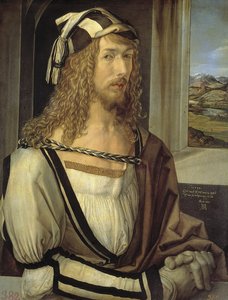
Albrecht Dürer
1471 - 1528 , Niemcy
Najważniejsze informacje
- Artistic Movement Or Style: Renesans północny
- Artists Or Movements Influenced By This Artist:
- Renesans włoski
- Gothic
- Artists Who Influenced This Artist:
- Leonardo da Vinci
- Michał Wolgemut
- Rafael
- Date Of Birth: 21 maja 1471
- Date Of Death: 6 kwietnia 1528
- Full Name: Albrecht Dürer
- Nationality: Niemiec
- Notable Artworks:
- Apokalipsa
- Melencolia I
- Jeremia w jego studiu
- Place Of Birth: Nuremberg, Niemcy