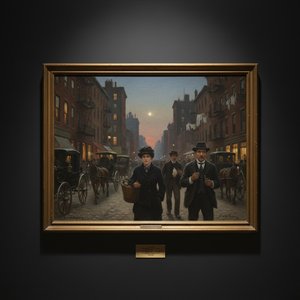
Wersja olejowa
 Wszystko o Second Class - the parting:







































 W przypadku dzieł sztuki lub reprodukcji, których którykolwiek z boków przekracza 105 cm (około 41 cali), rama zostanie wysłana w formie zestawu do samodzielnego montażu. Metoda ta zapewnia bezpieczną dostawę i zapobiega uszkodzeniom podczas transportu.


From the early 1800s, the British were encouraged to emigrate to Australia and become wealthy by working the land or, from the 1850s, by trying their luck on the goldfields. This work represents the changing popular response to emigration to Australia.When Abraham Solomon painted Second Class in 1854, circumstances in England and Australia had changed dramatically. Gold had been discovered in Australia, transportation had virtually ceased and the political print had lost its popularity in England. Solomon’s painting shows a young man leaving for the goldfields, his family accompanying him on the train journey. The work is aimed at a sentimental middle-class market – when will the mother see her son again?This painting forms part of a wider genre presenting free settlers (and gold rush emigrants) to Australia and other British empire colonies. After receiving accolades at the Royal Academy, Second Class, together with its counterpart First Class 1954, became popular through printed reproductions,being produced as a lithographic print both in England and Germany.Roger ButlerText © National Gallery of Australia, Canberra 2010From: Anne Gray (ed), Australian art in the National Gallery of Australia, National Gallery of Australia, Canberra, 2002
Pytania i odpowiedzi
Czy Second Class - the parting: jest dziełem namalowanym ręcznie, czy wydrukiem?
Malowane ręcznie: wykwalifikowany artysta wykonuje olejną kopię Second Class - the parting: na płótnie lnianym.
Jaki rozmiar wybrać dla Second Class - the parting: ?
Wymiary oryginału to 966 x 694 cm. Dostępne rozmiary obejmują zakres od 25.8 x 38.7 cm (zł789) do 164.8 x 246.8 cm (zł5993); tabela na tej stronie przedstawia główne warianty oraz ich ceny.
Ile trwa dostawa?
Czas dostawy wynosi od 4 do 5 tygodni, przy czym oferujemy bezpłatną ekspresową wysyłkę na cały świat; na tej stronie dostępna jest również opcja pilnej produkcji. Możesz dokonać zwrotu w ciągu 100 dni z pełnym zwrotem kosztów, bez żadnych dodatkowych warunków.
Gdzie znajduje się oryginał Second Class - the parting: ?
Oryginał znajduje się w zbiorach National Gallery of Australia w Canberra.
 Podgląd w skali 1:1

 Wyślij jako kartkę
 Udostępnij
 Szczegóły dzieła
 Karta informacyjna


 Pobierz obraz
 Podobne obiekty
 RTG
 Pokaz slajdów
 Pytania i odpowiedzi

 Statystyki