Portret Jean Jouvenet

Obrazy: 88 najsłynniejszych dzieł artysty Jean Jouvenet – spojrzenie galerii

Aktualizacja: Listopad 2026 · ranking według naszego wskaźnika popularności (liczba wyszukiwań, wizyt i zamówień dla każdego dzieła) · 89 dzieł Jean Jouvenet w naszym katalogu

W skrócie

Według galerii najsłynniejszym obrazem Jean Jouvenet jest LA MORT DE SAINT FRANCOIS. Claude-François Poullart des Places (1679-1709) (1700) i Head of an old man. (1687) dopełniają trio, które zna każde oko. Z 89 dzieł Jean Jouvenet w naszym katalogu, galeria prezentuje poniżej 88 najsłynniejszych prac – każda z nich jest oryginałem z podaniem roku powstania, muzeum oraz cech wyróżniających ją na tle innych.

1644 – 1717, Rouen Baroque Najwięcej dzieł: Luwr

10 najlepszych obrazów artysty Jean Jouvenet w galerii

1
LA MORT DE SAINT FRANCOIS autorstwa Jean Jouvenet

LA MORT DE SAINT FRANCOIS

Oil On Canvas

The scene captures the final moments of Saint Francis, lying upon a simple wooden bed within a crowded monastic cell. Surrounding the saint, a group of monks gather in various states of grief and prayer, their presence filling the interior space with a sense of solemnity. From above, an angel descends, extending a crown of leaves toward the dying man. This gesture signals a divine reward and the transition from…

2
Claude-François Poullart des Places (1679-1709) (1700) autorstwa Jean Jouvenet

Claude-François Poullart des Places (1679-1709)

1700 · Oil On Canvas · Bawarskie Państwowe Zbiory Malarstwa, Monachium

This three-quarter length portrait presents a young man positioned with a slight turn toward the viewer. He gazes directly forward with a composed expression. The subject is rendered against a dark, indeterminate background that lacks specific architectural or landscape details. His pale complexion and the white of his collar provide the primary points of light within the composition. A dark garment covers his shoulders and upper torso, its folds defined…

3
Head of an old man. (1687) autorstwa Jean Jouvenet

Head of an old man.

1687 · Oil On Canvas · Muzeum Narodowe w Warszawie, Warszawa

The oil on canvas painting titled Head of an old man. is a portrait created by the French artist Jean Jouvenet. This work, which dates to 1687, depicts an elderly man. The subject is presented in a close-up bust-length view, focusing on the physical characteristics of the man's face and head.

4
Venus in the Vulkan forge (1700) autorstwa Jean Jouvenet

Venus in the Vulkan forge

1700 · Oil On Canvas · Muzeum Narodowe w Warszawie, Warszawa

The oil on canvas painting titled Venus in the Vulkan forge is a work by the artist Jean Jouvenet. This piece depicts a mythological scene involving the goddess Venus and the god Vulcan. The composition centers on the figure of Venus, who is accompanied by a small Cupid within a subterranean setting. The artist, Jean Jouvenet, was born in 1644 in Rouen, France, and lived until 1717.

5
Descent from the Cross (1697) autorstwa Jean Jouvenet

Descent from the Cross

1697 · Oil On Canvas · Luwr, Paryż

In the grand, sweeping tapestry of the French Baroque, few works resonate with as much visceral intensity as Jean-Baptiste Jouvenet’s Descent from the Cross. Completed in 1697, this monumental canvas serves as a profound meditation on grief, faith, and the raw physicality of human suffering. The scene captures the harrowing moment when the body of Jesus Christ is lowered from the cross, a pivotal instant of transition between death and…

6
PORTRAIT DE CHANOINE autorstwa Jean Jouvenet

PORTRAIT DE CHANOINE

Chalk

The gaze of the sitter meets us directly in PORTRAIT DE CHANOINE, a work by the French artist Jean Jouvenet. This portrait captures a man known as Chanoine, whose presence fills the frame with a quiet, steady dignity. He sits as a church official, a man of status and religious duty, presented to the viewer through a lens of solemnity. The subject's identity is tied closely to his vocation, which…

7
Zéphyr et Flore autorstwa Jean Jouvenet

Zéphyr et Flore

Oil On Canvas · Opera w Wersalu, Wersal

The scene known as Zéphyr et Flore unfolds through the brush of Jean Jouvenet, a painter who captures the very essence of a mythological encounter. This work emerges from the late 17th century, specifically dating to about 1688. It breathes with the energy of a moment caught in mid-motion, where the wind and the bloom meet in a lush, natural setting.

8
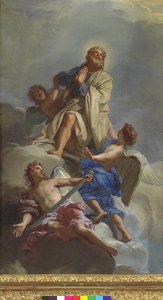
Saint Jean autorstwa Jean Jouvenet

Saint Jean

Oil On Canvas

A golden chalice catches the light, suspended between the mortal and the celestial. Saint John reaches upward, his arms open to receive the vessel offered by a seated angel. The scene is a fragment of a larger movement, a vertical slice of a heavenly encounter. Clouds, thick and billowing, form a soft foundation for the figures, while the background dissolves into a hazy, indeterminate sky. The light descends from an…

9
Jesus Christ at the Home of Martha and Mary (1675) autorstwa Jean Jouvenet

Jesus Christ at the Home of Martha and Mary

1675 · Oil

The air in the room feels heavy with the weight of a profound teaching. Light spills across the scene, catching the folds of heavy drapery and the soft contours of skin, while the shadows retreat into the corners of the stone architecture. Jesus Christ sits at the center of this domestic sanctuary, his presence commanding the space through a quiet, steady authority. He is engaged in conversation, his gestures guiding…

10
God the Father (1685) autorstwa Jean Jouvenet

God the Father

1685 · Oil · Musée des Beaux-Arts, Reims

In this 1685 oil painting, we encounter a celestial presence emerging from a swirling expanse of clouds. The figure of God the Father is rendered as an elderly man, his presence defined by flowing white hair and a beard that merges into the ethereal atmosphere. He is positioned in a three-quarter view, arms outstretched in a gesture that suggests both expansive movement and a reaching toward the heavens. The composition…

Obrazy artysty Jean Jouvenet, uszeregowane od 11 do 88 miejsca

11Portrait of Father Louis Bourdaloue (1680) autorstwa Jean JouvenetPortrait of Father Louis Bourdaloue1680 · Bawarskie Państwowe Zbiory Malarstwa 12Winter (1699) autorstwa Jean JouvenetWinter1699 · Musée-promenade de Marly-le-Roi 13Jesus Healing the Sick by the Shore of the Lake of Gennesaret (1689) autorstwa Jean JouvenetJesus Healing the Sick by the Shore of the Lake of Gennesaret1689 14The Triumph of Justice (1695) autorstwa Jean JouvenetThe Triumph of Justice1695 · Petit Palais 15Louis XIV touchant les malades des écrouelles (1690) autorstwa Jean JouvenetLouis XIV touchant les malades des écrouelles1690 16The Sacrifice of Iphigenia (1688) autorstwa Jean JouvenetThe Sacrifice of Iphigenia1688 · Statens Museum for Kunst 17Jean Jouvenet (1700) autorstwa Jean JouvenetJean Jouvenet1700 · Opera w Wersalu 18The Last Supper (1700) autorstwa Jean JouvenetThe Last Supper1700 19Self-Portrait of Jean-Baptiste Jouvenet Reduction of the painting kept in the Musée de Rouen (1701) autorstwa Jean JouvenetSelf-Portrait of Jean-Baptiste Jouvenet Reduction of the painting kept in the Musée de Rouen1701 · Musée Carnavalet 20The Deposition (1709) autorstwa Jean JouvenetThe Deposition1709 · Toledo Museum of Art 21Cena (1700) autorstwa Jean JouvenetCena1700 · Muzeum Narodowe w Warszawie 22The Miraculous Draught (1706) autorstwa Jean JouvenetThe Miraculous Draught1706 23The Ascension of Christ (1711) autorstwa Jean JouvenetThe Ascension of Christ1711 24Jesus Driving the Merchants from the Temple (1714) autorstwa Jean JouvenetJesus Driving the Merchants from the Temple1714 25Adoration of the Magi (1700) autorstwa Jean JouvenetAdoration of the Magi1700 · Detroit Institute of Arts 26Dr Raymond Finot (1704) autorstwa Jean JouvenetDr Raymond Finot1704 · Luwr 27LA RESURRECTION DE LAZARE autorstwa Jean JouvenetLA RESURRECTION DE LAZARELuwr 28Portrait of an Unknown Man (1700) autorstwa Jean JouvenetPortrait of an Unknown Man1700 · Ermitaż 29The Education of the Virgin (1700) autorstwa Jean JouvenetThe Education of the Virgin1700 · Galleria degli Uffizi 30LA DESCENTE DE CROIX autorstwa Jean JouvenetLA DESCENTE DE CROIXLuwr 31L'EXTREME ONCTION autorstwa Jean JouvenetL'EXTREME ONCTIONLuwr 32The Martyrdom of Saint Ovid autorstwa Jean JouvenetThe Martyrdom of Saint OvidMusée de Grenoble 33The Presentation in the Temple autorstwa Jean JouvenetThe Presentation in the TempleBrest national naval museum 34Christ healing the sick autorstwa Jean JouvenetChrist healing the sickMuzeum Narodowe w Warszawie 35St thomas autorstwa Jean JouvenetSt thomas 36Saint André autorstwa Jean JouvenetSaint André 37Saint Pierre autorstwa Jean JouvenetSaint Pierre 38Saint Paul autorstwa Jean JouvenetSaint Paul 39Saint Jude autorstwa Jean JouvenetSaint Jude 40Saint Thomas autorstwa Jean JouvenetSaint Thomas 41LA PENTECOTE autorstwa Jean JouvenetLA PENTECOTE 42Saint Simon autorstwa Jean JouvenetSaint Simon 43Saint Jacques le majeur autorstwa Jean JouvenetSaint Jacques le majeur 44Saint Philippe autorstwa Jean JouvenetSaint Philippe 45APOLLON SUR SON CHAR SE PRESENTE A THETYS autorstwa Jean JouvenetAPOLLON SUR SON CHAR SE PRESENTE A THETYSZamek Wersalski 46Saint Jacques le mineur autorstwa Jean JouvenetSaint Jacques le mineur 47Saint Barthélémy autorstwa Jean JouvenetSaint Barthélémy 48Latone et les paysans de Lycie autorstwa Jean JouvenetLatone et les paysans de Lycie 49Portrait de l'artiste par lui même autorstwa Jean JouvenetPortrait de l'artiste par lui mêmeNationalmuseum 50Autoportrait autorstwa Jean JouvenetAutoportrait 51Apothéose de Saint Jean autorstwa Jean JouvenetApothéose de Saint Jean 52Apothéose de Saint Luc autorstwa Jean JouvenetApothéose de Saint Luc 53L'ANNONCIATION autorstwa Jean JouvenetL'ANNONCIATION 54Le Christ descendu de la Croix autorstwa Jean JouvenetLe Christ descendu de la Croix 55Isaac bénissant Jacob autorstwa Jean JouvenetIsaac bénissant Jacob 56SAINT LOUIS SOIGNANT LES BLESSES APRES LA BATAILLE DE MANSOURAH.1250 autorstwa Jean JouvenetSAINT LOUIS SOIGNANT LES BLESSES APRES LA BATAILLE DE MANSOURAH.1250 57Le départ de Phaéton autorstwa Jean JouvenetLe départ de Phaéton 58PORTRAIT D'UN MAGISTRAT autorstwa Jean JouvenetPORTRAIT D'UN MAGISTRAT 59Saint Mathias (titre moderne) saint Mathieu (titre ancien) autorstwa Jean JouvenetSaint Mathias (titre moderne) saint Mathieu (titre ancien) 60JESUS AU JARDIN DES OLIVIERS autorstwa Jean JouvenetJESUS AU JARDIN DES OLIVIERS 61LA PRESENTATION AU TEMPLE autorstwa Jean JouvenetLA PRESENTATION AU TEMPLE 62MARC ANTOINE FAISANT CONSUL ALBINUS autorstwa Jean JouvenetMARC ANTOINE FAISANT CONSUL ALBINUS 63CYRUS HARANGUANT SES TROUPES autorstwa Jean JouvenetCYRUS HARANGUANT SES TROUPES 64LE TRIOMPHE DE LA JUSTICE autorstwa Jean JouvenetLE TRIOMPHE DE LA JUSTICE 65LA DESCENTE DU SAINT ESPRIT SUR LES APOTRES autorstwa Jean JouvenetLA DESCENTE DU SAINT ESPRIT SUR LES APOTRES 66JESUS CHRIST CHEZ MARTHE ET MARIE autorstwa Jean JouvenetJESUS CHRIST CHEZ MARTHE ET MARIELuwr 67LA MESSE DU CHANOINE DE LA PORTE OU LE MAITRE AUTEL DE NOTRE DAME autorstwa Jean JouvenetLA MESSE DU CHANOINE DE LA PORTE OU LE MAITRE AUTEL DE NOTRE DAMELuwr 68The Miraculous Draught autorstwa Jean JouvenetThe Miraculous DraughtLuwr 69Isaac blessing jacob autorstwa Jean JouvenetIsaac blessing jacob 70The Presentation in the Temple autorstwa Jean JouvenetThe Presentation in the Temple 71The Descent from the Cross autorstwa Jean JouvenetThe Descent from the Cross 72The Death of St Francis autorstwa Jean JouvenetThe Death of St Francis 73Apotheosis of st. nicholas autorstwa Jean JouvenetApotheosis of st. nicholasMuzeum Plantin-Moretus 74Christ in the House of Martha and Mary autorstwa Jean JouvenetChrist in the House of Martha and Mary 75Foundation of a Town in Germania by the Tectosages autorstwa Jean JouvenetFoundation of a Town in Germania by the Tectosages 76The Mass of Canon Antoine de La Porte or The Altar of Notre Dame autorstwa Jean JouvenetThe Mass of Canon Antoine de La Porte or The Altar of Notre Dame 77LA VICTOIRE SOUTENUE PAR HERCULE ET ACCOMPAGNEE DE L'ABONDANCE, DE LA FELICITE ET DE LA PAIX autorstwa Jean JouvenetLA VICTOIRE SOUTENUE PAR HERCULE ET ACCOMPAGNEE DE L'ABONDANCE, DE LA FELICITE ET DE LA PAIX 78Head of a man looking to the left autorstwa Jean JouvenetHead of a man looking to the left 79Fondation d'une ville en Germanie par les Tectosages autorstwa Jean JouvenetFondation d'une ville en Germanie par les Tectosages 80Esther devant Assuérus Evanouissement d'Ester (ancien titre) autorstwa Jean JouvenetEsther devant Assuérus Evanouissement d'Ester (ancien titre) 81Madonna of the Magnificat autorstwa Jean JouvenetMadonna of the Magnificat 82The Raising of Lazarus autorstwa Jean JouvenetThe Raising of LazarusLos Angeles County Museum of Art 83The marriage of the virgin autorstwa Jean JouvenetThe marriage of the virgin 84Madame de Maintenon as Saint Cecilia and a Boy (possibly the Duc de Maine) as an Angel Blowing an Organ autorstwa Jean JouvenetMadame de Maintenon as Saint Cecilia and a Boy (possibly the Duc de Maine) as an Angel Blowing an Organ 85LE MEDECIN RAYMOND FINOT DIT AUTREFOIS LE MEDECIN FAGON autorstwa Jean JouvenetLE MEDECIN RAYMOND FINOT DIT AUTREFOIS LE MEDECIN FAGONLuwr 86LA PECHE MIRACULEUSE autorstwa Jean JouvenetLA PECHE MIRACULEUSELuwr 87JESUS CHEZ SIMON LE PHARISIEN autorstwa Jean JouvenetJESUS CHEZ SIMON LE PHARISIENMusée des Beaux-Arts de Lyon 88The Raising of Lazarus (1706) autorstwa Jean JouvenetThe Raising of Lazarus1706 · Luwr

Słynne obrazy Jean Jouvenet epoka po epoce

Tematy, które przyciągnęły wzrok Jean Jouvenet

Cztery motywy najczęściej powracające w tych oryginałach, z których każdy doczekał się swojego najdoskonalszego przykładu.

Muzea przechowujące oryginały Jean Jouvenet

8 muzeów, w których znajduje się najwięcej obrazów z tej strony.

Muzea Miasto Dzieła artysty Jean Jouvenet Obrazy z tej listy
Luwr, ParyżLuwr Paryż 11 Descent from the Cross, Dr Raymond Finot, LA RESURRECTION DE LAZARE
Muzeum Narodowe w Warszawie, WarszawaMuzeum Narodowe w Warszawie Warszawa 4 Head of an old man., Venus in the Vulkan forge, Cena
Bawarskie Państwowe Zbiory Malarstwa, MonachiumBawarskie Państwowe Zbiory Malarstwa Monachium 2 Claude-François Poullart des Places (1679-1709), Portrait of Father Louis Bourdaloue
Opera w Wersalu, WersalOpera w Wersalu Wersal 2 Zéphyr et Flore, Jean Jouvenet
Musée des Beaux-Arts, ReimsMusée des Beaux-Arts Reims 1 God the Father
Musée-promenade de Marly-le-Roi, Marly-le-RoiMusée-promenade de Marly-le-Roi Marly-le-Roi 1 Winter
Petit Palais, ParyżPetit Palais Paryż 1 The Triumph of Justice
Statens Museum for Kunst, KopenhagaStatens Museum for Kunst Kopenhaga 1 The Sacrifice of Iphigenia

Jean Jouvenet, jedno kultowe dzieło na dekadę

Dzieła według dekad

Wybierz dekadę, aby zobaczyć dzieło, które ją definiuje.

Obrazy artysty Jean Jouvenet: odpowiedzi galerii

Który obraz Jean Jouvenet jest najsłynniejszy ze wszystkich?Odkryj odpowiedź

LA MORT DE SAINT FRANCOIS. Następne są Claude-François Poullart des Places (1679-1709) (1700) oraz Head of an old man. (1687).

Które to 10 najlepszych obrazów Jean Jouvenet?Odkryj odpowiedź

LA MORT DE SAINT FRANCOIS, Claude-François Poullart des Places (1679-1709), Head of an old man., Venus in the Vulkan forge, Descent from the Cross, PORTRAIT DE CHANOINE, Zéphyr et Flore, Saint Jean, Jesus Christ at the Home of Martha and Mary i God the Father. Powyższy ranking zawiera rok powstania oraz muzeum dla każdego z nich.

Ile dzieł stworzył/a Jean Jouvenet?Odkryj odpowiedź

Nasz katalog zawiera 89 dzieł artysty Jean Jouvenet, datowanych od 1675 do 1714.

Gdzie można znaleźć najsłynniejsze oryginały autorstwa Jean Jouvenet?Odkryj odpowiedź

W większości znajdują się w Luwr (Paryż), Muzeum Narodowe w Warszawie (Warszawa) i Bawarskie Państwowe Zbiory Malarstwa (Monachium). Powyższa tabela muzeów zawiera ich pełną listę.

Kiedy Jean Jouvenet stworzył swoje najsłynniejsze obrazy?Odkryj odpowiedź

W 1700s: 13 z 88 dzieł na tej stronie powstało w tym czasie, w tym Claude-François Poullart des Places (1679-1709).

Które z najsłynniejszych dzieł Jean Jouvenet należą do jego najwcześniejszych i najpóźniejszych prac?Odkryj odpowiedź

Na tej stronie najwcześniejszy to Jesus Christ at the Home of Martha and Mary (1675), a najpóźniejszy Jesus Driving the Merchants from the Temple (1714).

Do jakich tematów Jean Jouvenet powracał najczęściej?Odkryj odpowiedź

Man (14), Saints (10) i Figures (7), w ramach 88 dzieł na tej stronie.

W jakiej technice najczęściej tworzył Jean Jouvenet?Odkryj odpowiedź

Oil On Canvas, dla 29 z 88 dzieł na tej stronie.

Z jakim nurtem związany jest Jean Jouvenet?Odkryj odpowiedź

Baroque, sądząc po oryginałach na tej stronie.

Które oryginały artysty Jean Jouvenet znajdują się w zbiorach Luwr?Odkryj odpowiedź

Descent from the Cross, Dr Raymond Finot i LA RESURRECTION DE LAZARE: Luwr, Paryż posiada 11 dzieł widocznych na tej stronie.

Jean Jouvenet: artysta

Dziedzictwo Bożego Światła: Życie i Sztuka Jean-Baptiste Jouvenet

W wielkiej, rozległej tkaninie francuskiego baroku niewiele nici lśni z taką dramatyczną intensywnością i duchową głębią, jak te utkane przez Jean-Baptiste Jouveneta. Urodzony w 1644 roku w historycznym Rouen, Jouvenet był przeznaczony do życia przesiąkniętego pigmentami i filozofiami swoich przodków. Wywodził się z znamiennej linii artystycznej; jego ojciec, Laurent Jouvenet, zapewnił mu pierwsze wskazówki, podczas gdy szeptane o powiązaniach z legendarnym Nicolasem Poussinem poprzez dziadka, Noela Jouveneta, sugerują rodowód zakorzeniony w samych fundamentach europejskiej tradycji klasycznej. Ta wczesna immersja w język sztuki pozwoliła mu rozwinąć wrażliwość na światło i formę, która ostatecznie zachwyciła najbardziej prestiżowe dwory we Francji.

Awans Jouveneta w świecie paryskiej sztuki był niczym mniej niż meteoryczny. Po przybyciu do stolicy jego niezwykły talent przyciągnął wzrok Charlesa Le Bruna, tytana francuskiego malarstwa królewskiego. Pod przewodnictwem Le Bruna Jouvenet znalazł się w samym sercu najważniejszego przedsięwzięcia artystycznego epoki: dekoracji Salon de Mars w Wersalu. Ten okres intensywnej współpracy i obcowania z królewskim przepychem stał się tyglem dla kształtującego się jego stylu. Do 1675 roku został przyjęty do Académie Royale de Peinture et de Sculpture, co stanowiło osiągnięcie sygnalizujące jego przejście od obiecującego ucznia do mistrza we własnym prawie. Jego wpływ w Akademii rósł systematycznie, prowadząc go ostatecznie do prestiżowych ról profesora i jednego z czterech wieczystych rektorów, gdzie kształtował estetyczną wrażliwość kolejnego pokolenia francuskich malarzy.

Mistrzostwo Barokowego Naturalizmu

To, co naprawdę odróżnia Jouveneta od jego współczesnych, to zdolność do połączenia monumentalnej skali baroku z głębokim, poruszającym naturalizmem. Podczas gdy wielu artystów tej ery mocno skłaniało się ku teatralności i sztuczności, Jouvenet poszukiwał głębszej prawdy w swoich tematach. Jego kompozycje religijne, choć rozległe w swojej skali, posiadają intymny rezonans emocjonalny, który wciąga widza w świętą narrację. Bez względu na to, czy przedstawiał czułą domowość odnalezioną w Jezus Chrystus u Marty i Marii, czy dynamiczną, wirującą energię Cudownego połowu ryb, wykorzystywał bogatą paletę barw i mistrzowskie chiaroscuro, aby tchnąć życie w to, co boskie.

Jego techniczna biegłość była szczególnie widoczna w operowaniu ruchem i światłem. W dziełach takich jak Święty Filip można zaobserwować, jak stosuje żywe kolory i poczucie rytmicznego ruchu, aby przekazać majestat Chrystusa. Ta zdolność do balansowania między epickością a ludzkim wymiarem pozwoliła mu podjąć się ogromnych projektów fresków w ikonicznych miejscach, takich jak Luwr czy Pałac Tuileries, gdzie jego pociągnięcia pędzla potrafiły zapanować nad rozległymi przestrzeniami architektonicznymi, nie tracąc przy tym swojej niezbędnej intymności. Jego portrety, jak choćby sugestywny Dr Raymond Finot, dalej dowodzą tej wszechstronności, ukazując przenikliwe oko do głębi psychologicznej i realistyczne oddanie charakteru, które pozostaje uderzająco nowoczesne.

Znaczenie Historyczne i Trwały Wpływ

Historyczna waga Jean-Baptiste Jouveneta tkwi w jego roli jako pomostu między sztywnym klasycyzmem wczesnego XVII wieku a bardziej emocjonalnymi, płynnymi stylami, które nastąpiły później. Był centralną postacią szkoły Le Bruna, jednak tchnął w tę tradycję unikalną witalność, która zapobiegła jej stagnacji. Jego kariera, obejmująca szczyt panowania Ludwika XIV, odzwierciedlała przesunięcie epoki w stronę bardziej wyrafinowanego i emocjonalnie złożonego języka wizualnego.

Reflektując dziś nad jego dorobkiem, kilka kluczowych elementów jego dziedzictwa pozostaje niezaprzeczalnych:

  • Synteza Stylów: Jego unikalna zdolność do łączenia strukturalnej dyscypliny francuskiej tradycji klasycznej z dramatycznym emocjonalizmem baroku.
  • Duchowy Naturalizm: Transformacyjne podejście do ikonografii religijnej, które kładło nacisk na ludzkie emocje i namacalną rzeczywistość ponad czystą alegorię.
  • Przywództwo Akademickie: Jego głęboki wpływ na Académie Royale, zapewniający ciągłość wysokopoziomowego szkolenia technicznego we Francji.
  • Wszechstronność Skali: Rzadka umiejętność wymagana do wykonania zarówno monumentalnych pałacowych fresków, jak i intymnej, psychologicznie złożonej portretowości.

Choć odszedł w Paryżu w 1717 roku, echa pędzla Jouveneta wciąż można wyczuć w salach wielkich muzeów Europy. Pozostaje on mistrzem „boskiej chwili”, artystą, który potrafił uchwycić punkt styku tego, co ziemskie i wieczne, z niespotykaną gracją.