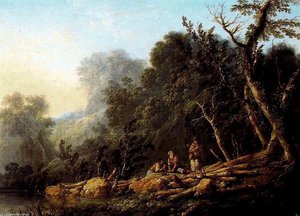
Portret Jean-Baptiste Pillement

Obrazy: 53 najsłynniejszych dzieł artysty Jean-Baptiste Pillement – spojrzenie galerii

Aktualizacja: Listopad 2026 · ranking według naszego wskaźnika popularności (liczba wyszukiwań, wizyt i zamówień dla każdego dzieła) · 54 dzieł Jean-Baptiste Pillement w naszym katalogu

W skrócie

Według galerii najsłynniejszym obrazem Jean-Baptiste Pillement jest Les lavandières. Landscape with Travelers and a Ruin (1750) i Chinoiserie (1767) dopełniają trio, które zna każde oko. Z 54 dzieł Jean-Baptiste Pillement w naszym katalogu, galeria prezentuje poniżej 53 najsłynniejszych prac – każda z nich jest oryginałem z podaniem roku powstania, muzeum oraz cech wyróżniających ją na tle innych.

1728 – 1808, Lyon Rococo Najwięcej dzieł: Petit Palais

10 najlepszych obrazów artysty Jean-Baptiste Pillement w galerii

1
Les lavandières autorstwa Jean-Baptiste Pillement

Les lavandières

Oil On Canvas

Les lavandières, also known as Landscape with Washerwomen, is a landscape painting by Jean-Baptiste Pillement. This oil on canvas work dates to 1792. It belongs to the genre of landscape painting, focusing on a natural setting involving rural labor.

2
Landscape with Travelers and a Ruin (1750) autorstwa Jean-Baptiste Pillement

Landscape with Travelers and a Ruin

1750 · Oil · Fine Arts Museums of San Francisco, San Francisco

The scene unfolds within Landscape with Travelers and a Ruin, a work that captures a quiet moment of passage through a rugged terrain. Jean-Baptiste Pillement invites the viewer into this pastoral setting, where the scale of nature begins to dwarf the small figures navigating the rocky path. The composition centers on the interaction between these travelers and the weathered stone remains of an ancient structure, creating a sense of stillness…

3
Chinoiserie (1767) autorstwa Jean-Baptiste Pillement

Chinoiserie

1767 · Painting · Petit Palais, Paryż

In this large-scale work titled Chinoiserie, Jean-Baptiste Pillement presents a highly decorative vision that functions as a wall painting or wallpaper design. Created about 1767, the piece captures a specific moment in the eighteenth century when the French aristocracy sought an escape into idealized, exotic landscapes. The composition invites the viewer into a curated garden space, where the boundaries between the interior and the natural world feel intentionally blurred.

4
Chinoiserie (1767) autorstwa Jean-Baptiste Pillement

Chinoiserie

1767 · Oil On Canvas · Petit Palais, Paryż

A curtain of flowering vines and slender trees frames a secret garden. The scene is a theatrical vignette, a stage set for a quiet afternoon of leisure. Figures dressed in the high fashion of the 18th century gather upon a raised, rocky platform. They move through a landscape of pale blues and muted greens, their clothing providing small sparks of red and yellow against the soft foliage. The air feels…

5
Fisherman pulling networks (Return from the catch). (1769) autorstwa Jean-Baptiste Pillement

Fisherman pulling networks (Return from the catch).

1769 · Oil On Canvas · Muzeum Narodowe w Warszawie, Warszawa

In this 1769 oil painting, we find ourselves at the edge of a rugged coast during the soft, diffused light of dawn or dusk. The scene focuses on the rhythmic, physical labor of fishermen as they pull their heavy nets from the water. A massive, towering rock formation dominates the right side of the composition, its textured surface rendered in earthy ochres and tans. This geological giant provides a sense…

6
A Shipwreck in a Storm (1782) autorstwa Jean-Baptiste Pillement

A Shipwreck in a Storm

1782 · Watercolor · Metropolitan Museum of Art, Nowy Jork

A Shipwreck in a Storm by Jean-Baptiste Pillement captures a violent maritime disaster. The scene centers on a large vessel in the process of breaking apart, its structure yielding to the overwhelming power of a tempest. Amidst the churning chaos, several figures cling to the jagged rocks of a rugged coastline. Their presence emphasizes the human struggle against the relentless forces of nature. This work, created about 1782, focuses on…

7
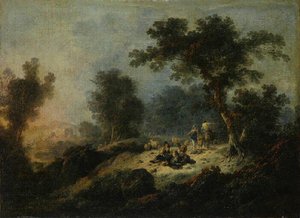
Landscape with Washerwomen and Peasants (1790) autorstwa Jean-Baptiste Pillement

Landscape with Washerwomen and Peasants

1790 · Oil On Canvas · National Gallery of Ireland, Dublin

In this 1790 oil on canvas, we find ourselves drawn into a rugged, mountainous scene where the rhythms of daily life unfold near a cascading river. The composition is framed by dark, craggy cliffs that act as a natural vignette, guiding the eye toward a central, atmospheric vista. An arched wooden footbridge spans the upper reaches of the frame, connecting the rocky heights, while a tall tower watches over a…
8
Rustic Landscape with Aqueduct and Figures (1794) autorstwa Jean-Baptiste Pillement

Rustic Landscape with Aqueduct and Figures

1794 · Oil On Panel · Cooper Hewitt, Smithsonian Design Museum, New York City

The scene unfolds within Rustic Landscape with Aqueduct and Figures, a work that invites the eye into a quiet, pastoral moment. Jean-Baptiste Pillement, an artist born in Lyon, France, in 1728, captures a world where nature and human presence exist in a delicate, rhythmic balance. The painting, dated about 1794, presents a vision of the countryside that feels both lived-in and dreamlike, as if the viewer has stumbled upon a…

9
Landscape with Washerwomen (detail) (1792) autorstwa Jean-Baptiste Pillement

Landscape with Washerwomen (detail)

1792 · Oil On Canvas

Landscape with Washerwomen (detail) is an oil on canvas painting by Jean-Baptiste Pillement. Created in 1792, this work belongs to the genre of landscape painting. It captures a specific moment of domestic activity within a natural setting. The scene focuses on rural labor, where human presence meets the movement of the earth.

Obrazy artysty Jean-Baptiste Pillement, uszeregowane od 11 do 53 miejsca

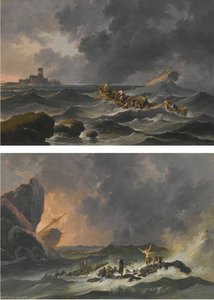
11PAYSAGE AVEC TROUPEAU autorstwa Jean-Baptiste PillementPAYSAGE AVEC TROUPEAULuwr 12Landscape. (1750) autorstwa Jean-Baptiste PillementLandscape.1750 · Narodowe Muzeum Sztuk Pięknych na Kubie 13A Wreck at the Rocky Seaside (1750) autorstwa Jean-Baptiste PillementA Wreck at the Rocky Seaside1750 · Tokyo Fuji Art Museum 14River landscape with a mill and shepherds (1748) autorstwa Jean-Baptiste PillementRiver landscape with a mill and shepherds1748 15Voyages du Roy au Chateau de Choisy (1751) autorstwa Jean-Baptiste PillementVoyages du Roy au Chateau de Choisy1751 · Zamek Wersalski 16Landscape with Aqua Julia in Rome. (1765) autorstwa Jean-Baptiste PillementLandscape with Aqua Julia in Rome.1765 · Muzeum Narodowe w Warszawie 17Market Scene in an Imaginary Oriental Port (1764) autorstwa Jean-Baptiste PillementMarket Scene in an Imaginary Oriental Port1764 · Muzeum J. Paula Getty'ego 18Temple of Minerva Medica in Rome (1765) autorstwa Jean-Baptiste PillementTemple of Minerva Medica in Rome1765 · Muzeum Narodowe w Warszawie 19Decorative Panel with Animal Subjects (1767) autorstwa Jean-Baptiste PillementDecorative Panel with Animal Subjects1767 · Petit Palais 20Decorative Panel with Animal Subjects (1767) autorstwa Jean-Baptiste PillementDecorative Panel with Animal Subjects1767 · Petit Palais 21View of the coast with fishing boats (Trip to catch) (1769) autorstwa Jean-Baptiste PillementView of the coast with fishing boats (Trip to catch)1769 · Muzeum Narodowe w Warszawie 22Title page, Plate 1 from (1775) autorstwa Jean-Baptiste PillementTitle page, Plate 1 from1775 23Title page, Plate 1, from (1775) autorstwa Jean-Baptiste PillementTitle page, Plate 1, from1775 24Animated Landscape (1785) autorstwa Jean-Baptiste PillementAnimated Landscape1785 · Musée Carnavalet 25Vue des jardins de Benfica (1785) autorstwa Jean-Baptiste PillementVue des jardins de Benfica1785 26Landscape with Muleteers and Peasants (1790) autorstwa Jean-Baptiste PillementLandscape with Muleteers and Peasants1790 · National Gallery of Ireland 27Landscape with Rustic Figures (1794) autorstwa Jean-Baptiste PillementLandscape with Rustic Figures1794 · Cooper Hewitt, Smithsonian Design Museum 28Winter (1792) autorstwa Jean-Baptiste PillementWinter1792 29Autumn (1792) autorstwa Jean-Baptiste PillementAutumn1792 30Landscape with Washerwomen (1792) autorstwa Jean-Baptiste PillementLandscape with Washerwomen1792 · Musée des Beaux-Arts de Bordeaux 31Mountainous Landscape (1780) autorstwa Jean-Baptiste PillementMountainous Landscape1780 · Wallraf-Richartz-Museum 32Print, jean pillement (1755) autorstwa Jean-Baptiste PillementPrint, jean pillement (1755) 33Naufrage autorstwa Jean-Baptiste PillementNaufrage 34Paysage autorstwa Jean-Baptiste PillementPaysage 35PAYSAGE AU PONT, PECHEUR ET BERGER autorstwa Jean-Baptiste PillementPAYSAGE AU PONT, PECHEUR ET BERGER 36PAYSAGE A LA CASCADE, BERGER autorstwa Jean-Baptiste PillementPAYSAGE A LA CASCADE, BERGER 37Paysage au pont, pêcheur et lavandière autorstwa Jean-Baptiste PillementPaysage au pont, pêcheur et lavandière 38Muletiers italiens autorstwa Jean-Baptiste PillementMuletiers italiensMuseum Voor Moderne Kunst 39PAYSAGE A LA CASCADE, PECHEURS autorstwa Jean-Baptiste PillementPAYSAGE A LA CASCADE, PECHEURS 40Chinois pêchant à la ligne autorstwa Jean-Baptiste PillementChinois pêchant à la ligneMusée National Magnin 41Untitled (AQQNCU) (1794) autorstwa Jean-Baptiste PillementUntitled (AQQNCU)1794 42Exotic market-place autorstwa Jean-Baptiste PillementExotic market-place 43Paysageavec troupeau autorstwa Jean-Baptiste PillementPaysageavec troupeau 44A decorative plate, french rococo art autorstwa Jean-Baptiste PillementA decorative plate, french rococo art 45Untitled (AQQNCN) autorstwa Jean-Baptiste PillementUntitled (AQQNCN) 46Les chèvres autorstwa Jean-Baptiste PillementLes chèvres 47Two shipwreck scenes autorstwa Jean-Baptiste PillementTwo shipwreck scenes 48River Landscape autorstwa Jean-Baptiste PillementRiver Landscape 49Pastoral Landscape with Shepherds autorstwa Jean-Baptiste PillementPastoral Landscape with Shepherds 50Landscape autorstwa Jean-Baptiste PillementLandscape 51Shipwrecked Sailors Coming Ashore autorstwa Jean-Baptiste PillementShipwrecked Sailors Coming AshoreMuseo del Prado 52A River landscape with a ruined tower and fishermen with their nets in the foreground autorstwa Jean-Baptiste PillementA River landscape with a ruined tower and fishermen with their nets in the foreground 53Landscape autorstwa Jean-Baptiste PillementLandscapeMuseo del Prado

Słynne obrazy Jean-Baptiste Pillement epoka po epoce

Tematy, które przyciągnęły wzrok Jean-Baptiste Pillement

Cztery motywy najczęściej powracające w tych oryginałach, z których każdy doczekał się swojego najdoskonalszego przykładu.

Muzea przechowujące oryginały Jean-Baptiste Pillement

8 muzeów, w których znajduje się najwięcej obrazów z tej strony.

Muzea Miasto Dzieła artysty Jean-Baptiste Pillement Obrazy z tej listy
Petit Palais, ParyżPetit Palais Paryż 4 Chinoiserie, Chinoiserie, Decorative Panel with Animal Subjects
Muzeum Narodowe w Warszawie, WarszawaMuzeum Narodowe w Warszawie Warszawa 4 Fisherman pulling networks (Return from the catch)., Landscape with Aqua Julia in Rome., Temple of Minerva Medica in Rome
National Gallery of Ireland, DublinNational Gallery of Ireland Dublin 2 Landscape with Washerwomen and Peasants, Landscape with Muleteers and Peasants
Cooper Hewitt, Smithsonian Design Museum, New York CityCooper Hewitt, Smithsonian Design Museum New York City 2 Rustic Landscape with Aqueduct and Figures, Landscape with Rustic Figures
Museo del Prado, MadrytMuseo del Prado Madryt 2 Shipwrecked Sailors Coming Ashore, Landscape
Fine Arts Museums of San Francisco, San FranciscoFine Arts Museums of San Francisco San Francisco 1 Landscape with Travelers and a Ruin
Metropolitan Museum of Art, Nowy JorkMetropolitan Museum of Art Nowy Jork 1 A Shipwreck in a Storm
Luwr, ParyżLuwr Paryż 1 PAYSAGE AVEC TROUPEAU

Jean-Baptiste Pillement, jedno kultowe dzieło na dekadę

Dzieła według dekad

Wybierz dekadę, aby zobaczyć dzieło, które ją definiuje.

Obrazy artysty Jean-Baptiste Pillement: odpowiedzi galerii

Który obraz Jean-Baptiste Pillement jest najsłynniejszy ze wszystkich?Odkryj odpowiedź

Les lavandières. Następne są Landscape with Travelers and a Ruin (1750) oraz Chinoiserie (1767).

Które to 10 najlepszych obrazów Jean-Baptiste Pillement?Odkryj odpowiedź

Les lavandières, Landscape with Travelers and a Ruin, Chinoiserie, Chinoiserie, Fisherman pulling networks (Return from the catch)., A Shipwreck in a Storm, Landscape with Washerwomen and Peasants, Rustic Landscape with Aqueduct and Figures, Landscape with Washerwomen (detail) i Waterfall Landscape in Portugal. Powyższy ranking zawiera rok powstania oraz muzeum dla każdego z nich.

Ile dzieł stworzył/a Jean-Baptiste Pillement?Odkryj odpowiedź

Nasz katalog zawiera 54 dzieł artysty Jean-Baptiste Pillement, datowanych od 1748 do 1794.

Gdzie można znaleźć najsłynniejsze oryginały autorstwa Jean-Baptiste Pillement?Odkryj odpowiedź

W większości znajdują się w Petit Palais (Paryż), Muzeum Narodowe w Warszawie (Warszawa) i National Gallery of Ireland (Dublin). Powyższa tabela muzeów zawiera ich pełną listę.

Kiedy Jean-Baptiste Pillement stworzył swoje najsłynniejsze obrazy?Odkryj odpowiedź

W 1760s: 9 z 53 dzieł na tej stronie powstało w tym czasie, w tym Chinoiserie.

Które z najsłynniejszych dzieł Jean-Baptiste Pillement należą do jego najwcześniejszych i najpóźniejszych prac?Odkryj odpowiedź

Na tej stronie najwcześniejszy to River landscape with a mill and shepherds (1748), a najpóźniejszy Rustic Landscape with Aqueduct and Figures (1794).

Do jakich tematów Jean-Baptiste Pillement powracał najczęściej?Odkryj odpowiedź

Landscape (11), Figures (6) i Trees (4), w ramach 53 dzieł na tej stronie.

W jakiej technice najczęściej tworzył Jean-Baptiste Pillement?Odkryj odpowiedź

Oil On Canvas, dla 7 z 53 dzieł na tej stronie.

Z jakim nurtem związany jest Jean-Baptiste Pillement?Odkryj odpowiedź

Rococo, sądząc po oryginałach na tej stronie.

Które oryginały artysty Jean-Baptiste Pillement znajdują się w zbiorach Petit Palais?Odkryj odpowiedź

Chinoiserie, Chinoiserie i Decorative Panel with Animal Subjects: Petit Palais, Paryż posiada 4 dzieł widocznych na tej stronie.

Jean-Baptiste Pillement: artysta

Zaczarowane krainy Jean-Baptiste Pillement

W złotym zmierzchu XVIII wieku niewielu artystów posiadało zdolność przeniesienia widza do świata tak onirycznego i egzotycznego, jak Jean-Baptiste Pillement. Urodzony w Nîmes w 1728 roku, Pillement wyłonił się nie tylko jako malarz, ale jako mistrz atmosfery, splatający delikatną elegancję stylu rokoko z głęboką fascynacją tym, co odległe i nieznane. Choć jego wczesne lata pozostają częściowo spowite mgłą historii, jego awans w hierarchii francuskiej sztuki był niczym meteoryt. Dzięki starannym szkoleniom pod okiem szanowanego Jean-Baptiste Hueta, opanował subtelne niuanse akwareli – medium, które pozwoliło mu uchwycić ulotne światło i żywe pigmenty niezbędne do tchnięcia życia w jego fantastyczne wizje.

Twórczość Pillementa służy jako okno na ruchy Chinoiserie oraz Exotisme, które porywały francuską arystokrację. W przeciwieństwie do tradycjonalistów swojej epoki, szukających ukojenia w klasycznych rzymskich ruinach czy ponurych portretach historycznych, Pillement spoglądał ku horyzontowi. Jego podróże przez Włochy oraz głębokie zaangażowanie w motywy perskie pozwoliły mu kreować krajobrazy, które wydawały się jednocześnie bujne i nieziemskie. W jego rękach świat natury został wyobrażony na nowo; strzeliste palmy, wijące się rzeki i ptaki o olśniewającym upierzeniu stały się protagonistami cichego, pięknego dramatu. To mistrzostwo egzotyki uczyniło go postacią nieodzowną na dworach Ludwika XV oraz
Marii Antoniny, gdyż jego sztuka zapewniała niezwykle potrzebną ucieczkę do krainy czystej, nieskrępowanej wyobraźni.

Technika, wpływ i duch rokoka

Blask techniki Pillementa tkwi w jego zdolności do balansowania precyzji z miękkim, eterycznym blaskiem. Stosował on delikatną technikę sfumato – mistrzowskie przenikanie się tonów poprzez skrupulatne nakładanie warstw – co nadawało jego krajobrazom niemal przezroczystą jakość. Podejście to pozwalało mu przywoływać atmosferyczną głębię mistrzów takich jak Claude Lorrain, jednak nasycał on te klasyczne fundamenty unikalną, fantazyjną energią. Jego kompozycje nigdy nie były statyczne; tętniły rytmiczną witalnością, charakteryzując się:

  • Zawiłym detalem botanicznym: głębokim skupieniem na florze, która wydawała się jednocześnie inspirowana nauką i podniesiona do rangi mitu.
  • Chromatyczną wibracją: użyciem odważnych, nasyconych barw w celu przedstawienia bujności tropikalnych i orientalnych środowisk.
  • Dekoracyjną płynnością: zdolnością do niwelowania różnic między malarstwem wysokim a projektowaniem dekoracyjnym, dzięki czemu jego dzieła doskonale prezentowały się zarówno na płótnie, jak i jako część wystawnych fresków wnętrz.

Jego ewolucja stylistyczna została głęboko ukształtowana przez poszukiwania artystów takich jak Nicolas Pocock czy Gaspar Pérégrine Rigaud. Przejmując ich podejście do krajobrazu i światła, Pillement zdołał dopracować charakterystyczną estetykę, która wydawała się jednocześnie zakorzeniona w europejskiej tradycji i dziko przygodowa. Jego wpływ wykraczał daleko poza płótno, gdyż jego projekty przenikały samą tkankę francuskiej sztuki dekoracyjnej, kształtując wszystko – od wzorów na tapetach po motywy porcelanowe.

Trwałe dziedzictwo w historii sztuki

Historycznego znaczenia Jean-Baptiste Pillement nie można przecenić, szczególnie w kontekście jego roli w definiowaniu wizualnego języka luksusu późnego XVIII wieku. Jego prestiżowe zlecenia, a zwłaszcza zapierające dech w piersiach freski zdobiące Château de Fontainebleau oraz Petit Trianon, stanowią świadectwo jego statusu ulubieńca francuskiej rodziny królewskiej. Dzieła te nie były jedynie dekoracjami; stanowiły immersyjne środowiska, które pomogły zdefiniować tożsamość estetyczną całej epoki.

W czasie, gdy świat sztuki przechodził od radosnej ekspresji rokoka ku bardziej ustrukturyzowanej dyscyplinie klasycyzmu, twórczość Pillementa pozostała cennym pomostem między tymi dwoma światami. Pozostawił po sobie dziedzictwo zachwytu, przypominając przyszłym pokoleniom, że sztuka posiada unikalną moc przekraczania granic geograficznych i przenoszenia ludzkiego ducha do krain nieskończonego piękna i tajemnicy. Dziś jego nazwisko pozostaje synonimem wyrafinowania, egzotyki i wiecznego uroku francuskiego rokoka.