Portrett av Salvator Rosa

Salvator Rosas malerier: De 100 mest kjente, sett gjennom et galleris øyne

Oppdatert November 2026 · rangert etter vår popularitetsscore (søk, besøk og bestillinger for hvert verk) · 274 verk av Salvator Rosa i vår katalog

Kort fortalt

Etter galleriets vurdering er Salvator Rosas mest kjente maleri The Baptism of the Eunuch (1660), hvis original henger i Chrysler Museum of Art, Norfolk. Pythagoras Emerging from the Underworld (1662) og Landscape with St Jerome (1670) fullfører trioen som alle kjenner igjen. Av de 274 verkene til Salvator Rosa i vår katalog, presenterer galleriet de 100 mest kjente nedenfor; hvert originalverk med årstall, museum og hva som gjør det unikt.

1615 – 1673, Napoli Baroque style Flest verk: Bavarian State Painting Collections

Galleriets 10 beste malerier av Salvator Rosa

1
The Baptism of the Eunuch (1660) av Salvator Rosa

The Baptism of the Eunuch

1660 · Oil On Canvas · Chrysler Museum of Art, Norfolk

In "The Baptism of the Eunuch" by Salvator Rosa, a profound moment of spiritual transformation unfolds within a rugged landscape. Created in 1660, the scene captures the precise instant of a man's rebirth through water. A figure, dressed in a white robe, receives the sacrament from another person. This act of baptism occurs amidst a natural setting where rocks rise from the earth, grounding the sacred event in a physical,…

2
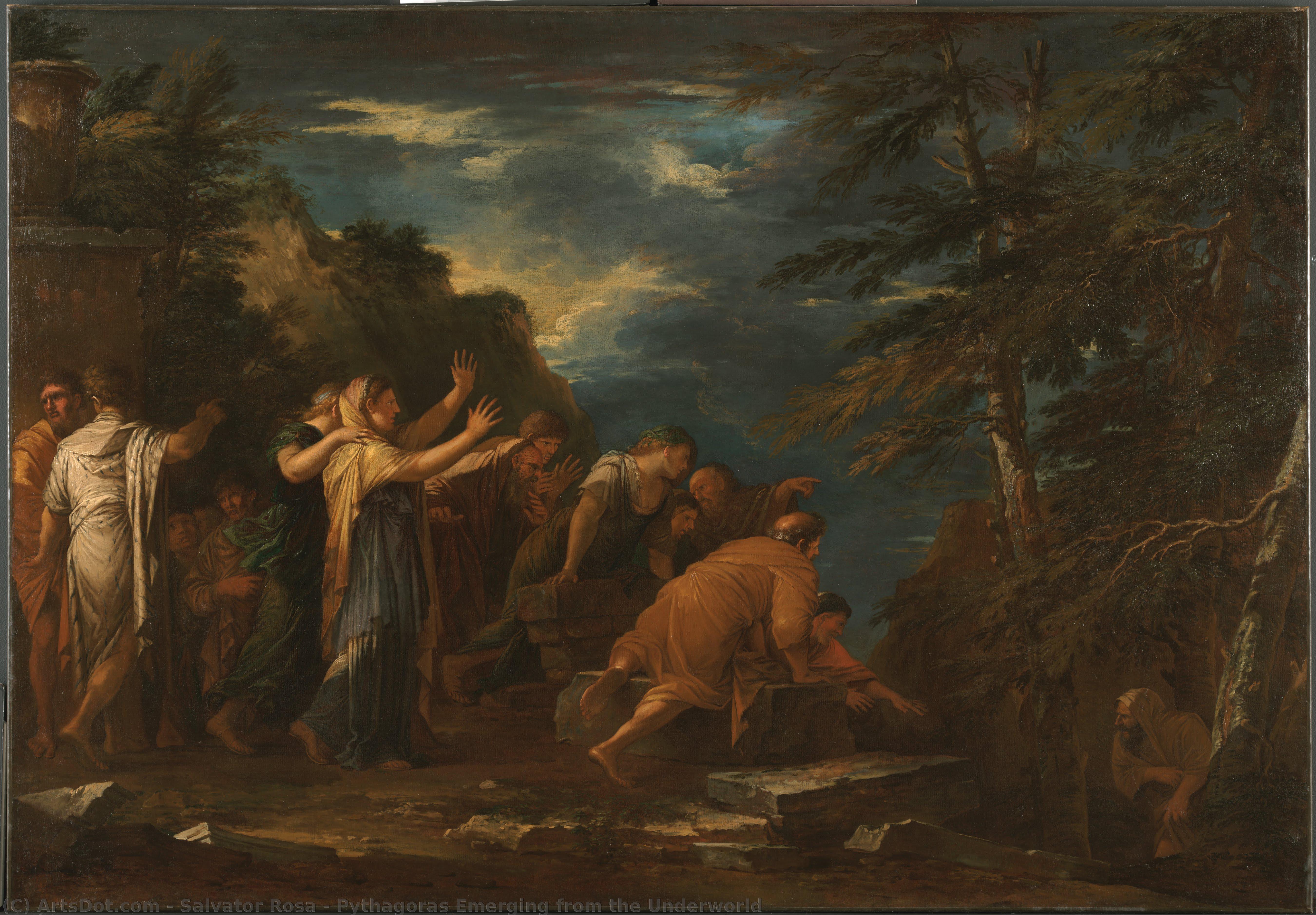
Pythagoras Emerging from the Underworld (1662) av Salvator Rosa

Pythagoras Emerging from the Underworld

1662 · Olje på lerret · Kimbell Art Museum, Fort Worth

Pythagoras Emerging from the Underworld – A Baroque Meditation on Mortality Salvator Rosa’s “Pythagoras Emerging from the Underworld” is more than just a depiction of myth; it's a profound exploration of philosophical ideas interwoven with masterful baroque artistry. Painted in 1662, this monumental canvas embodies the spirit of its time—a fascination with classical antiquity colliding with burgeoning scientific inquiry—and continues to resonate powerfully today. Rosa’s distinctive style, characterized by dramatic…

3
Landscape with St Jerome (1670) av Salvator Rosa

Landscape with St Jerome

1670 · Oil On Canvas · Musée Condé, Chantilly

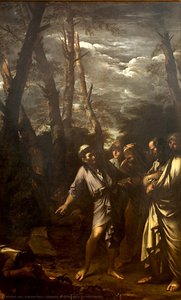
A rugged, mountainous gorge dominates the vertical composition, creating a sense of isolation through deep, narrow canyons. The landscape is defined by jagged, irregular rock faces and the skeletal, tangled branches of overhanging trees. Earthy tones of ochre, deep brown, and muted green establish a somber atmosphere, while a luminous patch of sky at the top center provides a sharp contrast to the shadows below. Within this untamed environment, a…

4
Head of a Man with a Turban (1652) av Salvator Rosa

Head of a Man with a Turban

1652 · Oil On Canvas · Birmingham Museum and Art Gallery, Birmingham

A single light source strikes the left side of a weathered face, carving it out of a heavy, ink-black void. The man’s gaze is steady, meeting the viewer with a quiet, stoic intensity. He wears a voluminous turban, its cream and ochre folds catching the light, revealing the coarse texture of the cloth. Deep shadows swallow the right side of his head, merging his beard and the nape of his…

5
Tobias and the Angel (1662) av Salvator Rosa

Tobias and the Angel

1662 · Oil On Canvas · Musée Condé, Chantilly

The canvas holds a vertical tension, a sudden movement between the heavens and the earth. A celestial figure descends, cutting through a darkness that feels heavy and thick. This is the moment of intervention, where the divine enters the realm of the mortal. Light does not merely illuminate; it strikes. It catches the curve of a reaching hand and the pale skin of a kneeling figure, leaving the rest of…

6
Return of Astrea (1642) av Salvator Rosa

Return of Astrea

1642 · Oil On Canvas · Kunsthistorisches Museum, Wien

A heavy, weathered stone structure anchors the left side of the canvas, its crumbling edges catching the light. Beside it, a gnarled tree leans into the frame, its dark branches reaching like fingers toward a vast, cloud-filled sky. In the lower foreground, rustic figures move through the shadows of the ruins. A man in white and blue stands amidst the earthy tones of ochre and sienna. Above this earthly realm,…

7
Daniel in the Lion's Den (1662) av Salvator Rosa

Daniel in the Lion's Den

1662 · Oil On Canvas · Musée Condé, Chantilly

Salvator Rosa painted Daniel in the Lion's Den as a profound exercise in religious art. This oil on canvas work emerged after 1662, a period when the artist sought to expand his reputation beyond the rugged landscapes for which he was known. The composition belongs to a larger, cohesive cycle of five thematically linked Biblical stories. These paintings were executed for Carlo de' Rossi, intended to decorate a private chapel…

8
Crucifixion of Polyclitus (1650) av Salvator Rosa

Crucifixion of Polyclitus

1650 · Oil · Nasjonalmuseet i Warszawa, Warszawa

In this dramatic Baroque oil painting, we find ourselves witnessing a moment of profound martyrdom. The composition is built upon a restless diagonal, pulling the eye from a crowded, agitated group of figures in the lower left toward the central figure of Polyclitus, suspended upon the cross in the upper right. The landscape is not a place of peace; it is a rugged, mountainous terrain of craggy rocks and turbulent…

9
Jesus carrying the cross (1667) av Salvator Rosa

Jesus carrying the cross

1667 · Oil · Musée Condé, Chantilly

A heavy, wooden cross dominates the composition, its diagonal thrust cutting through a turbulent scene of physical and spiritual struggle. Christ is caught in a moment of intense exertion, his body strained under the burden of the timber. Around him, a crowd of onlookers and tormentors creates a sense of claustrophobic chaos. The arrangement of figures is agitated, driving the eye across the canvas in a series of sharp, conflicting…

10
Witches at their Incantations (1646) av Salvator Rosa

Witches at their Incantations

1646 · Oil On Canvas · National Gallery, London

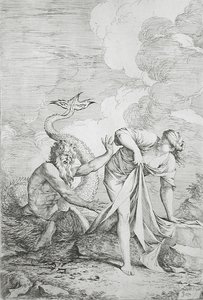
The shadows deepen as we encounter Witches at their Incantations, a work that pulls the viewer into a dark, nocturnal ritual. Painted by Salvator Rosa about 1646, the scene captures a gathering of figures caught in the midst of a witches' sabbath. This macabre assembly unfolds beneath a heavy, cloud-covered sky, where the line between the human and the monstrous begins to blur. It is a moment of profound unrest,…

Salvator Rosa sine malerier, rangert fra 11 til 100

11Group of Warriors (1644) av Salvator RosaGroup of Warriors1644 · Bavarian State Painting Collections 12Self-Portrait as Philosopher of Silence (1641) av Salvator RosaSelf-Portrait as Philosopher of Silence1641 · National Gallery 13Landscape with Bather (1660) av Salvator RosaLandscape with Bather1660 · Yale University Art Gallery 14Saint John the Baptist Baptizing Christ in the Jordan (1655) av Salvator RosaSaint John the Baptist Baptizing Christ in the Jordan1655 · Kelvingrove Art Gallery and Museum 15Jeremie pulled from the cistern (1622) av Salvator RosaJeremie pulled from the cistern1622 · Musée Condé 16Armed Robbers in Rocky Countryside (1644) av Salvator RosaArmed Robbers in Rocky Countryside1644 · Bavarian State Painting Collections 17Jonah Preaching to the People of Niniveh (1645) av Salvator RosaJonah Preaching to the People of Niniveh1645 · Statens Museum for Kunst 18Prometheus on the Rock (1644) av Salvator RosaPrometheus on the Rock1644 · Bavarian State Painting Collections 19Mountain Landscape (1644) av Salvator RosaMountain Landscape1644 · Bavarian State Painting Collections 20Landscape with Saint Anthony Abbot and Saint Paul the Hermit (1662) av Salvator RosaLandscape with Saint Anthony Abbot and Saint Paul the Hermit1662 · Scottish National Gallery 21Study for 'Il Genio di Rosa' av Salvator RosaStudy for 'Il Genio di Rosa' 22Astraea Leaves The Earth (1665) av Salvator RosaAstraea Leaves The Earth1665 · Kunsthistorisches Museum 23An Evangelist (1635) av Salvator RosaAn Evangelist1635 · Israels Museum 24The War People of Gideon (1644) av Salvator RosaThe War People of Gideon1644 · Bavarian State Painting Collections 25Allegory of Study (1647) av Salvator RosaAllegory of Study1647 · John and Mable Ringling Museum of Art 26Scenes of Witchcraft: Night (1640) av Salvator RosaScenes of Witchcraft: Night1640 · Cleveland Museum of Art 27Scenes of Witchcraft: Evening (1640) av Salvator RosaScenes of Witchcraft: Evening1640 · Cleveland Museum of Art 28Scenes of Witchcraft: Day (1640) av Salvator RosaScenes of Witchcraft: Day1640 · Cleveland Museum of Art 29Scenes of Witchcraft: Morning (1640) av Salvator RosaScenes of Witchcraft: Morning1640 · Cleveland Museum of Art 30A Philosopher (1643) av Salvator RosaA Philosopher1643 · Kedleston Hall 31The Founding of Thebes (1645) av Salvator RosaThe Founding of Thebes1645 · Statens Museum for Kunst 32The Martyrdom of Saint Januarius and his Fellows (1650) av Salvator RosaThe Martyrdom of Saint Januarius and his Fellows1650 · Städel Museum 33Head of a Philosopher, called 'Democritus' (1659) av Salvator RosaHead of a Philosopher, called 'Democritus'1659 34Bandits robbing Travellers (1656) av Salvator RosaBandits robbing Travellers1656 · Knole House 35Anchorites Tempted by Demons (1660) av Salvator RosaAnchorites Tempted by Demons1660 · Galleria Nazionale d'Arte Antica 36Three Marys at the Tomb (1665) av Salvator RosaThree Marys at the Tomb1665 · John and Mable Ringling Museum of Art 37Christ expelling the Money Changers from the Temple (1664) av Salvator RosaChrist expelling the Money Changers from the Temple1664 · Attingham Park 38The Angel Leaving the House of Tobias (1662) av Salvator RosaThe Angel Leaving the House of Tobias1662 39Cavalieri in Marcia (1673) av Salvator RosaCavalieri in Marcia1673 40Self-Portrait (1650) av Salvator RosaSelf-Portrait1650 · Detroit Institute of Arts 41Saint Simon the Apostle (1673) av Salvator RosaSaint Simon the Apostle1673 · Georgia Museum of Art 42Landscape with Armed Men (1640) av Salvator RosaLandscape with Armed Men1640 · Los Angeles County Museum of Art 43St. Francis in Ecstasy av Salvator RosaSt. Francis in EcstasyThe Phillips Collection 44Fall of the Giants av Salvator RosaFall of the Giants 45Saint Humphrey (Onuphrius) (1660) av Salvator RosaSaint Humphrey (Onuphrius)1660 · Minneapolis Institute of Art 46Landscape with an "Arco Naturale" (1651) av Salvator RosaLandscape with an "Arco Naturale"1651 · Statens Museum for Kunst 47Odysseus and Nausicaa (1655) av Salvator RosaOdysseus and Nausicaa1655 · Los Angeles County Museum of Art 48Sleeping Warrior (1644) av Salvator RosaSleeping Warrior1644 · Bavarian State Painting Collections 49Ceres and Phytalus (1662) av Salvator RosaCeres and Phytalus1662 · Los Angeles County Museum of Art 50Witches at their Incantations av Salvator RosaWitches at their Incantations 51A Cavalry Battle (1652) av Salvator RosaA Cavalry Battle1652 · Auckland Art Gallery Toi o Tāmaki 52Desolate Landscape with Two Figures (1662) av Salvator RosaDesolate Landscape with Two Figures1662 · Scottish National Gallery 53Landscape with Mercury and the Dishonest Woodman (1652) av Salvator RosaLandscape with Mercury and the Dishonest Woodman1652 · National Gallery 54Landscape with Warriors (1644) av Salvator RosaLandscape with Warriors1644 · Bavarian State Painting Collections 55Landscape with Armed Men (1640) av Salvator RosaLandscape with Armed Men1640 · Los Angeles County Museum of Art 56Glaucus and Scylla (1661) av Salvator RosaGlaucus and Scylla1661 · Los Angeles County Museum of Art 57The Raising of Lazarus av Salvator RosaThe Raising of LazarusMusée Condé 58Still Life (1673) av Salvator RosaStill Life1673 · Bavarian State Painting Collections 59Youth with An Effigy of Diana of Ephesus (1657) av Salvator RosaYouth with An Effigy of Diana of Ephesus1657 · Royal Collection 60River Landscape with Apollo and the Cumean Sibyl (1655) av Salvator RosaRiver Landscape with Apollo and the Cumean Sibyl1655 · Wallace Collection 61Rocky Landscape with a Huntsman and Warriors (1670) av Salvator RosaRocky Landscape with a Huntsman and Warriors1670 · Louvre 62The Finding of Moses (1650) av Salvator RosaThe Finding of Moses1650 · Kimbell Art Museum 63Bandits on a Rocky Coast (1656) av Salvator RosaBandits on a Rocky Coast1656 · Metropolitan Museum of Art 64Standing Warror with Shield (1657) av Salvator RosaStanding Warror with Shield1657 · Los Angeles County Museum of Art 65Saint John the Baptist Revealing Christ to the Disciples (1655) av Salvator RosaSaint John the Baptist Revealing Christ to the Disciples1655 · Kelvingrove Art Gallery and Museum 66Pythagoras and the Fisherman (1662) av Salvator RosaPythagoras and the Fisherman1662 · Staatliche Museen zu Berlin 67Rocky Landscape (1644) av Salvator RosaRocky Landscape1644 · Bavarian State Painting Collections 68A Pass with Travellers attacked by Bandits (1627) av Salvator RosaA Pass with Travellers attacked by Bandits1627 · Knole House 69Bay in a Calm Sea (1644) av Salvator RosaBay in a Calm Sea1644 · Bavarian State Painting Collections 70Sea Storm (1644) av Salvator RosaSea Storm1644 · Bavarian State Painting Collections 71Sea Bay with Rocky Coast (1644) av Salvator RosaSea Bay with Rocky Coast1644 · Bavarian State Painting Collections 72Landscape with Riders (1644) av Salvator RosaLandscape with Riders1644 · Bavarian State Painting Collections 73Sea Storm (1644) av Salvator RosaSea Storm1644 · Bavarian State Painting Collections 74Mountain Landscape (1644) av Salvator RosaMountain Landscape1644 · Bavarian State Painting Collections 75Rocky Coast at a Bay (1644) av Salvator RosaRocky Coast at a Bay1644 · Bavarian State Painting Collections 76Bay by Turbulent Sea (1644) av Salvator RosaBay by Turbulent Sea1644 · Bavarian State Painting Collections 77Seastorm (1644) av Salvator RosaSeastorm1644 · Bavarian State Painting Collections 78Wild rocky landscape (1644) av Salvator RosaWild rocky landscape1644 · Bavarian State Painting Collections 79Sea bay with castle ruins (1644) av Salvator RosaSea bay with castle ruins1644 · Bavarian State Painting Collections 80Coastal Landscape with Castle (1644) av Salvator RosaCoastal Landscape with Castle1644 · Bavarian State Painting Collections 81Lucrezia as Poetry (1641) av Salvator RosaLucrezia as Poetry1641 · Wadsworth Atheneum Museum of Art 82Evening Landscape (1640) av Salvator RosaEvening Landscape1640 83Harbour with Ruins (1640) av Salvator RosaHarbour with Ruins1640 · Szépművészeti Múzeum 84St John Preaching (1660) av Salvator RosaSt John Preaching1660 · York Art Gallery 85Rocky Landscape with Figures (1660) av Salvator RosaRocky Landscape with Figures1660 86The Finding of Moses (1660) av Salvator RosaThe Finding of Moses1660 · Detroit Institute of Arts 87The Return of the Prodigal Son (1660) av Salvator RosaThe Return of the Prodigal Son1660 · National Gallery of Canada 88A Seaport (1651) av Salvator RosaA Seaport1651 · Statens Museum for Kunst 89Southern Harbour (1651) av Salvator RosaSouthern Harbour1651 · Statens Museum for Kunst 90Rocky landscape with figures (1651) av Salvator RosaRocky landscape with figures1651 91Landscape with figures (1651) av Salvator RosaLandscape with figures1651 92Landscape with Tower and Boat (1660) av Salvator RosaLandscape with Tower and Boat1660 · Musée Condé 93Christ resurrected av Salvator RosaChrist resurrectedMusée Condé 94the Witches' Sabbath (1654) av Salvator Rosathe Witches' Sabbath1654 · Museum of Fine Arts, Houston 95Glaucus and Scylla (1661) av Salvator RosaGlaucus and Scylla1661 · Art Gallery of South Australia 96Diogenes Throwing Away His Drinking Cup. (1651) av Salvator RosaDiogenes Throwing Away His Drinking Cup.1651 · Statens Museum for Kunst 97Wooded Landscape (1650) av Salvator RosaWooded Landscape1650 98Portrait of the Artist's Wife Lucrezia (1657) av Salvator RosaPortrait of the Artist's Wife Lucrezia1657 · Galleria Nazionale d'Arte Antica 99Diogenes Casting away his Cup (1650) av Salvator RosaDiogenes Casting away his Cup1650 · Museum of Fine Arts, Houston 100Landscape with a Wide River, Waterfall and Three Figures (1665) av Salvator RosaLandscape with a Wide River, Waterfall and Three Figures1665 · John and Mable Ringling Museum of Art

Salvator Rosas berømte malerier, periode for periode

Motivene som fanget Salvator Rosas blikk

De fire motivene som går igjen hyppigst i disse originalverkene, hver med sitt fremste eksempel.

Museene som har Salvator Rosas originalverk

De 8 museene som innehar flest av maleriene på denne siden.

Museum By Verker av Salvator Rosa Malerier fra denne listen
Bavarian State Painting Collections, MünchenBavarian State Painting Collections München 21 Group of Warriors, Armed Robbers in Rocky Countryside, Prometheus on the Rock
Musée Condé, ChantillyMusée Condé Chantilly 9 Landscape with St Jerome, Tobias and the Angel, Daniel in the Lion's Den
Statens Museum for Kunst, KøbenhavnStatens Museum for Kunst København 10 Jonah Preaching to the People of Niniveh, The Founding of Thebes, Landscape with an "Arco Naturale"
Los Angeles County Museum of Art, Los AngelesLos Angeles County Museum of Art Los Angeles 7 Landscape with Armed Men, Odysseus and Nausicaa, Ceres and Phytalus
Cleveland Museum of Art, ClevelandCleveland Museum of Art Cleveland 5 Scenes of Witchcraft: Night, Scenes of Witchcraft: Evening, Scenes of Witchcraft: Day
National Gallery, LondonNational Gallery London 7 Witches at their Incantations, Self-Portrait as Philosopher of Silence, Landscape with Mercury and the Dishonest Woodman
John and Mable Ringling Museum of Art, SarasotaJohn and Mable Ringling Museum of Art Sarasota 4 Allegory of Study, Three Marys at the Tomb, Landscape with a Wide River, Waterfall and Three Figures
Kunsthistorisches Museum, WienKunsthistorisches Museum Wien 4 Return of Astrea, Astraea Leaves The Earth

Salvator Rosa, ett signaturmaleri per tiår

Verk per tiår

Velg et tiår for å se originalverket som definerer det.

Salvator Rosas malerier: galleriets svar

Hvilket maleri av Salvator Rosa er det mest kjente av alle?Avslør svaret

The Baptism of the Eunuch (1660), Chrysler Museum of Art, Norfolk. Deretter følger Pythagoras Emerging from the Underworld (1662) og Landscape with St Jerome (1670).

Hvor gammel var Salvator Rosa da The Baptism of the Eunuch ble ferdigstilt?Avslør svaret

45 år gammel: The Baptism of the Eunuch er fra 1660, og Salvator Rosa ble født i 1615.

Hvilke er de 10 beste maleriene til Salvator Rosa?Avslør svaret

The Baptism of the Eunuch, Pythagoras Emerging from the Underworld, Landscape with St Jerome, Head of a Man with a Turban, Tobias and the Angel, Return of Astrea, Daniel in the Lion's Den, Crucifixion of Polyclitus, Jesus carrying the cross og Witches at their Incantations. Rangeringen ovenfor viser årstall og museum for hvert verk.

Hvor mange verk skapte Salvator Rosa?Avslør svaret

Vår katalog inneholder 274 verk av Salvator Rosa, datert fra 1627 til 1673.

Hvor henger de mest kjente originalverkene til Salvator Rosa?Avslør svaret

Hovedsakelig i Bavarian State Painting Collections (München), Musée Condé (Chantilly) og Statens Museum for Kunst (København). Museumslisten ovenfor viser alle.

Når malte Salvator Rosa sine mest kjente malerier?Avslør svaret

I 1640s: 36 av de 100 verkene på denne siden ble laget da, Return of Astrea av dem.

Hvilke er Salvator Rosas tidligste og nyeste berømte verk?Avslør svaret

På denne siden er det eldste A Pass with Travellers attacked by Bandits (1627) og det nyeste Cavalieri in Marcia (1673).

Hvilke motiver vendte Salvator Rosa oftest tilbake til?Avslør svaret

Sky (25), People (25) og Figures (18), fordelt på 100 verk på denne siden.

Hvilket medium arbeidet Salvator Rosa mest med?Avslør svaret

Oil On Canvas, for 50 av de 100 verkene på denne siden.

Hvilken kunstretning er Salvator Rosa tilknyttet?Avslør svaret

Baroque style, basert på originalene på denne siden.

Hvilke originalverk av Salvator Rosa har Bavarian State Painting Collections i sin samling?Avslør svaret

Group of Warriors, Armed Robbers in Rocky Countryside og Prometheus on the Rock: Bavarian State Painting Collections, München har 21 av verkene på denne siden.

Salvator Rosa: kunstneren

Tidlig liv, familie og opplæring

I utkanten av Napoli, nærmere bestemt i Arenella, trer Salvator Rosa inn i verden. Datoen for hans fødsel er fortsatt gjenstand for historisk debatt, og faller enten på 20. juni eller 21. juli 1615. Han blir født inn i en familie med distinkte slektslinjer; hans mor, Giulia Greca Rosa, tilhører en av de greske familiene på Sicilia, mens hans far, Vito Antonio de Rosa, arbeider som landmåler. Skyggen fra Vesuv hviler over hans tidlige år, en geologisk tilstedeværelse som etter hvert vil forme hans visuelle språk.

Konflikt preger hans vei mot et kall. Hans far, som søker et mer stabilt og tradisjonelt liv for sin sønn, har til hensikt at Salvator Rosa skal tre inn i prestestanden eller forfølge en karriere som advokat. Somaschi-fedrenes kloster er destinasjonen som er forberedt for ham. Men guttens interesser trekker i en annen retning. Han vender ryggen til det religiøse livet for å forfølge kunsten i det skjulte. Under den stille veiledningen til sin morbror, Paolo Greco, begynner han å mestre sitt håndverks grunnleggende prinsipper. Denne hemmelige opplæringen fortsetter idet han beveger seg mot veiledningen til Francesco Fracanzano, hvor han absorberer det tekniske fundamentet som senere vil tillate ham å utfordre de etablerte estetiske normene i barokkens tidsalder.

Kunstnerisk karriere i Napoli, Roma og Firenze

Salvator Rosas karrierevei endrer seg i takt med de politiske og sosiale strømningene i 1600-tallets Italia. I 1635 forlater han sin fødeby Napoli til fordel for Roma, som på denne tiden var det ubestridte sentrum for kunstnerisk liv. Han vender tilbake til Napoli i 1637, men hans tilstedeværelse i byen blir stadig mer urolig. Innen 1648 er kunstneren tvunget til å flykte fra Napoli fullstendig, etter å ha blitt involvert i et mislykket opprør mot de spanske herskerne. Denne perioden med opprør markerer et definitivt brudd med hans tidlige år.

Hans påfølgende reise fører ham til Firenze. Denne andre perioden i byen tilbyr en helt annen form for engasjement. Utenfor atelieret fordypet Rosa seg i det intellektuelle og sanselige livet i de florentinske kretsene. Han tilbrakte timene sine med å spille musikk, skrive poesi og studere stoisk filosofi. Denne mangefasetterte eksistensen preger dybden i hans senere verker, ettersom hans interesse for det skrevne ord og filosofisk tenkning begynner å flettes sammen med hans visuelle praksis.

Teknikk og stil

Salvator Rosas penselstrøk avviser de polerte overflatene og de idealiserte formene som definerte store deler av barokken. I stedet omfavner han en uortodoks og ekstravanse stil, der han søker det råe og det utemmede. Gjennom en mesterlig bruk av chiaroscuro utnytter han det dramatiske samspillet mellom lys og skygge for å forme både form og stemning. Denne teknikken gjør mer enn bare å definere konturer; den skaper en gjennomgående følelse av spenning over hele lerretet. Hans landskap er ikke idylliske fristeder for kontemplasjon, men er snarere preget av det ville og det værbitte. Turbulente himler og ujevnt, steinete terreng dominerer komposisjonene hans, noe som gjenspeiler en dyp fascinasjon for naturens uforutsigbare og voldsomme krefter.

Motivene beveger seg ofte bort fra samtidens vanlige religiøse scener. Han velger hyppig obskure og esoteriske temaer hentet fra Bibelen, mytologien og filosofenes liv. Denne intellektuelle strengheten transformerer landskapet fra å være en enkel bakgrunn til å bli en sentral og aktiv deltaker i fortellingen. I hans hender blir omgivelsene en scene for moralsk og filosofisk utforskning. Han fremstiller ofte den menneskelige skikkelsen som marginal, overveldet av den enorme og ofte fiendtlige skalaen til den naturlige verden.

Viktige verk og mesterverk

Lerretet blir ofte en arena for intens psykologisk utforskning. I verket fra 1641, Self-Portrait as Philosopher of Silence, som befinner seg i National Gallery i London, møter kunstneren betrakteren gjennom et slør av stillhet. Dette verket fungerer som en meditasjon over visdom, der en mørk og kontemplativ atmosfære brukes for å etablere hans identitet. På lignende vis forsterker hans Self-Portrait as a Philosopher fra 1645, også i National Gallery i London, denne personaen som det tenkende mennesket, og beveger seg bort fra ren representasjon mot et uttrykk for intellektuell strenghet.

Naturen i Salvator Rosas hender er sjelden en fredelig kulisse; den er en turbulent kraft. Rundt 1640 oppstod Ruins in a Rocky Landscape, et verk som nå finnes i Cleveland Museum of Art, som benytter klassiske ruiner og et iriserende lys for å antyde en verden i konstant endring. Denne røffheten strekker seg inn i hans mytologiske og allegoriske komposisjoner. Verket Pythagoras Emerging from the Underworld fra 1662, lokalisert ved Kimbell Art Museum i Fort Worth, bruker en dramatisk landskapskomposisjon for å bygge bro mellom det fysiske og det metafysiske. I samme ånd benytter Democrito E Protagora fra 1664, ved Hermitage Museum i St. Petersburg, en filosofisk allegori satt i et dramatisk landskap.

Selv religiøse fortellinger gjennomgår en transformasjon under hans pensel. The Baptism of the Eunuch, malt i 1660 og utstilt ved Chrysler Museum of Art i Norfolk, tilfører den bibelske scenen et intenst drama. Hans evne til å navigere i disse mangfoldige motivene – fra det mytologiske til det hellige – definerer hans kunstneriske virke.

  • Self-Portrait as Philosopher of Silence (1641)
  • Pythagoras Emerging from the Underworld (1662)
  • Democrito E Protagora (1664)
  • The Baptism of the Eunuch (1660)
  • Ruins in a Rocky Landscape (ca. 1640)

Arv og innflytelse

Salvator Rosas innflytelse forplanter seg gjennom barokkens kunstneriske utvikling som ringvirkninger i vann. Hans brudd med samtidens idealiserte og ordnede landskap skaper en friksjon som endrer retningen for 1600-tallets malerkunst. Denne påvirkningen vandrer gjennom tiårene og når helt frem til verkene til senere kunstnere som Luca Giordano. Han maler ikke bare kulisser; han konstruerer et visuelt språk preget av turbulens som lever videre lenge etter hans død.

Hans romantiserte landskap og historiemalerier utøver et kraftfullt nærvær fra det 17. århundre og langt inn i det tidlige 19. århundre. Disse verkene fungerer som prototyper for det romantiske landskapet, der han bytter ut det "pittoreske" klassiske utsynet med noe langt mer uforutsigbart. I stedet for rolige, pastorale fristeder, presenterer han en vill og ofte fiendtlig natur. Dette skiftet i perspektiv foregriper den emosjonelle intensiteten som senere skulle definere romantikken som kunstretning.

Arven etter hans visjon finnes i spenningen mellom den menneskelige skikkelsen og den utemmede villmarken. Ved å plassere landskapet som et primært motiv, snarere enn bare en bakgrunn for religiøse eller mytologiske fortellinger, endrer han sjangrenes hierarki. Hans røffe, steinete terreng og stormfulle himler legger grunnlaget for en estetikk basert på det sublime, hvor naturen fremstår som en kraft for ærefrykt og introspeksjon, snarere enn en kontrollert hage.

Hvor man kan se verkene i dag

De fysiske restene av Salvator Rosas rastløse karriere er spredt over de store kunsthovedstedene i Europa og Amerika. I St. Petersburg bevarer Hermitasjemuseet hans tidlige presisjon i 1640-tallets Portrait of a Man. Over på kontinentet opprettholder Louvre i Paris sin tilstedeværelse gjennom hans Heroic Battle fra 1652. Disse verkene forankrer hans ettermæle i de store institusjonelle samlingene fra det 17. århundre.

Kunstnerens filosofiske og mytologiske besettelser har også funnet veien inn i spesialiserte samlinger. National Gallery i London huser hans Self-Portrait as a Philosopher fra 1645, et verk som fanger hans intense engasjement for intellektuell tenkning. I Fort Worth rommer Kimbell Art Museum Pythagoras Emerging from the Underworld, en komposisjon fra 1662 som fremhever hans evne til å smelte sammen myte med dramatiske landskap. Samtidig inneholder Metropolitan Museum of Art i New York hans Bandits on a Rocky Coast fra 1656, et stykke som reflekterer den røffe og utemmede naturen han foretrakk.