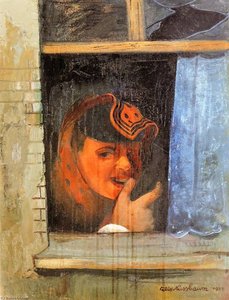
Portrett av Felix Nussbaum

Felix Nussbaums malerier: De 49 mest kjente, sett gjennom et galleris øyne

Oppdatert November 2026 · rangert etter vår popularitetsscore (søk, besøk og bestillinger for hvert verk) · 49 verk av Felix Nussbaum i vår katalog

Kort fortalt

Etter galleriets vurdering er Felix Nussbaums mest kjente maleri Fish Market (1936), hvis original henger i Kulturgeschichtliche Museum Osnabrück, Osnabrück. Fishing Boats with Island (1933) og Loneliness (1942) fullfører trioen som alle kjenner igjen. Av de 49 verkene til Felix Nussbaum i vår katalog, presenterer galleriet de 49 mest kjente nedenfor; hvert originalverk med årstall, museum og hva som gjør det unikt.

1904 – 1944, Osnabrück Surrealist expressionism Flest verk: Kulturgeschichtliche Museum Osnabrück

Galleriets 10 beste malerier av Felix Nussbaum

2
Fishing Boats with Island (1933) av Felix Nussbaum

Fishing Boats with Island

1933 · Gouache

The water holds the light in a pale, steady grip. In this 1933 gouache on paper, the sea is a surface of calm, interrupted only by the presence of two boats. One vessel rests near the left edge, while another sits further back, drifting toward the right. Between them, two figures stand close together on the shore. They are small against the expanse, mere silhouettes of companionship amidst the blue…

5
Memory of Norderney (1929) av Felix Nussbaum

Memory of Norderney

1929 · Oil On Canvas · Kulturgeschichtliche Museum Osnabrück, Osnabrück

In the hauntingly beautiful oil on canvas, Memory of Norderney, Felix Nussbaum invites us into a world that feels simultaneously vibrant and ghostly. Painted in 1929, this large-scale masterpiece captures a moment of serene leisure, yet it is imbued with a profound sense of nostalgia that transcends its literal subject matter. The scene unfolds before a stately building, perhaps a grand hotel or a coastal mansion, characterized by its classical…

6
Entombment (also known as Organ Grinders at the Roman Forum) (1933) av Felix Nussbaum

Entombment (also known as Organ Grinders at the Roman Forum)

1933 · Oil On Canvas · Kulturgeschichtliche Museum Osnabrück, Osnabrück

This oil on canvas painting depicts the entombment of Jesus Christ. The central figure of Jesus lies at the heart of the scene, surrounded by a group of individuals. Some figures stand in close proximity to the body, while others are positioned at a distance. In the background, two men are engaged in playing musical instruments. To the left of the main group, a horse is visible, its form contributing…

Felix Nussbaum sine malerier, rangert fra 11 til 49

11Self-Portrait in a Shroud (Group picture) (1942) av Felix NussbaumSelf-Portrait in a Shroud (Group picture)1942 · Berlinische Galerie 12Self-Portrait with Jewish Identity Card (1943) av Felix NussbaumSelf-Portrait with Jewish Identity Card1943 13Man with Flower (1939) av Felix NussbaumMan with Flower1939 14Evening (unfinished) (also known as Self Portrait with Felka Platek) (1942) av Felix NussbaumEvening (unfinished) (also known as Self Portrait with Felka Platek)1942 · Kulturgeschichtliche Museum Osnabrück 15Jaqui in the Street (1944) av Felix NussbaumJaqui in the Street1944 · Kulturgeschichtliche Museum Osnabrück 16Drawbridge across a Moorland Ditch (1927) av Felix NussbaumDrawbridge across a Moorland Ditch1927 · Kulturgeschichtliche Museum Osnabrück 17Gypsy Woman (1927) av Felix NussbaumGypsy Woman1927 · Kulturgeschichtliche Museum Osnabrück 18The Hakenhof in Kommenderiestrasse in Onasbrück (1927) av Felix NussbaumThe Hakenhof in Kommenderiestrasse in Onasbrück1927 19Men Mending Nets in a Street in Ostend (1928) av Felix NussbaumMen Mending Nets in a Street in Ostend1928 20Fairground (1925) av Felix NussbaumFairground1925 21Group Portrait (1930) av Felix NussbaumGroup Portrait1930 22Gallows (also known as Funeral) (1930) av Felix NussbaumGallows (also known as Funeral)1930 · Berlinische Galerie 23Fisherman's House (1933) av Felix NussbaumFisherman's House1933 · Kulturgeschichtliche Museum Osnabrück 24The Hurdy Gurdy Man (1931) av Felix NussbaumThe Hurdy Gurdy Man1931 · Berlinische Galerie 25Narcussus (1932) av Felix NussbaumNarcussus1932 · Kulturgeschichtliche Museum Osnabrück 26Harbor Scene (1935) av Felix NussbaumHarbor Scene1935 · Kulturgeschichtliche Museum Osnabrück 27Interior with Still Life (1935) av Felix NussbaumInterior with Still Life1935 28Landscape (also known as Tree Behind a Wall) (1935) av Felix NussbaumLandscape (also known as Tree Behind a Wall)1935 29Locomotive (1936) av Felix NussbaumLocomotive1936 · Kulturgeschichtliche Museum Osnabrück 30Man behind the Window (also known as Self Portrait after Adriaen van Ostade) (1937) av Felix NussbaumMan behind the Window (also known as Self Portrait after Adriaen van Ostade)1937 · Kulturgeschichtliche Museum Osnabrück 31Don Quixote and the Windmills (1938) av Felix NussbaumDon Quixote and the Windmills1938 · Kulturgeschichtliche Museum Osnabrück 32Dover Ferry (1935) av Felix NussbaumDover Ferry1935 · Kulturgeschichtliche Museum Osnabrück 33Nightly view from the workshop with dishcloth. (1940) av Felix NussbaumNightly view from the workshop with dishcloth.1940 34The Refugee (1939) av Felix NussbaumThe Refugee1939 35The Kitchen in Hiding (1943) av Felix NussbaumThe Kitchen in Hiding1943 · Kulturgeschichtliche Museum Osnabrück 36Man with Withered Leaf (1941) av Felix NussbaumMan with Withered Leaf1941 37Stillleben mit Schachteln (Still life with boxes) (1941) av Felix NussbaumStillleben mit Schachteln (Still life with boxes)1941 38Hurdy Gurdy Man in a Surreal Landscape (1939) av Felix NussbaumHurdy Gurdy Man in a Surreal Landscape1939 · Kulturgeschichtliche Museum Osnabrück 39Jew by the Window (1943) av Felix NussbaumJew by the Window1943 · Niedersächsisches Landesmuseum Für Kunst Und Kulturgeschichte Oldenburg 40Manikins (1943) av Felix NussbaumManikins1943 · Kulturgeschichtliche Museum Osnabrück 41Group of Three (1944) av Felix NussbaumGroup of Three1944 42Felka Platek Painting (1935) av Felix NussbaumFelka Platek Painting1935 · Jüdisches Museum Rendsburg 43In the camp (1940) av Felix NussbaumIn the camp1940 · Deutsches Historisches Museum 44Gypsy (1928) av Felix NussbaumGypsy1928 · Kulturgeschichtliche Museum Osnabrück 45Min mor (1926) av Felix NussbaumMin mor1926 · Kulturgeschichtliche Museum Osnabrück 46Untitled (AQQJ26) av Felix NussbaumUntitled (AQQJ26) 47Masquerade (1927) av Felix NussbaumMasquerade1927 48Death Triumphant (1944) av Felix NussbaumDeath Triumphant1944 49Self-Portrait in the Camp (1940) av Felix NussbaumSelf-Portrait in the Camp1940 · Neue Galerie New York

Felix Nussbaums berømte malerier, periode for periode

Motivene som fanget Felix Nussbaums blikk

De fire motivene som går igjen hyppigst i disse originalverkene, hver med sitt fremste eksempel.

Museene som har Felix Nussbaums originalverk

De 7 museene som innehar flest av maleriene på denne siden.

Museum By Verker av Felix Nussbaum Malerier fra denne listen
Kulturgeschichtliche Museum Osnabrück, OsnabrückKulturgeschichtliche Museum Osnabrück Osnabrück 21 Fish Market, Fear (also known as Self Portrait with His Niece Marianna), Memory of Norderney
Berlinische Galerie, BerlinBerlinische Galerie Berlin 4 The mad square, Self-Portrait in a Shroud (Group picture), Gallows (also known as Funeral)
Jødisk museum Berlin, BerlinJødisk museum Berlin Berlin 2 Loneliness, Self-Portrait With Painters Cloth
Niedersächsisches Landesmuseum Für Kunst Und Kulturgeschichte Oldenburg, OldenburgNiedersächsisches Landesmuseum Für Kunst Und Kulturgeschichte Oldenburg Oldenburg 1 Jew by the Window
Jüdisches Museum Rendsburg, RendsburgJüdisches Museum Rendsburg Rendsburg 1 Felka Platek Painting
Deutsches Historisches Museum, BerlinDeutsches Historisches Museum Berlin 1 In the camp
Neue Galerie New York, New YorkNeue Galerie New York New York 1 Self-Portrait in the Camp

Felix Nussbaum, ett signaturmaleri per tiår

Verk per tiår

Velg et tiår for å se originalverket som definerer det.

Felix Nussbaums malerier: galleriets svar

Hvilket maleri av Felix Nussbaum er det mest kjente av alle?Avslør svaret

Fish Market (1936), Kulturgeschichtliche Museum Osnabrück, Osnabrück. Deretter følger Fishing Boats with Island (1933) og Loneliness (1942).

Hvor gammel var Felix Nussbaum da Fish Market ble ferdigstilt?Avslør svaret

32 år gammel: Fish Market er fra 1936, og Felix Nussbaum ble født i 1904.

Hvilke er de 10 beste maleriene til Felix Nussbaum?Avslør svaret

Fish Market, Fishing Boats with Island, Loneliness, Fear (also known as Self Portrait with His Niece Marianna), Memory of Norderney, Entombment (also known as Organ Grinders at the Roman Forum), Lovers, The mad square, Self-Portrait With Painters Cloth og Masks and Cat. Rangeringen ovenfor viser årstall og museum for hvert verk.

Hvor mange verk skapte Felix Nussbaum?Avslør svaret

Vår katalog inneholder 49 verk av Felix Nussbaum, datert fra 1925 til 1944.

Hvor henger de mest kjente originalverkene til Felix Nussbaum?Avslør svaret

Hovedsakelig i Kulturgeschichtliche Museum Osnabrück (Osnabrück), Berlinische Galerie (Berlin) og Jødisk museum Berlin (Berlin). Museumslisten ovenfor viser alle.

Når malte Felix Nussbaum sine mest kjente malerier?Avslør svaret

I 1930s: 22 av de 49 verkene på denne siden ble laget da, Fish Market av dem.

Hvilke er Felix Nussbaums tidligste og nyeste berømte verk?Avslør svaret

På denne siden er det eldste Fairground (1925) og det nyeste Jaqui in the Street (1944).

Hvilke motiver vendte Felix Nussbaum oftest tilbake til?Avslør svaret

People (5), Men (5) og Woman (4), fordelt på 49 verk på denne siden.

Hvilket medium arbeidet Felix Nussbaum mest med?Avslør svaret

Oil On Canvas, for 4 av de 49 verkene på denne siden.

Hvilken kunstretning er Felix Nussbaum tilknyttet?Avslør svaret

Surrealist expressionism og New objectivity, basert på originalene på denne siden.

Hvilke originalverk av Felix Nussbaum har Kulturgeschichtliche Museum Osnabrück i sin samling?Avslør svaret

Fish Market, Fear (also known as Self Portrait with His Niece Marianna) og Memory of Norderney: Kulturgeschichtliche Museum Osnabrück, Osnabrück har 21 av verkene på denne siden.

Felix Nussbaum: kunstneren

Felix Nussbaum (1904-1944): A Life Etched in Exile

Felix Nussbaum’s story is a stark and profoundly moving testament to the power of art born from unimaginable suffering. Born in Osnabrück, Germany, in 1904, his life unfolded against the backdrop of rising nationalism and escalating persecution, culminating in the horrors of the Holocaust. He wasn't simply a victim *of* history; he was an artist who meticulously documented its impact on his soul, creating a body of work that stands as both a personal lament and a universal warning. Nussbaum’s paintings offer a rare, unflinching glimpse into the psychological landscape of displacement, fear, and ultimately, annihilation – a perspective often absent from broader historical narratives. His father, Philipp Nussbaum, a World War I veteran with an early passion for painting himself, recognized and nurtured his son's talent, providing encouragement that would prove vital in the darkening years to come. This initial support fostered a lifelong dedication to art, even as political realities increasingly constricted his path.

Early Life and Artistic Influences

Nussbaum’s artistic journey began with formal studies in Hamburg and Berlin in 1920, continuing for as long as circumstances allowed. His early work reveals a clear debt to the Post-Impressionist masters, particularly Vincent van Gogh and Henri Rousseau. The vibrant colors and expressive brushwork of these artists provided a foundation upon which Nussbaum would later build his unique style. However, he wasn’t content with mere imitation. He actively sought out new influences, drawn to the unsettling dreamscapes of Giorgio de Chirico and Carlo Carrà, pioneers of the *pittura metafisica* movement. The careful attention to color demonstrated by Carl Hofer's expressionist paintings also left a lasting impression on Nussbaum’s approach. These diverse inspirations coalesced into what would become known as his “New Objectivity” style – a blend of realism and surrealism, characterized by precise detail, unsettling compositions, and a pervasive sense of alienation. This period was marked by experimentation and growth, but the looming shadow of Nazi ideology soon threatened to extinguish his artistic promise.

Formative Years: The Seeds of Surrealism

Nussbaum’s formative years were shaped by a deep engagement with European intellectual currents. He absorbed the ideas of Sigmund Freud and Karl Marx, recognizing their significance in understanding the anxieties of modern life. His fascination with psychoanalysis fueled his exploration of subconscious imagery and emotional intensity—elements that would become central to his artistic vision. Simultaneously, he was captivated by the burgeoning Surrealist movement, spearheaded by André Breton and Pablo Picasso. Nussbaum embraced Surrealism’s rejection of rational thought and its embrace of dreamlike logic, incorporating fantastical elements into his paintings and drawings. The influence of Henri Rousseau's naive landscapes—characterized by luminous colors and simplified forms—particularly resonated with Nussbaum's aesthetic sensibilities. He admired Rousseau's ability to convey profound emotion through deceptively simple imagery, a technique he would adopt throughout his career.

The Rise of Nazism and Artistic Exile

The political climate in Germany shifted dramatically in 1933 when Adolf Hitler seized power. Nussbaum’s artistic trajectory was irrevocably altered by this event. Studying on a scholarship at Villa Massimo in Rome—a pivotal moment for him—he witnessed firsthand the chilling pronouncements of Hitler's propaganda minister, outlining the tenets of Nazi art – glorification of heroism and the Aryan race. Recognizing that as a Jew, he could not remain within the confines of this doctrine, Nussbaum abandoned his studies and fled Rome shortly thereafter. He moved to Paris in January 1935, where he continued to paint and exhibit his work—a defiant assertion of artistic freedom amidst growing repression. However, the Nazi invasion of Belgium in 1940 forced him into a perilous situation. Arrested as a “hostile alien,” Nussbaum endured confinement at Saint-Cyprien camp for nine months before escaping under cover of darkness. He sought refuge in Brussels with Felka Platek and their friends—a precarious existence marked by constant fear and uncertainty. Despite the challenges posed by Nazi persecution, Nussbaum persevered in his artistic endeavors, producing some of his most poignant and evocative paintings during this period.

The Final Years: Auschwitz and Legacy

Felix Nussbaum’s final years were tragically curtailed by the horrors of World War II. His parents perished at Auschwitz—a devastating loss that profoundly impacted his artistic output. Shortly thereafter, he and Felka Platek were deported to Mechelen transit camp before being transferred to Auschwitz itself, where Nussbaum was murdered upon arrival in August 1944. His brother and sister-in-law followed soon after, completing the annihilation of his family within a single year—a heartbreaking testament to the indiscriminate cruelty of Nazi barbarity. Yet, despite this unimaginable tragedy, Nussbaum’s art endures as a powerful symbol of resilience and defiance—a haunting reminder of the human cost of intolerance and oppression. His paintings—particularly *Self Portrait with Jewish Identity Card* and *Triumph of Death*, continue to inspire contemplation and provoke dialogue about themes of displacement, loss, and the enduring power of artistic expression. Nussbaum’s legacy rests on his unwavering commitment to truthfulness and compassion—qualities embodied in every brushstroke of his extraordinary oeuvre.