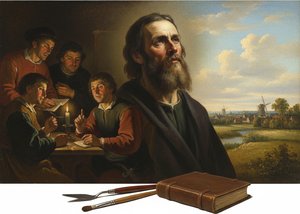
The Son of Glass and Light
In the bustling streets of Ghent, a child was born into a world of color and light, the son of Jacob De Liemaker, a man who shaped beauty through the medium of glass. This lineage of craftsmanship flowed through the veins of Nicolas de Liemaker, shaping a young mind that would eventually turn from the transparency of glass to the heavy, dramatic textures of oil on canvas. While some suggest he may have learned his craft under the guidance of Markus Geeraerts the younger, the shifting tides of history suggest a different path. It is more likely that his hands were first guided by the teachings of Otto van Veen in the great artistic center of Antwerp, where the foundations of his talent were laid before he returned to his birthplace.
His life was one of movement and professional ascent. By 1625, he had established himself with such distinction that his presence in Ghent was felt throughout the artistic community. He was a man of his time, a painter of history who understood the weight of religious narrative and the grand scale required by the churches of Flanders. He did not merely paint scenes; he constructed worlds of movement and monumentality, drawing upon the dramatic energy of the Baroque style to command the attention of those who knelt before his altarpieces.
The Language of the Baroque
The brush of Liemaker spoke a language of grand gestures and spiritual intensity. His work often mirrored the monumental spirit of Rubens and the structured grace of Gaspar de Crayer, yet he maintained a distinct voice that resonated with the ecclesiastical patrons of his region. He found his greatest success in the service of the divine, creating compositions that sought to bridge the gap between the earthly viewer and the celestial realm.
His artistic development was marked by several key characteristics:
- A reliance on the dramatic movement and scale characteristic of the Baroque period.
- The use of models and types derived from the Mannerist traditions of the previous century.
- A focus on large-scale religious subjects intended for high altars and public worship.
His compositions were not static. They possessed a certain muscularity, a sense of unfolding action that drew the eye upward. This was particularly evident in his most celebrated work, the 'Consecration of St. Nicholas, Bishop of Myra,' which was placed high above the altar in the church of St. Nicholas at Ghent. To see such a work was to witness the culmination of his skill, a piece that defined his reputation in the city of his birth.
A Legacy in Stone and Color
Though his life was cut short in 1646, the impact of his hand remained etched into the very fabric of Flemish religious life. His works were not confined to private collections but were woven into the spiritual architecture of the land. From the Museum of Ghent to the quiet corners of various churches throughout Flanders, his presence is felt through the canvases he left behind. He was a painter who understood that art was a public service, a way to give form to the faith of his people through the medium of pigment and light.
Spørsmål og svar
Hvilken by og hvilket land er Nicolas de Liemaker født i?
Nicolas de Liemaker ble født i Ghent i Belgium.
Hvilke farger brukte Nicolas de Liemaker oftest?
Nicolas de Liemaker sin fargebruk i verkene oppført på denne nettsiden kan studeres på kunstnerens Fargepalettens sjel-side.
Hvor kan jeg se Nicolas de Liemaker sine kunstverk i et 3D-galleri?
Nicolas de Liemaker sine kunstverk kan oppleves i et 3D-galleri på artistens side Virtuelt 3D-galleri.