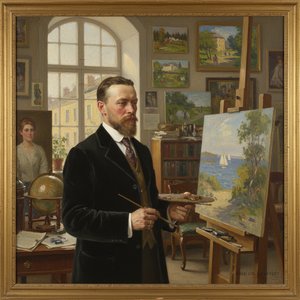
A Visionary of the Finnish Golden Age
Born in the heart of Helsinki in 1853, Maria Catharina Wiik emerged as a luminous figure within the vibrant tapestry of the Finnish Golden Age of art. The daughter of an esteemed architect, her upbringing in Brunnsparken provided a foundation of cultural richness that would later inform her delicate and profound approach to the canvas. Her journey into the world of fine art was not merely a pursuit of skill, but a deep immersion into the soul of her surroundings. From her early training under the guidance of Professor Adolf von Becker at the Academy of Fine Arts in Helsinki, Wiik began to cultivate a technical mastery that would allow her to navigate diverse genres with grace and emotional depth.
The trajectory of her career was profoundly shaped by her travels and her connection to the broader European art scene. In 1875, seeking to expand her horizons beyond the borders of Finland, she ventured to Paris, a city then pulsating with the energy of modernism. At the Académie Julian—a rare sanctuary for female artists in an era of restrictive academic traditions—she studied under Tony Robert-Fleury. This period of intense study and exposure to French techniques infused her work with a sophisticated light and a nuanced understanding of form. Her time in Paris was not a solitary endeavor; she often traveled alongside her contemporary and friend, the renowned Helene Schjerfbeck, creating a shared legacy of artistic exploration that spanned from the studios of France to the rugged coasts of Cornwall.
Mastery of Light, Life, and Landscape
Wiik’s artistic repertoire was remarkably versatile, characterized by an ability to find extraordinary beauty in both the minute and the monumental. She moved seamlessly between still life, genre paintings, landscapes, and portraits, each subject treated with a unique psychological sensitivity. In her still lifes, one finds a meticulous attention to detail that transcends mere representation, imbuing inanimate objects with a quiet, breathing vitality. Her genre scenes, often capturing moments of everyday life, possess a subtle atmospheric quality that invites the viewer into a shared human experience, ranging from the playful energy of a dancer to the contemplative stillness of a young girl.
Her landscapes, too, reflect a deep connection to the natural world, capturing the shifting moods of the Nordic light. Whether depicting the serene vistas of her homeland or the coastal charms of England, Wiik utilized color and texture to evoke the ephemeral qualities of nature. This technical prowess was recognized on the international stage; her work Out into the World earned a prestigious bronze medal at the 1900 Exposition Universelle in Paris, a testament to her ability to communicate universal themes through a distinctly personal lens. Her paintings from the early 1880s, in particular, are noted for their psychological depth, where minute details serve as windows into the inner lives of her subjects.
A Lasting Legacy in Finnish Art
Throughout her life, Maria Wiik remained a steadfast presence in the Helsinki art community, even serving as a substitute teacher at the Academy of Fine Arts. Her contributions helped solidify the identity of Finnish painting during a period of intense national and cultural awakening. Though her later years were marked by the physical decline of her vision, her impact on the history of Finnish art remained undiminished. She stands today not only as a skilled practitioner of her craft but as a pioneer who navigated the challenges of being a woman artist in the nineteenth century to achieve international acclaim.
The significance of her work can be summarized through several key pillars of her career:
- Technical Versatility: Her ability to master diverse genres, from the intimate precision of still life to the expansive emotion of portraiture.
- International Influence: The integration of French academic training and Parisian sensibilities into the Nordic tradition.
- Cultural Connection: Her role in the movement of Finnish artists who sought to define their national identity through a modern, European lens.
- Enduring Recognition: Her inclusion in historical records such as Women Painters of the World, marking her place among the great female masters of her era.
Spørsmål og svar
Kan jeg bla gjennom Maria Wiik sine verk etter medium?
Siden Alle medier grupperer Maria Wiik sine kunstverk etter teknikk.
Hvordan utviklet kunsten til Maria Wiik seg over tid?
Karriereløp til Maria Wiik er en rullebar tidslinje som presenterer kunstnerens verk i kronologisk rekkefølge, gruppert i kapitler etter ulike perioder i karrieren.
Hvordan finner jeg verk av Maria Wiik i en bestemt fargepalett?
For å finne verk av Maria Wiik i en bestemt fargepalett, bruk kunstnerens Etter fargepalett-side.