Portrett av Joseph Anton Koch

De 48 mest kjente maleriene av Joseph Anton Koch, et gallerivalg

Oppdatert November 2026 · rangert etter vår popularitetsscore (søk, besøk og bestillinger for hvert verk) · 50 verk av Joseph Anton Koch i vår katalog

Kort fortalt

Av alle originalverkene Joseph Anton Koch etterlot seg, er det mest kjente Heroic Landscape with Rainbow (1824), som er en del av samlingen til Metropolitan Museum of Art i New York. Like bak følger The death of Oscar (from The Poems of Ossian) (1804) og Landscape with Noah, Offering a Sacrifice of Gratitude (1803). Vår katalog inneholder 50 verk av Joseph Anton Koch; galleriet har bevart de 48 verkene som verden beundrer mest, hver vist med sin dato, sitt museum og sin historie.

1768 – 1839, Elbigenalp Romanticism Flest verk: Bavarian State Painting Collections

Joseph Anton Kochs topp 10 malerier: galleriets utvalg

1
Heroic Landscape with Rainbow (1824) av Joseph Anton Koch

Heroic Landscape with Rainbow

1824 · Oil On Canvas · Metropolitan Museum of Art, New York

Joseph Anton Koch's "Heroic Landscape with Rainbow," painted in 1824, isn’t merely a depiction of a mountain vista; it’s an immersive experience, a carefully constructed dialogue between the grandeur of nature and the aspirations of the Romantic spirit. Born in the Austrian Alps, Koch possessed an innate understanding of the rugged beauty of his homeland – a landscape he would later translate onto canvas with remarkable precision and emotional depth.…

4
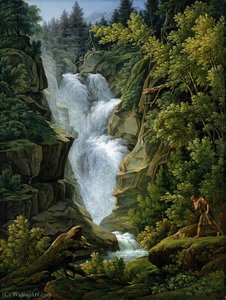
Waterfall near Subiaco (1813) av Joseph Anton Koch

Waterfall near Subiaco

1813 · Oil On Canvas · Nationalgalerie, Berlin

In the quiet majesty of Joseph Anton Koch’s 1813 masterpiece, "Waterfall near Subiaco," the viewer is invited into a world where the terrestrial and the divine converge. This breathtaking landscape does not merely depict a valley; it orchestrates a profound encounter with the sublime. At first glance, the eye is drawn to the powerful descent of the waterfall, a cascading ribbon of white that cuts through the rugged textures of…

5
Wine Festival near Olevano (1812) av Joseph Anton Koch

Wine Festival near Olevano

1812 · Oil On Canvas · Bavarian State Painting Collections, München

This work, titled Wine Festival near Olevano, was painted by the Austrian artist Joseph Anton Koch. Created about 1812, the piece captures a communal celebration set within a lush, hilly landscape. It reflects a specific moment in the artist's career, a period during which he was navigating the transition between the structured principles of Neoclassicism and the emotive spirit of the German Romantic movement.

6
Heroic Landscape with Saint George (1807) av Joseph Anton Koch

Heroic Landscape with Saint George

1807 · Oil On Canvas · Bavarian State Painting Collections, München

In this work, titled Heroic Landscape with Saint George, Joseph Anton Koch presents a scene of significant narrative tension. Painted about 1807, the composition centers on the legendary figure of Saint George. He is depicted on horseback, locked in a struggle against a dragon. This combat takes place in the lower right foreground, grounding the mythic action within the rugged terrain.

7
The Hospice on the Grimsel Pass (1813) av Joseph Anton Koch

The Hospice on the Grimsel Pass

1813 · Oil On Canvas · Staatliche Kunsthalle Karlsruhe, Karlsruhe

The rugged majesty of the Swiss Alps takes center stage in The Hospice on the Grimsel Pass. Painted by Joseph Anton Koch about 1813, this work captures a dramatic alpine scene at the Grimsel Pass. High, jagged peaks reach toward a turbulent sky, looming over the landscape with a sense of geological permanence. The scale of the mountains dwarfs the small signs of life below, creating a profound sense of…

8
Heroic Landscape with Rainbow (1805) av Joseph Anton Koch

Heroic Landscape with Rainbow

1805 · Oil On Canvas · Staatliche Kunsthalle Karlsruhe, Karlsruhe

The canvas of Heroic Landscape with Rainbow presents a sweeping, dramatic vista where the elements of nature collide in a quiet, monumental struggle. Joseph Anton Koch captures a moment of transition, where the heavy, dark weight of storm clouds meets the sudden, luminous clarity of a breaking sky. A prominent rainbow arcs across the upper frame, acting as a bridge between the turbulent weather on one side and the tranquil,…

9
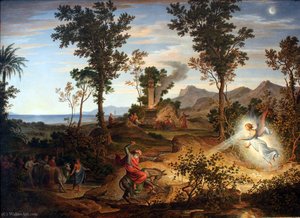
Noah's Offers up Thanks (1814) av Joseph Anton Koch

Noah's Offers up Thanks

1814 · Oil · Alte Nationalgalerie, Berlin

Noah's Offers up Thanks is a work by the Austrian painter Joseph Anton Koch. Executed in 1814, the piece reflects the artist's transition through the shifting currents of Neoclassicism and the German Romantic movement. Koch, born in 1768 in Elbigenalp, Austria, spent much of his career navigating the artistic centers of Europe, eventually settling in Rome, where he died in 1839.

10
Dante and Virgil (1811) av Joseph Anton Koch

Dante and Virgil

1811 · Engraving

This work, titled Dante and Virgil, was created by the Austrian painter Joseph Anton Koch. Dating to 1811, the piece reflects the artist's specific approach to narrative and landscape. Koch, who was born in 1768 in Elbigenalp, Austria, spent much of his career navigating the transition between different artistic movements, eventually settling in Rome, where he died in 1839.

Utvalget av Joseph Anton Koch fortsetter, fra 11 til 48

11The Berner Oberland (1815) av Joseph Anton KochThe Berner Oberland1815 12Tyrolean Landsturm 1809 (1820) av Joseph Anton KochTyrolean Landsturm 18091820 13Scene: Ship of Atonement and Mount Purgatory from the Purgatorio (1822) av Joseph Anton KochScene: Ship of Atonement and Mount Purgatory from the Purgatorio1822 14Landscape with messagers from the promised land (1816) av Joseph Anton KochLandscape with messagers from the promised land1816 · Wallraf-Richartz-Museum 15Italian Landscape with a Plowing Peasant (Die Serpentara near Olevano, Landscape near Paliano) (1825) av Joseph Anton KochItalian Landscape with a Plowing Peasant (Die Serpentara near Olevano, Landscape near Paliano)1825 16Landscape from Civitella near Olevano (1823) av Joseph Anton KochLandscape from Civitella near Olevano1823 · Statens Museum for Kunst 17Dante's Inferno (1825) av Joseph Anton KochDante's Inferno1825 18Diana and Actaeon (1833) av Joseph Anton KochDiana and Actaeon1833 · Bavarian State Painting Collections 19Landscape with the Rape of Hylas (1832) av Joseph Anton KochLandscape with the Rape of Hylas1832 · Städel Museum 20Apollo among the shepherds (1837) av Joseph Anton KochApollo among the shepherds1837 21Macbeth and the witches (1835) av Joseph Anton KochMacbeth and the witches1835 22The Upland near Bern (1816) av Joseph Anton KochThe Upland near Bern1816 · Gemäldegalerie Alte Meister 23View from Kloster S. Isidoro on the Engelsburg (1793) av Joseph Anton KochView from Kloster S. Isidoro on the Engelsburg1793 24The Via Mala in Graubünden (1804) av Joseph Anton KochThe Via Mala in Graubünden1804 · Staatliche Kunsthalle Karlsruhe 25The Lauterbrunnen Valley (1821) av Joseph Anton KochThe Lauterbrunnen Valley1821 26Brickworks near Olevano (1830) av Joseph Anton KochBrickworks near Olevano1830 · Bavarian State Painting Collections 27The Wetterhorn with the Reichenbachtal (1824) av Joseph Anton KochThe Wetterhorn with the Reichenbachtal1824 · Kunst Museum Winterthur | Reinhart am Stadtgarten 28Grindelwald Glacier in the Alps (1823) av Joseph Anton KochGrindelwald Glacier in the Alps1823 · National Museum in Wrocław 29Southern Landscape with Approaching Thunderstorm (1837) av Joseph Anton KochSouthern Landscape with Approaching Thunderstorm1837 30Landscape with Ruth and Boaz av Joseph Anton KochLandscape with Ruth and BoazMilwaukee Art Museum 31The Waterfalls of Tivoli near Rome av Joseph Anton KochThe Waterfalls of Tivoli near Rome 32Landscape with Ruth and Boaz av Joseph Anton KochLandscape with Ruth and BoazMilwaukee Art Museum 33Mountain Scene (1796) av Joseph Anton KochMountain Scene1796 · Wallraf-Richartz-Museum 34Heroic Landscape with Rainbow (1815) av Joseph Anton KochHeroic Landscape with Rainbow1815 · Neue Pinakothek 35Monastery of San Francesco di Civitella in the Sabine Mountains (1812) av Joseph Anton KochMonastery of San Francesco di Civitella in the Sabine Mountains1812 · Eremitasjen 36View of the town of Olevano (Rome Province, Italy) with Rainbow av Joseph Anton KochView of the town of Olevano (Rome Province, Italy) with RainbowKupferstichkabinett 37Waterfalls at Subiaco av Joseph Anton KochWaterfalls at SubiacoAlte Nationalgalerie 38Landscape after a thunderstorm av Joseph Anton KochLandscape after a thunderstormStaatsgalerie Stuttgart 39Rape of Proserpine av Joseph Anton KochRape of Proserpine 40Two Models av Joseph Anton KochTwo Models 41Waterfall in the Bern Highlands av Joseph Anton KochWaterfall in the Bern HighlandsHamburger Kunsthalle 42Landscape with Shepherds and Cows and at the Spring av Joseph Anton KochLandscape with Shepherds and Cows and at the SpringHamburger Kunsthalle 43Countryside at Olevano with a mounted monk av Joseph Anton KochCountryside at Olevano with a mounted monkBavarian State Painting Collections 44Landscape with Abraham and the Three Angels in the Valley of Mambre av Joseph Anton KochLandscape with Abraham and the Three Angels in the Valley of Mambre 45Landscape with Bileam av Joseph Anton KochLandscape with Bileam 46Three Musicians (1958) av Joseph Anton KochThree Musicians1958 47Santa Maria Maggiore in Rome av Joseph Anton KochSanta Maria Maggiore in RomeMuseum Folkwang 48The Schmadribach Falls (1821) av Joseph Anton KochThe Schmadribach Falls1821 · Neue Pinakothek

Joseph Anton Kochs berømte malerier, periode for periode

Motivene som fanget Joseph Anton Kochs blikk

De fire motivene som går igjen hyppigst i disse originalverkene, hver med sitt fremste eksempel.

Museene som har Joseph Anton Kochs originalverk

De 8 museene som innehar flest av maleriene på denne siden.

Museum By Verker av Joseph Anton Koch Malerier fra denne listen
Bavarian State Painting Collections, MünchenBavarian State Painting Collections München 5 Wine Festival near Olevano, Heroic Landscape with Saint George, Diana and Actaeon
Alte Nationalgalerie, BerlinAlte Nationalgalerie Berlin 3 The death of Oscar (from The Poems of Ossian), Noah's Offers up Thanks, Waterfalls at Subiaco
Staatliche Kunsthalle Karlsruhe, KarlsruheStaatliche Kunsthalle Karlsruhe Karlsruhe 3 The Hospice on the Grimsel Pass, Heroic Landscape with Rainbow, The Via Mala in Graubünden
Städel Museum, FrankfurtStädel Museum Frankfurt 2 Landscape with Noah, Offering a Sacrifice of Gratitude, Landscape with the Rape of Hylas
Wallraf-Richartz-Museum, KölnWallraf-Richartz-Museum Köln 2 Landscape with messagers from the promised land, Mountain Scene
Milwaukee Art Museum, MilwaukeeMilwaukee Art Museum Milwaukee 2 Landscape with Ruth and Boaz, Landscape with Ruth and Boaz
Neue Pinakothek, MünchenNeue Pinakothek München 2 Heroic Landscape with Rainbow, The Schmadribach Falls
Hamburger Kunsthalle, HamburgHamburger Kunsthalle Hamburg 2 Waterfall in the Bern Highlands, Landscape with Shepherds and Cows and at the Spring

Joseph Anton Koch tiår for tiår: originalverket som definerer hvert av dem

Verk per tiår

Velg et tiår for å se originalverket som definerer det.

Samlere spør om maleriene til Joseph Anton Koch

Hvilket verk er Joseph Anton Koch mest kjent for?Avslør svaret

Heroic Landscape with Rainbow (1824), Metropolitan Museum of Art, New York. Deretter følger The death of Oscar (from The Poems of Ossian) (1804) og Landscape with Noah, Offering a Sacrifice of Gratitude (1803).

Hvor gammel var Joseph Anton Koch da Heroic Landscape with Rainbow ble laget?Avslør svaret

56 år gammel: Heroic Landscape with Rainbow er fra 1824, og Joseph Anton Koch ble født i 1768.

Hva er de ti mest kjente maleriene til Joseph Anton Koch?Avslør svaret

Heroic Landscape with Rainbow, The death of Oscar (from The Poems of Ossian), Landscape with Noah, Offering a Sacrifice of Gratitude, Waterfall near Subiaco, Wine Festival near Olevano, Heroic Landscape with Saint George, The Hospice on the Grimsel Pass, Heroic Landscape with Rainbow, Noah's Offers up Thanks og Dante and Virgil. Rangeringen ovenfor viser årstall og museum for hvert verk.

Hvor mange malerier etterlot Joseph Anton Koch?Avslør svaret

Vår katalog inneholder 50 verk av Joseph Anton Koch, datert fra 1793 til 1837.

I hvilke museer henger mesterverkene til Joseph Anton Koch?Avslør svaret

Hovedsakelig i Bavarian State Painting Collections (München), Alte Nationalgalerie (Berlin) og Staatliche Kunsthalle Karlsruhe (Karlsruhe). Museumslisten ovenfor viser alle.

I hvilke år malte Joseph Anton Koch sine mest kjente verk?Avslør svaret

I 1810s: 10 av de 48 verkene på denne siden ble laget da, Waterfall near Subiaco av dem.

Hva er de første og de siste kjente originalverkene til Joseph Anton Koch?Avslør svaret

På denne siden er det eldste View from Kloster S. Isidoro on the Engelsburg (1793) og det nyeste Apollo among the shepherds (1837).

Hvilke motiver valgte Joseph Anton Koch oftest?Avslør svaret

Mountains (24), Trees (19) og Landscape (14), fordelt på 48 verk på denne siden.

Hvilken teknikk brukte Joseph Anton Koch mest?Avslør svaret

Oil On Canvas, for 24 av de 48 verkene på denne siden.

Hvilken kunstretning tilhører Joseph Anton Koch?Avslør svaret

Romanticism og Neoclassicism, basert på originalene på denne siden.

Hvilke verk av Joseph Anton Koch stilles ut på Bavarian State Painting Collections?Avslør svaret

Wine Festival near Olevano, Heroic Landscape with Saint George og Diana and Actaeon: Bavarian State Painting Collections, München har 5 av verkene på denne siden.

Joseph Anton Koch: liv og virke

Den heroiske landskapets arkitekt

Joseph Anton Koch står som en unik skikkelse i østerriksk kunsthistorie—en maler som på mesterlig vis navigerte gjennom nyklassisismens skiftende strømninger og inn i den spirende gløden fra tysk romantikk. Han ble født i 1768 i Elbigenalp, Østerrike, og hans tidlige liv var preget av en pastoral enkelhet som skulle forme hans kunstneriske visjon dypt; det å gjete kveg i ungdommen ga ham en intim forståelse for naturens verden, en forbindelse som senere kom til uttrykk i hans monumentale skildringer av jord og himmel. En heldig anbefaling fra biskop Umgelder sikret ham en prestisjefylt akademisk utdannelse ved Karlsschule i Stuttgart, et strengt militærakademi der disiplin og intellektuell streben smeltet sammen. Likevel gjorde Kochs ungdommelige ånd opprør mot slike begrensninger, noe som førte til en kort, men formende vandring gjennom Frankrike og Sveits før han endelig etablerte seg i Roms kunstneriske smeltedigel i 1795.

I hjertet av Italia fant Koch slektskap med medmaleren Asmus Jacob Carstens, og han adopterte en stil som ofte omtales som den heroiske estetikken. Denne tilnærmingen speilet i starten Carstens' bokstavelige tolkninger av mytologiske fortellinger, preget av en viss skulpturell klarhet og formell strenghet. Koch demonstrerte sin tekniske dyktighet ikke bare gjennom maleri, men også gjennom den møysommelige kunsten med grafikk, der han blant annet etset sidene i Carrends Les Argonautes. Denne perioden av hans liv var definert av en mestring av detaljer og en kontroll over linjen som skulle tjene som fundamentet for hans senere, mer ekspansive komposisjoner.

En visjonær utvikling: Fra myte til fjell

Etter hvert som karrieren skred frem, gjennomgikk Koch en dyp kunstnerisk evolusjon, der han beveget seg fra nyklassissismens strukturerte narrativer mot landskapsmaleriets storslåtte storhet. Han begynte å gjenfortolke klassiske idealer gjennom linsen av de østerrikske Alpene og det italienske kulturlandskapet, og skapte verk som føltes både tidløse og intense i sin umiddelbarhet. Inspirert av de monumentale komposisjonene til mestere som Nicolas Poussin og Claude Lorrain, utviklet Koch en unik måte å organisere rommet på, der dramatisk lyssetting og enorme, viltre terreng skapte en følelse av ærefrykt. Hans landskap var aldri bare topografiske registreringer; de var emosjonelle reiser gjennom heroiske omgivelser.

Hans evne til å forene det klassiske med det romantiske kommer kanskje best til syne i hans behandling av lys og atmosfære. I verk som Heroisk landskap med regnbue benytter han en barokk sanselighet for å introdusere dramatiske værforhold som bryter stillheten i fjellene. Denne teknikken gjorde det mulig for ham å bygge bro mellom to epoker: opplysningstidens ordnede, rasjonelle verden og romantikkens emosjonelle, utemmede ånd. Selv når han skildret fredfulle scener, slik som Klosteret San Francesco di Civitella i Sabinesfjellene, forblir det en underliggende følelse av det sublime—en erkjennelse av naturens enorme kraft og skala.

Ettermæle og historisk betydning

De senere årene av Kochs liv var preget av både bevegelse og motstandskraft. Da han møtte økonomiske vanskeligheter forverret av Napoleons invasjoner, flyttet han til Wien i 1812. I disse nye omgivelsene blomstret han under beskyttelse av innflytelsesrike intellektuelle som Friedrich Schlegel, og ble en sentral skikkelse i den germanske kunsttradisjonen. Hans arbeid i denne perioden begynte å reflektere et skifte mot hardere, mer dramatiske elementer, noe som ytterligere sementerte hans rolle som en pioner innen landskapssjangeren.

Den historiske betydningen av Joseph Anton Koch ligger i hans evne til å transformere landskapet fra et sekundært, dekorativt element til et primært verktøy for filosofisk og emosjonell uttrykksform. Hans bidrag kan oppsummeres gjennom flere sentrale kunstneriske pilarer:

  • Syntese av stiler: Han lyktes i å forene den formelle disiplinen fra nyklassisismen med den emosjonelle dybden i tysk romantikk.
  • Den heroiske estetikken: Han redefinerte landskapsmaleriet ved å introdusere en følelse av monumental skala og dramatiske, "heroiske" komposisjoner.
  • Teknisk mestring: Hans ferdigheter strakte seg fra den delikate presisjonen i etsing til det svepende, atmosfæriske penselarbeidet som kreves for enorme fjellutsikter.
  • Kulturell brobygger: Han fungerte som et livsviktig bindeledd mellom de klassiske tradisjonene i Roma og de fremvoksende nasjonalistiske landskapsbevegelsene i Østerrike og Tyskland.

I dag huskes ikke Koch bare som en østerriksk maler, men som en visjonær som lærte betrakteren å skue mot fjellene og se selve sjelen av det sublime i dem.