Portrett av Jan Baptist Weenix

De 78 mest kjente maleriene av Jan Baptist Weenix, et gallerivalg

Oppdatert November 2026 · rangert etter vår popularitetsscore (søk, besøk og bestillinger for hvert verk) · 86 verk av Jan Baptist Weenix i vår katalog

Kort fortalt

Av alle originalverkene Jan Baptist Weenix etterlot seg, er det mest kjente Tobit, asleep under a vine, is blinded (1642), som er en del av samlingen til Museum Boijmans Van Beuningen i Rotterdam. Like bak følger Italian landscape with shelter and antiques ruins (1658) og Still Life with a Dead Swan (1651). Vår katalog inneholder 86 verk av Jan Baptist Weenix; galleriet har bevart de 78 verkene som verden beundrer mest, hver vist med sin dato, sitt museum og sin historie.

1621 – 1659, Amsterdam Dutch golden age Flest verk: Bavarian State Painting Collections

Jan Baptist Weenixs topp 10 malerier: galleriets utvalg

1
Tobit, asleep under a vine, is blinded (1642) av Jan Baptist Weenix

Tobit, asleep under a vine, is blinded

1642 · Oil On Canvas · Museum Boijmans Van Beuningen, Rotterdam

A single man reclines in the heavy shade of a vine. He is Tobit, lost to a deep, unsuspecting sleep. The air around him feels thick, weighted by the muted tones of ochre and forest green. Sunlight does not flood this scene; instead, it pierces through the foliage in sharp, controlled beams, illuminating the textures of his slumped posture and the coarse fabric of his clothing. He rests amidst a…

2
Italian landscape with shelter and antiques ruins (1658) av Jan Baptist Weenix

Italian landscape with shelter and antiques ruins

1658 · Oil On Panel · Mauritshuis, Haag

The oil on panel painting titled Italian landscape with shelter and antiques ruins was executed by the artist Jan Baptist Weenix in 1658. This landscape painting depicts a specific pastoral setting within an Italianate environment. The scene is populated by a group of peasants and various livestock, including sheep and goats. These figures are situated near a rustic cottage and several ancient architectural ruins that occupy the landscape.

3
Still Life with a Dead Swan (1651) av Jan Baptist Weenix

Still Life with a Dead Swan

1651 · Oil On Canvas · Detroit Institute of Arts, Detroit

The painting Still Life with a Dead Swan by Jan Baptist Weenix captures a heavy, silent moment of the hunt. Created about 1651, the work presents a collection of fallen game as a trophy of the chase. A white swan rests at the center, its pale plumage a stark contrast to the darker forms surrounding it. This central figure is accompanied by a turkey, two partridges, and a small finch,…

4
Tobit Sleeping Under the Vine (1641) av Jan Baptist Weenix

Tobit Sleeping Under the Vine

1641 · Oil · Museum Catharijneconvent, Utrecht

In this work, titled Tobit Sleeping Under the Vine, we encounter a significant piece by the Dutch Golden Age painter Jan Baptist Weenix. Created around 1642, the painting belongs to the Baroque period, a time when the interplay of light and shadow began to define the dramatic tension of Northern European art. Weenix, born in Amsterdam, Netherlands, brought a disciplined approach to his subjects, often blending meticulous observation with a…

5
The Scissors Grinder (1641) av Jan Baptist Weenix

The Scissors Grinder

1641 · Oil · Bavarian State Painting Collections, München

The air feels heavy with the scent of damp stone and the rhythmic, metallic scrape of steel against stone. Under a vast, expansive sky, a group of figures gathers within the skeletal remains of a classical ruin. A man leans into his work, operating a grinding wheel that cuts through the quietude of the scene. Beside him, a woman sits in repose, while a small child stands close by, watching…

6
Hunters Near Ruins (1648) av Jan Baptist Weenix

Hunters Near Ruins

1648 · Oil On Canvas · Cleveland Museum of Art, Cleveland

Hunters Near Ruins is an oil on canvas painting by Jan Baptist Weenix. The work is dated 1648. This piece belongs to the Dutch Golden Age, a period during which the artist developed a specific approach to landscape and human figures.

7
Portrait of René Descartes (1647) av Jan Baptist Weenix

Portrait of René Descartes

1647 · Oil · Centraal Museum, Utrecht

In this 1647 oil painting, Jan Baptist Weenix captures the French philosopher René Descartes. The subject appears in a medium close-up, his presence defined by a heavy, somber stillness. He is an elderly man, his face marked by the weight of thought and the passage of years. A bright white collar cuts through the darkness of his attire, framing a pale countenance that emerges from a deep, umber shadow.

8
Monument at a Harbour (1648) av Jan Baptist Weenix

Monument at a Harbour

1648 · Oil · Statens Museum for Kunst, København

The composition relies on strong vertical elements, primarily through imposing columns and a central, highly ornate pedestal topped with a large urn. These structures anchor the scene, providing a sense of scale against the scattered human figures in the foreground and middle ground. Through a use of deep recession, the perspective draws the eye past a colonnade toward a distant, hazy horizon where the masts of ships are visible.

9
Harbour with Antique Ruins (1648) av Jan Baptist Weenix

Harbour with Antique Ruins

1648 · Oil On Canvas · Nationalmuseum, Stockholm

The scene unfolds in 1648, a moment captured in the oil on canvas known as Harbour with Antique Ruins. This work belongs to the hand of Jan Baptist Weenix, an artist who brings the weight of history into a living, breathing maritime setting. The painting presents a world where the weathered stone of classical antiquity meets the constant, rhythmic movement of a working harbor. It is a vision of a…

10
The Angel Raphael Leaving Tobias's Family (1648) av Jan Baptist Weenix

The Angel Raphael Leaving Tobias's Family

1648 · Oil · Nationalmuseum, Stockholm

In "The Angel Raphael Leaving Tobias's Family" by Jan Baptist Weenix, a divine departure unfolds with sudden, celestial energy. The scene captures the exact moment the Angel Raphael ascends toward the heavens, leaving the family below in a state of profound awe and reverence. A powerful diagonal movement pulls the eye from the lower left foreground upward toward the upper left, where the angelic figure climbs into a swirling formation…

Utvalget av Jan Baptist Weenix fortsetter, fra 11 til 78

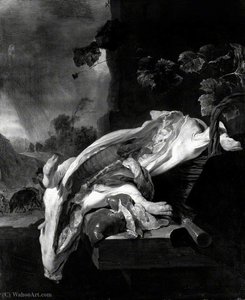
11vegetable-sellers at the house-door, 5 figures (1646) av Jan Baptist Weenixvegetable-sellers at the house-door, 5 figures1646 12caravane near the shore (1646) av Jan Baptist Weenixcaravane near the shore1646 13Mother and Child (1647) av Jan Baptist WeenixMother and Child1647 14Circumcision of Moses' son (1640) av Jan Baptist WeenixCircumcision of Moses' son1640 · Nasjonalmuseet i Warszawa 15Still Life with Game, Hunter and Two Dogs (1652) av Jan Baptist WeenixStill Life with Game, Hunter and Two Dogs1652 · Bavarian State Painting Collections 16Butterfly Dog and Dead Bird (1649) av Jan Baptist WeenixButterfly Dog and Dead Bird1649 · Museum Mayer van den Bergh 17Pleasure boating (1650) av Jan Baptist WeenixPleasure boating1650 18The Sleeping Shepherdess (1658) av Jan Baptist WeenixThe Sleeping Shepherdess1658 · National Gallery of Ireland 19Roman Tinker (1656) av Jan Baptist WeenixRoman Tinker1656 · Städel Museum 20The love letter (1650) av Jan Baptist WeenixThe love letter1650 · Nasjonalmuseet 21Italian Harbour (1651) av Jan Baptist WeenixItalian Harbour1651 · Eremitasjen 22Italian Peasants among Ruins (1650) av Jan Baptist WeenixItalian Peasants among Ruins1650 · Detroit Institute of Arts 23Sleeping girl (1656) av Jan Baptist WeenixSleeping girl1656 · Bavarian State Painting Collections 24Rest on the Flight into Egypt (1657) av Jan Baptist WeenixRest on the Flight into Egypt1657 · Museum Boijmans Van Beuningen 25Merry Company on a Ferry (1649) av Jan Baptist WeenixMerry Company on a Ferry1649 · Museum Gouda 26Battle at the foot of the mountain. (1650) av Jan Baptist WeenixBattle at the foot of the mountain.1650 · Nasjonalmuseet i Warszawa 27Christina Lepper de Kempenaer and Her Children (1653) av Jan Baptist WeenixChristina Lepper de Kempenaer and Her Children1653 28Italian port scene, 1649 (1649) av Jan Baptist WeenixItalian port scene, 16491649 · Centraal Museum 29Italian Landscape with Horsemen by a Spring (1657) av Jan Baptist WeenixItalian Landscape with Horsemen by a Spring1657 · Centraal Museum 30Before the walls of Rome (1650) av Jan Baptist WeenixBefore the walls of Rome1650 · National Museum in Wrocław 31Portrait of a man with a letter (1650) av Jan Baptist WeenixPortrait of a man with a letter1650 · Agnes Etherington Art Center 32A Landscape with a Ford (1660) av Jan Baptist WeenixA Landscape with a Ford1660 · Regional Gallery in Liberec 33In the Campagna (1669) av Jan Baptist WeenixIn the Campagna1669 · National Gallery of Ireland 34Dead Fowl Being Eaten by a Cat (1653) av Jan Baptist WeenixDead Fowl Being Eaten by a Cat1653 · Städel Museum 35Departure of an Oriental Entourage (1647) av Jan Baptist WeenixDeparture of an Oriental Entourage1647 · Louvre 36Display of Dead Game (1641) av Jan Baptist WeenixDisplay of Dead Game1641 · Petit Palais 37Dead Game (1641) av Jan Baptist WeenixDead Game1641 38River Landscape with a Ferry (1650) av Jan Baptist WeenixRiver Landscape with a Ferry1650 · Montreal Museum of Fine Arts 39Still Life with Dead Game and Poultry (1656) av Jan Baptist WeenixStill Life with Dead Game and Poultry1656 · Centraal Museum 40Still Life with Fowl (1650) av Jan Baptist WeenixStill Life with Fowl1650 · Museum of Fine Arts Ghent (MSK) 41Marine with a Venetian Bucintoro (1650) av Jan Baptist WeenixMarine with a Venetian Bucintoro1650 · Staatliche Kunsthalle Karlsruhe 42The Dutch Ambassador on his Way to Isfahan, Jan Baptist Weenix, 1653 - 1659 (1659) av Jan Baptist WeenixThe Dutch Ambassador on his Way to Isfahan, Jan Baptist Weenix, 1653 - 16591659 · Rijksmuseum 43After the Hunt, Jan Baptist Weenix, c. 1656 (1656) av Jan Baptist WeenixAfter the Hunt, Jan Baptist Weenix, c. 16561656 · Rijksmuseum 44Still Life with White Mouse (1680) av Jan Baptist WeenixStill Life with White Mouse1680 · Ernest Zmeták Art Gallery 45Still Life with Game av Jan Baptist WeenixStill Life with GameHarvard Art Museums 46The Ford in the River (1647) av Jan Baptist WeenixThe Ford in the River1647 · Eremitasjen 47Harbor View with Rider in Oriental Dress, av Jan Baptist WeenixHarbor View with Rider in Oriental Dress,Groninger Museum 48The Holy Women at the Tomb av Jan Baptist WeenixThe Holy Women at the TombNational Gallery of Ireland 49An Italian Seaport av Jan Baptist WeenixAn Italian SeaportKoninklijk Museum voor Schone Kunsten Antwerpen 50Architectural interior with foreign shippers, ruins and a shipyard beyond av Jan Baptist WeenixArchitectural interior with foreign shippers, ruins and a shipyard beyond 51Study of a sheep av Jan Baptist WeenixStudy of a sheep 52A pig's carcase av Jan Baptist WeenixA pig's carcase 53The Tinker and His Dog av Jan Baptist WeenixThe Tinker and His Dog 54Landscape with Peasants and Animals av Jan Baptist WeenixLandscape with Peasants and Animals 55Dead Partridge (1650) av Jan Baptist WeenixDead Partridge1650 · Mauritshuis 56Goat Lying Down, Jan Baptist Weenix, 1645 - 1660 (1660) av Jan Baptist WeenixGoat Lying Down, Jan Baptist Weenix, 1645 - 16601660 · Rijksmuseum 57A Dog and a Cat near a partially disembowelled Deer, Jan Baptist Weenix, 1645 - 1660 (1660) av Jan Baptist WeenixA Dog and a Cat near a partially disembowelled Deer, Jan Baptist Weenix, 1645 - 16601660 · Rijksmuseum 58Still Life with Dead Poultry, Lidded Pitcher and Passglas av Jan Baptist WeenixStill Life with Dead Poultry, Lidded Pitcher and PassglasBavarian State Painting Collections 59Game-piece av Jan Baptist WeenixGame-pieceNational Gallery of Ireland 60Dead game and hunting tackle in landscape av Jan Baptist WeenixDead game and hunting tackle in landscape 61Hound with a Joint of Meat and a Cat Looking on av Jan Baptist WeenixHound with a Joint of Meat and a Cat Looking on 62Bouquet of flowers av Jan Baptist WeenixBouquet of flowersGemäldegalerie 63Shipping in Harbour av Jan Baptist WeenixShipping in Harbour 64Herons and Lapwings av Jan Baptist WeenixHerons and Lapwings 65Still Life of Dead Game in a Landscape with a Huntsman av Jan Baptist WeenixStill Life of Dead Game in a Landscape with a Huntsman 66An italian port scene av Jan Baptist WeenixAn italian port scene 67Shepherds and Flocks among Classical Ruins av Jan Baptist WeenixShepherds and Flocks among Classical Ruins 68A Coast Scene with Classical Ruins av Jan Baptist WeenixA Coast Scene with Classical RuinsWallace Collection 69Still Life with Dead Game av Jan Baptist WeenixStill Life with Dead Game 70Hounds and an Owl with Dead Birds and Sculptures in a Landscape av Jan Baptist WeenixHounds and an Owl with Dead Birds and Sculptures in a Landscape 71Still Life with Dead Birds av Jan Baptist WeenixStill Life with Dead Birds 72Family in a Mediterranean Seaport av Jan Baptist WeenixFamily in a Mediterranean Seaport 73Figures near a Seaport av Jan Baptist WeenixFigures near a SeaportScottish National Gallery 74A Huntsman cutting up a Dead Deer, with Two Deerhounds av Jan Baptist WeenixA Huntsman cutting up a Dead Deer, with Two DeerhoundsNational Gallery 75Ancient Ruins av Jan Baptist WeenixAncient RuinsSzépművészeti Múzeum 76Figures among ruins av Jan Baptist WeenixFigures among ruinsThe Kremer Collection 77Ancient Ruins (detail) av Jan Baptist WeenixAncient Ruins (detail)Szépművészeti Múzeum 78Girl as Shepherdess (1650) av Jan Baptist WeenixGirl as Shepherdess1650 · Musée de Picardie

Jan Baptist Weenixs berømte malerier, periode for periode

Motivene som fanget Jan Baptist Weenixs blikk

De fire motivene som går igjen hyppigst i disse originalverkene, hver med sitt fremste eksempel.

Museene som har Jan Baptist Weenixs originalverk

De 8 museene som innehar flest av maleriene på denne siden.

Museum By Verker av Jan Baptist Weenix Malerier fra denne listen
Bavarian State Painting Collections, MünchenBavarian State Painting Collections München 4 The Scissors Grinder, Still Life with Game, Hunter and Two Dogs, Sleeping girl
Centraal Museum, UtrechtCentraal Museum Utrecht 4 Portrait of René Descartes, Italian port scene, 1649, Italian Landscape with Horsemen by a Spring
National Gallery of Ireland, DublinNational Gallery of Ireland Dublin 4 The Sleeping Shepherdess, In the Campagna, The Holy Women at the Tomb
Rijksmuseum, AmsterdamRijksmuseum Amsterdam 4 The Dutch Ambassador on his Way to Isfahan, Jan Baptist Weenix, 1653 - 1659, After the Hunt, Jan Baptist Weenix, c. 1656, Goat Lying Down, Jan Baptist Weenix, 1645 - 1660
Museum Boijmans Van Beuningen, RotterdamMuseum Boijmans Van Beuningen Rotterdam 2 Tobit, asleep under a vine, is blinded, Rest on the Flight into Egypt
Mauritshuis, HaagMauritshuis Haag 2 Italian landscape with shelter and antiques ruins, Dead Partridge
Detroit Institute of Arts, DetroitDetroit Institute of Arts Detroit 2 Still Life with a Dead Swan, Italian Peasants among Ruins
Nationalmuseum, StockholmNationalmuseum Stockholm 2 Harbour with Antique Ruins, The Angel Raphael Leaving Tobias's Family

Jan Baptist Weenix år for år: originalverkene som definerer hvert år

Fra 1640 til 1659 arbeidet Jan Baptist Weenix i 20 år: utvalget følger denne lange karrieren år for år, gjennom de fineste originalverkene.

Verk per år

Velg et år for å se originalverkene.

Samlere spør om maleriene til Jan Baptist Weenix

Hvilket verk er Jan Baptist Weenix mest kjent for?Avslør svaret

Tobit, asleep under a vine, is blinded (1642), Museum Boijmans Van Beuningen, Rotterdam. Deretter følger Italian landscape with shelter and antiques ruins (1658) og Still Life with a Dead Swan (1651).

Hvor gammel var Jan Baptist Weenix da Tobit, asleep under a vine, is blinded ble laget?Avslør svaret

21 år gammel: Tobit, asleep under a vine, is blinded er fra 1642, og Jan Baptist Weenix ble født i 1621.

Hva er de ti mest kjente maleriene til Jan Baptist Weenix?Avslør svaret

Tobit, asleep under a vine, is blinded, Italian landscape with shelter and antiques ruins, Still Life with a Dead Swan, Tobit Sleeping Under the Vine, The Scissors Grinder, Hunters Near Ruins, Portrait of René Descartes, Monument at a Harbour, Harbour with Antique Ruins og The Angel Raphael Leaving Tobias's Family. Rangeringen ovenfor viser årstall og museum for hvert verk.

Hvor mange malerier etterlot Jan Baptist Weenix?Avslør svaret

Vår katalog inneholder 86 verk av Jan Baptist Weenix, datert fra 1640 til 1659.

I hvilke museer henger mesterverkene til Jan Baptist Weenix?Avslør svaret

Hovedsakelig i Bavarian State Painting Collections (München), Centraal Museum (Utrecht) og National Gallery of Ireland (Dublin). Museumslisten ovenfor viser alle.

I hvilke år malte Jan Baptist Weenix sine mest kjente verk?Avslør svaret

I 1650: 11 av de 78 verkene på denne siden ble laget da, Pleasure boating av dem.

Hva er de første og de siste kjente originalverkene til Jan Baptist Weenix?Avslør svaret

På denne siden er det eldste Circumcision of Moses' son (1640) og det nyeste The Dutch Ambassador on his Way to Isfahan, Jan Baptist Weenix, 1653 - 1659 (1659).

Hvilke motiver valgte Jan Baptist Weenix oftest?Avslør svaret

Landscape (18), Ruins (17) og Sky (13), fordelt på 78 verk på denne siden.

Hvilken teknikk brukte Jan Baptist Weenix mest?Avslør svaret

Oil On Canvas, for 30 av de 78 verkene på denne siden.

Hvilken kunstretning tilhører Jan Baptist Weenix?Avslør svaret

Dutch golden age og Baroque, basert på originalene på denne siden.

Hvilke verk av Jan Baptist Weenix stilles ut på Bavarian State Painting Collections?Avslør svaret

The Scissors Grinder, Still Life with Game, Hunter and Two Dogs og Sleeping girl: Bavarian State Painting Collections, München har 4 av verkene på denne siden.

Jan Baptist Weenix: liv og virke

Den visjonære fra den nederlandske gullalderen

Jan Baptist Weenix står som en enestående skikkelse innen den nederlandske gullalderen, hyllet for sin særegne forening av nitid observasjon og fantasifull visjon. Selv om hans kunstneriske produksjon var relativt beskjeden sammenlignet med samtidige mestere som Rembrandt eller Vermeer, er Weenix' bidrag til nederlandsk kunsthistorie ubestridelig—særlig hans banebrytende utforskning av italienske landskap befolket av menneskefigurer, noe som etablerte en stilistisk presedens som skulle gjenlyde gjennom påfølgende generasjoner. Han ble født i Amsterdam i 1621, nær den travle havnen, og stammet fra en familie av arkitekter, en slekt som sannsynligvis formet hans formative år midt i epokens intellektuelle og strukturelle brytninger.

Til tross for personlige utfordringer—historiske beretninger antyder at han slet med talen på grunn av en medisinsk tilstand—besatt Weenix en brennende lidenskap for litteratur og kunst. Denne interessen ble pleiet av en mor som proaktivt sørget for at han fikk læretid under Jan Micker, Rembrandts svoger. Denne tidlige opplæringen innprentet ham en disiplinert tilnærming til tegning og observasjon som skulle bli selve kjennetegnet på hans virke. Han foredlet sine ferdigheter ytterligere i Utrecht under veiledning av Abraham Bloemaert, før han vendte tilbake til Amsterdam for å studere under Claes Corneliszoon Moeyaert, noe som sementerte hans fundament i de rådende kunstneriske strømningene i Nederland.

En reise gjennom lys og landskap

Veien i Weenix' karriere ble fundamentalt endret av hans reiser, mest bemerkelsesverlig ferden til Roma i 1643 sammen med Nicolaes Pieterszoon Berchem. Denne ekskursjonen lot ham tre inn i det levende intellektuelle og kunstneriske miljøet i Bentvueghels-lauget, en opplevelse som drev ham mot en mer ekspansiv stilistisk rekkevidde. I Roma omfavnet han den italienske stilen, preget av et varmt, gyllent lys og klassiske landskap som sto i vakker kontrast til de kjøligere, mer dyster tones i det tradisjonelle nederlandske maleriet. Denne perioden med romersk innflytelse gjorde det mulig for ham å mestre kunsten bak det "italienske landskapet", hvor Sør-Europas rå skjønnhet ble gjenskapt gjennom et nordeuropeisk blikk.

Hans arbeid i denne epoken forente ofte storheten i klassiske omgivelser med intime, menneskelige elementer. Enten han avbildet havnescener som hvisket om maritim handel eller vidstrakte utsikter som fremkalte en følelse av tidløshet, besatt Weenix en unik evne til å fange et steds atmosfære. Hans mesterskap var ikke begrenset til de store horisontene; han var like dyktig til å fange livets stille og ofte instinktive virkelighet gjennom sine stilleben. Hans fremstillinger av vilt og dyr var preget av en slående realisme, der hver tekstur—fra den grove pelsen til en jakthund til det delikate skimmeret i fjær—ble gjengitt med pustløs presisjon.

Arven etter realisme og kunstnerskap

Betydningen av Jan Baptist Weenix ligger i hans evne til å bygge bro mellom den rå realismen i den nederlandske tradisjonen og den idealiserte skjønnheten i den italienske bevegelsen. Hans allsidighet lot ham navigere i mangfoldige motiver, fra den dramatiske spenningen funnet i verk som Etter jakten til den stille, nesten dystre intensiteten i hans dyrestudier. Gjennom hans pensel inviteres betrakteren inn i en verden hvor grensene mellom den observerte naturlige verden og den forestilte klassiske fortiden er vakkert visket ut.

Når vi reflekterer over hans liv og virke, er det flere nøkkelelementer som definerer hans varige betydning:

  • Stilistisk innovasjon: Han var en pioner i å integrere italienske landskapselementer i den nederlandske tradisjonen, og skapte et nytt visuelt språk for sine samtidige.
  • Teknisk mesterskap: Hans disiplinerte opplæring muliggjorde et ekstraordinært detaljnivå i både storslåtte landskap og intime stilleben.
  • Allsidighet: Hans evne til å bevege seg sømløst mellom havnescener, jaktmotiver og dyreportretter demonstrerer en sjelden bredde i talent.
  • Historisk innvirkning: Som medlem av Bentvueghels bidro han til å fremme den internasjonale utvekslingen av kunstneriske ideer som definerte det 17. århundrets kunstverden.

Selv om hans liv var relativt kort, og endte i 1661, forblir avtrykket etter Jan Baptist Weenix synlig i utviklingen av landskapsmaleriet. Han lærte kommende generasjoner hvordan man ser på horisonten, ikke bare som en grense, men som et lerret for lys, historie og menneskelige følelser.